Can You Transfer Money Without a Bank Account? 5 Legal Routes in India, and RBI's New Limits for November 2026
- ₹5,000Cash pay-in at a bank agent, per transfer
- ₹10,000Cash pay-out to someone without an account
- ₹2 lakhFull-KYC wallet balance limit
- ₹15,000UPI Circle monthly limit
- ₹5,000Post office money order cap
Payments · Financial inclusion · November 2026
Can You Transfer Money Without a Bank Account? 5 Legal Routes in India, and RBI’s New Limits for November 2026
Yes. RBI’s Domestic Money Transfer Directions, 2026, issued on 11 November, let people without accounts send up to ₹25,000 a month in cash through bank agents. Wallets, UPI Circle and money orders offer other routes, each with its own limits.
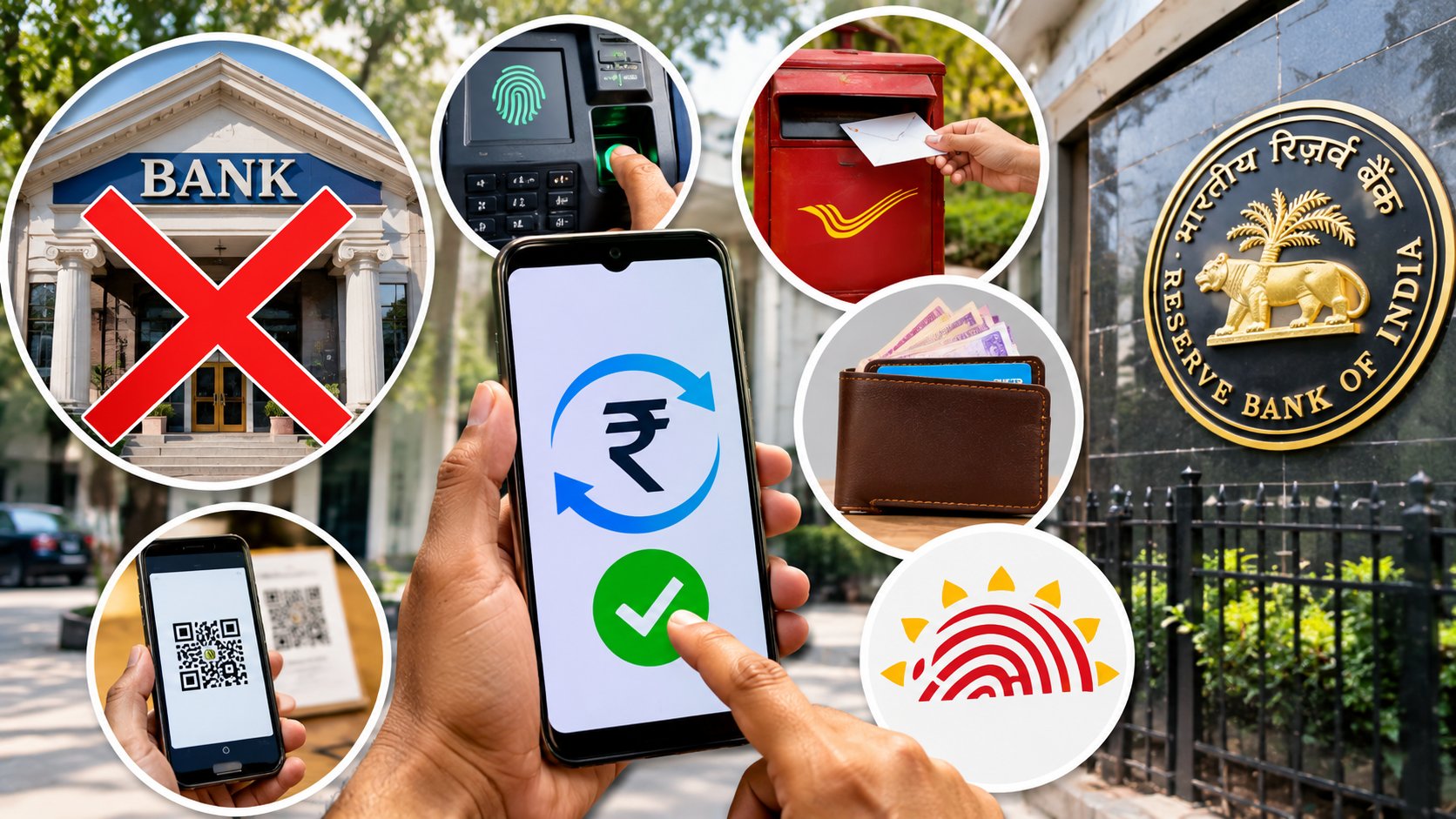
A construction worker in Pune wants to send part of this month’s wages to his mother in a village in Bihar. He has cash and a basic phone, but no bank account. His mother has no account either. Can the money still reach her, safely and legally, without either of them visiting a bank to open one? The answer is yes, and the Reserve Bank of India has just restated the rules. On 11 November 2026, it issued the RBI (Domestic Money Transfer) Directions, 2026, which bring the cash transfer rules into one document. Here are the five routes that work, what each one allows, and where the limits bite.
What RBI did on 11 November
The RBI’s notification RBI/DPSS/2026-27/476 consolidates the Domestic Money Transfer framework, first set out in October 2011 and revised in July 2024, into a single set of directions that are “effective immediately”. The covering letter says the aim is “harmonising and consolidating the extant instructions”. The framework exists to help people, “including migrant workers, who lack access” to formal banking channels make small-value transfers.
CorpLawUpdates noted that the limits themselves are unchanged and that “anyone reporting this as a limit hike would be wrong”. What changes is that banks and payment companies now follow one rulebook, and complaints fall under the Reserve Bank Integrated Ombudsman Scheme, 2026.
- 2011Year the Domestic Money Transfer framework began
- 1 Nov 2024When the stricter KYC framework took effect
- ₹10,000Cash pay-out per transaction, up from ₹5,000 before 2024
- ₹25,000Monthly cap per beneficiary for cash pay-out
- ₹314 trillionUPI transaction value in FY 2025-26
- ₹2,000Cash withdrawal per transaction from a non-bank full-KYC wallet
Route 1 and 2: cash in, cash out through bank agents
- ₹5,000 a transfer · ₹25,000 a monthCash pay-in: you have cash, they have an accountWalk into a bank’s business correspondent (BC) outlet, or use an ATM that offers it, hand over cash and have it credited to a family member’s bank account. You register once with a verified mobile number and a self-certified officially valid document, such as Aadhaar or a voter ID.
- ₹10,000 a transfer · ₹25,000 a monthCash pay-out: they have an account, you do notA sender with a bank account can arrange for cash to be handed to you at an ATM or BC outlet. The bank must record your name and address. This is how a family member can send money to someone who has never had a bank account.
Every pay-in transaction must be confirmed with an additional factor of authentication, typically an OTP, under paragraph 11 of the directions. Banks must also run velocity checks, alert customers on credits, and flag unusual spurts in credits to authorities. These safeguards were added because cash remittances are a known route for mule-account fraud.
The branch option most people forget
If you can reach a bank branch, the directions allow a walk-in customer without an account to send up to ₹50,000 to a beneficiary’s account through NEFT, paragraph 8 says. That is ten times the agent limit, though you will usually need to provide ID and fill in a form.
₹ per transaction. Sources: RBI DMT Directions, 2026 (pay-in, pay-out, walk-in NEFT); NPCI rules via bank and app guides (UPI Circle); India Post (money order); RBI PPI rules of May 2021 (wallet cash withdrawal).
Route 3: a full-KYC wallet that works on UPI
A prepaid wallet, which the RBI calls a prepaid payment instrument or PPI, holds money that is not in a bank account. With full KYC, it can hold up to ₹2 lakh, a limit the RBI raised from ₹1 lakh in May 2021. Since April 2024, the RBI has allowed UPI payments to and from full-KYC wallets through third-party UPI apps, so a wallet user can pay or receive money using a UPI ID.
The same 2021 circular allowed cash withdrawal from non-bank full-KYC wallets, capped at ₹2,000 per transaction and ₹10,000 a month. Money in a wallet earns no interest, and the issuer must keep 100% of balances in an escrow account at a scheduled bank.
What people get wrong: assuming a basic “small” wallet set up with just an OTP can send money to others. It cannot. Small PPIs are limited to ₹10,000 and are meant for merchant payments; person-to-person transfers and cash withdrawals need a full-KYC wallet.
Wallet limits may tighten
The RBI’s draft PPI Directions of 22 April 2026, which took public comments until 22 May, propose a flat ₹25,000 monthly cap on person-to-person transfers from full-KYC wallets and a ₹10,000 monthly limit on cash loading. As of this update, the draft had not been finalised.
₹ per month unless stated. Current rules per RBI’s 2021 PPI framework as summarised by Ananta IAS; draft per Business Today, Khaitan & Co and Vinod Kothari, April to May 2026.
Route 4: UPI Circle, using a family member’s account
UPI Circle, from the National Payments Corporation of India, lets an account holder authorise up to five “secondary users” to make UPI payments from the primary user’s bank account. The secondary user does not need their own bank account. Under full delegation, the primary user sets a limit of up to ₹15,000 a month, with a per-transaction cap of ₹5,000, according to bank and app guides citing NPCI rules.
BHIM added full delegation in November 2025; Business Standard reported that a secondary user “may or may not have a bank account”. Google Pay offers it as Pocket Money, and PhonePe launched UPI Circle in April 2025. Access can last up to five years, Angel One reported, and every payment appears in the primary user’s bank statement.
Who it suits: an elderly parent, a student or a household helper who needs to pay shops or bills digitally while the family keeps an eye on spending. It is not a way for someone without an account to receive money from others, because the money stays in the primary user’s account.
Route 5: the post office money order, still running
India Post’s money order remains the route of last resort for recipients with no account and no smartphone: the postman delivers cash to the door. India Post’s own site says the maximum per money order is ₹5,000 and the charge is 5% of the amount sent. The electronic money order (eMO) transmits the instruction digitally and is usually paid within one to three days, guides say.
₹. Our calculation at 5% of the amount, per India Post’s money remittance page. Amounts above ₹5,000 need more than one money order; some guides cite lower eMO slab fees, so check at the counter.
All five routes compared
| Route | Who needs a bank account | Limit | ID needed | Speed |
|---|---|---|---|---|
| Cash pay-in at BC or ATM | Recipient only | ₹5,000 a transfer, ₹25,000 a month | Verified mobile and self-certified OVD; OTP for each transfer | Real time or near real time |
| Walk-in NEFT at a branch | Recipient only | ₹50,000 | As required by the bank | NEFT batches |
| Cash pay-out | Sender only | ₹10,000 a transfer, ₹25,000 a month per recipient | Recipient’s name and address recorded | Real time or near real time |
| Full-KYC wallet on UPI | Neither, for wallet-to-wallet | ₹2 lakh balance; transfer caps apply | Full KYC, including video KYC | Instant |
| UPI Circle | Primary user only | ₹5,000 a payment, ₹15,000 a month | Government ID entered by primary user | Instant |
| Money order | Neither | ₹5,000 each; 5% charge | Sender and recipient address | 1 to 3 days for eMO |
Sending ₹20,000 home: three ways, worked out
Worked example: a monthly remittance of ₹20,000. Through a bank agent’s cash pay-in, this takes four transfers of ₹5,000, within the ₹25,000 monthly cap; agent charges are set by each bank and are not fixed by the RBI. By money order, it takes four orders, with commission of ₹1,000 at 5%. With a full-KYC wallet, ₹20,000 would fit within the draft ₹25,000 monthly cap, and under current rules the cap depends on whether the recipient is pre-registered. Our calculation.
If the family member can open a basic account, the cheapest long-term route is usually a zero-balance account and free UPI transfers. The no-account routes work best as a bridge, not a permanent arrangement.
- Decide who needs to receive the money and whether they have a bank account.
- If they have an account and you do not, use a bank’s BC outlet or a branch for cash pay-in.
- Register once with your mobile number and an ID such as Aadhaar or a voter ID card.
- Confirm each transfer with the OTP, and collect a receipt with the reference number.
- If neither of you has an account, use a money order or a full-KYC wallet.
- For a dependant who only needs to pay shops, set up UPI Circle with a monthly limit.
- If something goes wrong, complain to the bank, then the RBI Ombudsman at cms.rbi.org.in.
How the rules evolved
- RBI sets up the Domestic Money Transfer framework.
- Full-KYC wallet limit raised to ₹2 lakh; cash withdrawal allowed from non-bank wallets.
- RBI enables UPI payments from full-KYC wallets through third-party apps.
- DMT framework revised: stricter KYC, cash pay-out raised to ₹10,000.
- Revised DMT rules take effect.
- PhonePe launches UPI Circle for users without linked bank accounts.
- BHIM introduces UPI Circle full delegation.
- RBI issues draft PPI Directions; comments close 22 May.
- RBI issues the Domestic Money Transfer Directions, 2026.
Stay safe when you send cash
- Use only a bank’s authorised BC, not a private “transfer shop”
- Insist on an OTP for every pay-in transfer
- Keep the receipt and UTR or reference number
- Stay within ₹5,000 a transfer and ₹25,000 a month
- Never let anyone use your ID to send money for them
- Check the recipient’s account number twice before paying
- Keep wallet balances well below the ₹2 lakh cap
- Set a UPI Circle limit lower than ₹15,000 if you can
- Report problems to the bank within 1 day
- Escalate to the RBI Ombudsman after 30 days without a fix
Lending your ID for someone else’s cash transfers can make you part of a mule-account chain, the kind of fraud the RBI’s velocity checks are designed to catch. The 1-day reporting step and 30-day Ombudsman wait are practical guides drawn from RBI’s general complaint process, not limits in the DMT directions.
Sending money without a bank account: your questions
Can I transfer money without a bank account in India?
Yes. You can pay in cash at a bank’s business correspondent or ATM to credit someone’s account, use a full-KYC wallet on UPI, be added to a family member’s UPI Circle, or send a post office money order.
How much cash can I send to a bank account without having an account myself?
Up to ₹5,000 per transaction and ₹25,000 a month through business correspondents or ATMs, or up to ₹50,000 by walking into a bank branch and using NEFT, under RBI’s DMT Directions, 2026.
Can someone without a bank account receive money?
Yes. A sender can arrange cash pay-out at an ATM or bank agent, up to ₹10,000 per transaction and ₹25,000 a month per recipient. A money order or full-KYC wallet also works.
What changed in RBI’s money transfer rules in November 2026?
The RBI consolidated its 2011 and 2024 circulars into the Domestic Money Transfer Directions, 2026, on 11 November. The limits did not change.
Can I use UPI without a bank account?
Yes, through a full-KYC wallet linked to UPI, or as a secondary user in someone’s UPI Circle, who can pay up to ₹5,000 a time and ₹15,000 a month from the primary user’s account.
What ID do I need for a cash money transfer?
A verified mobile number and a self-certified officially valid document, such as Aadhaar, a voter ID card or a passport. Each transfer is confirmed with an additional authentication step, usually an OTP.
How much does a money order cost?
India Post’s website lists a charge of 5% of the amount, with a maximum of ₹5,000 per money order. Sending ₹5,000 costs about ₹250.
Where can I complain about a failed cash transfer?
First to the bank or its agent, and if unresolved, to the RBI Ombudsman through cms.rbi.org.in. Such complaints fall under the Integrated Ombudsman Scheme, 2026.
The short version
You do not need a bank account to send money in India. A bank agent or ATM can take your cash and credit someone’s account, up to ₹5,000 a time and ₹25,000 a month; a branch can send up to ₹50,000 by NEFT. Someone without an account can collect cash pay-outs of up to ₹10,000 a time. Full-KYC wallets work on UPI, UPI Circle lets dependants pay from a family account, and money orders still reach any address for 5%. RBI’s 11 November directions restate these limits in one rulebook. For regular transfers, a basic bank account is still the cheapest long-term option.