Central Bank of India and IOB Are Back in Privatisation Talk — What It Could Mean for Customers, Staff and Competition
Banking · Policy · India
Central Bank of India and IOB Are Back in Privatisation Talk — What It Could Mean for Customers, Staff and Competition
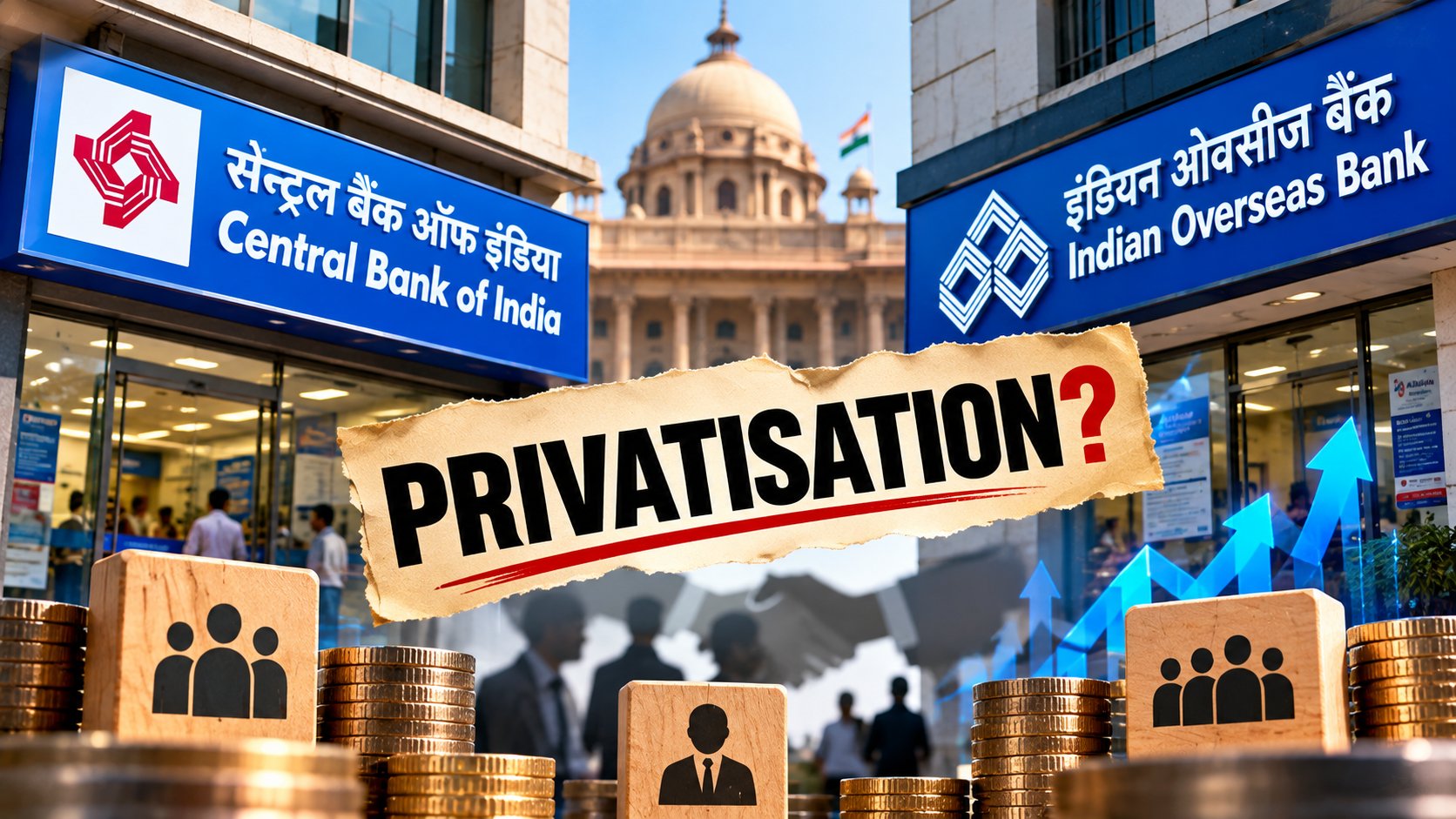
Reports that the Centre is weighing stake sales in four public sector banks have revived NITI Aayog’s earlier shortlisting of Central Bank of India and Indian Overseas Bank for privatisation. No final decision has been announced.
Dashed line marks 75%, the maximum allowed under the 25% minimum public shareholding rule. Figures after the May 2026 and December 2025 stake sales.
If you hold a savings account at Central Bank of India or Indian Overseas Bank, the headlines this week may have raised a simple question: is my bank about to be sold? The short answer is no, not yet. What has happened is that a five-year-old idea has returned to the news, alongside a much more concrete plan to sell smaller slices of these banks on the stock market.
The distinction matters. Selling a few per cent of shares to meet a listing rule is routine. Handing control of a bank with thousands of branches to a private owner is a political, legal and social decision of a very different order. This article separates the two, sets out what the numbers say about both banks, and looks at who would be affected if privatisation moved forward.
Why a 2021 Shortlist Is Making Headlines in 2026
In her Budget speech on February 1, 2021, Finance Minister Nirmala Sitharaman announced plans to privatise two public sector banks and one general insurance company. NITI Aayog, the government’s policy think tank, was then reported in June 2021 to have recommended Central Bank of India and Indian Overseas Bank as the two banks. Business Standard reported that shares of both jumped by 20% on the news.
Then the plan stalled. A bill to amend the banking laws was listed for Parliament’s winter session in 2021 but was not taken up. What people often get wrong is assuming the shortlist is new. It is not. What is new is the context: the IDBI Bank sale has finally been approved after a process of more than five years, and the deadline for state-owned firms to meet the 25% public shareholding rule has arrived.
The listing rule forcing the government’s hand
SEBI’s minimum public shareholding rule requires listed companies to have at least 25% of their shares held by the public. Government-owned companies had an exemption until August 2026, according to Outlook Business, and BW Businessworld says a further extension is expected to be notified. Either way, the government needs to sell shares in the four banks to bring its holding down to 75%.
Stake Sale or Privatisation? The Difference Decides Everything
The two ideas are often reported together, but they lead to different outcomes. A stake sale or offer for sale means the government sells some shares on the stock exchange while staying the majority owner. The bank remains a public sector bank. Its management, policies and obligations do not change.
Privatisation means the government sells enough shares, usually to a single buyer, to give up control. That is what the IDBI deal does: Fairfax will hold 60.72%. For Central Bank or IOB, it would require changing the Banking Companies (Acquisition and Transfer of Undertakings) Act, 1970, which nationalised both banks and requires the government to hold at least 51%.
| Question | Offer for sale | Strategic privatisation | Status today |
|---|---|---|---|
| Who controls the bank? | Government, above 51% | Private buyer | Government |
| Law change needed? | No | Yes, the 1970 Act | No bill introduced |
| Typical size | 2% to 8% per sale | Often 51% or more | Up to 8% sold so far |
| RBI approval of owner | Not applicable | Fit-and-proper test | Not started |
| Effect on accounts | None | Accounts continue under new owner | No change |
How the Two Banks Look on Paper Today
When NITI Aayog’s shortlist was first reported, both banks were recovering from years of bad loans. IOB had been under the Reserve Bank of India’s prompt corrective action framework since 2015 and exited it in September 2021; Central Bank exited in September 2022. Since then, their numbers have changed considerably.
On paper, these are now profitable, well-capitalised banks. Central Bank’s capital adequacy ratio was 17.18% in September 2026, and IOB reported 17.94% at the end of 2025, according to Samco. That cuts both ways for privatisation. Healthier banks would attract better bids. But the original economic case, that the government should stop pouring capital into weak lenders, is less pressing than it was in 2021.
What Could Change for Employees
Employees are usually the most vocal group in any bank privatisation debate. IOB’s corporate presentation lists more than 21,000 staff, and Central Bank said in 2026 it planned to hire about 1,400 officers in FY27, according to Outlook Business. Bank unions organised a nationwide strike in December 2021 against the earlier privatisation plan.
Public sector bank employees have pay scales agreed through industry-wide wage settlements, pensions linked to government rules, and strong job security. A private owner would not be bound by those arrangements for new hires. In past strategic sales, the government has typically required buyers to protect existing staff for a period. The IDBI sale terms are the best guide to what conditions might apply, but they have not been fully published.
Why staff numbers could shift, even without layoffs
Private banks generally run leaner branch networks and rely more on digital channels and outsourced sales. Over time, a new owner could slow hiring, offer voluntary retirement schemes or move staff into different roles. Tribune India reported in 2021 that banks then considered for privatisation were preparing voluntary retirement schemes. None of this would happen overnight, and any change would depend on the terms of a sale.
What It Would Mean for Your Account and Your Loan
For customers, the practical answer is reassuring. A change of ownership does not close accounts, cancel fixed deposits or change loan terms already agreed. Deposits remain covered by DICGC insurance up to ₹5 lakh per depositor per bank, as at any other bank. Your account number, cheque book and branch would continue unless the new owner later merges systems, and customers would be told in advance.
Competition: Would One Sale Change Indian Banking?
India nationalised 14 banks in July 1969, including both Central Bank of India and IOB. After the mergers announced in 2019, which took effect in April 2020, the number of public sector banks fell from 27 to 12. BW Businessworld reports that the long-term aim is three to four large public sector banks, which suggests the smaller lenders could be either merged or sold.
Supporters of privatisation argue it would bring fresh capital, faster decisions and better technology, and reduce the government’s dual role as policymaker and majority owner. A credible private owner could also make the sector more competitive. Critics counter that public sector banks carry social obligations, from government scheme accounts to lending in remote districts, and that private ownership could weaken those. Both banks’ recent turnarounds are also cited by opponents, who argue state ownership can deliver results when governance improves.
How long the IDBI sale took
The IDBI precedent gives a sense of scale. The Cabinet approved its strategic sale in May 2021, and the stake sale to Fairfax was approved only in October 2026, more than five years later. A Central Bank or IOB sale would need an extra step that IDBI did not: a change in the law.
Three Ways This Could Play Out
Based on what has been reported, the next stage could go one of three broad ways. These are our reading of the options, not forecasts.
Stake sales only
The government sells shares through further offers for sale until its holding in each of the four banks falls to 75%, and goes no further. This is the path most directly supported by the October 2026 reports. Customers and employees would notice little change, and the banks would remain public sector banks with the government firmly in control.
Consolidation first
The government folds some smaller lenders into larger public sector banks, in line with the reported aim of creating three to four large state-owned banks. This avoids a politically difficult sale to a private buyer, but mergers bring their own disruption: new account details for some customers, branch closures where networks overlap, and staff transfers.
A genuine strategic sale
Parliament amends the 1970 Act, and the government sells a controlling stake in one or both shortlisted banks. This is the outcome that would reshape the sector, and it has the longest path ahead of it. Given the IDBI experience, even a decision taken in 2027 would be unlikely to produce a completed sale for several years.
From Nationalisation to Today’s Headlines
Signals to Watch Over the Next Year
For customers, employees and shareholders, a few specific developments will show whether this is just another round of speculation or the start of a real sale.
- A banking laws amendment bill listed for a session of Parliament, which would be the clearest sign that privatisation is moving forward.
- A formal notification extending, or not extending, the minimum public shareholding deadline for state-owned banks.
- Further offers for sale in Central Bank, IOB, UCO Bank or Punjab & Sind Bank, which would show the stake-cut plan in action.
- A finance ministry or DIPAM statement naming banks for strategic sale, as happened with IDBI.
- Details of the IDBI sale’s employee and customer protections, which would set a template for later deals.
Frequently Asked Questions
Is Central Bank of India being privatised?
Not at present. NITI Aayog reportedly shortlisted Central Bank of India and Indian Overseas Bank for privatisation, a recommendation first reported in 2021 and revived in October 2026. The government has not announced a final decision, and a sale would need Parliament to amend the law.
Is my money safe in Indian Overseas Bank or Central Bank of India?
Yes. Both banks remain government-owned and regulated by the RBI. Deposits are insured by DICGC up to ₹5 lakh per depositor per bank. A change of ownership would not by itself close accounts or affect deposits.
Which banks did NITI Aayog shortlist for privatisation?
Central Bank of India and Indian Overseas Bank, according to media reports. The shortlist was first reported in June 2021, after the Budget announced plans to privatise two public sector banks, and was cited again in October 2026 reports.
What happens to bank employees after privatisation?
Existing employees’ terms would depend on the conditions of any sale. Governments have typically required buyers to protect current staff for a period, but a private owner would not be bound by public sector wage settlements for new hires. No such terms have been announced for these two banks.
What is the government’s stake in Central Bank of India and IOB?
About 81.19% in Central Bank of India after an offer for sale in May 2026, and 92.44% in Indian Overseas Bank after an offer for sale in December 2025, according to media reports of exchange filings.
Why is the government selling stakes in public sector banks?
Partly to meet SEBI’s rule that at least 25% of a listed company’s shares must be held by the public. State-owned firms were exempt until August 2026. Stake sales also raise money for the government.
Will my loan EMI change if my bank is privatised?
No. Existing loan contracts, including the agreed interest rate method, tenure and EMI, continue after a change of ownership. Floating-rate loans would still move with their benchmark, as they do now.
Has any public sector bank been privatised before?
IDBI Bank is the closest case. The government approved selling a 60.72% stake to Fairfax Financial Holdings for ₹52,878 crore in October 2026. IDBI was not nationalised under the 1970 Act, so it did not need the same legal change.
The Short Version
Central Bank of India and Indian Overseas Bank are back in privatisation news because the Centre is reportedly weighing stake cuts to 75% in four public sector banks, and reports have revived NITI Aayog’s 2021 shortlist of the two lenders. No sale has been decided. Privatisation would need Parliament to change the 1970 nationalisation law, followed by bidding and RBI approval, a process that took more than five years for IDBI. Customers’ deposits and loans would continue unchanged. The larger questions are about jobs, rural branches and how much of India’s banking should stay in government hands.