Why China's CXMT Rattled Samsung, SK Hynix and Micron — and How Big the Threat Really Is
Why China’s CXMT Rattled Samsung, SK Hynix and Micron — and How Big the Threat Really Is
ChangXin Memory Technologies has gone from under 1% of the global DRAM market in 2023 to about 10% this year. A single remark about a new chip design on 13 October wiped 10% off SK Hynix in a day. Here is what CXMT has done, what it still cannot do, and why investors are nervous.
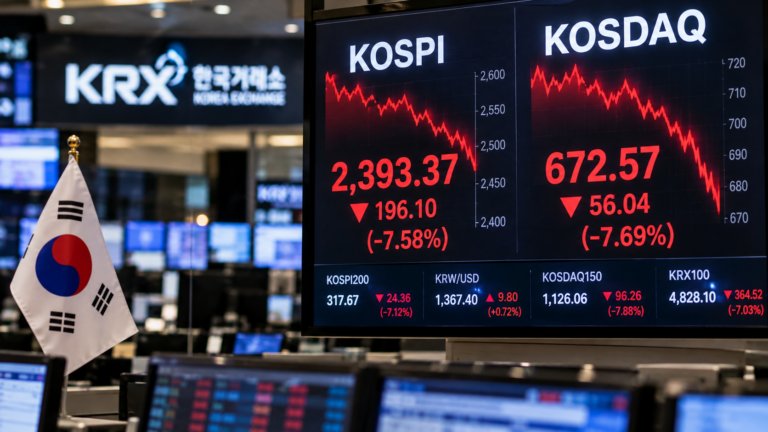
Every phone, laptop and AI server needs DRAM, the working memory that holds data while a processor uses it. For a decade, three companies made almost all of it: Samsung, SK Hynix and Micron. On Tuesday 13 October, a fourth name moved their share prices by billions of dollars. SK Hynix closed 10% lower in Seoul, Samsung fell 7.4% and Micron 3.62% in New York.
The trigger was not a product launch or a price war. It was a conference remark by the president of CXMT, a company most people outside the chip industry had never heard of until its July stock market debut. To understand why that remark carried so much weight, you need to see how fast CXMT has grown, and where the real limits on it lie.
Quick Summary
CXMT is now a real force in mainstream memory, but not yet in the AI chips that drive the industry’s profits. It held 9.5% of DRAM revenue in the second quarter of 2026 by TrendForce’s count, or 10% by Counterpoint’s, up from about 4% a year earlier. It earned ¥77.6 billion in the first half. Markets reacted to its plan to ship a denser 4F² server chip by year-end, a technology Samsung targets for 2028. But CXMT still lags in high-bandwidth memory and lacks access to the most advanced chipmaking tools.
What We Know
- CXMT’s president said its first 4F² product, a server DDR5 RDIMM, is due by the end of 2026.
- TrendForce put CXMT at 9.5% of global DRAM revenue in Q2 2026, fourth behind Samsung, SK Hynix and Micron.
- CXMT reported H1 2026 revenue of ¥150.3 billion and net profit of ¥77.6 billion, against a loss a year earlier.
- It listed on Shanghai’s STAR Market on 27 July 2026 at ¥8.66 a share, raising ¥57.9 billion.
What Is Still Unclear
- Speed, capacity, yield and volume of the 4F² product, none of which CXMT has disclosed.
- Whether independent testers will confirm its performance.
- How quickly CXMT can make high-bandwidth memory at competitive yields.
- How long the current memory shortage, which has lifted every maker’s profits, will last.
From Startup to Fourth Place in Under a Decade
CXMT was founded in 2016 in Hefei, in eastern China, as part of Beijing’s push to build a domestic memory industry. For years it was a minor player. Counterpoint Research figures, reported by Tech Times, show its share of global DRAM revenue at under 1% in 2023, 4% in the second quarter of 2025 and 8% by the end of 2025.
That pace matters. Counterpoint and UBS had expected CXMT to reach about 10% only in 2028, Tech Times notes. It got there two years early. The combined share of the Big Three fell to about 87%, a level the article says had not been seen in a decade.
The Remark That Moved Billions
At a chips conference in China, CXMT president Cao Kanyu said the company’s first product using a 4F² cell design would be a server DDR5 RDIMM, due by the end of 2026, Tom’s Hardware reported on 13 October. Memory stocks fell the same day. CNBC, as summarised by UA News, said investors read it as a sign that CXMT could reach advanced designs sooner than expected.
What 4F² actually means
A DRAM chip is made of billions of memory cells. Today’s mainstream cells occupy about 6F², where F is the smallest feature size on the chip. A 4F² cell stands the transistor upright, so each cell takes about two-thirds of the area. On paper, that cuts the footprint per cell by roughly a third and allows more memory per wafer. CXMT’s version wraps the gate around a vertical channel, which it calls a Vertical Surrounded Gate.
The reason the market cared is timing. Samsung presented a 4F² design at a conference in February 2026 and reportedly targets mass production in 2028. SK Hynix’s is expected one process generation after Samsung’s. If CXMT ships even a partial 4F² product in 2026, it would be first in a technology the leaders have spent years on.
A Profit Machine Built on a Shortage
CXMT’s numbers would be remarkable for any company. The Standard reported first-half 2026 revenue of ¥150.3 billion, up 873.64% from a year earlier, and net profit of ¥77.6 billion, against a loss of ¥2.3 billion. Tiger Brokers put its gross margin on the main business at 84.84%.
The context explains them. The whole industry is in a shortage, driven by AI servers that consume huge amounts of memory. Counterpoint said the DRAM market grew 57% quarter on quarter and 385% year on year in Q2 2026. Samsung reported a third-quarter operating profit of 107.4 trillion won, up 782.5%, according to the same Tiger Brokers report. CXMT is riding a rising tide, which makes its profits less a measure of its competitiveness than of the market’s tightness.
| Measure | Figure | Period | Source |
|---|---|---|---|
| Revenue | ¥150.3 billion | H1 2026 | The Standard |
| Net profit | ¥77.6 billion | H1 2026 | The Standard |
| Gross margin, main business | 84.84% | H1 2026 | Tiger Brokers |
| R&D spending | ¥6.86 billion, up 87% | H1 2026 | Tech Times |
| New investment plan | ¥34.9 billion | Announced 28 Sep 2026 | Tiger Brokers |
| IPO proceeds | ¥57.9 billion | 27 Jul 2026 | Tech Times |
The IPO That Made It China’s Market Giant
CXMT listed on Shanghai’s STAR Market on 27 July 2026 at ¥8.66 a share. It closed its first day at ¥49, a gain of about 466%, raising ¥57.9 billion, or about $8.6 billion. TradingKey put its valuation at about ¥3.3 trillion, or roughly $487 billion, and described it as the most valuable company on the mainland A-share market. Only about 7% of shares are freely traded, with 93% locked up.
The stock has since become volatile. On 8 October, the day it reported first-half results, it fell as much as 7.65% intraday, its largest drop since listing, Tiger Brokers reported. CNBC reported another fall of nearly 8% on 19 October as investors looked past the profit turnaround. Reasons cited include slowing DRAM price rises, CXMT’s own ¥34.9 billion spending plan and signs that other makers are adding capacity.
How the Market Is Divided Today
TrendForce’s second-quarter 2026 revenue figures, cited by Investing.com, show the leaders still far ahead. Samsung held 39.4%, SK Hynix 24.9% and Micron 23.3%, with CXMT at about 9.5%. Counterpoint’s figures for the same quarter are close: 38%, 25%, 24% and 10%.
The AI memory gap
The more important battle is in high-bandwidth memory, the stacked DRAM used beside AI processors from Nvidia and AMD. Counterpoint’s HBM shares for Q2 2026, reported by Asset Management News, were SK Hynix 50%, Samsung 33% and Micron 18%. CXMT has reportedly begun HBM production in small quantities, but SemiAnalysis models its yield on an eight-die HBM3 stack at about 25%. TrendForce analyst Ellie Wang said CXMT’s capabilities “remain limited for high-capacity server memory and advanced AI-server products.”
US export controls are part of the reason. CXMT cannot buy ASML’s most advanced EUV lithography machines, which makes the finest chip features much harder to produce. That is why most analysts see it as a threat in commodity DRAM for PCs and phones first, and in AI memory only later.
Why Beijing Wanted a Memory Champion
Memory is one of the largest categories of chips China imports, and for years almost all of it came from South Korean and American companies. CXMT, together with YMTC in NAND flash storage, is the core of China’s effort to change that. Counterpoint data cited by Tech Times put YMTC at 13% of global NAND revenue in Q1 2026, up from 8% a year earlier. The two companies are now visible in both main memory markets at once.
Scale is the strategy. CXMT runs about 320,000 wafers a month and targets 420,000 by 2027, according to Tech Times. One analysis cited by Investing.com mentions plans for 600,000 by 2030 and a share target of 15% or more. Tech Times also reports an investment banker’s target of 30% of global DRAM revenue for Chinese producers by 2030. These are ambitions, not commitments, but they show why rivals take the company seriously.
The case for calm
There is a sober counter-argument. Investing.com notes reports that CXMT’s costs are at or above those of the incumbents, and that it has in some cases charged more than foreign rivals. Its growth has come during a severe shortage, when almost any capacity sells. A shortage flatters newcomers. The real test comes when supply catches up and buyers can choose on price, quality and reliability. That test has not happened yet.
Customer qualification is the other hurdle. Lynx Equity Research’s channel checks, reported by Asset Management News, found CXMT qualified for one low-volume Mac product but not for iPhones, citing supply limits and yields on the high-density LPDDR5X chips Apple needs. Winning the most demanding customers takes years of consistent quality, and that cannot be bought with IPO money alone.
What It Means for People Who Buy Devices
For consumers, the memory shortage has raised component costs for device makers, and those costs can feed through to the prices of PCs, phones and servers. A fourth large supplier is, in principle, good news: more capacity tends to ease prices once demand settles. Counterpoint’s Neil Shah said expanded capacity and successful qualifications “could materially change market shares”, and market share shifts usually come with price competition.
The effect will not be immediate. Citi’s view that DRAM price growth peaks in Q2 2027 suggests relief, if it comes, is a 2027 story. Device makers selling into China are likely to adopt CXMT parts first, as Apple’s reported testing for China-market devices suggests. Buyers elsewhere may see the effect only indirectly, through lower memory prices as the market rebalances.
For India and other countries building electronics manufacturing, CXMT also adds a supplier option, though trade rules and security reviews will shape how freely its chips are used. That is a policy question as much as a technical one, and it will differ from country to country.
Who Is Most Exposed, and How Much
An Investing.com analysis published on 12 October called CXMT “a medium-term pricing threat and not yet a volume threat.” The exposure differs by company, depending on how much each relies on ordinary DRAM rather than AI memory.
Pricing is where the threat would show first. Citi projects that DRAM price growth will slow over four quarters, peak in Q2 2027 and then turn negative, according to Investing.com. Tiger Brokers notes that fourth-quarter contract prices for general DRAM are expected to rise 10% to 15% quarter on quarter, against about 60% in Q2. If CXMT’s capacity grows from 320,000 wafers a month towards 420,000 by 2027 just as demand cools, it could add pressure on prices for everyone.
Eight Moments in CXMT's Rise
Signals to Watch Over the Next Year
Whether CXMT turns from a market scare into a lasting shift depends on a handful of measurable signals. None of them require predicting share prices.
Frequently Asked Questions
What is CXMT?
ChangXin Memory Technologies is a Chinese DRAM memory chipmaker founded in 2016 and based in Hefei. It is the world’s fourth-largest DRAM maker by revenue, behind Samsung, SK Hynix and Micron.
Why did Samsung and SK Hynix shares fall?
On 13 October 2026, after CXMT’s president said its first 4F² server DRAM would launch by the end of 2026, SK Hynix fell 10% and Samsung 7.4%. Micron fell 3.62%.
What is CXMT’s DRAM market share?
About 9.5% of global DRAM revenue in Q2 2026 according to TrendForce, or 10% according to Counterpoint, up from about 4% a year earlier.
What is 4F² DRAM?
A memory cell design that stands the transistor upright, taking about two-thirds of the area of today’s 6F² cells. It allows more memory per wafer. Samsung reportedly targets mass production in 2028.
How much profit did CXMT make?
Net profit of ¥77.6 billion in the first half of 2026, on revenue of ¥150.3 billion, compared with a loss of about ¥2.3 billion a year earlier.
Can CXMT make HBM for AI chips?
It has reportedly begun small-scale HBM production, but analysts say it is not yet a substitute for the HBM used in Nvidia and AMD accelerators. One model puts its eight-die HBM3 yield at about 25%.
How did the CXMT IPO perform?
It listed on Shanghai’s STAR Market on 27 July 2026 at ¥8.66, closed its first day at ¥49, about 466% higher, and raised ¥57.9 billion.
Do US export controls affect CXMT?
Yes. Restrictions on advanced equipment, including ASML’s EUV lithography machines, make the most advanced chips harder to produce and keep customised products such as HBM harder to reach.
The Short Version
CXMT has grown from under 1% of global DRAM to about 10% in three years, earned ¥77.6 billion in six months and plans a 4F² server chip by year-end, ahead of Samsung’s 2028 target. That remark sent SK Hynix down 10% on 13 October. But CXMT still trails in AI memory, faces export controls, and has disclosed no specifications for the new chip. It is a pricing threat for 2027 and beyond, not yet a volume one.