ICICI Bank Raises FD Rates by 10 bps — Seniors Now Get 7.20%, but What Do You Keep After Tax? Plus Karbonn and Nothing
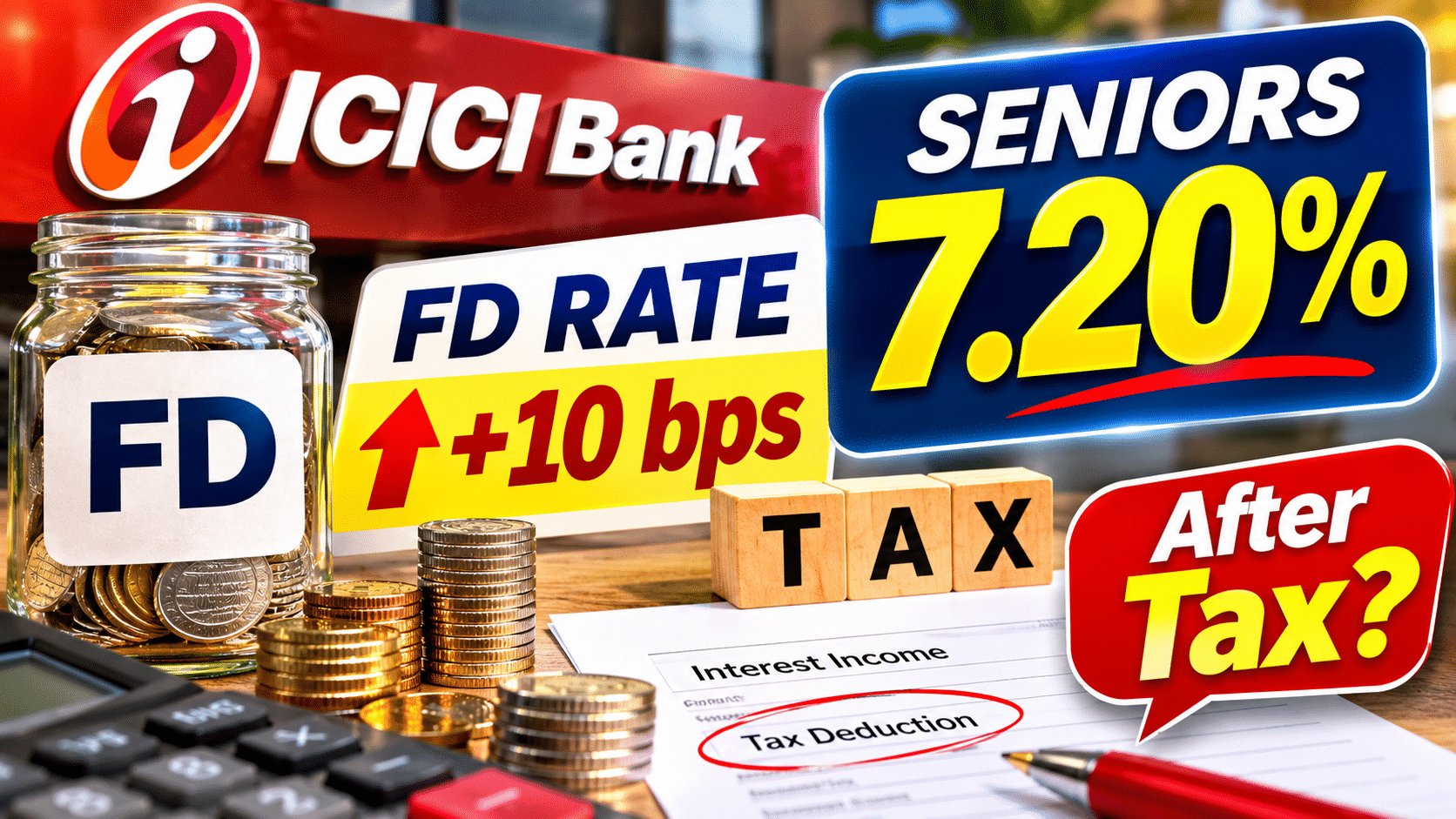
ICICI Bank has raised fixed deposit rates by up to 10 basis points on deposits below ₹3 crore, with the top rate at 6.60% for the public and 7.20% for senior citizens. Also in this briefing: Karbonn’s November 2 smartphone comeback and Nothing’s 2027 roadmap.
If you were about to renew a fixed deposit at ICICI Bank, the rate card has just moved in your favour, slightly. The bank raised rates by 10 basis points on tenures from 2 years 1 day to 10 years, and on its 5-year tax-saver FD. A senior citizen locking in ₹5 lakh for three to five years now earns 7.20% instead of 7.10%. Short-term rates did not change.
Ten basis points is a small move, and that is exactly why the arithmetic matters. It adds about ₹3,400 to ₹3,500 over five years on a ₹5 lakh deposit. Tax can take away far more than that, and for savers in the top bracket the real return after inflation may be negative. This briefing sets out the new card, what you actually keep, how ICICI compares with peers that also repriced this month, and then turns to two smartphone stories from the same week.
The New ICICI Rate Card, Tenure by Tenure
Goodreturns, reporting on October 31, gives the revision as effective from October 23 for domestic retail deposits below ₹3 crore; Outlook Money lists the senior rates as effective from October 24. The difference may reflect publication timing, so check the effective date on ICICI’s own rate card if your booking date falls on those days. The table combines rates from both reports.
| Tenure | General public | Senior citizens | Change |
|---|---|---|---|
| 7 to 45 days | 2.75% | 3.25% | Unchanged |
| 46 to 90 days | 4.00% | 4.50% | Unchanged |
| 91 to 184 days | 4.50% | 5.00% | Unchanged |
| 185 days to less than 1 year | 5.50% | Not reported | Unchanged |
| 1 year to less than 18 months | 6.25% | 6.75% | Unchanged |
| 18 months to 2 years | 6.30% | 6.80% | Unchanged |
| 2 years 1 day to 3 years | 6.55% | 7.05% | +10 bps |
| 3 years 1 day to 5 years | 6.60% | 7.20% | +10 bps |
| 5 years 1 day to 10 years | 6.60% | 7.10% | +10 bps (senior) |
| 5-year tax-saver FD | 6.60% | 7.20% | +10 bps |
Two details in the card are easy to miss. First, the senior premium is not uniform: it is 50 bps on most tenures but 60 bps on 3 years 1 day to 5 years, which makes that band the sweet spot for seniors. Second, the general rate is flat at 6.60% from 3 years 1 day all the way to 10 years, so a general depositor gains nothing by locking money away beyond about three years.
Old Rate, New Rate: Where the 10 Basis Points Landed
What 10 bps is worth (our calculation, quarterly compounding, cumulative FD): ₹5 lakh for 5 years at 6.60% matures at ₹6,93,614, against ₹6,90,210 at 6.50%, a gain of ₹3,404. For a senior citizen, 7.20% gives ₹7,14,374 against ₹7,10,873 at 7.10%, a gain of ₹3,501. Over 3 years at 6.55% versus 6.45%, the gain is ₹1,791. The effective annual yield at 6.60% is 6.77% and at 7.20% is 7.40%, because interest compounds every quarter.
What You Actually Keep After Tax and Inflation
FD interest is taxed at your slab rate, and it is taxed as it accrues each year, even on a cumulative deposit that pays nothing until maturity. That makes the same 6.60% deposit a very different product depending on who holds it. The figures below are our calculations on ₹5 lakh for 5 years, with an assumed inflation rate of 5%.
The spread is striking. A senior citizen in the 5% slab using the old tax regime can deduct up to ₹50,000 of interest under Section 80TTB, and keeps roughly 7.40% a year in effective terms, a real return of about 2.40 percentage points. A working-age saver in the 30% slab keeps about 4.74%, which falls slightly below 5% inflation. Same bank, same deposit, opposite outcomes.
What savers often get wrong: TDS is not the tax. Banks deduct TDS once interest crosses ₹50,000 a year per bank for general depositors and ₹1,00,000 for seniors, but the full interest is taxable at your slab when you file. A 30% slab saver who only “pays” 10% TDS owes the rest at filing. If your total income is below the taxable limit, the declaration that stops TDS is now Form 121, which replaces the familiar Forms 15G and 15H under the Income-tax Act, 2025.
How ICICI Stacks Up Against This Month’s Other Revisions
ICICI was one of several lenders that repriced in the week of October 20. Outlook Money’s round-up of senior citizen rates on October 24 shows that ICICI’s 7.20% is competitive among large private banks but sits below special-tenure offers from public sector and old private banks, and well below small finance banks.
The higher small finance bank rates come with a condition that matters: DICGC insurance covers deposits of up to ₹5 lakh per depositor per bank, principal and interest combined. A senior placing ₹10 lakh in one small finance bank at 8.60% has ₹5 lakh or more uninsured. Splitting across banks, or keeping balances within the limit, keeps the cover in place. Peak rates also sit in narrow tenure windows, such as Ujjivan’s 3 years 1 day to 3 years 6 months, so booking a round 5-year term may earn less.
What the cluster of revisions does and does not tell you
Seven lenders repricing within five days, mostly upwards, shows that banks are competing harder for deposits on medium and long tenures this month. It does not tell you where rates go next, and nobody can reliably time the peak. What it does suggest is a practical rule: if a deposit is due for renewal now, compare at least three rate cards in your preferred tenure band rather than auto-renewing, because gaps between banks can be wider than any single hike: the chart above shows 30 bps between ICICI’s 7.20% and City Union Bank’s 7.50% for seniors. On ₹5 lakh over three years, even 30 bps is worth more than this ICICI hike.
Two Mistakes That Cost More Than the Hike Is Worth
Breaking a long FD early
Premature withdrawal does not simply forfeit future interest. The bank re-prices the whole deposit at the card rate for the period you actually held it, then subtracts a penalty. Take ₹5 lakh booked at 6.60% for 5 years and broken after 2 years. ICICI’s card rate for 18 months to 2 years is 6.30%; with an assumed 1% penalty, the deposit earns 5.30% for the period. In our calculation, you receive ₹5,55,524 instead of the ₹5,69,940 the booked rate would have produced over the same two years, a cost of ₹14,416.
That loss is more than four times the ₹3,404 the 10 bps hike adds over five full years. The penalty used here is illustrative; check ICICI’s current premature withdrawal terms before booking. If you might need the money early, a loan or overdraft against the FD is often cheaper than breaking it, and a ladder avoids the problem altogether.
Locking everything into one tenure
A ladder spreads money across several maturities so that one portion falls due every year. Split ₹10 lakh into four rungs of ₹2.5 lakh on ICICI’s revised general rates: 1 year at 6.25%, 2 years at 6.30%, 3 years at 6.55% and 4 years at 6.60%. Held to maturity, the rungs return a combined ₹11,77,919 by our calculation, and ₹2.5 lakh becomes available every year without breaking anything.
What a ladder buys
- ₹2.5 lakh of liquidity every 12 months
- Only 25% of the money exposed to reinvestment each year
- No penalty if one rung is needed early
What it costs
- Short rungs earn 6.25% to 6.30% instead of 6.60%
- More deposits to track and renew
- TDS still aggregates across all rungs at one bank
A ladder does not raise returns; on an upward-sloping rate card it slightly lowers them. What it buys is flexibility and protection against having to reinvest everything at once, whichever way rates move next. That trade-off is usually worth more than chasing a single 10 bps increase.
Should You Book, Wait or Split?
Use the steps below to decide. The thresholds are indicative and based on the calculations above, not on a rate forecast.
- Check the effective date and tenure band on ICICI’s own rate card before booking.
- Pick tenure by when you need the money, not by the headline rate; premature withdrawal re-prices the whole deposit at the lower rate for the period actually held, minus a penalty.
- Compare post-tax returns at your slab, not gross rates.
- If over 60 and under the old regime, factor in the ₹50,000 Section 80TTB deduction.
- Submit Form 121 at the start of the year only if your total income is below the taxable limit.
Before you renew or book
Also This Week: Karbonn Returns and Nothing Plans Big
Karbonn Rebel 5G and Rebel Pro 5G launch on November 2
Karbonn, which now sells only feature phones in India, according to Digit, returns to smartphones on November 2, My Mobile India reports, with Amazon microsites live for both models. Reports differ on specs: My Mobile India lists the Rebel 5G with a 6.75-inch HD+ LCD, 7,000mAh battery and 18W charging, and the Rebel Pro 5G with a 6.7-inch 120Hz display, 6,000mAh battery, 20W charging and two Android upgrades. A tipster cited by Digit describes a Unisoc T8200 and 6,000mAh. Pricing is rumoured at about ₹14,990, with Digit expecting ₹15,000 to ₹17,000.
Nothing will launch more than twice as many phones in 2027
Nothing co-founder and India President Akis Evangelidis posted on October 30 that the company will launch “more than twice the number of smartphone launches” next year, ETV Bharat reported. Nothing launched three phones in India in 2026, the Phone (4a), Phone (4a) Pro and Phone (4b), the last from ₹29,999, so that implies at least six. The company skipped a flagship this year because of rising memory costs and is inviting community members to preview 2027 phones through a Co-Creation Programme at its Delhi headquarters.
Dates That Shaped This Briefing
- October 20, 2026: Punjab and Sind Bank revises FD rates, senior peak 7.40% for 500 days.
- October 21 to 22: City Union Bank, Jana SFB and Suryoday SFB revise rates.
- October 23: ICICI Bank and Indian Bank revisions take effect, per Goodreturns.
- October 24: Ujjivan SFB revises rates; Outlook Money lists ICICI senior rates as effective.
- October 30: Nothing posts its 2027 plan on X.
- November 2: Karbonn Rebel 5G and Rebel Pro 5G launch.
Questions Savers and Buyers Are Asking
What are ICICI Bank’s new FD rates?
For deposits below ₹3 crore, ICICI offers 2.75% to 6.60% for general depositors and 3.25% to 7.20% for senior citizens. The top rates apply to 3 years 1 day to 5 years for seniors and 3 years 1 day to 10 years for others.
What is the ICICI FD rate for senior citizens?
Up to 7.20% for 3 years 1 day to 5 years and on the 5-year tax-saver FD; 7.05% for 2 years 1 day to 3 years; and 7.10% for 5 years 1 day to 10 years.
When were ICICI’s FD rates revised?
Goodreturns reports the change as effective from October 23, 2026, while Outlook Money lists senior rates effective October 24. Check ICICI’s rate card for the exact date.
How much will ₹5 lakh earn in an ICICI FD for 5 years?
At 6.60% with quarterly compounding, ₹5 lakh grows to about ₹6,93,614. At the senior rate of 7.20%, it grows to about ₹7,14,374, before tax. These are our calculations.
Is FD interest taxable?
Yes, at your slab rate, each year as it accrues. A 6.60% FD yields about 4.74% after tax for a 30% slab saver. Seniors under the old regime can deduct up to ₹50,000 of interest under Section 80TTB.
Is my FD safe if I deposit more than ₹5 lakh?
DICGC insures up to ₹5 lakh per depositor per bank, including interest. Amounts above that in one bank are not insured, which matters most with smaller or higher-rate banks.
When is the Karbonn Rebel 5G launching?
My Mobile India reports the Rebel 5G and Rebel Pro 5G launch on November 2, 2026, with Amazon as the sales platform. Prices are expected around ₹15,000.
How many phones will Nothing launch in 2027?
More than twice the three it launched in 2026, so at least six, according to co-founder Akis Evangelidis. Names and dates have not been announced.
The Short Version
ICICI Bank has raised FD rates by 10 bps on tenures above 2 years, taking the top rate to 6.60% for the public and 7.20% for seniors on deposits below ₹3 crore. That adds about ₹3,400 to ₹3,500 on ₹5 lakh over five years, but tax matters far more: a 30% slab saver keeps about 4.74%, while a low-slab senior using 80TTB keeps about 7.40%. Higher rates elsewhere carry DICGC limits. In tech, Karbonn returns on November 2 and Nothing plans six-plus phones in 2027.