10 High-Value Transactions the Income Tax Department Tracks in 2026, and When One of Them Can Lead to a Tax Notice
Income Tax · High-Value Transactions · FY 2026-27
10 High-Value Transactions the Income Tax Department Tracks in 2026, and When One of Them Can Lead to a Tax Notice
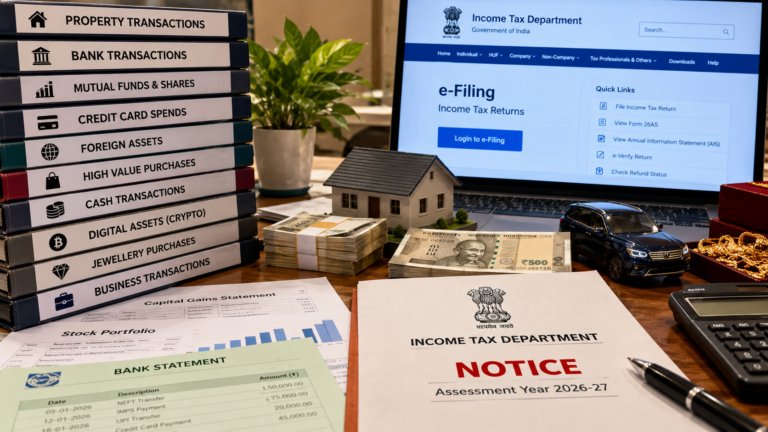
Banks, card issuers and property registrars report these transactions automatically. Crossing a limit is legal. The trouble starts when the money does not match your tax return.
You sell an old car for cash, your father gives you money towards a flat, and you put it all in your savings account over a few months. Nobody at the bank asks a question. The following summer, a message from the tax department arrives asking you to explain cash deposits of ₹12 lakh.
Nothing illegal has happened. What has happened is that a reporting system built to run silently has done its job. Ten kinds of transaction are sent to the Income Tax Department as a matter of routine, and several of the limits changed on 1 April 2026. Knowing them is the difference between a one-line reply and a stressful few weeks.
Quick Summary
The department is told when you deposit ₹10 lakh or more in cash in savings accounts in a year, pay credit card bills of ₹10 lakh (or ₹1 lakh in cash), buy or sell property worth ₹45 lakh or more, or put ₹10 lakh into fixed deposits, shares, bonds or foreign currency. Being reported is not a notice and not a tax. A notice follows a mismatch with your return. Separately, taking ₹2 lakh or more in cash from one person in a day is prohibited outright.
What We Know
These points are consistent across published guides to the new rules from Patron Accounting, Taxscan, TaxClear and CAclubindia.
- The Income-tax Act, 2025 and the Income-tax Rules, 2026 apply from 1 April 2026, replacing the 1961 Act and 1962 Rules.
- Specified entities must file a Statement of Financial Transactions for transactions above set limits, by 31 May after the financial year ends.
- Cash deposits are reported at ₹10 lakh a year in savings-type accounts and ₹50 lakh in current accounts.
- PAN is now needed when cash deposits or withdrawals reach ₹10 lakh in a year. The old trigger of ₹50,000 a day has gone.
- Receiving ₹2 lakh or more in cash from one person in a day remains prohibited, with a penalty equal to the amount.
- Reporting does not by itself make a transaction taxable.
What Is Still Unclear
- The property threshold. Taxscan and TaxClear state that the reporting limit rose from ₹30 lakh to ₹45 lakh for 2026-27. Two other guides still quote ₹30 lakh. We have used ₹45 lakh and could not check the notified rule text directly.
- Limits without PAN. Some guides mention lower triggers of ₹5 lakh where PAN has not been given. The exact coverage should be confirmed with your bank or dealer.
- How many notices are sent. The department has not published a count of messages issued on these transactions for the current year.
- New section numbers. Several guides refer to “corresponding provisions” of the 2025 Act without naming them, so we cite a section only where a source does.
The Ten Transactions, With Their 2026 Limits
Each tile shows what is counted and the level at which it is reported or, for the last two, restricted. Limits are totals for a financial year unless the tile says otherwise.
Two of the ten are a different kind of rule
Here is the point most lists blur. The first eight are simply reported. You may do any of them freely. The last two are rules that bind you directly. A cash gift above ₹50,000 from someone who is not a specified relative is taxed as your income. And accepting ₹2 lakh or more in cash from one person in a day is not allowed at all, whatever the reason.
| Transaction | Limit | Who reports it | How it is counted | Proof worth keeping |
|---|---|---|---|---|
| Cash into savings accounts | ₹10 lakh | Bank or post office | All your savings accounts with that bank, full year | Sale receipts, gift deed, withdrawal slips |
| Cash in a current account | ₹50 lakh | Bank | Deposits and withdrawals, full year | Cash book, sales invoices |
| Card bill paid in cash | ₹1 lakh | Card issuer | All cash payments in the year | Source of the cash |
| Card bills, other modes | ₹10 lakh | Card issuer | All payments in the year | Statements; reimbursement records |
| Property | ₹45 lakh | Registrar or sub-registrar | Deal value or stamp duty value | Sale deed, loan sanction, bank trail |
| Fixed deposits | ₹10 lakh | Bank, NBFC, post office | Fresh deposits only | Source account statement |
| Foreign currency and travel | ₹10 lakh | Authorised dealer | Total in the year | Invoices, purpose of remittance |
| Shares, bonds, mutual funds | ₹10 lakh | Company, fund house, depository | Per issuer, full year | Contract notes, bank debits |
Cash deposits: the total matters, not the single slip
The ₹10 lakh test adds up every cash deposit in your savings accounts with a bank over the year. Twenty deposits of ₹50,000 count the same as one of ₹10 lakh. Under the new rules PAN is asked for at this yearly level, where earlier a single deposit of ₹50,000 needed it. Homemakers, retirees and small traders who bank accumulated cash are the people most often surprised.
Credit cards: spending is a signal of income
Card issuers report payments, not purchases. If you settle ₹10 lakh or more of bills in a year, the figure is passed on. That is common for people who put office travel or family expenses on a personal card. Keep reimbursement mails or a note of who repaid you. Paying ₹1 lakh or more of card bills in cash is reported separately and tends to draw closer attention.
Property: both sides are named
The registrar reports the buyer and the seller, using the higher of the deal value and the stamp duty value. Gifts of property and joint development agreements are covered too. For the buyer, the question is where the money came from. For the seller, it is whether capital gains were declared. A sale that appears in your statement with no gains in the return is one of the most frequent mismatches.
Fixed deposits, shares and funds: the forgotten income
A large deposit or investment is rarely the issue by itself. The income it produces is. Interest on deposits is taxable every year, including interest that is reinvested, and banks report it. Sales of shares and fund units reach the department with gains data under the new half-yearly reporting. Leaving out ₹40,000 of interest is a more likely cause of a message than the ₹10 lakh deposit behind it.
Weddings and other one-day events
The ₹2 lakh cash rule has three tests: per day, per transaction and per event. A caterer or jeweller cannot take ₹2 lakh or more in cash from you for one wedding even if it is paid in parts over a week. The penalty falls on the person receiving the cash, which is why established vendors insist on bank transfers for large bills.
Reported Is Not the Same as Noticed
The fear in the phrase “one wrong transaction” comes from treating three separate things as one. A report is a file your bank sends. A mismatch is what a computer finds when that file disagrees with your return. A notice is what follows if the mismatch is not cleared up. Most people stop at the first stage and never hear about it.
The system is designed around your PAN. That is why the common idea of spreading deposits over several branches does not work, and why deliberately structuring cash to stay under a limit is a poor plan. The pattern itself draws attention, and the source still has to be explained.
What Changed on 1 April 2026
The new rules moved away from small per-day triggers towards yearly totals, and raised several limits that had not been touched for years. For ordinary account holders the paperwork is lighter. The amount of data reaching the department is not.
Three other additions are worth knowing. Purchases of stamp paper are now reported at ₹2 lakh, or ₹1 lakh without PAN. Crypto platforms have begun reporting user transactions. And PAN is required for vehicles costing more than ₹5 lakh, which brings premium two-wheelers into the net.
Cash Is Where the Real Penalties Sit
Reporting limits carry no penalty for the individual. The cash rules do, and they apply at much lower amounts. These are the ones that can turn a family arrangement into a tax problem.
| Cash rule | Limit | Earlier section | Section in 2025 Act | Consequence |
|---|---|---|---|---|
| Receiving cash | ₹2 lakh or more from one person in a day, per transaction or per event | 269ST | 186 | Penalty of 100% of the amount, on the receiver |
| Cash loans and deposits | ₹20,000 or more | 269SS, 269T | 185, 188 | Treated as a violation |
| Business payment in cash | More than ₹10,000 to one person in a day | 40A(3) | 36 | Whole expense disallowed |
| Cash withdrawal | Above ₹1 crore in a year | 194N | 393 | 2% TDS by the bank |
| Unexplained cash or credits | Any amount without a satisfactory source | 69A, 115BBE | 104, 195 | About 39% tax; penalty up to 200% of tax if detected |
The gift rule families trip over
Money from parents, a spouse, siblings, children and other specified relatives is not taxed in your hands, however large. The ₹50,000 limit applies to gifts from everyone else, counted together across the year. What causes trouble is not the tax but the proof. A cash gift with no paper behind it looks, to a matching system, exactly like undeclared income. A short gift deed and a bank transfer remove the doubt.
Read Your Own File Before the Department Does
Everything reported about you is visible to you. The Annual Information Statement on the e-filing portal lists reported transactions alongside tax deducted, interest and dividends. Checking it before filing is the single most useful habit in this whole subject.
- Open the statement after June. Reports for the year that ended on 31 March are due by 31 May.
- Tick off each entry. Match deposits, card payments, property and investments to your own records.
- Flag errors. If an entry is wrong, duplicated or not yours, submit feedback against it on the same screen.
- Make the return agree. Report interest, capital gains and other income linked to those entries.
- File the papers. Keep sale deeds, gift deeds and bank trails for at least six years.
If a message does arrive
It usually comes first as an email or text pointing you to the portal, not as a formal order. Open it there and nowhere else, since fake tax notices are a common fraud. Check the transaction and the year, compare it with your statement, and reply by the date shown with the supporting document. If you find that income was left out, an updated return with the tax paid is far cheaper than waiting to be assessed.
Frequently Asked Questions
Which transactions are reported to the Income Tax Department?
Banks, card issuers, registrars, fund houses and others report cash deposits of ₹10 lakh or more a year in savings accounts, ₹50 lakh or more in current accounts, fixed deposits of ₹10 lakh or more, credit card payments of ₹1 lakh in cash or ₹10 lakh by other modes, property deals of ₹45 lakh or more, investments in shares, bonds and mutual funds of ₹10 lakh or more, and foreign currency purchases of ₹10 lakh or more.
How much cash can I deposit in a savings account without a tax notice?
There is no legal ceiling on deposits. Cash deposits totalling ₹10 lakh or more in a financial year are reported to the tax department and PAN must be quoted at that level. A notice follows only if the deposits do not match the income and sources shown in your return, so keep proof of where the cash came from.
Does crossing a reporting limit mean I will get a tax notice?
No. Reporting is automatic and does not create tax or a penalty by itself. The reported transaction appears in your Annual Information Statement and is compared with your income tax return. A message or notice is likely only where the two do not match or the source of funds is not evident.
What is the limit for receiving cash from one person in a day?
You cannot receive ₹2 lakh or more in cash from one person in a day, for a single transaction, or for one event. The rule was Section 269ST of the 1961 Act and is Section 186 of the Income-tax Act, 2025. The penalty on the receiver can equal the full amount received.
Is a cash gift above ₹50,000 taxable?
Gifts from specified relatives such as parents, spouse, siblings and children are not taxed, whatever the amount. Gifts from others are taxed as your income at slab rates if they total more than ₹50,000 in a financial year. A written gift deed and a bank transfer make the source easy to prove.
What is the tax on unexplained cash deposits in 2026?
From 1 April 2026, unexplained cash, credits or investments are taxed at a base rate of 30%, about 39% with surcharge and cess, according to CAclubindia. The earlier effective rate was about 78%. If the officer detects the income, a penalty of up to 200% of the tax can be added.
How do I check which of my transactions have been reported?
Log in to the income tax e-filing portal and open the Annual Information Statement. It lists reported transactions under SFT information along with TDS, interest and dividends. If an entry is wrong or not yours, submit feedback against that entry on the same screen before filing your return.
What should I do if I receive a notice for a high-value transaction?
Read which transaction and year it refers to, compare it with your Annual Information Statement, and reply on the e-filing portal within the date given, attaching proof of the source of funds. If income was left out, file an updated return and pay the tax. Do not ignore the message, and take professional help for large amounts.
The Short Version
Ten kinds of transaction reach the Income Tax Department without any action from you, from ₹10 lakh of yearly cash deposits to property deals of ₹45 lakh. None of them is forbidden, and being reported is not a notice. Notices come from mismatches between those reports and your return. The hard limits are on cash: no receipts of ₹2 lakh or more from one person in a day, no cash loans of ₹20,000 or more, and tax on non-relative gifts above ₹50,000. Check your Annual Information Statement each year, keep proof of where large sums came from, and move big amounts through the bank.