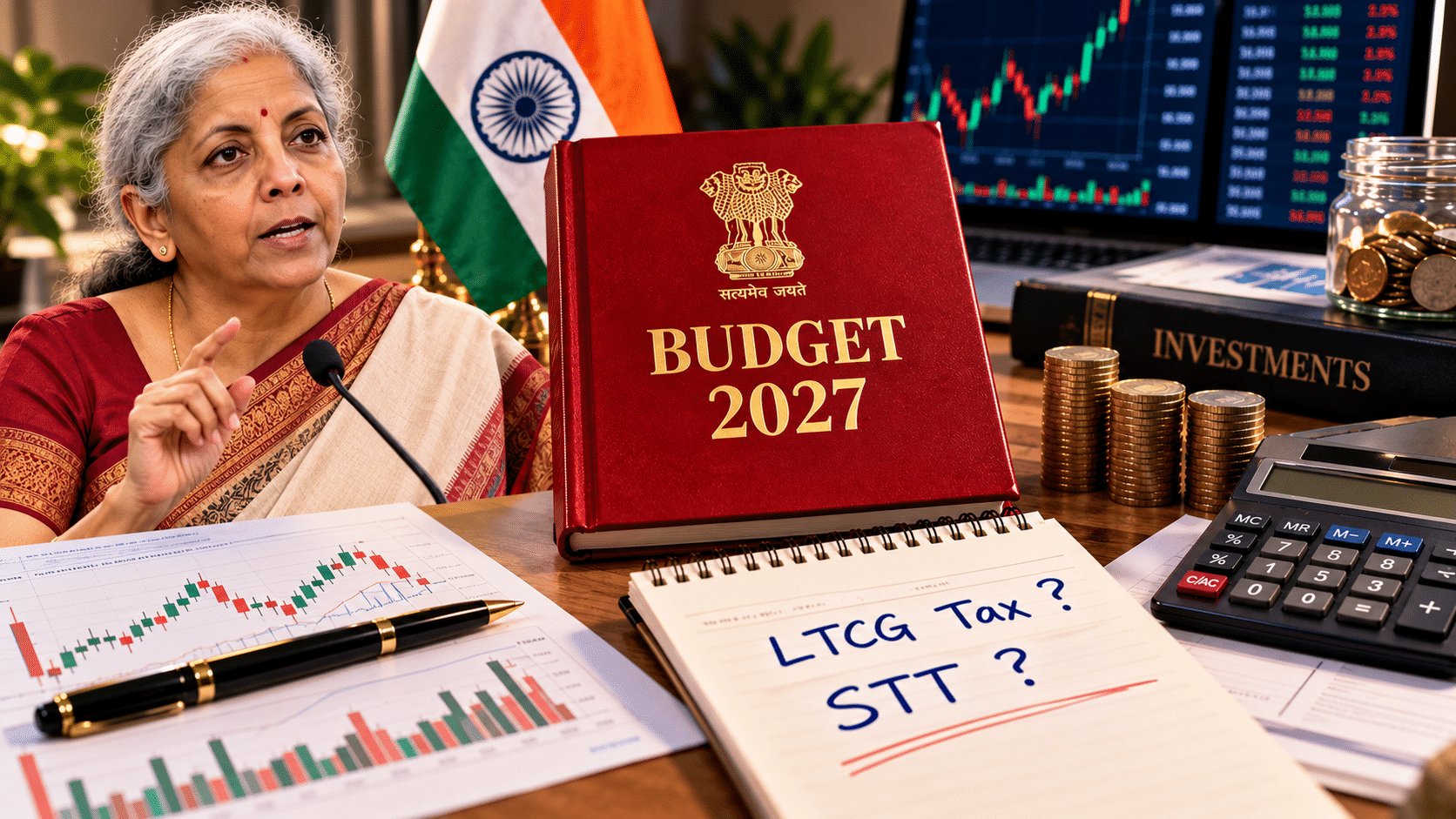
Will LTCG Tax or STT Change in Budget 2027? What the Finance Minister Actually Said — and What It Could Mean for Investors
Will LTCG Tax or STT Change in Budget 2027? What the Finance Minister Actually Said — and What It Could Mean for Investors
On 13 October 2026, Nirmala Sitharaman said the government is open to views on capital gains tax and the securities transaction tax, but would not say what Budget 2027 will consider. Markets rallied anyway. Here is what she said, what the rates are today, and what each possible outcome would be worth to you.
We are very close to the budget and the preparation for the budget has started. It may not be the best time for me to say what I will or what I will not consider.
Finance Minister Nirmala Sitharaman, Bloomberg New Economy Forum, New Delhi, 13 October 2026, as reported by ANIFor most of 2026, investors have watched the market fall and foreign funds pull out record sums, while paying more tax on gains and more tax on every derivatives trade than they did two years ago. So when the Finance Minister was asked on Tuesday about long-term capital gains tax and the securities transaction tax, every word mattered. The Sensex rose 1,109 points that afternoon.
Read carefully, though, her answer committed to nothing. She did not say LTCG would be cut or scrapped. She did not say STT would fall. She said the debate was healthy, that the government would hear views, and that with Budget preparation under way it was not the time to say what she would consider. That leaves investors with a question this article answers as precisely as the facts allow: what could change, and what would it be worth?
What We Know
- On 13 October 2026, the FM said investors in India and abroad have been debating capital gains tax and that the government is open to hearing views.
- She declined to say what she would or would not consider, as Budget preparation has begun.
- LTCG on listed equity is 12.5% above an annual exemption of ₹1.25 lakh; STCG is 20%.
- Budget 2026 raised STT on futures to 0.05% and on option premiums to 0.15% from 1 April 2026.
What Is Still Unclear
- Whether Budget 2027 will change LTCG, STCG or STT at all.
- Whether any change would target foreign investors, long-term holders or traders.
- Whether a cut would be offset elsewhere, since capital gains and STT are significant revenue sources.
- Whether the remarks signal intent or were simply a cautious answer to an audience question.
What She Said, and What She Did Not
The remarks came during a question from the audience at the Bloomberg New Economy Forum in New Delhi, according to ANI’s report carried by The Tribune. The Finance Minister acknowledged that capital gains taxation, transaction taxes and the treatment of different asset classes are being discussed by investors at home and abroad, and called that debate healthy. She said the government would listen.
What she did not do is equally important. She gave no figure, no direction and no timeline. She did not mention abolishing LTCG, which some headlines suggested. In the same session she spoke about the rupee, fiscal discipline, semiconductors and infrastructure, and stressed that the government’s finances remain sound. Fiscal discipline and tax cuts pull in opposite directions, which is one reason to read her answer as an opening for consultation rather than a promise.
Why the market reacted anyway
The Sensex closed 1,109 points higher at 73,033.78 and the Nifty 1.60% higher at 22,721.95 on 13 October. Kotak Neo noted that Nifty IT jumped 5% and that stocks of exchanges and depositories, such as BSE, CDSL and NSDL, rose, a pattern consistent with hopes for lower trading costs. The same report cautioned that no evidence established the remarks as the sole cause. The market had fallen to a 52-week low five sessions earlier, and short-covering after a steep fall often produces sharp rallies on modest news.
The Two Taxes, Explained Without Jargon
LTCG and STT are often mentioned together, but they are different taxes charged at different moments, and confusing them leads to wrong conclusions about who would benefit from a change.
Capital gains tax: charged on your profit
When you sell listed shares or equity mutual fund units at a profit, the gain is taxed. If you held them for more than 12 months, the gain is long-term and taxed at 12.5% on the amount above ₹1.25 lakh in a financial year. If you held them for 12 months or less, the gain is short-term and taxed at 20%. A 4% health and education cess is added to the tax. If you make a loss, there is no capital gains tax.
STT: charged on the trade itself
The securities transaction tax is collected by the exchange on the value of the transaction, whether you make money or not. For delivery-based equity trades it is 0.1% on both the buy and the sell. For intraday equity trades it is 0.025% on the sell side. For derivatives, Budget 2026 raised it to 0.05% on the sale of futures, 0.15% on the sale of option premiums and 0.15% on exercised options, from 1 April 2026, according to ICICI Direct’s table.
Twenty-Two Years of Moving Goalposts
Equity taxation has changed several times since 2004, almost always in one direction: up. That history explains why investors react so strongly to any hint of relief.
- 2004STT introduced; LTCG on listed equity abolished.
- 2018LTCG reintroduced at 10% above ₹1 lakh, with gains up to 31 January 2018 grandfathered.
- 2023STT on futures and option premiums raised.
- 23 July 2024LTCG raised to 12.5%, exemption to ₹1.25 lakh; STCG raised from 15% to 20%.
- 1 Oct 2024STT on futures to 0.02% and option premiums to 0.1%.
- 1 Apr 2026STT on futures to 0.05% and option premiums to 0.15%.
What Each Outcome Would Be Worth to You
Because nothing has been proposed, the only honest way to assess the stakes is to price the possibilities. The matrix shows tax payable, before the 4% cess, on long-term gains of different sizes under today’s rules and three hypothetical changes that have featured in public debate.
| Long-term gain in a year | Today: 12.5% above ₹1.25L | If exemption rose to ₹2L | If rate fell back to 10% | If LTCG were scrapped |
|---|---|---|---|---|
| ₹1 lakh | ₹0 | ₹0 | ₹0 | ₹0 |
| ₹2 lakh | ₹9,375 | ₹0 | ₹7,500 | ₹0 |
| ₹5 lakh | ₹46,875 | ₹37,500 | ₹37,500 | ₹0 |
| ₹10 lakh | ₹1,09,375 | ₹1,00,000 | ₹87,500 | ₹0 |
| ₹25 lakh | ₹2,96,875 | ₹2,87,500 | ₹2,37,500 | ₹0 |
The pattern is clear. A higher exemption mostly helps small investors: at ₹2 lakh of gains it removes the tax entirely, while at ₹25 lakh it saves only ₹9,375. A lower rate mostly helps large investors. Scrapping LTCG helps everyone, but most of the money saved would go to those with the largest gains, which is one reason it is the least likely of the three.
Where STT matters more: active traders
For derivatives traders the arithmetic reverses. Selling ₹1 crore of futures now costs ₹5,000 in STT, against ₹2,000 before April 2026. Selling options with ₹10 lakh of premium costs ₹1,500, against ₹1,000 before. A trader who turns over ₹50 crore of futures in a year pays ₹2.5 lakh in STT whether or not the trades made money. Brokers and exchanges argue this has hurt volumes; the government’s stated aim in raising it was to cool speculative trading.
Four Ways Budget 2027 Could Go
These are not predictions. They are the broad outcomes discussed by tax practitioners, ordered from least to most change, with this desk’s view of the trade-offs each would involve.
Tax experts quoted by The Federal set out what the industry wants. Sandeep Sehgal of AKM Global said “certainty in the tax regime is as important as the tax rate itself.” Richa Sawhney of Grant Thornton Bharat noted that the 2018 rationale for LTCG was neutrality across asset classes and revenue, and said “the debate today is different.” Others have called for a holistic review of the tax burden on foreign portfolio investors, whose selling of ₹3.08 lakh crore this year is the backdrop to the whole discussion.
Why the government may hesitate
Three forces argue for caution. Capital gains and STT have become meaningful revenue sources as more Indians invest. The Finance Minister stressed fiscal discipline in the same session. And the government raised these taxes repeatedly in 2023, 2024 and 2026, partly to discourage short-term speculation; reversing that quickly would be a notable change of course. On the other side are a weak market, record foreign outflows and the argument that India’s combined tax on equity is high by regional standards.
What Investors Should Do Before February
- Do not delay selling for tax reasons alone. No change is proposed; waiting four months for a possible cut risks larger price moves than the tax saved.
- Use this year’s ₹1.25 lakh exemption. If you have unrealised long-term gains, booking up to ₹1.25 lakh before 31 March and reinvesting resets your cost at no tax.
- Offset losses. Short-term losses can be set off against short- and long-term gains; long-term losses only against long-term gains. Unused losses carry forward for 8 years if you file on time.
- Keep SIPs running. Each instalment has its own 12-month clock; tax speculation is no reason to stop.
- Traders: price STT into strategy. At 0.05% on futures and 0.15% on option premiums, high-frequency strategies need wider margins to break even.
- Unrealised long-term gains checked against ₹1.25 lakh exemption
- Holding period above 12 months confirmed before selling
- Losses from this year listed for set-off
- Carried-forward losses within their 8-year window
- Derivative STT at 0.05% and 0.15% built into costs
- Budget 2027 speech date noted, conventionally 1 February
Frequently Asked Questions
Has LTCG tax been removed in India?
No. Long-term capital gains on listed equity are still taxed at 12.5% above ₹1.25 lakh a year. On 13 October 2026 the Finance Minister said the government is open to views on capital gains tax, but announced no change.
What did Nirmala Sitharaman say about LTCG and STT?
She said investors in India and abroad were debating capital gains tax and the treatment of different asset classes, that the debate was healthy and that the government would listen. She added that with Budget preparation under way, it may not be the best time to say what she would or would not consider.
What is the current LTCG tax rate on shares?
12.5% on long-term gains above ₹1.25 lakh in a financial year, for listed shares and equity mutual funds held for more than 12 months, plus 4% cess. The rate has applied since 23 July 2024.
What is the current STT on futures and options?
From 1 April 2026, STT is 0.05% on the sale of futures, 0.15% on the sale of option premiums and 0.15% on exercised options. Delivery equity trades attract 0.1% on both buy and sell.
When is Budget 2027?
The Union Budget is conventionally presented on 1 February. The date for Budget 2027 will be confirmed by the government. Any change to LTCG or STT would be announced in the Budget speech or Finance Bill.
Should I wait for Budget 2027 before selling shares?
Not for tax reasons alone. No change has been proposed, and market movements over four months can easily exceed any tax saving. Use the ₹1.25 lakh annual exemption and loss set-off rules, which apply now.
Why did the stock market rise after the FM’s comments?
The Sensex rose 1,109 points on 13 October 2026, with exchange and IT stocks among the gainers. Investors read the remarks as openness to lower market taxes, though the market was also rebounding from a 52-week low and other factors contributed.
Is STT charged even if I make a loss?
Yes. STT is charged on the value of each eligible transaction, regardless of profit or loss. Capital gains tax, by contrast, applies only when you make a gain.
The Short Version
The Finance Minister kept LTCG and STT open for discussion before Budget 2027 but promised nothing. Today, long-term gains on listed equity are taxed at 12.5% above ₹1.25 lakh, short-term gains at 20%, and STT on derivatives rose on 1 April 2026. A higher exemption would help small investors most; a lower rate or abolition would help large investors most; an STT cut would mainly help traders. With revenue and fiscal discipline at stake, no change is the default. Plan with today’s rules and use this year’s exemption.