Which Bank Lets You Open a Savings Account Online Instantly With Video KYC — and When Can You Actually Get on the Call?
Banking / Accounts / India, October 2026
Which Bank Lets You Open a Savings Account Online Instantly With Video KYC — and When Can You Actually Get on the Call?
Most large Indian banks now open savings accounts through a short video call instead of a branch visit. The real differences are when their video KYC desks are open, how fast the account goes live, and what you can do before the call.
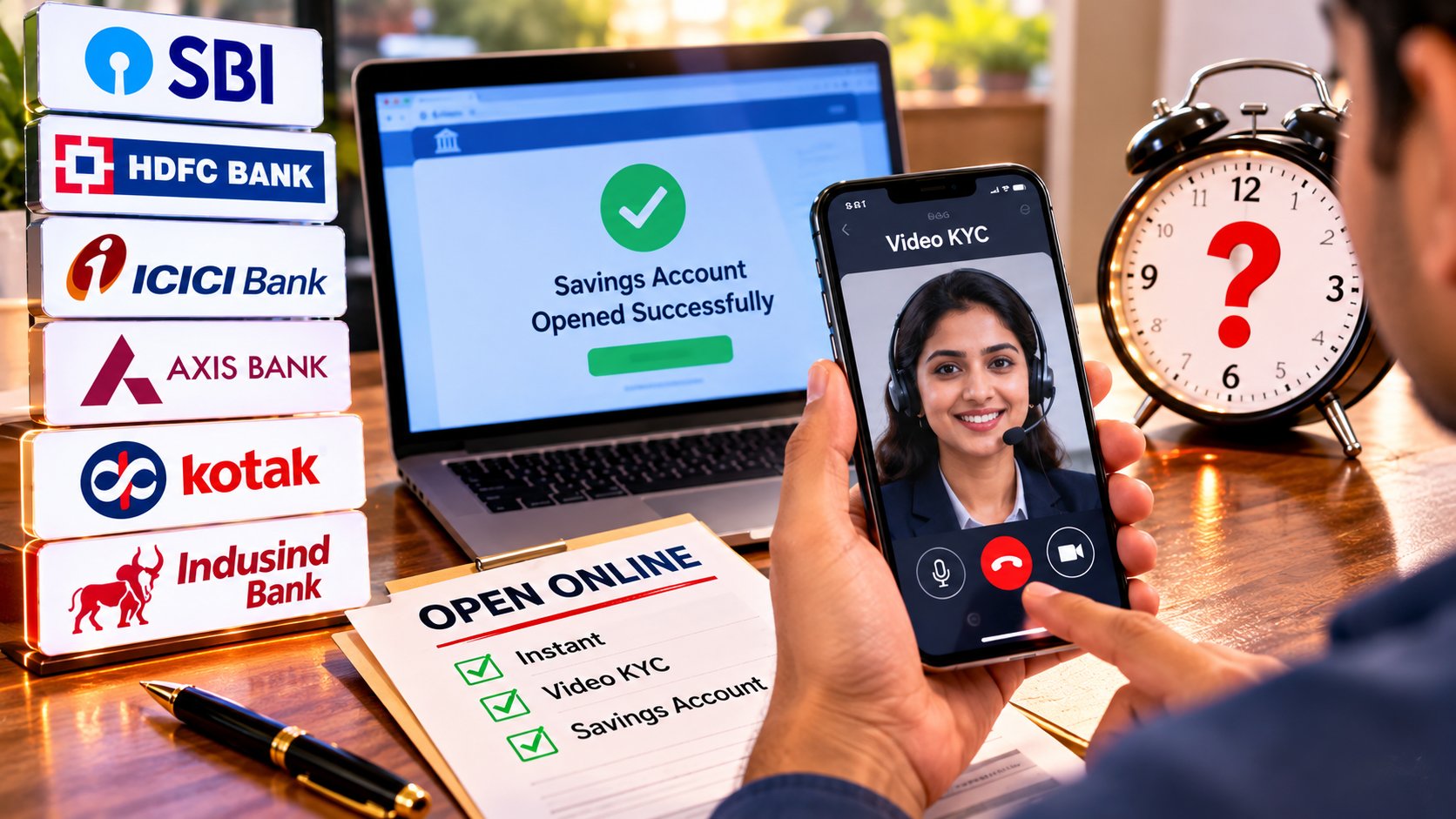
It is 10 pm, you have your PAN card on the table, and you want a new savings account before tomorrow’s salary transfer. Every bank’s app says you can open one “instantly” with video KYC. Then you reach the video call step and discover the desk closed hours ago, or the account will not go live until a bank official has checked it.
Video KYC really has made branch visits optional. But “instant” means different things at different banks. This guide compares the main options, explains the RBI rules behind the call, and shows what to prepare so you get it right first time.
Seven Banks, Seven Different Clocks
Video KYC is a live call with a trained bank official, not an automated selfie check. That is why it has opening hours. A bank must staff its desk with officials, and the RBI requires them to check that you are a real person, physically present and matching your documents. Banks that staff longer hours give you more flexibility.
| Bank | Video KYC hours | Activation | Documents | Note |
|---|---|---|---|---|
| AU Small Finance Bank | 24×7 | Instantly, per the bank | Aadhaar, PAN | Under 10 minutes in total, bank claim |
| HDFC Bank | 10am to 11:59pm, daily | On successful call | Aadhaar, PAN, white sheet, pen | Call link valid 3 days |
| Kotak 811 | Not published | About 6 hours | Aadhaar, original PAN, white sheet, pen | New Kotak customers only |
| IDFC First Bank | Not published | Instantly after call | Aadhaar, PAN | About 2 minutes, bank page |
| Axis Bank | 9am to 8pm, business days | After call | PAN plus Aadhaar, Voter ID or passport | Restart if audio or video fails |
| ICICI Bank | 9:15am to 6:15pm, Mon to Fri | After call | Aadhaar, PAN, white sheet, pen | Closed on bank holidays |
| SBI (YONO, Insta Plus) | Book a slot | After SBI officials verify | Aadhaar, PAN | Choose a home branch |
What Actually Happens on the Call
The exact screens differ, but every bank follows the same RBI-defined sequence. You first verify yourself with Aadhaar OTP and enter your details. Then you join a video call where an official checks your face, captures a live photo, and looks at your original PAN card. Some banks also ask you to sign on a white sheet and hold it up to the camera.
The rules the official must follow
The RBI’s May 2021 amendment to the KYC Master Direction sets strict conditions. The video must carry live GPS coordinates and a date and time stamp. Calls from IP addresses outside India, or from spoofed IPs, must be blocked. If the bank uses Aadhaar offline XML or a Secure QR code, it must be no more than three days old. Recordings must be stored on systems in India, and the account becomes operational only after a concurrent audit.
That last rule explains why some accounts are not usable the moment the call ends. Kotak’s six-hour activation and SBI’s “activated after officials verify” wording both reflect this internal review step.
Why So Many Video KYC Calls Fail
What people often get wrong is treating video KYC as a formality. The official must be satisfied that the person, the location and the documents are genuine, and small problems can end the call. The banks’ own instructions point to the same recurring issues.
Video KYC, OTP e-KYC or a Branch Visit: How the Routes Differ
There are three common ways to open a savings account in India today, and the difference between them is not just convenience. Each route gives the bank a different level of assurance about who you are, so each comes with different limits.
Aadhaar OTP e-KYC only
This is the fastest route. You enter your Aadhaar number, verify an OTP, and the bank creates an account from your Aadhaar data. Because no one has seen you, the RBI treats this as a non-face-to-face account with restrictions. Kotak’s limited KYC account, for example, cannot hold more than ₹1 lakh or receive more than ₹2 lakh a year, and cash withdrawals are blocked. The account must be upgraded to full KYC within a year.
Video KYC
The RBI treats a properly conducted video KYC as equivalent to face-to-face verification. Once it is complete and the bank’s audit is done, the account works like any branch-opened account. Kotak says accounts opened through video KYC have no restrictions on deposits, balances or spends. This is why most digital-first banks now push customers to finish the call straight away.
Branch or doorstep KYC
The traditional route still matters for people who cannot complete a video call, such as those without a smartphone, without an Aadhaar-linked mobile number or with a document mismatch. It takes longer, but it handles complications a video official cannot resolve, such as a name spelt differently on Aadhaar and PAN.
- Choose OTP e-KYC only if you need an account within minutes and will finish full KYC soon.
- Choose video KYC if you want a fully functional account without visiting a branch.
- Choose a branch if your documents do not match or the video call keeps failing.
Who Cannot Use Video KYC Easily
Most digital account flows are designed for a single resident individual aged 18 or over, with Aadhaar and PAN. Kotak’s 811 video KYC page, for instance, says the route is open to Indian residents who are physically in India during the process. Several groups may find the process harder or unavailable.
Non-resident Indians living abroad generally cannot complete the call from outside India, because the RBI requires banks to block foreign IP addresses and check live location. Minors usually need a guardian-operated account, which most instant flows do not cover. Joint accounts are often opened through a branch or a separate process. People whose Aadhaar is not linked to a current mobile number will first need to update it at an Aadhaar centre, since the OTP step comes before the call. In each case, the bank’s branch or customer care is the practical fallback.
Instant Account, Limited Powers: The Two-Stage Trap
Many apps let you open an account with only Aadhaar OTP, then complete video KYC later. Until you do, RBI rules cap that account. Kotak’s fee schedule effective July 1, 2026 shows the limits clearly, and RBI’s KYC directions say OTP-based accounts cannot run for more than a year without full KYC.
After the Call: Your KYC Is Not Done Forever
Banks must update KYC periodically, based on how risky they classify a customer. Under the RBI’s Master Direction, that is at least every two years for high-risk customers, every eight years for medium-risk customers and every ten years for low-risk customers. Most individuals with ordinary salary accounts fall in the low-risk band. Re-KYC can often be done online, and RBI rules allow a self-declaration where nothing has changed.
How Video KYC Became Normal
Your Pre-Call Routine, Step by Step
Ten minutes of preparation saves most failed calls. This order works at every bank we reviewed.
- Check the bank’s video KYC hours in its app. Start the application well before the desk closes, so the call does not run past it.
- Confirm that your mobile number is linked to Aadhaar, since the OTP goes only to that number.
- Keep your original physical PAN card ready. A printout or photo will not do.
- Have a blank white sheet and a blue or black pen for your signature.
- Sit in a well-lit room against a plain wall, with your face clearly visible and no one else in the frame.
- Turn on location services and grant the app camera, microphone and location permissions.
- Use a stable Wi-Fi or mobile data connection, and keep your phone charged.
- After the call, wait for the bank’s confirmation SMS or email before giving the account number to your employer.
So Which Bank Should You Pick?
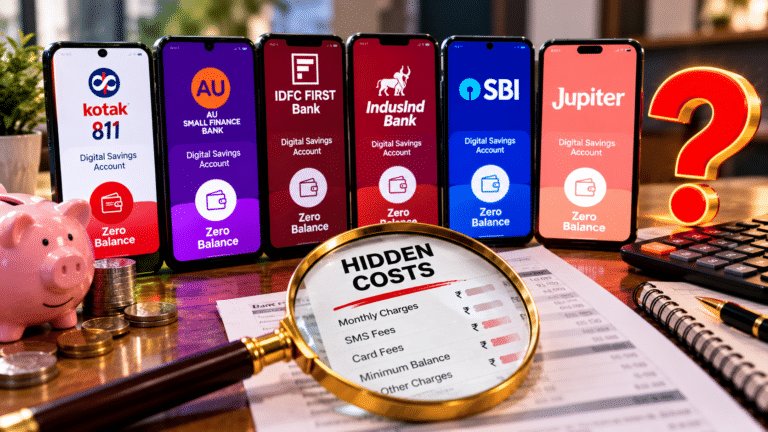
If you want the widest window, AU Bank’s 24×7 video banking and HDFC Bank’s 10 am to midnight desk are the most flexible on paper. If you want a zero-balance account and can wait a few hours for activation, Kotak 811 is the best-known option. IDFC First says its call takes about two minutes and the account is activated immediately after it, though its regular savings accounts require an average balance. SBI suits people who want India’s largest branch network behind the account, but its slot-based process is less instant.
The video KYC step should be the last part of your decision, not the first. Choose the bank for its fees, interest rates, branch and ATM access and app quality, then check that its video KYC hours suit your schedule. A great call experience is no compensation for an account whose charges do not fit how you bank.
Frequently Asked Questions
Which bank opens a savings account instantly with video KYC?
AU Small Finance Bank, HDFC Bank, Kotak 811, IDFC First Bank, ICICI Bank, Axis Bank and SBI all offer video KYC savings accounts. AU says its video banking runs 24×7 and accounts can be activated instantly, while Kotak says 811 accounts are activated within about 6 hours.
What are the video KYC timings for HDFC Bank?
HDFC Bank’s video KYC desk runs from 10 am to 11:59 pm every day, including weekends, according to BankBazaar’s page updated in October 2026. The video KYC link sent by SMS is valid for three days.
Can I do video KYC on Sunday?
It depends on the bank. AU Bank says it offers video banking 24×7, and HDFC Bank’s desk is open on weekends. ICICI Bank’s desk is open Monday to Friday only, and Axis Bank lists business days.
What documents are needed for video KYC?
You need your Aadhaar number with a linked mobile number for OTP, and your original PAN card. Many banks also ask for a blank white sheet and a blue or black pen for your signature. Printed e-PAN or other printed e-documents are not accepted.
Can I do video KYC from outside India?
No. RBI rules require the video to carry live location data and require banks to block connections from IP addresses outside India. You must be physically present in India during the call.
How long does video KYC take?
AU Bank and IDFC First say the video call itself takes about two minutes, and AU says the whole process takes under 10 minutes. Activation can be instant or take a few hours, since RBI requires a concurrent audit before the account becomes operational.
What happens if I do not complete video KYC on an OTP-based account?
The account stays limited. On Kotak 811 Limited KYC, the balance cannot exceed ₹1 lakh and credits are capped at ₹2 lakh a year. RBI rules say OTP-based accounts cannot continue beyond one year without full KYC.
Is video KYC safe?
Video KYC run through the bank’s official app follows RBI security rules, including recording storage in India and audits. Never start video KYC from a link sent by an unknown caller or messaging account, and never share OTPs.
The Short Version
Several major banks let you open a savings account online with video KYC, but their desks keep very different hours. AU Bank says it runs 24×7, HDFC Bank runs from 10 am to 11:59 pm daily, Axis runs on business days and ICICI only on weekday working hours. Kotak 811 activates in about six hours, and SBI asks you to book a slot. You need Aadhaar with a linked mobile, an original PAN card, location turned on and to be in India. Finish video KYC early, because OTP-only accounts are capped at a ₹1 lakh balance.