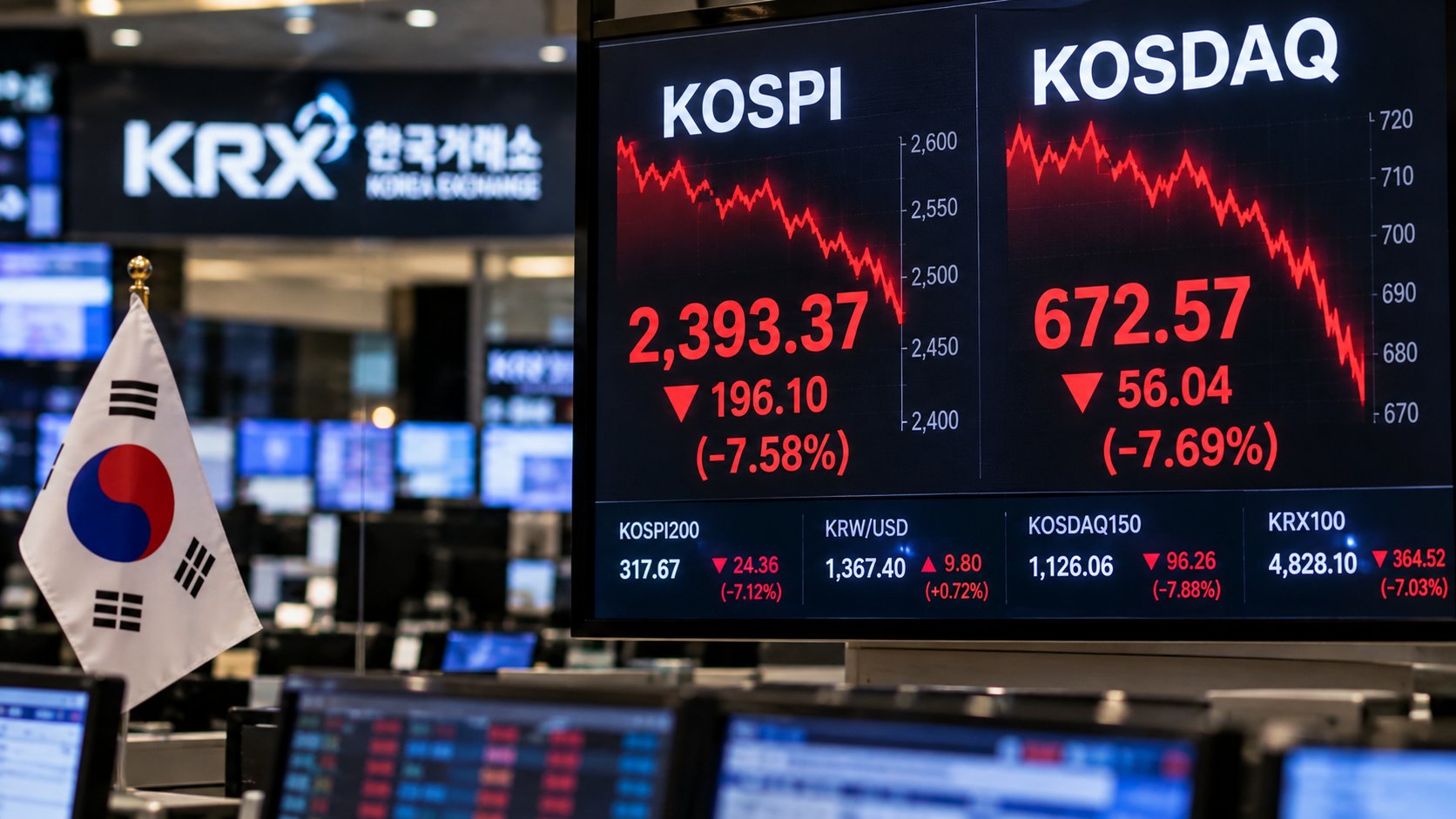
Why KOSPI and KOSDAQ Hit Circuit Breakers on 'Black Thursday' — and What the 7.6% Crash Means Now
Why KOSPI and KOSDAQ Hit Circuit Breakers on ‘Black Thursday’ — and What the 7.6% Crash Means Now
Both of South Korea’s main indexes fell 8% intraday on 15 October, forcing 20-minute trading halts. Chip stocks led the rout on US rate and AI-spending fears. On Friday, the market recovered about a quarter of the loss.
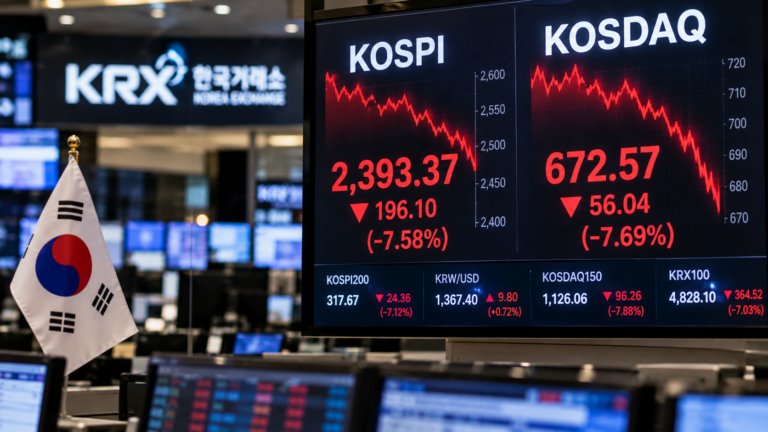
At 12:23 pm on Thursday, the screens at the Korea Exchange froze for KOSDAQ. Fifteen minutes later, KOSPI followed. Both indexes had fallen 8% from the previous close, the threshold that automatically stops all trading for 20 minutes. It was the first time both had halted together since 29 July, and for KOSPI it was the tenth circuit breaker of 2026.
By the close, KOSPI was down 7.57% at 5,554.22, its lowest finish since April, and KOSDAQ down 7.65% at 760.82. Korean media quickly called it “Black Thursday.” On Friday, both indexes bounced, KOSPI by 2.05% and KOSDAQ by 4.46%. For anyone holding Korean stocks, or funds with large Korea or memory-chip exposure, the questions are simple: what caused it, how do these halts actually work, and is the worst over?
Quick Summary
KOSPI and KOSDAQ both triggered Level 1 circuit breakers on 15 October 2026 after falling 8%, closing down 7.57% and 7.65%. The trigger was a global chip-stock selloff after hotter US inflation, rising Treasury yields and doubts about AI infrastructure spending. Foreign investors sold a net 3.62 trillion won on the main board while Korean retail and institutional investors bought. Friday brought a partial rebound, but analysts say a quick V-shaped recovery is unlikely.
What We Know
- KOSDAQ hit a Level 1 circuit breaker at 12:23 pm and KOSPI at 12:38 pm, each halting trading for 20 minutes.
- KOSPI fell as low as 5,465.03, about 9%, before closing at 5,554.22.
- SK hynix closed down 11.06% and Samsung Electronics down 9.48%.
- The Financial Services Commission held an emergency meeting at 2:30 pm the same day.
- On 16 October, KOSPI closed at 5,668.05 and KOSDAQ at 794.78.
What Is Still Unclear
- Whether foreign selling, which reversed on Friday, has truly ended or merely paused.
- Whether the US Federal Reserve will raise rates in October, which markets priced at about 50%.
- What specific steps, if any, regulators will take beyond monitoring and warnings.
- How far AI infrastructure spending forecasts will be cut, the key driver for Korean chip earnings.
Inside a Market Halt: Thursday, Minute by Minute
The selling began at the open and never really let up. According to Seoul Economic Daily, KOSPI opened 5.59% lower at 5,673.01, after overnight falls of 1.88% in the Nasdaq and 1.11% in the S&P 500. Sell-side “sidecars,” which pause program trading, were triggered on both markets before noon. Then the circuit breakers fired.
- OvernightNasdaq falls 1.88%, S&P 500 1.11%, led by memory chip stocks
- 9:00 amKOSPI opens 5.59% lower at 5,673.01
- MorningSell-side sidecars triggered on both markets
- 12:23 pmKOSDAQ hits Level 1 circuit breaker, down 8.01%; 20-minute halt
- 12:38 pmKOSPI hits Level 1 at 5,528.05, down 8%; 20-minute halt
- IntradayKOSPI touches 5,465.03, about 9% down
- 2:30 pmFSC emergency meeting chaired by Lee Eog-weon
- 3:30 pmKOSPI closes at 5,554.22, down 7.57%; KOSDAQ at 760.82, down 7.65%
- Fri closeKOSPI 5,668.05, up 2.05%; KOSDAQ 794.78, up 4.46%
How Korea’s circuit breakers work
The Korea Exchange uses three escalating levels, each measured against the previous day’s close and each usable once a day. A drop of 8% sustained for one minute triggers Level 1: a 20-minute halt to all trading, followed by a 10-minute single-price auction before normal trading resumes. During the halt, new orders are blocked but cancellations are allowed, Korea JoongAng Daily noted. Breakers are not triggered in the last 40 minutes of the session.
- 5%SidecarFutures move 5% for 1 minute; program trades paused 5 minutes
- 8%Level 1Index down 8% for 1 minute; 20-minute halt, hit on 15 Oct
- 15%Level 2Down 15% and 1% further than Level 1; another 20-minute halt
- 20%Level 3Down 20% and 1% further than Level 2; trading ends for the day
The purpose is to interrupt panic, not to stop prices falling. A forced pause gives investors time to check whether selling reflects new information or simply other people selling, and lets brokers manage margin calls in an orderly way. Thursday’s experience shows the limits: KOSPI fell further after trading resumed, to about 9% at the low, before buyers stepped in.
Why Seoul Fell Harder Than Everyone Else
Korea’s market is unusually concentrated in memory chips. Samsung Electronics and SK hynix together make up a very large share of KOSPI, so when global investors turn on semiconductors, Korea takes the hit first and hardest. Thursday combined several blows at once.
Four triggers, one direction
Hotter US inflation. The US Bureau of Labor Statistics reported on 14 October that consumer prices rose 3.7% in the year to September, with core inflation at 2.6%, both above expectations according to BigGo Finance. Bets on a Fed rate hike in October rose to about 50%. Rising yields. Seoul Economic Daily reported the US 10-year Treasury yield reaching 5.3% as oil prices climbed, raising the cost of financing AI data centres.
AI spending doubts. Gartner warned of $3.5 trillion in AI infrastructure investment at risk of impairment through 2030, and bond yields of AI cloud provider CoreWeave approached 15%. Memory competition. China’s ChangXin Memory Technologies announced plans for a new DRAM architecture, adding to worries about future memory prices. Each alone might have been a bad day. Together, they produced a crash.
The gap between Wall Street and Seoul is the story in one picture. A fall of less than 2% in the Nasdaq became a fall of more than 7% in Korea because Korean indexes are heavily weighted toward memory makers and their suppliers, and because foreign investors, who hold a large slice of those stocks, can exit quickly through a deep, liquid market. When global funds want to cut chip exposure in a hurry, Samsung and SK hynix are often the first and easiest shares to sell.
The pattern is classic risk-off: investors sold anything tied to AI capital spending, including Hyosung Heavy Industries, which makes power equipment for data centres, and moved into defensive names such as drugmakers and tobacco.
Who Sold and Who Bought
The flow data tells the clearest story. Foreign investors drove the selling, while Korean investors absorbed it. On the main board, foreigners sold a net 3.6243 trillion won, about $2.5 billion, Seoul Economic Daily reported, extending a run of net selling to eight sessions. Korean institutions bought 1.6932 trillion won and retail investors 1.2886 trillion won.
Friday flipped the pattern: foreigners turned net buyers of 341 billion won, while Korean retail and institutional investors took some profits from Thursday’s purchases. One day does not make a trend, but the switch helped KOSPI close above 5,600 again.
Friday’s rebound was broad. Seoul Economic Daily reported that all of KOSPI’s 20 largest stocks rose, and KOSDAQ’s 4.46% jump was strong enough to trigger a buy-side sidecar, the mirror image of Thursday’s sell-side pause, according to Digital Today. Samsung Electronics gained 2.62% to about 215,500 won, while SK hynix added a more modest 0.79%, a sign that investors were still cautious about the most AI-exposed names.
How It Compares With Korea’s Worst Days
Before 2026, KOSPI had triggered circuit breakers only six times since the system was introduced, which explains why this year’s ten feel so extraordinary. Thursday’s close was severe, but not the worst on record.
Why so many in one year? KOSPI spent much of 2026 in a steep, AI-driven rally that took it above 7,000. Markets that rise that fast on a narrow theme tend to fall fast too, and leveraged retail positions amplify the swings. A circuit breaker counts every time an index falls 8% in a day, so a year with several sharp air pockets accumulates halts quickly, even if the index never collapses outright.
| Date | Trigger | KOSPI close change | Context |
|---|---|---|---|
| 12 Sep 2001 | US terror attacks | −12.02% | Largest one-day fall on record |
| 24 Oct 2008 | Global financial crisis | −10.57% | Lehman aftermath |
| 5 Aug 2024 | US recession fears, yen carry unwind | −8.77% | Global selloff |
| 19 Mar 2020 | Covid-19 pandemic | −8.39% | Second halt in a week |
| 15 Oct 2026 | US rates, AI spending doubts | −7.57% | 10th halt of 2026 |
| 16 Oct 2026 | Rebound | +2.05% | Foreign buying returns |
Historical figures are from Korea Exchange records as widely reported; the earlier dates are included for context and were not re-verified against exchange data for this article.
What Regulators and Analysts Are Saying
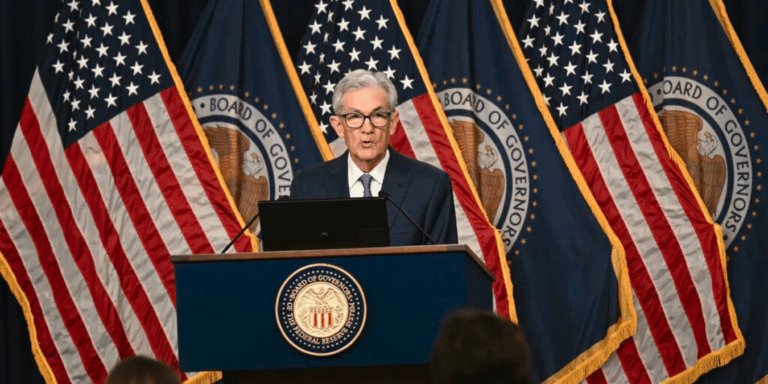
The Financial Services Commission met at 2:30 pm on Thursday, with Chairman Lee Eog-weon presiding, according to BigGo Finance. Officials concluded that the recent falls and capital outflows “may have been excessive,” pledged to monitor markets and act if needed, and promised strict action against false rumours, manipulation and illegal short selling. They also urged lenders to avoid indiscriminate credit expansion, a nod to the leveraged retail positions that can turn falls into forced selling.
Two other pieces of the policy picture surfaced the same week. Korea and Japan agreed to extend their $10 billion currency swap line through 2029, Korea JoongAng Daily reported, a backstop that matters if foreign outflows put pressure on the won. And an opinion piece in the same paper questioned why the National Pension Service, Korea’s largest domestic investor, bought relatively little during the rout, linking it to the fund’s earlier decision to suspend its usual rebalancing during the summer rally. Whether the pension fund steps in more actively is one of the variables investors will watch next week.
Valuations look cheap, but buyers are wary
KED Global reported that KOSPI’s forward price-to-earnings ratio fell to a 26-year low, yet investors were reluctant to buy because of doubts about AI-driven chip earnings. Samsung Securities cited 5,000 as a support level, noting that a forward price-to-book ratio of 1 corresponds to about 5,200. Daishin Securities’ Lee Kyoung-min said falls below 5,300 should be limited and suggested staged buying in dividend stocks, or waiting for earnings to confirm.
The outlook range is wide. Yorkville Ives’ Dan Ives told KED Global he sees KOSPI recovering to 9,000 within six to 12 months. A Korea Economic Daily survey of 53 fund managers cut their three-month target to 7,700. Most Korean analysts quoted this week agreed on one point: a sharp V-shaped rebound is unlikely while sentiment remains frozen.
A calm checklist for anyone holding Korean stocks
- Check your Korea and memory-chip exposure in all funds
- Know the 8%, 15% and 20% halt levels
- Avoid margin; forced selling worsens 8% days
- Stage any buying across 3 or more tranches
- Watch foreign flows after 8 sessions of selling
- Track US CPI, 3.7%, and Fed decisions
- Note analysts’ support zone of 5,000 to 5,300
- Review the next chip earnings before adding
Frequently Asked Questions
Why did KOSPI crash on 15 October 2026?
KOSPI fell 7.57% as global chip stocks sold off after hotter-than-expected US inflation of 3.7%, rising Treasury yields, rate-hike fears and doubts about AI infrastructure spending. Heavy weighting in Samsung Electronics and SK hynix magnified the fall.
What is a circuit breaker in the Korean stock market?
It is an automatic trading halt. If KOSPI or KOSDAQ falls 8% from the previous close for one minute, trading stops for 20 minutes, then resumes after a 10-minute single-price auction. Further levels apply at 15% and 20%.
What time did the circuit breakers trigger on Black Thursday?
KOSDAQ triggered its Level 1 circuit breaker at 12:23 pm and KOSPI at 12:38 pm Korea time on 15 October 2026.
How many times has KOSPI triggered a circuit breaker?
The 15 October halt was KOSPI’s 10th circuit breaker of 2026 and its 16th on record, according to Seoul Economic Daily. KOSDAQ’s was its 5th of the year.
Who sold Korean stocks on Black Thursday?
Foreign investors sold a net 3.62 trillion won on the main board, their eighth straight day of selling. Korean institutions bought 1.69 trillion won and retail investors 1.29 trillion won.
Did KOSPI recover after Black Thursday?
Partly. On 16 October, KOSPI rose 2.05% to 5,668.05 and KOSDAQ rose 4.46% to 794.78, with foreigners turning net buyers. That recovered roughly a quarter of Thursday’s fall.
How much did Samsung Electronics and SK hynix fall?
Samsung Electronics closed down 9.48% at 210,000 won and SK hynix down 11.06% at 1,262,000 won on 15 October. Both edged higher on Friday.
Is this a good time to buy Korean stocks?
Analysts disagree. Valuations are at multi-decade lows and some see support at 5,000 to 5,300, but others expect no quick rebound while AI and rate fears persist. This is not personal advice; consider your risk tolerance and diversification.
The Short Version
On 15 October 2026, KOSDAQ and KOSPI both fell 8% and triggered 20-minute circuit breakers, at 12:23 pm and 12:38 pm. KOSPI closed down 7.57% at 5,554.22, its 10th halt of the year. Hotter US inflation, rising yields, rate-hike bets and doubts about AI spending hit Korea’s chip-heavy market hardest, with SK hynix down 11% and Samsung down 9.5%. Foreigners sold 3.62 trillion won while Koreans bought. Friday’s 2.05% rebound helped, but analysts expect a slow recovery rather than a V-shape.