Retirement Income · Pension Schemes · India · 2026
The Guaranteed 7.4% Pension That Stopped Taking Applicants — What PMVVY Pays, and Who Can Still Get It
Pradhan Mantri Vaya Vandana Yojana paid an assured 7.4% for a full ten years with the rate fixed on the day of purchase. It also closed to new subscribers on 31 March 2023, and has not been reopened since. Both facts matter, and only one of them is widely reported.
Type the name of this scheme into a search box today and you will find dozens of pages explaining how to apply, which documents to carry and how to buy it online. Almost all of them are describing a door that has been shut for more than three years.
Pradhan Mantri Vaya Vandana Yojana was a genuinely unusual product: a government-subsidised pension paying a guaranteed rate for ten years, sold only by LIC, with the purchase price returned intact at the end. Its final subscription window closed on 31 March 2023. Understanding what it did remains useful, both for the roughly eight lakh households still drawing a pension from it and for anyone trying to work out what now does the same job.
Quick Summary
PMVVY (LIC Plan 856) paid 7.4% a year to its final cohort, in monthly, quarterly, half-yearly or yearly instalments, for a fixed 10-year term, with a maximum purchase price of ₹15 lakh per senior citizen. At the ceiling that is ₹9,250 a month. The scheme closed to new subscribers on 31 March 2023 and has not been reopened. Existing policies run to their own maturity dates, the last of them in 2033.
What We Know: the confirmed position on this scheme
These are matters of record rather than interpretation, and the first one is the most important.
- It is closed to new subscribers. The final subscription window ended on 31 March 2023. The government has neither extended nor reopened it. Any website or agent offering a fresh PMVVY subscription in 2026 is giving incorrect information.
- It was launched on 4 May 2017 and relaunched in modified form on 26 May 2020, with LIC as the sole authorised operator on behalf of the Government of India.
- The Cabinet set the terms of the modified scheme in May 2020: an assured 7.4% a year for 2020-21, with an annual reset in line with the Senior Citizen Savings Scheme up to a ceiling of 7.75%, and a fresh appraisal if that threshold were breached.
- The rate was locked at purchase. Whatever rate applied in the year a policy was bought stayed fixed for its entire ten-year term, which is the feature that made it valuable in a falling-rate period.
- Existing policies are unaffected by the closure. Pension payments continue on their original terms, and each policy matures ten years after its own purchase date.
How the scheme actually worked, in one paragraph
A senior citizen paid a single lump sum, called the purchase price. LIC then paid a pension at the assured rate for exactly ten years, in whichever frequency the pensioner chose at the outset. At the end of the term, the purchase price came back along with the final instalment. If the pensioner died during the term, the purchase price went to the nominee. The gap between the guaranteed rate and what LIC actually earned was subsidised by the Government of India and reimbursed to the Corporation, which is the reason a scheme like this could promise a rate the market was no longer offering.
Worked example: ₹15 lakh at the ceiling
A 62-year-old pays ₹15,00,000 in the monthly mode at 7.4%. The pension is ₹15,00,000 multiplied by 7.4% and divided by twelve, which is ₹9,250 every month, or ₹1,11,000 a year. Across the ten-year term that is ₹11,10,000 of pension, and at maturity the ₹15 lakh returns in full. Total received: ₹26,10,000. Because the limit applied per individual, a couple who both qualified could hold ₹30 lakh between them and draw ₹18,500 a month.
The payout ladder: what each purchase price produced
The pension scaled in a straight line with the purchase price, because the interest was simple and paid out rather than reinvested. What most summaries miss is that the four payout frequencies did not carry the same rate.
| Purchase price | Monthly at 7.40% | Quarterly at 7.45% | Half-yearly at 7.52% | Yearly at 7.66% |
|---|---|---|---|---|
| Minimum permitted | ₹1,000 | ₹3,000 | ₹6,000 | ₹12,000 |
| ₹5,00,000 | ₹3,083 | ₹9,313 | ₹18,800 | ₹38,300 |
| ₹7,50,000 | ₹4,625 | ₹13,969 | ₹28,200 | ₹57,450 |
| ₹10,00,000 | ₹6,167 | ₹18,625 | ₹37,600 | ₹76,600 |
| ₹12,50,000 | ₹7,708 | ₹23,281 | ₹47,000 | ₹95,750 |
| Maximum permitted | ₹9,250 | ₹27,750 | ₹55,500 | ₹1,11,000 |
The quiet 26 basis points hidden in the payout frequency
Choosing the monthly mode got you 7.40%. Choosing the yearly mode got you 7.66%. The difference is not generosity; it is the time value of money. Paying a pensioner once at the end of the year lets the insurer hold the money longer than paying in twelve instalments, and the pensioner is compensated for the wait.
Pick the frequency your household actually runs on
The higher yearly rate is only worth having if you can live on a single annual payment and let the balance sit in your own account through the year. A retiree paying monthly bills from the pension is usually better served by the monthly mode even at 7.40%, because the alternative is drawing down savings for eleven months and being repaid in the twelfth. Rate is not the same thing as usefulness.
What ten years of a ₹15 lakh policy delivered
The scheme’s life story, from launch to last maturity
Where a senior citizen looks in 2026 instead
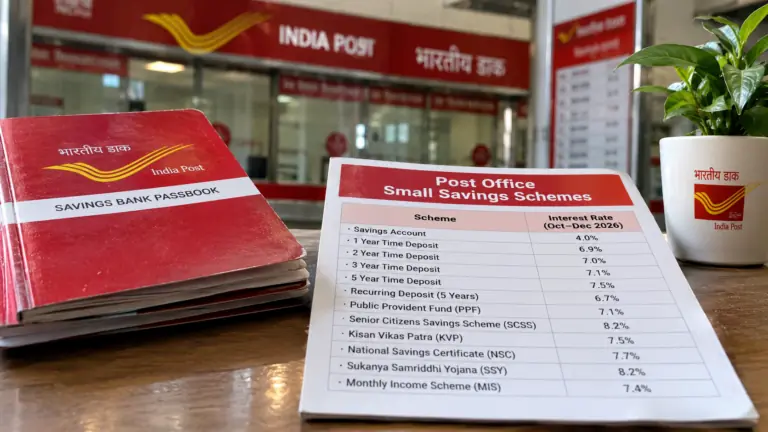
The uncomfortable comparison for anyone who missed the window is that the closed scheme is no longer the best rate available. The Senior Citizen Savings Scheme currently pays 8.2%, holds up to ₹30 lakh per individual, and locks its rate for five years at the time of opening.
The honest caveat is that these are not identical products. PMVVY locked its rate for ten years; SCSS locks for five and then re-rates on extension. A retiree who bought PMVVY in 2022 at 7.4% has certainty until 2032, which is worth something that a headline rate comparison cannot capture. But for money being placed today, SCSS pays more, holds twice as much, and is open.
Build the income from more than one source
Most advisers now assemble what PMVVY used to do in one product from two or three: SCSS for the core rate up to ₹30 lakh, the Post Office Monthly Income Scheme for a monthly cheque within its own limits, and a life annuity where the requirement is income that genuinely never stops. Annuities pay less than 8.2% but do not end after five or ten years, which is the risk a fixed-term scheme leaves on the table.
If you already hold a policy, these are the levers you have
Nothing about the closure changes an existing contract. Four provisions are worth knowing, because they are the only flexibility the policy contains.
- Loan after three policy years. Up to 75% of the purchase price could be borrowed against the policy once three years were complete, with the loan interest recovered from the pension instalments and the principal from the eventual claim proceeds.
- Premature exit on serious illness. The scheme permitted early exit for the treatment of a critical or terminal illness of the pensioner or the spouse, on which 98% of the purchase price was refunded.
- Death during the term. The purchase price is paid to the nominee, which makes keeping the nomination current more than a formality.
- Maturity. At the end of ten years the purchase price is paid along with the final pension instalment, and the policy ends. Plan the replacement income before that date, not after it.
Treat every offer of a new PMVVY policy as a red flag
The scheme is closed. Nobody can sell you one, and LIC is the only entity that ever could. If a website, a call or an agent offers to enrol you, that is a reason to stop rather than to hurry. Servicing of an existing policy is handled through any LIC branch or the customer portal, and no third party needs to be involved.
The tax treatment, which surprised a lot of pensioners
The pension was fully taxable in the hands of the recipient at slab rates. This is a meaningful difference from PPF or Sukanya Samriddhi, where the return is exempt, and it is the detail most likely to have been glossed over at the point of sale.
The purchase itself was exempt from service tax and later from GST, which was a real saving compared with a commercial annuity. But the scheme was never a tax-free instrument, and a pensioner in a taxable bracket kept correspondingly less than the 7.4% headline suggests. For a retiree whose total income now falls under the ₹12 lakh threshold that the new regime treats as tax-free, the point is largely academic; for anyone above it, it is not.
What Is Still Unclear
Three things cannot be stated with confidence, and it is better to name them than to fill the gap with speculation.
- Whether a successor scheme is planned. There has been no announcement of a replacement for PMVVY, and no indication that the closure will be reversed. Nothing in the public record supports the periodic claims that a relaunch is imminent.
- The precise number of live policies. Figures circulating for the size of the scheme at closure, of the order of eight lakh subscribers and around ₹95,000 crore, are attributed to LIC’s annual reporting rather than to a current official count, and should be treated as indicative.
- Whether the purchase price ever qualified for a deduction. Published guides contradict one another on this point. Since no new policy can be bought, it matters only for historical returns, and a tax adviser should be consulted rather than a web page.
A short checklist, depending on which side of the door you are on
Frequently asked questions
Is Pradhan Mantri Vaya Vandana Yojana still open in 2026?
No. The scheme closed to new subscribers on 31 March 2023 and has not been extended or reopened since. Fresh applications are not accepted by LIC or by anyone else, and LIC was the only authorised operator. Any website or agent offering a new PMVVY subscription today is providing incorrect information. Policies bought before the deadline continue on their original terms.
What was the PMVVY interest rate and was it guaranteed?
The final cohort received an assured 7.4% a year in the monthly payout mode, with 7.45% quarterly, 7.52% half-yearly and 7.66% yearly. The rate was fixed at the time of purchase and stayed unchanged for the whole ten-year term, with the Government of India subsidising the difference between the guaranteed rate and what LIC actually earned.
How much pension did ₹15 lakh give under PMVVY?
₹9,250 a month, which is ₹1,11,000 a year, in the monthly payout mode at 7.4%. Over the ten-year term that totals ₹11,10,000, and the ₹15 lakh purchase price is returned at maturity along with the final instalment. Because the ₹15 lakh ceiling applied per senior citizen, a couple who both qualified could hold ₹30 lakh and draw ₹18,500 a month.
What happens to my PMVVY policy now that the scheme has closed?
Nothing changes. The closure applied only to new subscriptions. Your pension continues at the rate locked in when you bought the policy, for the full ten years, and the purchase price is returned at maturity with the final instalment. Servicing is handled at any LIC branch or through the LIC customer portal.
Can I withdraw from PMVVY before ten years?
Only in limited circumstances. Premature exit was permitted for the treatment of a critical or terminal illness of the pensioner or the spouse, with 98% of the purchase price refunded. Separately, a loan of up to 75% of the purchase price could be taken after three policy years, with the interest recovered from the pension instalments. On death during the term, the purchase price is paid to the nominee.
Is PMVVY pension income taxable?
Yes. The pension is taxable in the hands of the recipient at applicable slab rates, unlike PPF or Sukanya Samriddhi where returns are exempt. The purchase price itself was exempt from service tax and GST, which reduced the cost compared with a commercial annuity, but the scheme was never a tax-free instrument.
What is the best alternative to PMVVY for senior citizens now?
For guaranteed income the Senior Citizen Savings Scheme is the closest match and currently pays more: 8.2% for the July to September 2026 quarter, up to ₹30 lakh per individual, with the rate locked for five years. The Post Office Monthly Income Scheme pays 7.4% within its own limits, and a life annuity pays less but does not stop at the end of a fixed term. Many retirees now use two or three of these together.
How was PMVVY different from the Senior Citizen Savings Scheme?
PMVVY was an LIC pension policy with a ten-year term, a ₹15 lakh ceiling and a rate locked for the full decade. SCSS is a post office and bank deposit with a five-year term, a ₹30 lakh ceiling and a rate locked for those five years. PMVVY offered a longer certainty window; SCSS offers a higher rate, twice the capacity and, decisively, the ability to actually open an account today.
The short version
PMVVY did something few products manage: it guaranteed a senior citizen a fixed rate for ten years and handed the capital back at the end, with the government absorbing the shortfall. The rate for its last cohort was 7.4% in the monthly mode, ₹9,250 a month at the ₹15 lakh ceiling, and ₹26.10 lakh received in total across the term. It also stopped accepting applications on 31 March 2023, which makes most of the how-to-apply advice online actively misleading. If you hold a policy, note the maturity date and plan the replacement income a year ahead. If you are looking to place money now, start with SCSS at 8.2%, which pays more and takes twice as much, and be sceptical of anyone who tells you the old scheme is still available.