Small Savings · Girl Child · India · FY 2026-27
Sukanya Samriddhi Still Pays 8.2% — And the Six Years You Deposit Nothing Build the Biggest Share of It
The Finance Ministry left small savings rates unchanged for July to September 2026, a ninth consecutive quarter. SSY remains the joint-highest payer on the table, and its unusual shape means the account keeps growing for six full years after the last deposit is made.
Most parents open a Sukanya Samriddhi account with a rough idea in their head: put money in for fifteen years, get a large tax-free number back at the end. That idea is right about the deposits and wrong about almost everything else, because the account’s most productive phase begins on the day you stop paying into it.
Deposits run for fifteen years. The account matures at twenty-one. In those six deposit-free years, a fully funded account grows by more than the entire amount a parent ever put in. Understanding that gap is the difference between a plan that arrives when your daughter needs it and one that arrives years after she did.
Quick Summary
SSY pays 8.2%, compounded annually and entirely tax-free. Deposits of ₹250 to ₹1.5 lakh a year run for 15 years, and the account matures 21 years from the date of opening. Depositing the maximum each April builds roughly ₹71.8 lakh at maturity on total deposits of ₹22.5 lakh. Half the balance can be withdrawn once the girl turns 18 or clears Class 10.
What We Know: the confirmed position today
These are the facts on the record, separate from any projection.
- The rate is unchanged at 8.2%. The Department of Economic Affairs notified on 30 June 2026 that small savings rates for the second quarter of FY 2026-27 remain as notified for the first quarter. SSY has been at 8.2% since January 2024.
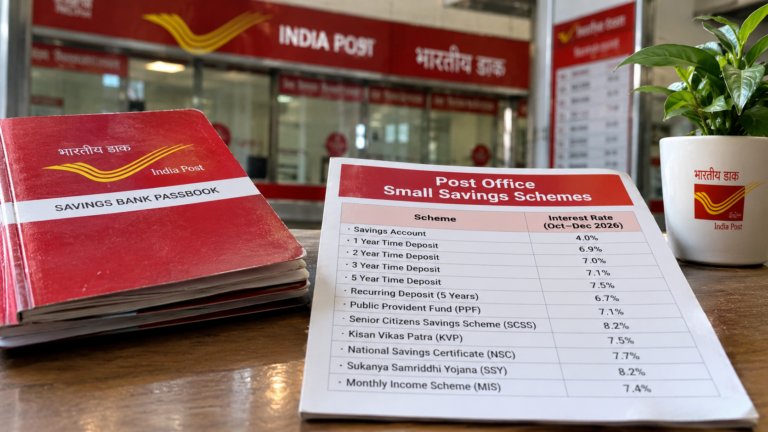
- It shares the top of the small savings table with the Senior Citizen Savings Scheme, ahead of the National Savings Certificate at 7.7%, Kisan Vikas Patra at 7.5%, the Post Office Monthly Income Scheme at 7.4% and PPF at 7.1%.
- The account is for a girl child below the age of 10, opened by a parent or legal guardian, with a maximum of two accounts per family and an exception where a third child arrives as one of twins or triplets.
- Deposits run ₹250 to ₹1.5 lakh a financial year for 15 years, and the account matures 21 years from the date of opening. Amounts above the annual ceiling earn no interest at all.
- The tax status is exempt-exempt-exempt. Deposits qualify for the ₹1.5 lakh deduction that moved from Section 80C to Section 123 of the Income-tax Act, 2025 from 1 April 2026, and both the interest and the maturity amount are tax-free.
The six quiet years that do the heaviest lifting
Take the fully funded version: ₹1.5 lakh deposited at the start of each financial year, fifteen times, at a constant 8.2% compounded annually. At the end of year fifteen, when the last deposit has been made and the account closes to new money, the balance is about ₹44.76 lakh.
Then nothing happens for six years, and the balance reaches roughly ₹71.82 lakh. That is about ₹27.06 lakh added while the parent contributes nothing at all, which is more than the ₹22.5 lakh of deposits made across the entire fifteen years. The scheme’s design quietly does the last third of the work by itself.
Why an early account beats a large one
Those six growth years are fixed by the rules, not by your effort. They arrive only if the account has been open long enough to reach them, which is why an account opened for a two-year-old with modest deposits can finish ahead of one opened for a nine-year-old with maximum deposits. The scheme rewards the calendar at least as much as the cheque book.
Why two SSY calculators give you two different answers
Search for a maturity figure and you will find numbers between roughly ₹63 lakh and ₹75 lakh for the same ₹1.5 lakh annual deposit. The scheme has not changed between those pages. The assumption behind the arithmetic has.
Interest is calculated on the lowest balance between the close of the fifth day of the month and the month end, and credited at the end of the financial year. A deposit made on 5 April therefore earns for the full year. The same money paid on 31 March earns for almost none of it. Over fifteen years of deposits and six years of compounding stacked on top, that single habit is the difference between about ₹71.82 lakh and about ₹66.38 lakh.
₹5.4 lakh for a date in the diary
Two families deposit an identical ₹22.5 lakh across identical fifteen years. One pays in the first week of April, the other in the last week of March. At the same 8.2% the first ends with roughly ₹71.82 lakh and the second with roughly ₹66.38 lakh. Nothing separates them except when the money arrived. If you can only manage monthly instalments, pay before the fifth of each month for exactly the same reason.
The date most parents get wrong: 21 years from opening, not her 21st birthday
The account matures twenty-one years from the date it is opened. It does not mature when your daughter turns twenty-one. For a newborn those are the same thing. For a nine-year-old they are nine years apart, and that distance is where most disappointed expectations come from.
Open an account for a girl aged nine and the deposits finish when she is twenty-four and the money is released when she is thirty. That may suit a family planning for a later milestone. It does not fund a degree at eighteen, which is usually the stated reason for opening the account in the first place. The partial withdrawal at eighteen exists precisely to bridge that gap, and it should be planned for rather than discovered.
Match the exit to the goal before you open
Write down two years: the one in which your daughter is likely to need the money, and the one in which the account will actually mature. If they are far apart, the plan is not broken, but it is a marriage-and-later-life corpus rather than a college fund, and the education money will have to come from the 50% withdrawal or from somewhere else entirely.
What different deposit levels actually produce
The maximum is the headline case, but the scheme was built to accept as little as ₹250 a year without penalty, and the proportions hold at every level. The table below runs the same arithmetic across five realistic deposit sizes.
| Deposit each year | Paid in over 15 years | Balance at year 15 | Maturity at year 21 | Interest earned |
|---|---|---|---|---|
| ₹12,000 | ₹1.80 lakh | ₹3.58 lakh | ₹5.75 lakh | ₹3.95 lakh |
| ₹25,000 | ₹3.75 lakh | ₹7.46 lakh | ₹11.97 lakh | ₹8.22 lakh |
| ₹50,000 | ₹7.50 lakh | ₹14.92 lakh | ₹23.94 lakh | ₹16.44 lakh |
| ₹1,00,000 | ₹15.00 lakh | ₹29.84 lakh | ₹47.88 lakh | ₹32.88 lakh |
| ₹1,50,000 | ₹22.50 lakh | ₹44.76 lakh | ₹71.82 lakh | ₹49.32 lakh |
Read the last column rather than the first. At every level the interest is roughly twice what the family paid in, because the money is left alone for two decades. That ratio, not the size of the instalment, is what makes the scheme work for households that cannot approach the ceiling.
Where 8.2% sits, and why the PPF comparison is the honest one
Against most of the small savings table SSY simply pays more. The comparison worth making carefully is with PPF, because both carry exempt-exempt-exempt status, so the gap between them is a clean 110 basis points with no tax adjustment needed in either direction.
The extra 1.1 percentage points is not the whole story, and neither is the lock-in. PPF money can be redirected to a house deposit or a medical emergency. SSY money belongs to the daughter and can be used for very little else before she is eighteen. Whether that rigidity is a cost or a benefit depends entirely on how disciplined the household expects to be over twenty-one years.
The withdrawal at 18, and what taking it actually costs
Once the girl turns eighteen or passes Class 10, whichever is earlier, up to 50% of the balance at the end of the preceding financial year can be withdrawn, and the rules name higher education as the purpose.
On a fully funded account opened at birth, the balance at the end of year eighteen is about ₹56.70 lakh, so roughly ₹28.35 lakh is available in exactly the year admission fees fall due. What the calculators rarely show is the other side of that transaction. Take the ₹28.35 lakh out and the remaining balance compounds for three years to about ₹35.9 lakh, so the family receives around ₹64.26 lakh in total instead of ₹71.82 lakh. The withdrawal costs roughly ₹7.6 lakh of final corpus.
That is a price, not a penalty
Giving up ₹7.6 lakh of future growth to have ₹28.35 lakh in hand in the year it is needed is often an excellent trade, and considerably cheaper than an education loan carrying interest for a decade. The point is to make the choice deliberately, with the number visible, rather than discovering the shortfall three years later. Premature closure on marriage is also permitted after the girl turns eighteen, on application and with the prescribed documents.
The account’s full timeline, in the order it happens
Five rules that quietly damage accounts
- Missing the ₹250 minimum. A financial year without the minimum turns the account into a default account. It can be regularised by paying ₹50 for each defaulted year plus the missed minimums, but only until the fifteen-year deposit window closes.
- Depositing above ₹1.5 lakh in a year. The excess earns no interest whatsoever. It is not a penalty so much as dead money parked inside a high-interest account.
- Leaving the opening until she is nine. The under-10 rule is a hard cut-off, and every year of delay pushes the maturity date one more year past the goal it was meant to fund.
- Forgetting the two-account limit. A family may hold two accounts, with an exception for a third child born as one of twins or triplets, subject to the prescribed documents being produced.
- Treating it as accessible savings. Beyond the withdrawal at eighteen and closure on marriage after eighteen, this money is not available to the household. Build the emergency fund somewhere else first.
The tax position, and the one condition attached to it
SSY belongs to a very small group of Indian instruments where nothing is taxed at any stage. The interest credited each year is exempt and the maturity payment is exempt, under both tax regimes, with no TDS along the way.
The deduction on the deposit is the part carrying a condition. Up to ₹1.5 lakh a year qualifies under Section 123 of the Income-tax Act, 2025, which replaced Section 80C from 1 April 2026 with eligible instruments listed in Schedule XV, and it is available only under the old tax regime. The new regime is the default. If you are on it, deposits still compound and mature tax-free, but they buy no deduction going in, and the case for filling the account competes on returns alone.
What Is Still Unclear
Three things a parent would want settled are not, and it is more useful to say so than to project false confidence.
- The rate for October to December 2026. It is normally notified in the last days of September. Nine unchanged quarters make continuity the reasonable expectation, not a guarantee.
- The rate for the next two decades. This is the significant one. Unlike the Senior Citizen Savings Scheme, SSY carries no rate lock: every quarterly revision applies to the whole balance. A twenty-one-year projection at a constant 8.2% is arithmetic, not a forecast, and the real maturity value will follow whatever path rates actually take.
- How a withdrawal interacts with a future rate change. Because the balance left after a partial withdrawal compounds at the prevailing rate, the true cost of taking money out at eighteen depends on rates in force then, which nobody can currently know.
A checklist for the week you open the account
Frequently asked questions
What is the Sukanya Samriddhi interest rate for July to September 2026?
8.2% per annum, compounded annually and unchanged. The Department of Economic Affairs notified on 30 June 2026 that small savings rates for the second quarter of FY 2026-27 remain as notified for the first quarter, the ninth consecutive quarter without a change. SSY has been at 8.2% since January 2024 and shares the top of the small savings table with the Senior Citizen Savings Scheme.
How much will I get if I deposit ₹1.5 lakh a year in SSY?
Roughly ₹71.82 lakh at maturity, if the deposit is made at the start of each financial year for fifteen years and the rate holds at 8.2% throughout. Total deposits are ₹22.5 lakh, so about ₹49.32 lakh is interest, and none of it is taxed. Depositing at the end of each year instead brings the figure closer to ₹66.38 lakh, which is why published estimates vary so widely.
When does a Sukanya Samriddhi account mature?
Twenty-one years from the date the account is opened, not on the girl’s twenty-first birthday. Deposits are accepted only for the first fifteen years; the balance then compounds for six more years with no further contribution. An account opened for a nine-year-old therefore matures when she is thirty, which is worth checking against your actual goal before opening.
Can I withdraw money from SSY before maturity?
Yes, once. After the girl turns eighteen or passes Class 10, whichever is earlier, up to 50% of the balance at the end of the preceding financial year can be withdrawn, with higher education named as the purpose. Premature closure is also permitted on her marriage after the age of eighteen, subject to the prescribed application and documents.
What is the minimum and maximum deposit in Sukanya Samriddhi Yojana?
₹250 minimum and ₹1.5 lakh maximum in a financial year, with no fixed instalment schedule inside that range. Falling below the minimum in a year makes the account a default account, which can be regularised by paying ₹50 for each defaulted year plus the missed minimums. Anything deposited above the ₹1.5 lakh ceiling earns no interest.
Is SSY better than PPF for a daughter’s education?
On rate, yes: 8.2% against 7.1%, and both carry exempt-exempt-exempt status, so no tax adjustment is needed to compare them. On flexibility PPF is ahead, since it is open to anyone, allows loans from year three and partial withdrawals from year seven. If the money is genuinely earmarked for a daughter and the timeline works, SSY usually wins on returns, and many families run both.
Is the Sukanya Samriddhi maturity amount taxable?
No. The scheme carries exempt-exempt-exempt status, so the annual interest and the maturity amount are both tax-free under either tax regime. The deposit itself qualifies for a deduction of up to ₹1.5 lakh under Section 123 of the Income-tax Act, 2025, which replaced Section 80C from 1 April 2026, but that deduction is available only if you opt for the old tax regime.
How many SSY accounts can one family open?
Two, one for each of up to two girl children, with an exception permitting a third where the additional child is born as one of twins or triplets, subject to the prescribed documentation. Each account is for a girl below the age of ten, opened by a parent or legal guardian, and the ₹1.5 lakh annual ceiling applies to each account separately.
The short version
SSY at 8.2% is the highest tax-free rate an Indian family can currently get for a long-horizon goal, and its structure matters more than its rate. Deposits stop at fifteen years while the account runs to twenty-one, so the final six years add about ₹27 lakh on a fully funded account without a rupee of new money. Open it as early as the rules allow, pay in the first week of April rather than the last week of March, keep ₹250 flowing even in a difficult year, and decide in advance whether the withdrawal at eighteen is part of the plan or a last resort. The one thing no projection can promise is the rate itself: unlike a locked-in deposit, every quarterly revision here applies to the whole balance, for the next twenty-one years.