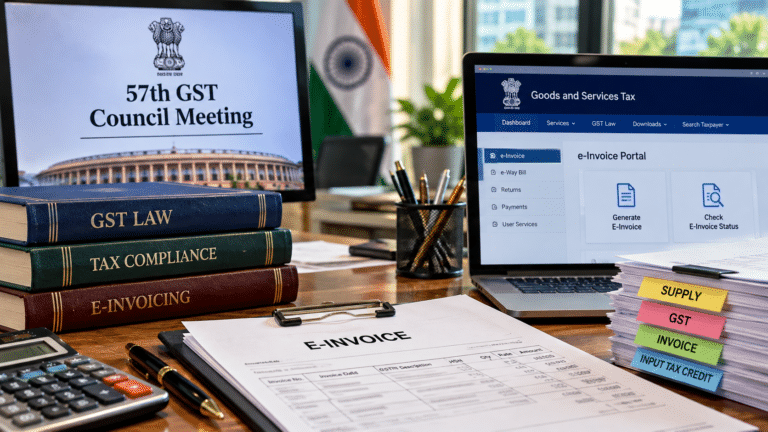
Is the ₹5 Crore E-Invoice Limit Scrapped? What the 57th GST Council Actually Changed — and Who Must Act
Is the ₹5 Crore E-Invoice Limit Scrapped? What the 57th GST Council Actually Changed — and Who Must Act
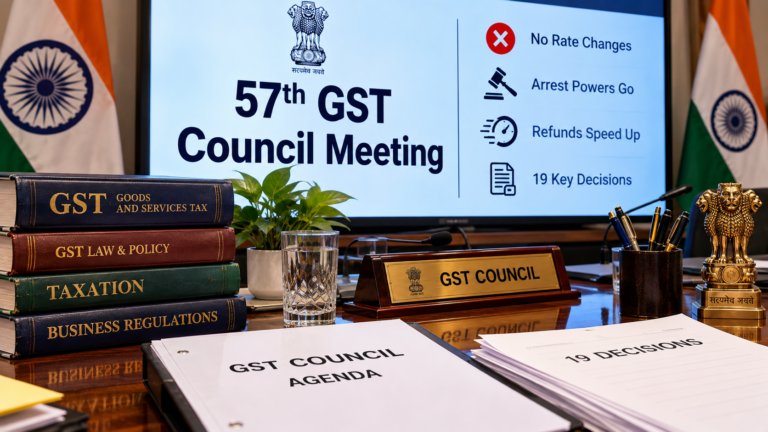
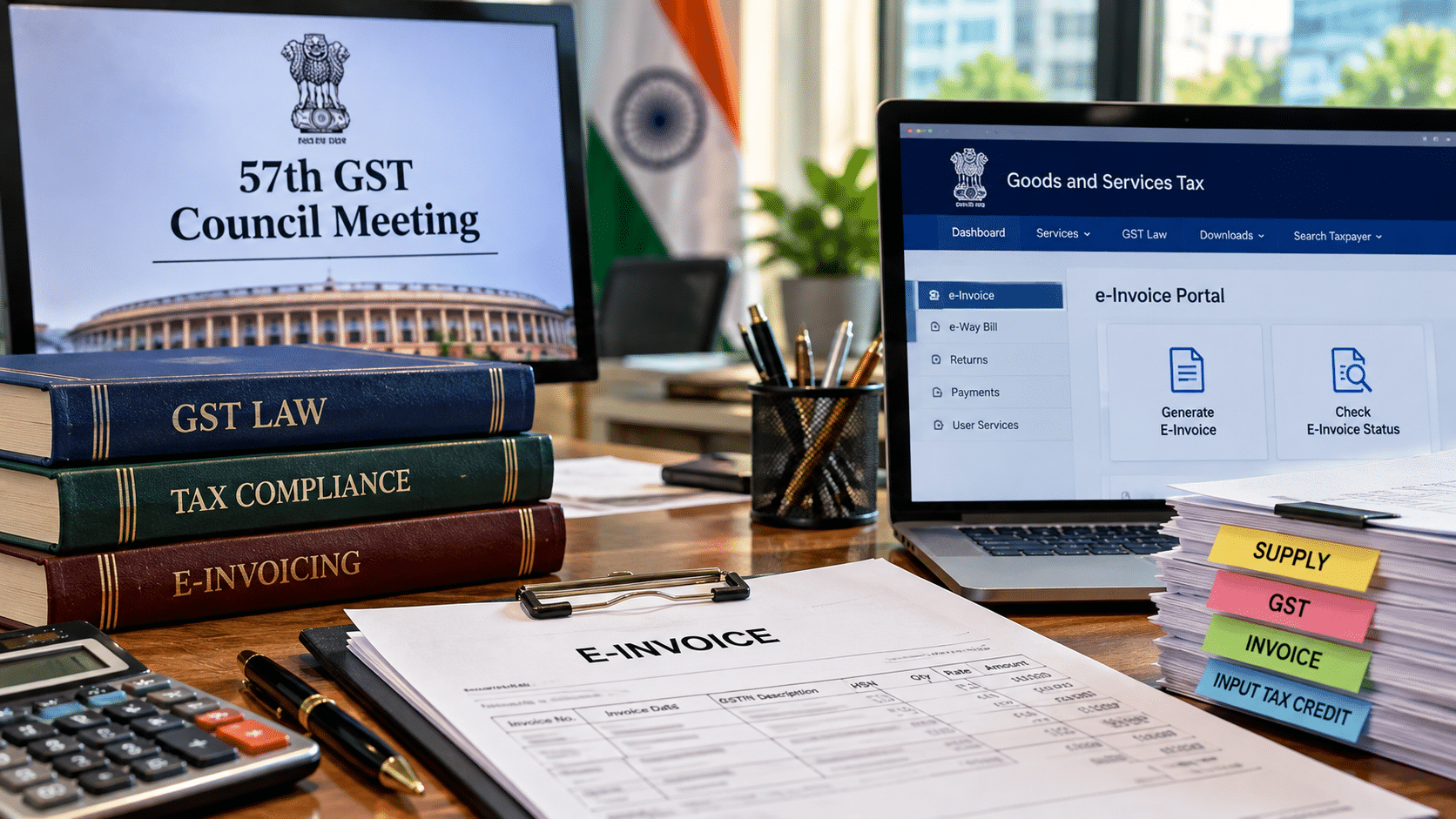
The threshold stays. What the Council recommended on 8 October 2026 is a wider scope for the same businesses: reverse-charge purchases and imported services. Here is what that means, and four different ₹5 crore figures not to mix up.
Since the GST Council met on 8 October, accountants have been fielding the same anxious question from small business owners: has the ₹5 crore e-invoice limit gone? Some social posts say it has been scrapped. Others say it has been lowered, or that every business will now need an IRN on every bill.
None of that is what happened. The ₹5 crore threshold is intact, and no notification has changed it. What the Council did recommend is narrower and more practical: businesses already above the threshold may soon have to e-invoice two kinds of transactions they currently handle on paper. The confusion is understandable, because the same ₹5 crore number appears in at least four separate recommendations from the same meeting.
What We Know
- 1The e-invoice threshold remains aggregate turnover above ₹5 crore, set by CBIC Notification 10/2023-Central Tax from 1 August 2023.
- 2The 57th GST Council, meeting on 8 October 2026, recommended extending e-invoicing to reverse-charge supplies received from unregistered persons and to imports of services.
- 3That extension is for taxpayers with aggregate annual turnover of ₹5 crore and above, according to published summaries of Recommendation 22.
- 4The Council’s recommendations are not yet law; amendments, rules or notifications must follow.
What Is Still Unclear
- ?The start date for the wider e-invoicing. The finance minister indicated most process reforms target 1 April 2027, but no date was tied to this item.
- ?Whether the new scope uses “₹5 crore and above” or the existing “exceeds ₹5 crore” test; the two differ only for a business at exactly ₹5 crore.
- ?How the IRP will handle a document where the supplier has no GSTIN, and what schema fields it will require.
- ?Whether the 30-day reporting limit will apply to these new documents.
How the Threshold Fell From ₹500 Crore to ₹5 Crore
E-invoicing in India was never switched on for everyone at once. CBIC phased it in from the largest businesses down, six times in under three years, so that software vendors, the Invoice Registration Portals and taxpayers could absorb the load. Each step was announced by notification months in advance. That pattern matters now, because it shows how a real change to the threshold would arrive: by a numbered notification with a start date, not by a social media post.
Why the speculation keeps returning
Because the threshold halved so regularly until 2023, many people assumed the next step, to ₹1 crore or to all registered businesses, was due. Vendor blogs have repeated that expectation for two years. It may happen eventually; the trend points that way. But as of 13 October 2026 there is no notification, no Council recommendation and no announced date for lowering the ₹5 crore limit. Speculation is not law.
There is also a practical reason the limit has held. Each step down brought in many more taxpayers than the one before, because small businesses vastly outnumber large ones. Moving below ₹5 crore would pull in a very large group of firms that often run basic billing software and have no dedicated tax staff. Expanding the transactions covered for businesses already on the system, as the Council has now proposed, is the less disruptive way to widen the digital trail.
What the Council Actually Recommended on 8 October
Recommendation 22 of the 57th meeting, as summarised by Taxguru and other professional publications, proposes extending e-invoicing to two categories of inward supply for taxpayers with aggregate annual turnover of ₹5 crore and above. In both cases the business is the buyer and pays the GST itself under reverse charge, so today it raises a self-invoice rather than receiving a tax invoice from a registered supplier.
Category one: reverse-charge purchases from unregistered suppliers
Some domestic purchases from unregistered persons attract GST under reverse charge, which the buyer pays. Under existing rules, the buyer issues a self-invoice for these. These documents do not currently pass through the IRP, so they carry no IRN and do not flow automatically into returns. Bringing them into e-invoicing would put them on the same digital trail as normal B2B sales.
Category two: imports of services
When an Indian business pays a foreign provider for software, cloud services or consultancy, the Indian business pays GST under reverse charge. The overseas supplier issues no GST invoice. Under the recommendation, the Indian recipient would report these transactions through e-invoicing. For a typical mid-sized company with a dozen overseas subscriptions, that could mean several new IRN documents every month.
A mid-sized company, before and after
Consider a ₹40 crore software services firm that pays for 12 overseas tools each month: cloud hosting, a design suite, a CRM and so on. Today it records each payment, pays GST under reverse charge in GSTR-3B, raises a self-invoice in its books and claims the credit. Nothing goes to the IRP. Once the extension is notified, each of those 12 monthly payments, or 144 a year, would also need an e-invoice. The tax paid does not change; the paperwork moves from the accounts ledger to the portal, with an IRN as proof.
For the same firm, a handful of reverse-charge purchases from unregistered suppliers in India would follow the same path. The practical work is in the software: most ERPs generate e-invoices for outward sales, and many will need an update to produce one for an inward self-invoice where the supplier field has no GSTIN.
Four ₹5 Crore Figures From One Meeting
Much of the confusion comes from the Council using ₹5 crore for four different purposes on the same day. Three are turnover tests; one is not. Two apply above the figure; two apply up to it. Reading one as another is how the “limit scrapped” rumour spreads.
Of the four, only the first touches e-invoicing, and it expands the system rather than shrinking it. A business with ₹3 crore turnover gains from the late fee waiver and may benefit from the optional scheme, but it has no new e-invoicing duty. A business with ₹30 crore turnover keeps every existing e-invoicing duty and may gain two more.
Where Your Business Sits Today
E-invoicing duties now step up at three turnover levels. The test is aggregate turnover across all GSTINs on the same PAN, in any financial year from 2017-18 onward. Once you cross ₹5 crore in any one year, the obligation stays even if turnover later falls.
The row that matters most for small and mid-sized firms is the first. A business averaging about ₹42 lakh of sales a month is already at the e-invoicing threshold, and a single large order in a strong quarter can tip a ₹4.5 crore business over the line. Because the test looks back at every year since 2017-18, crossing it once is enough.
What Changes, Transaction by Transaction
The table sets out which documents need an IRN today and which would if the recommendation is notified. “Proposed” means recommended by the Council, not yet in force.
| Document type | Turnover up to ₹5 crore | Above ₹5 crore, today | ₹5 crore and above, after notification |
|---|---|---|---|
| B2B tax invoice | Not required | Required | Required |
| Export invoice | Not required | Required | Required |
| Credit and debit notes, B2B | Not required | Required | Required |
| Reverse-charge purchase from unregistered supplier | Not required | Self-invoice, no IRN | Proposed: e-invoice |
| Import of services | Not required | Self-invoice, no IRN | Proposed: e-invoice |
| B2C invoice | Not required | Not required below ₹500 crore | No change proposed |
| Import of goods | Not required | Bill of entry, not IRP | No change proposed |
What a Missing IRN Can Cost
An invoice that should carry an IRN but does not is not a valid tax invoice under Rule 48(5). The consequences fall on both sides of the sale, which is why buyers increasingly refuse to pay against invoices without a QR code.
Who Stays Outside E-Invoicing Whatever Their Size
Certain categories are exempt regardless of turnover. These exemptions are unchanged by the October recommendations.
| Category | Exempt from e-invoicing? | Note | Affected by Oct 2026 proposal? |
|---|---|---|---|
| SEZ units | Yes | SEZ developers are not exempt | No |
| Insurers, banks, NBFCs | Yes | Includes financial institutions | No |
| Goods transport agencies | Yes | For transport of goods by road | No |
| Passenger transport services | Yes | Applies to passenger transport supplies | No |
| Multiplex cinema admission | Yes | For admission tickets | No |
| Government departments, local authorities | Yes | As notified by CBIC | No |
Timeline: From First Notification to Today
- 1 October 2020E-invoicing begins for turnover above ₹500 crore.
- 2021 and 2022Threshold falls to ₹100 crore, ₹50 crore, ₹20 crore and ₹10 crore in four steps.
- 1 May 202330-day IRP reporting limit for turnover of ₹100 crore or more.
- 1 August 2023Threshold reaches ₹5 crore under Notification 10/2023-Central Tax.
- 1 April 202530-day reporting limit extended to turnover of ₹10 crore or more.
- 8 October 202657th GST Council recommends e-invoicing for reverse-charge purchases and imported services at ₹5 crore and above.
- April 2027, targetedMost process reforms, including the new reverse-charge statement, targeted from this return period.
What to Do Before the Notification Lands
Nothing changes legally until CBIC issues a notification. But businesses above ₹5 crore can prepare cheaply now, because the work is mostly about data that already exists.
- Confirm your status. Check aggregate turnover on your PAN for every year since 2017-18. If any year exceeded ₹5 crore, you are in.
- List reverse-charge purchases. Pull the last 12 months of self-invoices for unregistered suppliers and imported services; count documents per month.
- Ask your software vendor. Find out whether your ERP can generate an e-invoice for a self-invoice where the supplier has no GSTIN.
- Clean supplier masters. Overseas vendors need consistent names, countries and service codes before any schema arrives.
- Watch for the notification. Track CBIC and GSTN advisories; past phases gave 2 to 6 months of notice.
- Turnover checked for all years since 2017-18
- All GSTINs under one PAN added together
- B2B invoices reported to IRP within 30 days if ₹10 crore or more
- 6-digit HSN codes on B2B invoices above ₹5 crore
- Cancellations done within 24 hours, otherwise by note
- Monthly count of reverse-charge self-invoices recorded
- Overseas service vendors listed with SAC codes
- CBIC notification alerts set up for e-invoicing
If you are below ₹5 crore today
Businesses under the threshold have nothing new to do as a result of this meeting. The useful step is to track turnover through the year. If sales are running at more than ₹41.7 lakh a month on average, the business is on course to cross ₹5 crore, and e-invoicing would apply from the following financial year. Choosing billing software that can already generate e-invoices costs little now and avoids a rushed switch later. The same meeting also brought two items that do help smaller firms: the proposed late fee waiver and the optional annual return scheme, both for turnover up to ₹5 crore.
Frequently Asked Questions
Has the ₹5 crore e-invoice limit been scrapped?
No. The threshold remains aggregate turnover above ₹5 crore, as set by Notification 10/2023-Central Tax from 1 August 2023. No notification in 2026 has removed or lowered it.
What did the 57th GST Council change about e-invoicing?
It recommended extending e-invoicing to reverse-charge purchases from unregistered suppliers and to imports of services, for businesses with turnover of ₹5 crore and above. This needs a notification before it applies, and no start date has been announced.
Is e-invoicing mandatory for businesses below ₹5 crore turnover?
No. If aggregate turnover has not exceeded ₹5 crore in any financial year since 2017-18, e-invoicing is not required. Such businesses issue normal tax invoices.
How is the ₹5 crore turnover calculated for e-invoicing?
It is aggregate turnover across all GSTINs registered under the same PAN in India. If it exceeded ₹5 crore in any year from 2017-18 onward, e-invoicing applies from then on, even if turnover later falls.
What is the 30-day rule for e-invoices?
Businesses with aggregate turnover of ₹10 crore or more must report each invoice to the Invoice Registration Portal within 30 days of its date, from 1 April 2025. Older invoices are rejected by the portal.
Will e-invoicing apply to imports of services?
The Council has recommended it for businesses at ₹5 crore and above. Once notified, the Indian recipient paying GST under reverse charge would report these transactions through e-invoicing. Until then, the existing self-invoice process continues.
What happens if I issue a B2B invoice without an IRN when e-invoicing applies?
The invoice is not treated as a valid tax invoice. The seller can face a penalty of the higher of ₹10,000 or the tax involved, the buyer’s input tax credit can be denied, and goods in transit can be detained.
Is the ₹5 crore prosecution threshold the same as the e-invoice limit?
No. The prosecution threshold, recommended to rise from ₹1 crore to ₹5 crore, relates to the amount involved in an offence, not turnover. It has nothing to do with e-invoicing.
The Short Version
The ₹5 crore e-invoice limit has not been scrapped, lowered or changed. Businesses whose turnover has exceeded ₹5 crore in any year since 2017-18 still need an IRN on B2B invoices, notes and exports, and those below it still do not. What the 57th GST Council recommended is wider coverage for the same businesses: reverse-charge purchases from unregistered suppliers and imported services. That needs a notification, and no date has been set. Do not confuse it with the separate ₹5 crore figures for late fee waivers, the optional annual scheme or prosecution.