ICICI Bank and Indian Bank Raise FD Rates — but the 8.5% Senior Citizen Rate Comes From Elsewhere
Fixed Deposits · Senior Citizens · Rates as of October 24, 2026
ICICI Bank and Indian Bank Raise FD Rates — but the 8.5% Senior Citizen Rate Comes From Elsewhere
ICICI Bank and Indian Bank lifted fixed deposit rates on October 23, 2026, with peak senior citizen rates of 7.20% and 7.30%. The headline 8.5% for seniors comes from small finance banks, where deposit insurance limits matter far more.
If you are over 60 and have money coming up for renewal, this month’s headlines looked promising. Two of India’s best-known lenders, ICICI Bank and Indian Bank, raised their fixed deposit rates on October 23, and reports put senior citizen rates at “up to 8.5%”. But the 8.5% is not on either bank’s rate card.
The rate story is real; the pairing is misleading. ICICI’s best senior rate is now 7.20%, and Indian Bank’s is 7.30% on a special 555-day deposit. Senior rates of 8.5% and above are being offered by small finance banks, on specific tenures, with a deposit insurance ceiling that changes how much you should put in. Here is what each bank changed, and what you actually keep after tax.
Why Banks Are Paying More Again
For most of the past year, deposit rates drifted lower as RBI kept policy easy. That changed on October 7, 2026, when the Monetary Policy Committee raised the repo rate by 25 basis points to 5.50%, its first increase in more than three years, and shifted its stance to calibrated tightening. CPI inflation stood at 4.8% in August, and RBI projected 5.2% for FY 2026-27, according to SCC Online’s summary of the policy.
When the policy rate rises, banks’ own funding costs follow, and they compete harder for deposits. The October revisions are that first response. They are modest at large banks, between 10 and 15 basis points, and more aggressive at small finance banks that rely almost entirely on deposits to fund lending.
ICICI Bank: Exactly Which Tenures Moved
ICICI’s hike is narrow. It applies only to deposits of more than 2 years and below ₹3 crore. Rates for 7 days to 2 years did not change. The table shows the old and new rates for the tenures that moved, as reported by inkl.
| Tenure | General: old | General: new | Senior: old | Senior: new |
|---|---|---|---|---|
| 2 yrs 1 day to 3 yrs | 6.45% | 6.55% | 6.95% | 7.05% |
| 3 yrs 1 day to 5 yrs | 6.50% | 6.60% | 7.10% | 7.20% |
| 5 yrs 1 day to 10 yrs | 6.50% | 6.60% | 7.00% | 7.10% |
| 5-year tax-saver FD | 6.50% | 6.60% | 7.10% | 7.20% |
| 7 days to 2 years | Unchanged | |||
The lesson is the one rate cards always teach. A saver who books a tidy 10-year deposit gets 7.10%. Someone who picks a 5-year deposit, inside the 3 years 1 day to 5 years band, gets 7.20%. The best rate sits in a specific window, not at the longest tenure.
Indian Bank: Two Special Deposits, Two Odd Tenures
Indian Bank, a public sector lender, did not change its regular card. It raised rates on two limited-period special FDs by 15 basis points from October 23, 2026, according to Upstox and inkl. Senior citizens get an extra 50 basis points on both.
| Scheme | Tenure | General: old | General: new | Senior: new |
|---|---|---|---|---|
| Ind Grow | 555 days | 6.65% | 6.80% | 7.30% |
| Ind Prosper | 777 days | 6.60% | 6.75% | 7.25% |
| Ind Green | 500 days | Unchanged | 6.90% | |
| Regular, 1 year | 1 year | Unchanged | 6.60% | |
| Regular, 5 years | 5 years | Unchanged | 6.50% | |
The 555-day Ind Grow deposit runs for about 18 months. That makes it useful for a known expense, or for a saver who does not want to lock money in for five years while rates are rising. Indian Bank’s 5-year senior rate, by contrast, is just 6.50%.
So Where Does 8.5% Come From?
Outlook Money’s roundup for the week ending October 24, 2026 lists the senior rates that sit above both banks. They come from small finance banks, which are licensed and regulated by RBI and covered by DICGC insurance, but which pay more because they depend heavily on retail deposits.
| Bank | Peak senior rate | Tenure band | Revised |
|---|---|---|---|
| Public sector banks | |||
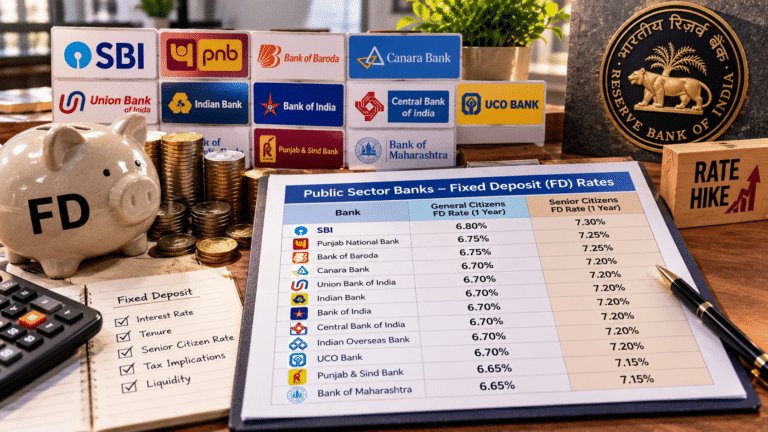
| Punjab & Sind Bank | 7.40% | 500 days | October 20, 2026 |
| Indian Bank | 7.30% | 555 days (Ind Grow) | October 23, 2026 |
| Private banks | |||
| City Union Bank | 7.50% | 556 days to 3 years | October 21, 2026 |
| ICICI Bank | 7.20% | 3 yrs 1 day to 5 yrs | October 23 to 24, 2026 |
| Small finance banks | |||
| Ujjivan SFB | 8.60% | 3 yrs 1 day to 3 yrs 6 months | October 24, 2026 |
| Suryoday SFB | 8.50% | 5 years | October 22, 2026 |
| Jana SFB | 8.30% | 3 years (1,095 days) | October 22, 2026 |
What 7.20% Becomes After Tax
A quoted rate is the start of the calculation, not the end. Indian banks compound cumulative FDs quarterly, so ₹5 lakh at 7.20% for five years grows to ₹7,14,374, an effective annual yield of 7.40%. But FD interest is taxed at your slab rate, every year, as it accrues, even when nothing is paid out until maturity.
Senior citizens have two advantages. The TDS threshold is ₹1 lakh of interest per bank per financial year, double the ₹50,000 for others. And under the old tax regime, Section 80TTB lets seniors deduct up to ₹50,000 of bank interest. Under the new regime, which is now the default, that deduction is not available.
| Depositor and regime | Rate | Slab | Post-tax yield | Real return at 5.2% inflation |
|---|---|---|---|---|
| Senior, old regime | 7.20% | 5% | 7.24% | +2.04% |
| Senior, old regime | 7.20% | 30% | 6.47% | +1.27% |
| Senior, new regime | 7.20% | 20% | 5.92% | +0.72% |
| Senior, new regime | 7.20% | 30% | 5.18% | −0.02% |
| General, new regime | 6.60% | 20% | 5.41% | +0.21% |
| General, new regime | 6.60% | 30% | 4.74% | −0.46% |
The ₹5 Lakh Line That 8.5% Can Cross
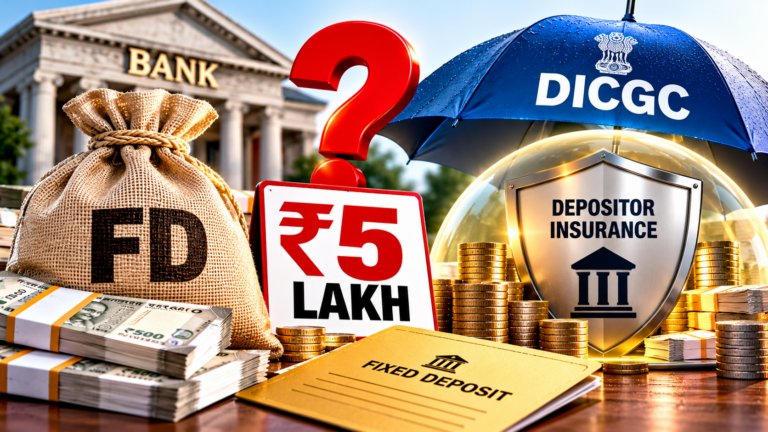
Small finance bank deposits are insured by DICGC exactly as large-bank deposits are, up to ₹5 lakh per depositor per bank. The catch is that the limit covers principal and interest together. A high rate pushes the balance past the limit faster.
₹5 lakh at Suryoday’s 8.50% for five years matures at ₹7,61,397. Only ₹5 lakh of that would be insured. To keep a five-year deposit’s maturity value within the cover at 8.50%, the starting principal would need to be about ₹3.28 lakh. At ICICI’s 7.20%, the equivalent is about ₹3.50 lakh, though the risk profile of a large private bank is very different.
Breaking an FD Early Costs More Than You Think
With rates rising, some savers are tempted to break an old FD and rebook at the new rate. Breaking early does not simply forfeit future interest. The bank re-prices the whole deposit at the card rate for the period actually held, and then deducts a penalty.
Consider ₹5 lakh booked at 7.20% for five years and broken after one year. If the one-year card rate is 6.75% and the penalty is 1%, the bank pays 5.75% for that year. The saver receives about ₹5,29,376 instead of ₹5,36,984, a cost of ₹7,608. A 10 or 15 basis point hike rarely recovers that loss. For short-term cash needs, a loan or overdraft against the FD is often cheaper than breaking it.
| Line on the rate card | What it really means |
|---|---|
| Below ₹3 crore | Retail rate; larger deposits are priced separately |
| Special or limited period | Can be withdrawn without notice; book before it closes |
| 3 yrs 1 day to 5 yrs | The band where ICICI’s peak senior rate sits |
| Senior citizen (60+) | Usually 50 bps extra; resident deposits only |
| Cumulative | Interest compounds quarterly; higher effective yield |
| Non-cumulative or payout | Pays the quoted rate, not the compounded yield |
| Premature withdrawal penalty | Charged on top of re-pricing to the shorter tenure |
| Tax-saver FD | 5-year lock-in, no early withdrawal, old regime only |
Monthly Income or One Lump Sum at the End?
Most senior citizens use FDs for one of two jobs: steady income to cover monthly expenses, or a safe place to park a lump sum for a known future need. The choice between a payout deposit and a cumulative one follows from that job, and it changes the return you actually see.
Payout deposits pay the quoted rate
A non-cumulative deposit pays interest out monthly or quarterly, so nothing compounds inside the deposit. ₹10 lakh at 7.20% paid quarterly gives about ₹18,000 every three months. Monthly payout versions are sometimes quoted at a slightly lower rate, because the bank pays out sooner. This suits retirees who need regular cash, but the effective yield is the quoted 7.20%, not 7.40%.
Cumulative deposits compound, but tax still bites every year
A cumulative deposit reinvests interest each quarter, which is why ₹5 lakh at 7.20% reaches ₹7,14,374 in five years. What people often get wrong is assuming the tax is due only at maturity. Interest is taxable as it accrues, each year, and appears in your Annual Information Statement. A senior who declares five years of interest only in the maturity year risks a mismatch notice.
What This Hike Does and Does Not Tell You
RBI’s move to calibrated tightening means the central bank is more concerned about inflation than it was a few months ago. Mechanically, a higher policy rate raises banks’ cost of funds, and deposit rates tend to follow, usually with a lag and unevenly across banks. October’s moves, of 10 basis points at ICICI and 15 at Indian Bank, show how cautiously large banks are adjusting.
It does not tell you where rates will be in six months. Nobody can promise that waiting will earn more, or that booking now locks in a peak. That uncertainty is the practical case for laddering and for choosing tenures to fit your needs rather than to guess the rate cycle.
It also helps to compare like with like. A gross FD rate cannot be set against a post-tax return from another product. For senior citizens, government-backed options such as the Senior Citizens’ Savings Scheme are worth comparing on the same basis, using current rates from official sources, the same tax treatment and the same lock-in.
A Five-Step Way to Choose Your Deposit
Before You Book: Rate Card Checklist
Frequently Asked Questions
What is ICICI Bank’s highest FD rate for senior citizens now?
After the October 2026 revision, ICICI Bank’s highest senior citizen rate is 7.20% for 3 years 1 day to 5 years, on deposits below ₹3 crore. The general rate for the same band is 6.60%. Rates for tenures up to 2 years were not changed.
What is the new Indian Bank FD rate for senior citizens?
Indian Bank’s 555-day Ind Grow deposit now pays seniors 7.30%, and its 777-day Ind Prosper deposit pays 7.25%, from October 23, 2026. General rates are 6.80% and 6.75%. These are special schemes with no published end date.
Which bank gives 8.5% FD interest to senior citizens?
In the week ending October 24, 2026, Suryoday Small Finance Bank offered seniors 8.50% on 5-year deposits, and Ujjivan Small Finance Bank 8.60% on 3 years 1 day to 3 years 6 months. Neither ICICI Bank nor Indian Bank offers 8.5%. Verify rates on each bank’s website before booking.
Are small finance bank FDs safe for senior citizens?
Small finance banks are licensed and regulated by RBI, and their deposits are insured by DICGC up to ₹5 lakh per depositor per bank, including interest. Above that limit, the deposit carries credit risk. Spreading money across banks keeps more of it within insurance.
How much tax do senior citizens pay on FD interest?
FD interest is taxed at your slab rate each year as it accrues. Under the old regime, seniors can deduct up to ₹50,000 of bank interest under Section 80TTB; this is not available in the new regime. Banks deduct TDS only if interest exceeds ₹1 lakh per bank in a financial year for seniors.
Should I break my old FD to get the new higher rate?
Usually not for a small hike. Breaking early re-prices the deposit to the shorter tenure’s rate and adds a penalty. In our example, breaking a ₹5 lakh, 7.20% FD after one year costs about ₹7,608, which a 10 to 15 basis point increase rarely recovers.
Why did banks raise FD rates in October 2026?
RBI raised the repo rate by 25 basis points to 5.50% on October 7, 2026, citing rising inflation, and moved to a calibrated tightening stance. Banks typically raise deposit rates as their funding costs rise and they compete for deposits.
What replaced Form 15H for senior citizens?
Under the Income-tax Act, 2025, effective April 1, 2026, Forms 15G and 15H have been replaced by a single declaration, Form 121. Seniors whose total income is below the taxable limit can submit it to each bank at the start of the financial year to avoid TDS.
The Short Version
ICICI Bank and Indian Bank raised FD rates on October 23, 2026, after RBI lifted the repo rate to 5.50%. Seniors now get up to 7.20% at ICICI, for 3 years 1 day to 5 years, and 7.30% at Indian Bank on a 555-day special deposit. The 8.5% headline belongs to small finance banks such as Suryoday. After tax, a 7.20% deposit can return anywhere from 7.24% to 5.18% depending on regime and slab. Pick the right tenure band, check your tax regime, and keep each bank’s balance within DICGC’s ₹5 lakh cover.