Are Cheque Book Rules Changing From 1 January 2027? RBI Says the Viral Message Is Fake — What Actually Applies to Your Cheques
Banking · Fact check · Cheques · November 2026
Are Cheque Book Rules Changing From 1 January 2027? RBI Says the Viral Message Is Fake — What Actually Applies to Your Cheques
On 7 November 2026, the RBI called a viral claim of new CTS cheque books from 1 January 2027 “factually incorrect and misleading”. Existing cheque books remain valid. The real changes are faster clearing and Positive Pay for large cheques.
The forward arrived in family WhatsApp groups with an official-looking list: new cheque books with alphanumeric codes and hidden UV marks from 1 January 2027, old leaves capped at ₹50,000, one bank already issuing the new books. Some people started asking their branch for a fresh book. They did not need to. The Reserve Bank of India says it is not introducing any such measure. But the episode is a useful moment to check what has genuinely changed for cheque users in the past year, because some of it affects how fast your money arrives and whether a large cheque gets paid at all.
What the viral message claimed, and what RBI said
Outlook Money reported that the message claimed standard CTS cheque books would change from 31 December 2026, with new books effective from 1 January 2027. It said existing leaves would be accepted only for payments up to ₹50,000, and that Bank of Baroda had supposedly already started issuing the new books.
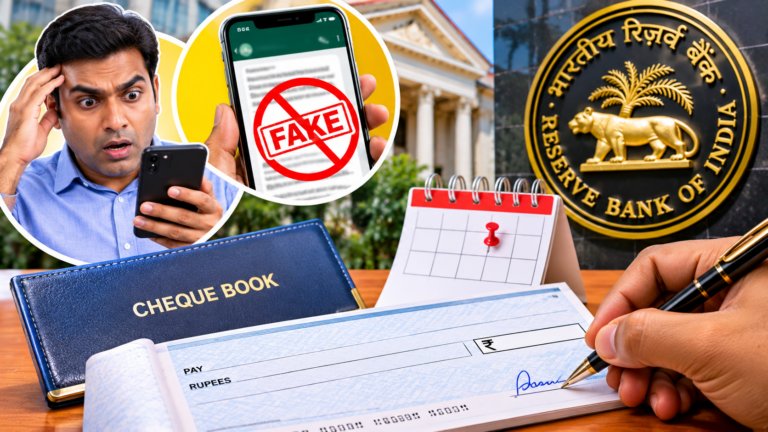
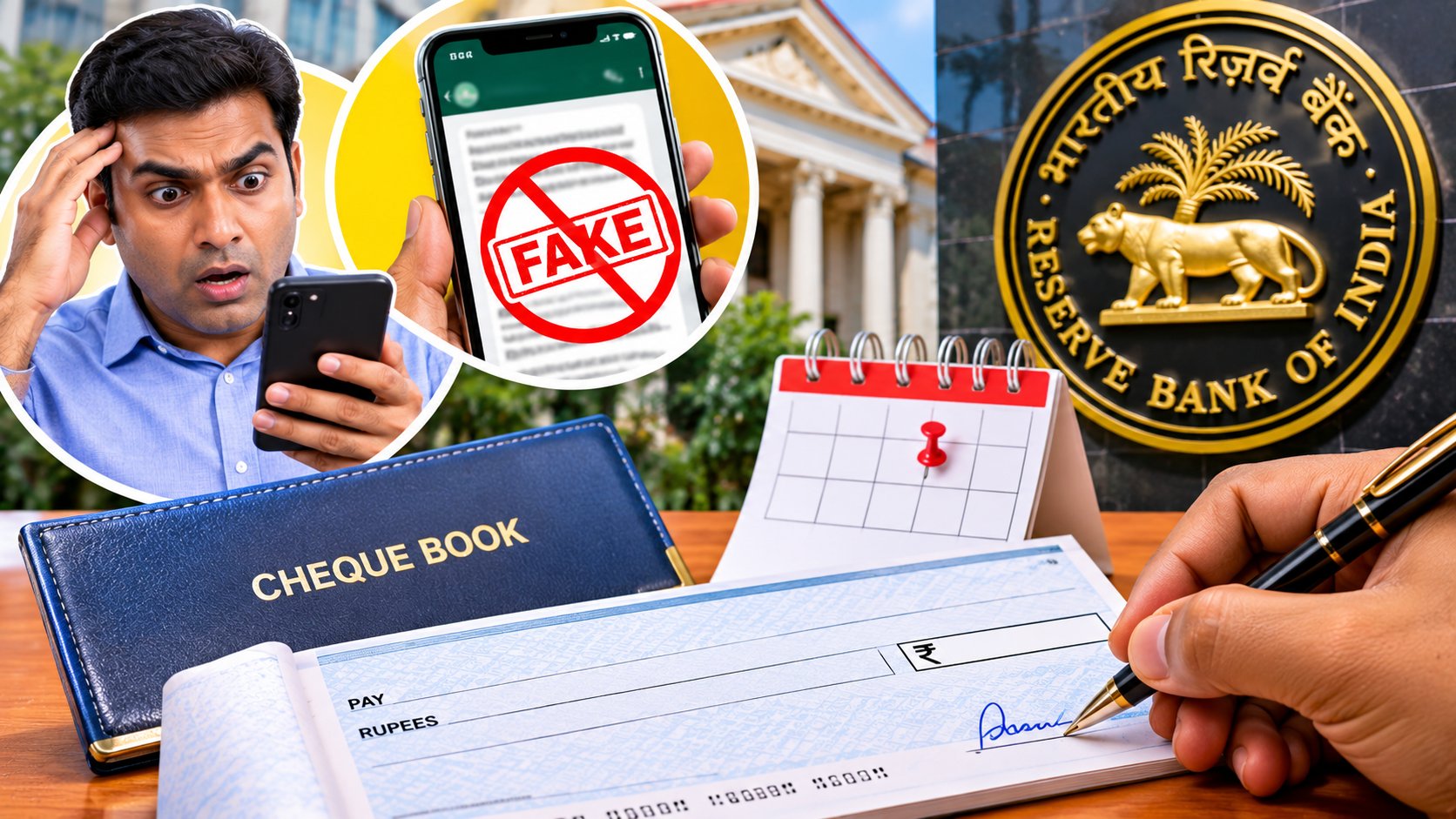
The RBI responded on X. “At present, the Reserve Bank of India is not introducing any such measures with regard to the CTS cheque books,” it said, attaching an image of the message marked as fake and advising people to rely only on information it publishes. Daijiworld and The Hawk reported the statement on 7 November.
- CLAIMExisting CTS cheque books become invalid after 31 December 2026FALSE
- CLAIMOld leaves accepted only for payments up to ₹50,000 from 1 January 2027FALSE
- CLAIMNew books with alphanumeric codes, improved MICR lines and hidden UV codesFALSE
- CLAIMEach cheque leaf to be linked directly to the RBI systemFALSE
- CLAIMOne bank already issuing the new books, with others to followFALSE
“False” here means the RBI has not announced any such rule. Eletsonline noted the denial was backed by PIB Fact Check, giving banks a clear official line that there is no cheque book overhaul from 1 January 2027.
What people get wrong: assuming that a message naming a specific bank and listing technical features must be genuine. Fake banking forwards often borrow real terms like CTS, MICR and UV printing to look credible. A real change to cheque standards would come through an RBI circular on rbi.org.in and a notice from your own bank.
Cheques are shrinking, but still carry serious money
The rumour spread partly because cheques still matter. RBI’s Payment System Indicators show 5,587.83 lakh cheques cleared through CTS in FY 2025-26, worth ₹71.48 lakh crore. Volume fell about 8.3% from FY 2024-25, our calculation, while value was almost unchanged.
- 55.9 croreCheques cleared through CTS in FY 2025-26
- ₹71.48 lakh crValue of those cheques
- ₹1.28 lakhAverage cheque value, our calculation
- -8.3%Fall in cheque volume from FY 2024-25
- 432UPI transactions for every cheque in FY 2025-26
- 6.8%Cheques’ share of retail payment value
RBI Payment System Indicators. Averages, shares and ratios are our calculations from the published volume and value data.
The pattern is clear: cheques are rare but large. They are used for rent deposits, property payments, business bills and loan instalments, which is why fraud prevention around them gets attention.
Lakh cheques. Source: RBI Payment System Indicators, provisional data.
The real change: same-day cheque clearing
The genuine cheque reform began on 4 October 2025. Under an RBI circular of 13 August 2025, the Cheque Truncation System moved from batch processing to continuous clearing with settlement on realisation. Bank of Maharashtra’s customer notice said this replaced a cycle that could take up to two working days with one that clears cheques within a few hours.
- 9 AM-3 PMPresentationYour bank scans and sends the cheque image during the day.
- 9 AM-7 PMConfirmationThe payer’s bank approves or rejects it.
- 7 PMDeemed approvedCheques not confirmed by then are treated as approved.
- Same daySettlementFunds move once the cheque is realised.
The timings above are the revised ones. Business Standard reported that when the RBI postponed the next phase in December 2025, it changed the presentation session to 9 AM to 3 PM and the confirmation session to 9 AM to 7 PM, with 7 PM as the expiry time for all cheques.
The 3-hour phase that has not arrived
Phase 2 was meant to start on 3 January 2026. It would have required banks to approve or reject each cheque within three hours of receiving its image. In a circular of 24 December 2025, the RBI said Phase 2 was “being postponed, until further notice, to allow more time for banks to streamline their operations”, Business Today reported. As of this update, we found no announcement of a new date.
Worked example: a cheque deposited at 10:30 AM. Under the current Phase 1 rules, the payer’s bank has until 7 PM the same day to confirm it, or it is deemed approved, so the money normally reaches you that day. Under the planned Phase 2, a cheque received between 10 and 11 AM would have had to be confirmed by 2 PM, according to the RBI’s original example. So Phase 2 would save a few hours, not days. The big gain, from up to two working days to the same day, has already happened.
Positive Pay: the rule that can actually stop your cheque
If any cheque rule deserves attention, it is this one. Under Positive Pay, introduced by RBI from January 2021, the person writing a cheque shares its key details, such as date, payee, amount and cheque number, with their bank in advance. When the cheque is presented, the bank matches the details. The RBI’s FAQ says banks should enable it for cheques of ₹50,000 and above and “may consider making it mandatory in case of cheques for amounts of ₹5,00,000 and above”.
Several banks have done exactly that. Canara Bank’s notice says Positive Pay is mandatory for cheques of ₹5 lakh and above, phased in from ₹1 crore by 31 August 2025, to ₹25 lakh by 30 September and ₹5 lakh by 15 October 2025. It warns that failing to submit the details before presentation “will lead to dishonour of the cheque”, with return charges.
₹ per cheque. RBI FAQ for the ₹50,000 and ₹5 lakh levels; Canara Bank notice for the phased mandatory thresholds. Other banks’ thresholds may differ.
Why it matters to you: the RBI says only cheques registered under Positive Pay are eligible under its dispute resolution mechanism. Registering a large cheque takes a minute on net banking or the app, is free at banks such as Canara, and protects both you and the payee from tampering.
Cheque rules that already apply every day
While nothing changes on 1 January, a few long-standing rules catch people out. A cheque is valid for three months from the date written on it; after that, banks treat it as stale and will not pay it. Canara Bank’s Positive Pay notice applies the same three-month window to registered cheques.
The RBI’s CTS FAQ warns that cheques with alterations or corrections are not accepted under the system. If you make a mistake on a large cheque, cancel the leaf and write a fresh one rather than overwriting. The FAQ also notes that the RBI has not prescribed specific ink colours, despite forwards that periodically claim otherwise.
When a cheque bounces
A cheque returned for insufficient funds can lead to a criminal complaint under Section 138 of the Negotiable Instruments Act. The payee must send a legal notice within 30 days of the return memo, and the issuer then has 15 days to pay. Positive Pay mismatches and missing registrations can also cause returns, with bank charges, so the cheapest protection is to register the cheque and keep enough balance.
Rumour against reality, side by side
| Topic | Viral message | Actual position | Source | What you should do |
|---|---|---|---|---|
| Validity of current book | Ends 31 Dec 2026 | Remains valid | RBI, 7 Nov 2026 | Keep using it |
| ₹50,000 cap on old leaves | From 1 Jan 2027 | No such cap | RBI, PIB Fact Check | Ignore the forward |
| New security features | UV codes, new MICR | No new measure announced | RBI | No new book needed |
| Clearing speed | Not mentioned | Same day since 4 Oct 2025 | RBI circular, 13 Aug 2025 | Deposit before 3 PM |
| 3-hour clearing | Not mentioned | Postponed until further notice | RBI circular, 24 Dec 2025 | Expect same-day, not 3-hour |
| Large cheques | Not mentioned | Positive Pay, often mandatory at ₹5 lakh+ | RBI FAQ, bank notices | Register details before issuing |
How the cheque rules really evolved
- RBI announces the Positive Pay System for CTS.
- Positive Pay goes live for cheques of ₹50,000 and above.
- RBI announces continuous clearing in two phases.
- Phase 1 starts: same-day clearing, 7 PM confirmation deadline.
- Canara Bank makes Positive Pay mandatory from ₹5 lakh.
- Phase 2, the 3-hour window, postponed until further notice.
- Fake cheque book message spreads on social media.
- RBI and PIB Fact Check call the message fake.
- No change to CTS cheque books is scheduled.
How to spot a fake banking rule
- Check rbi.org.in for a circular with a number and date
- Look for a notice on your own bank’s website or app
- Be wary of forwards with no link to an official source
- Treat “from 1 January” deadlines with suspicion
- Check PIB Fact Check on X before forwarding
- Never share account details to “upgrade” a cheque book
- Register cheques of ₹50,000 and above under Positive Pay
- Use only CTS-compliant leaves your bank issued
- Deposit cheques by 3 PM for same-day presentation
- Report suspicious calls offering new cheque books to 1930
Scammers sometimes follow viral rumours with calls offering to “replace” cheque books in exchange for account details or OTPs. No genuine bank asks for an OTP to issue a cheque book.
Cheque rule questions people are searching
Are cheque book rules changing from 1 January 2027?
No. The RBI said on 7 November 2026 that it is not introducing any such measures for CTS cheque books and called the viral message factually incorrect and misleading.
Will my old cheque book become invalid after 31 December 2026?
No. Existing CTS cheque books remain valid. There is no RBI directive asking customers to replace them.
Is there a ₹50,000 limit on cheques from 2027?
No. That claim came from the fake message. The RBI has announced no such limit.
How fast do cheques clear now?
On the same day. Since 4 October 2025, cheques are presented between 9 AM and 3 PM and must be confirmed by 7 PM, or they are deemed approved.
What happened to 3-hour cheque clearing?
The RBI postponed Phase 2, which would have required confirmation within three hours, on 24 December 2025 until further notice.
What is Positive Pay for cheques?
A system where you share a cheque’s date, amount, payee and number with your bank before it is presented. RBI asks banks to enable it from ₹50,000 and lets them make it mandatory from ₹5 lakh.
Can a cheque bounce if I do not use Positive Pay?
At banks that have made it mandatory for large cheques, yes. Canara Bank, for example, says missing details will lead to dishonour of cheques of ₹5 lakh and above.
How can I check whether a banking rule is real?
Look for an RBI circular on rbi.org.in, a notice from your bank, or a PIB Fact Check post. Forwards without an official source should not be trusted.
The short version
There is no new cheque book rule from 1 January 2027. The RBI called the viral message fake on 7 November 2026, and PIB Fact Check agreed. Your CTS cheque book stays valid, with no ₹50,000 cap. What has really changed is speed and safety: cheques now clear on the same day, the planned 3-hour phase is on hold, and many banks require Positive Pay details for cheques of ₹5 lakh and above. Register large cheques, deposit before 3 PM, and check rbi.org.in before believing the next forward.