Google Pay Flex Credit Card
Google Pay Flex Credit Card Changes: Is 3.2% Back Worth It — and Who Actually Gets It After 16 October?
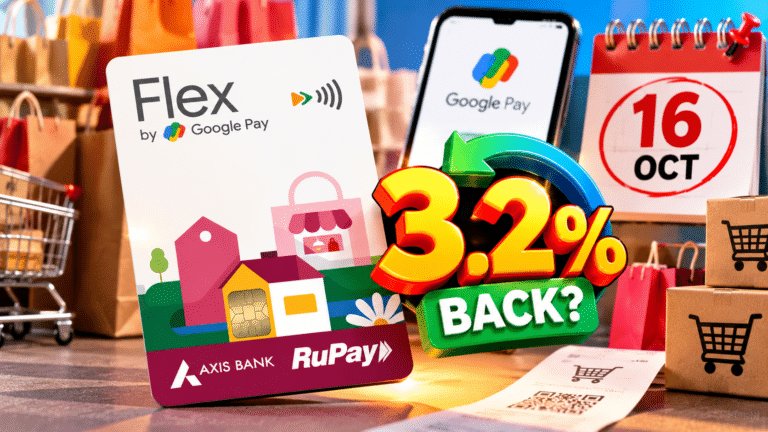
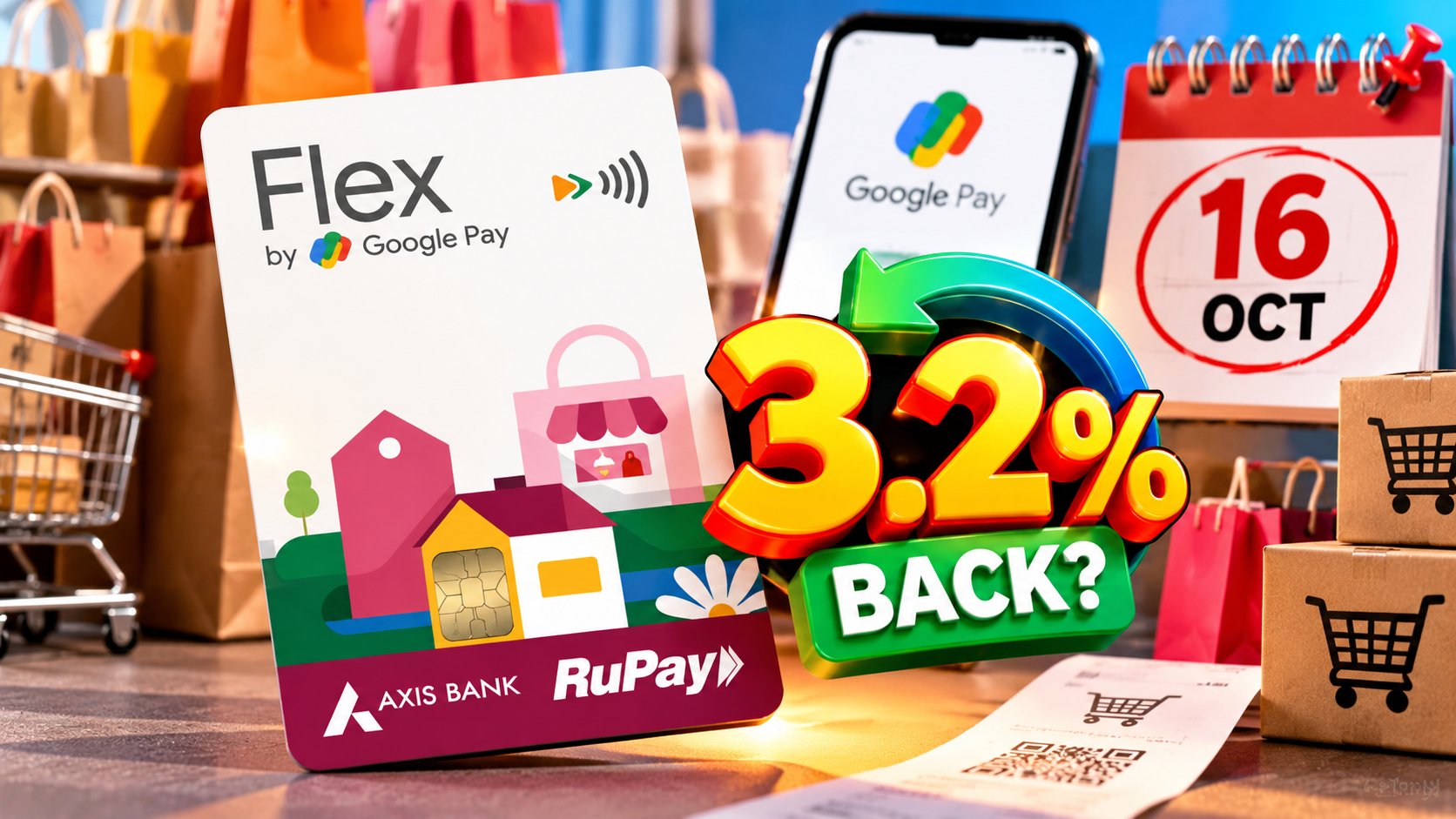
Flex by Google Pay quadrupled its top reward rate from 16 October 2026. Non-members now earn 0.8% to 1.6% back in Stars, and Google One members 1.6% to 3.2%. Every cycle is still capped at ₹1,500, and the Stars can only be spent inside Google Pay.
If you use Google Pay’s Flex card to scan UPI codes at the grocery store, your reward rate changed last week, and probably for the better. Before 16 October, Flex paid as little as 0.4% back on everyday spending, which most cardholders barely noticed. Now the same card can pay up to 3.2%, eight times as much, and Google is advertising first-year savings of up to ₹35,000.
The headline rate is real, but it has three conditions attached: you need a paid Google One subscription, you need to spend more than ₹15,000 in a reward cycle, and you cannot earn more than ₹1,500 in any cycle. There is also a cliff at ₹15,000 that can double or halve your rewards for a single rupee of spending. Here is how the new structure works, who benefits, and how to calculate your own number.
Quick Summary
The change is a real upgrade, but 3.2% is the ceiling, not the norm. From 16 October 2026, Flex pays 0.8% back on cycles below ₹15,000 and 1.6% above it. Google One members get double: 1.6% and 3.2%. Crossing ₹15,000 lifts the rate on the whole cycle’s spending, not just the excess. Rewards are capped at 1,500 Stars, worth ₹1,500, per cycle, which a Google One member reaches at about ₹46,875 of spend. Stars are worth ₹1 each but can only be used on Flex payments or vouchers inside Google Pay, and expire after a year.
What We Know
- The revised rewards apply from 16 October 2026, with reward cycles running from the 16th to the 15th.
- Rates are 0.8% and 1.6% for non-members and 1.6% and 3.2% for Google One members, either side of ₹15,000.
- Rates halve for a cycle if the previous cycle’s eligible spend was below ₹100.
- Google One members get extra Stars on bills and on food and grocery apps, within the same ₹1,500 cap.
- Flex is issued by Axis Bank and, since 29 July 2026, by SBI Card.
What Is Still Unclear
- How long the boosted rates will last; Google One member benefits are stated as valid until 15 October 2027, subject to extension.
- When the ₹1,000 referral reward, announced as coming soon, will start.
- When the Pixel and Fitbit discount will reach Flex SBI Card holders.
- Whether the issuers’ own terms documents have been fully updated to match Google’s help page.
What Flex Is, and Why Google Wants You Using It at the Kirana Shop
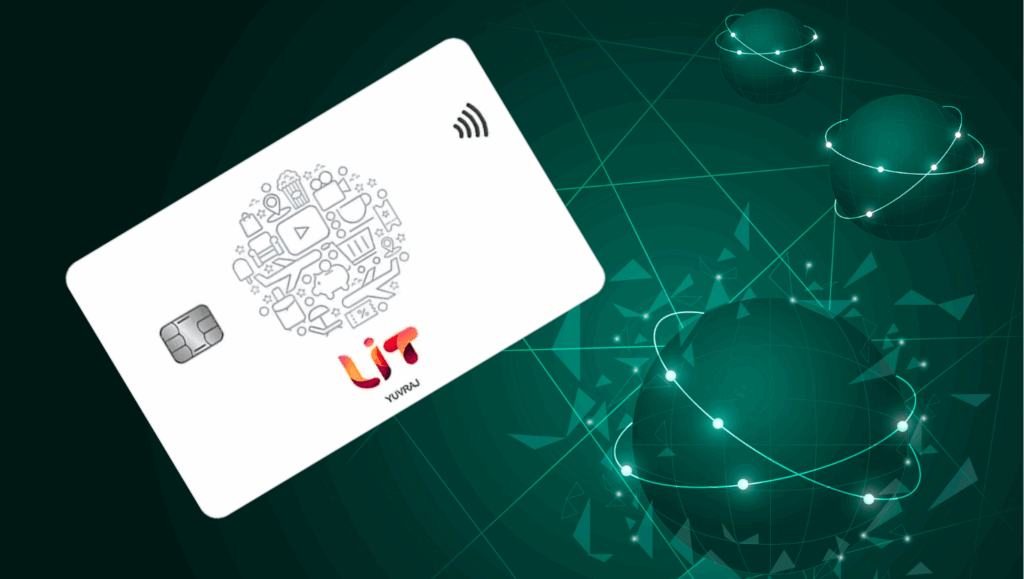
Flex by Google Pay is a co-branded credit card issued digitally inside the Google Pay app. TechCrunch reported its announcement with Axis Bank in December 2025, on the RuPay network so it can be linked to UPI. Google’s India blog said on 29 July 2026 that SBI Card had joined as a second issuer, on both RuPay and Visa, and that adoption had been strong.
The strategy is clear from the numbers Google shared with TechCrunch. More than 530 million people have made at least one payment through Google Pay, but fewer than 50 million Indians hold a credit card. A credit card that works by scanning the same QR codes people already use is Google’s way to turn UPI habits into credit, and the new rewards are designed to make Flex the default way to pay.
Fact box: Stars are not cashback
Each Star is worth ₹1, but Google’s help page says Stars can only be redeemed on Flex payments made within Google Pay or towards vouchers in its gift card store. They cannot be cashed out or used elsewhere, and they expire one year after they are earned. For a voucher, 100 Stars take ₹100 off a ₹1,000 voucher, so you pay ₹900.
The Four Reward Rates, and the One That Halves Them
The new structure depends on two questions: are you a Google One member, and did your cycle spend cross ₹15,000? A third rule halves every rate if you were inactive the previous cycle.
| Cardholder | Cycle spend up to ₹15,000 | Cycle spend above ₹15,000 | If previous cycle under ₹100 |
|---|---|---|---|
| Before 16 Oct, as reported | 0.4% | 0.8% | Not applicable |
| Non-member, from 16 Oct | 0.8% | 1.6% | 0.4% or 0.8% |
| Google One member, from 16 Oct | 1.6% | 3.2% | 0.8% or 1.6% |
| Google One family member | 0.8% | 1.6% | 0.4% or 0.8% |
| Google One billed via a partner | 0.8% | 1.6% | 0.4% or 0.8% |
Two groups miss out on the Google One rates even though they have the subscription: members of a Google One family group, and members billed through third-party partners such as telecom bundles, according to Google’s help page. If you get Google One through a mobile plan, check whether you qualify before assuming 3.2%.
The ₹15,000 Cliff: One Rupee That Can Double Your Rewards
The most important detail is easy to miss. When your total cycle spend crosses ₹15,000, the higher rate applies to the entire cycle, not just to the amount above ₹15,000. That creates a cliff: the rewards on ₹15,100 of spending are more than double those on ₹14,900.
For a Google One member who has spent ₹14,900 by the 14th of the month, a ₹200 purchase before the cycle closes on the 15th is worth an extra ₹245 in Stars. For a non-member, the jump is from about ₹119 to ₹242. The threshold also resets every cycle, so one quiet month drops you back to the lower rate.
What cardholders often get wrong
Excluded spending does not count towards the ₹15,000. Google’s help page lists insurance, rent, wallet loads, education, government services, jewellery, cash withdrawals and payments converted to EMI as earning nothing and not counting towards cycle milestones. Converting even part of a purchase to EMI cancels rewards for the whole payment. A month with a large rent or insurance payment can look like ₹20,000 of spending and still leave you below the threshold.
What You Will Actually Earn at Seven Spending Levels
The table compares the old rates with the new ones for non-members and Google One members, with the ₹1,500 cycle cap applied. The last column adds the maximum Google One category bonuses, ₹450 on bills and ₹250 on food and grocery apps, where spending is high enough to qualify.
| Cycle spend | Before 16 Oct | Non-member now | Google One now | Google One with bonuses |
|---|---|---|---|---|
| ₹5,000 | ₹20 | ₹40 | ₹80 | Not reachable |
| ₹10,000 | ₹40 | ₹80 | ₹160 | ₹860 |
| ₹14,900 | ₹60 | ₹119 | ₹238 | ₹938 |
| ₹15,100 | ₹121 | ₹242 | ₹483 | ₹1,183 |
| ₹25,000 | ₹200 | ₹400 | ₹800 | ₹1,500, capped |
| ₹40,000 | ₹320 | ₹640 | ₹1,280 | ₹1,500, capped |
| ₹60,000 | ₹480 | ₹960 | ₹1,500, capped | ₹1,500, capped |
Bonuses assume at least ₹3,000 on eligible bills and ₹5,000 on listed food and grocery apps within the cycle, so they cannot apply at ₹5,000 total spend. All figures assume the previous cycle had at least ₹100 of eligible spend. Our calculations; indicative.
Worked example: Kavya’s monthly UPI spending
Kavya, a Google One member, spends ₹18,000 a cycle on Flex: ₹3,000 on electricity, mobile and broadband bills, ₹6,000 on Swiggy, Zepto and Blinkit, and ₹9,000 at local shops by scanning UPI codes. Because she crosses ₹15,000, she earns 3.2% on all ₹18,000, which is ₹576. Her bills qualify for the ₹450 bonus and her food and grocery spending for the ₹250 bonus, taking her to ₹1,276 in Stars, about 7.1% of her spending. Over a year, that is about ₹15,300, against ₹708 for twelve months of Google One at ₹59. Without Google One, she would earn 1.6%, or ₹288 a cycle, about ₹3,460 a year.
Where the ₹1,500 Cap Bites, and How Google Gets to ₹35,000
Every reward on Flex, including the category bonuses and milestone Stars, sits under one ceiling of 1,500 Stars per cycle. Google’s help page also limits instant credit to 300 Stars a day, with any excess credited 24 to 48 hours after settlement. The higher your rate, the sooner you hit the ceiling, and beyond it each extra rupee of spending earns nothing.
The practical message is that a Google One member who uses Flex for bills and groceries gets maximum value at about ₹25,000 a cycle. Spending beyond that on Flex earns no further Stars that cycle, so a second card with uncapped rewards becomes the better choice for anything extra, such as a large electronics purchase.
Unpacking the “up to ₹35,000 a year” promise
FoneArena’s report of Google’s announcement mentions potential first-year savings of up to ₹35,000. That figure is a sum of the maximum of everything: 12 cycles at the ₹1,500 cap make ₹18,000; welcome rewards add up to ₹2,500; the first-two-month bonus adds ₹1,000; the Google One AI Plus discount is worth up to about ₹3,900; and the Pixel or Fitbit discount is worth up to ₹10,000. Together that is about ₹35,400. Most people will not buy a Pixel or hit the cap every month, so a realistic first-year figure for a typical member is far lower, closer to the ₹15,000 in our worked example.
That still compares well with many entry-level cards. But it rests on Stars that can only be spent inside Google Pay, so the value is real only if you keep using Flex.
Axis or SBI: The Same Rewards, Different Fine Print
Google’s rewards apply to both issuers, but the cards are not identical. PickMyCard’s review of the issuers’ terms highlights differences in fees, networks and welcome benefits.
| Feature | Flex Axis Bank | Flex SBI Card |
|---|---|---|
| Annual fee | Nil, as reported | ₹499 plus tax, waived at ₹1 lakh a year |
| Network | RuPay | RuPay or Visa; only RuPay links to UPI |
| Welcome rewards | Up to ₹2,000 | Up to ₹2,500 |
| Extra exclusions | Tolls, FASTag and gift cards | Standard list |
| Pixel and Fitbit discount | Up to ₹10,000, live | Coming soon |
| Finance charge on unpaid balance | 3.75% a month | 3.75% a month |
| Forex markup | 3.5% | 3.5% |
For most people, the Axis variant’s lack of an annual fee makes it the simpler choice, unless the larger SBI welcome benefit or Visa acceptance abroad matters to you. Note that Visa variants cannot be used for UPI credit payments, which removes much of the point of a Flex card.
From Launch to the Rewards Reset
Scan, Tap or Swipe: Does How You Pay Change the Stars?
Flex is built to be used by scanning UPI QR codes, but it is a full credit card and can also be tapped or swiped at card machines. According to FoneArena’s report of the change, swipe and tap payments earn the same rewards as UPI payments, and small transactions still earn Stars.
What differs is timing. Google’s help page says Stars on Flex payments made inside Google Pay are credited instantly, with no minimum, while Stars on payments through other apps are credited after the transaction settles. The 300-Stars-a-day instant limit means a big day of spending may see some Stars arrive a day or two later.
There are also limits on what UPI credit can be used for. PickMyCard notes that UPI credit on RuPay cards works only for payments to merchants, not transfers to friends or family, and is subject to a ₹1 lakh daily cap. If a refund comes through later, Google deducts the Stars earned on it and reduces your progress towards the ₹15,000 threshold by the refunded amount, which can drop a cycle below the line after the fact.
Should You Pay ₹59 a Month to Double Your Rewards?
Google One starts at ₹59 a month, or ₹708 a year. Above ₹15,000 a cycle, membership adds 1.6 percentage points to your rate, worth ₹240 or more each cycle, plus up to ₹700 in category bonuses. On those numbers the subscription pays for itself many times over for any regular user. Even below ₹15,000, the extra 0.8% covers ₹59 once you spend about ₹7,400 a cycle.
Six Moves to Get the Most From the New Flex Rewards
- Note your cycle: it runs from the 16th to the 15th, not the calendar month.
- Check in the app whether your Google One plan qualifies; family members and partner-billed plans do not.
- Route eligible bills, recharges and OTT payments through Flex to unlock the ₹450 bonus at ₹3,000.
- Pay listed food and grocery apps by Flex via UPI to reach ₹5,000 and the ₹250 bonus.
- Keep at least ₹100 of eligible spend every cycle so the next cycle’s rates are not halved.
- Redeem Stars within a year, on Flex payments or vouchers, before they expire.
Frequently Asked Questions
What changed in Google Pay Flex rewards from 16 October 2026?
Rates roughly doubled for non-members to 0.8% below ₹15,000 and 1.6% above, and quadrupled at the top for Google One members to 1.6% and 3.2%. Google One members also get bonus Stars on bills and food and grocery apps. The ₹1,500 cycle cap remains.
How do I get 3.2% back on Flex?
You need an eligible Google One membership, more than ₹15,000 of eligible Flex spend in the cycle running from the 16th to the 15th, and at least ₹100 of spend in the previous cycle.
What is the maximum reward on Google Pay Flex?
1,500 Stars, worth ₹1,500, per reward cycle, including category bonuses and milestone Stars. A Google One member reaches it at about ₹46,875 of spend without bonuses.
Can I convert Google Pay Flex Stars to cash?
No. Stars are worth ₹1 each but can only be redeemed on Flex payments within Google Pay or towards vouchers in its gift card store. They expire one year after they are earned.
Does rent or insurance count towards the ₹15,000 threshold?
No. Rent, insurance, education, government services, jewellery, wallet loads, cash withdrawals and EMI-converted payments earn no Stars and do not count towards cycle milestones.
Is the Google Pay Flex card free?
The Axis Bank variant is reported as having no annual fee. The SBI Card variant charges ₹499 plus tax, waived on ₹1 lakh of annual spend. Interest on unpaid balances is 3.75% a month.
Do Google One family members get the higher Flex rates?
No. Google’s help page says Google One family group members and those billed through third-party partners do not qualify for the Google One rates.
Which is better, Flex Axis Bank or Flex SBI Card?
Rewards are the same. Axis is reported as fee-free, while SBI offers a larger welcome benefit of up to ₹2,500 and a Visa option. Only RuPay variants can be used for UPI payments.
The Short Version
Since 16 October 2026, Flex by Google Pay pays 0.8% back in Stars below ₹15,000 a cycle and 1.6% above it, doubled to 1.6% and 3.2% for eligible Google One members, who also get up to ₹700 a cycle in bill and grocery bonuses. Crossing ₹15,000 raises the rate on the whole cycle. Everything is capped at ₹1,500 a cycle, Stars only work inside Google Pay and expire in a year, and excluded spends like rent do not count. For regular UPI users, Google One at ₹59 a month pays for itself easily. Just never carry a balance at 3.75% a month.