DA Is Now 63% — So Why Won't Your HRA Rise This Time, and What Actually Goes Up?
DA Is Now 63% — So Why Won’t Your HRA Rise This Time, and What Actually Goes Up?
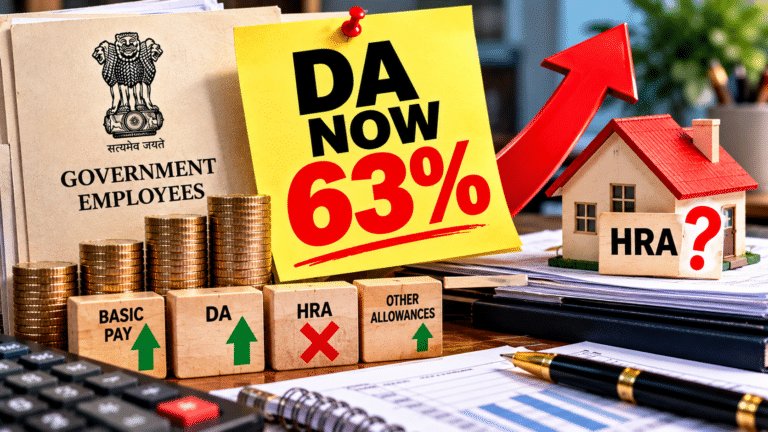
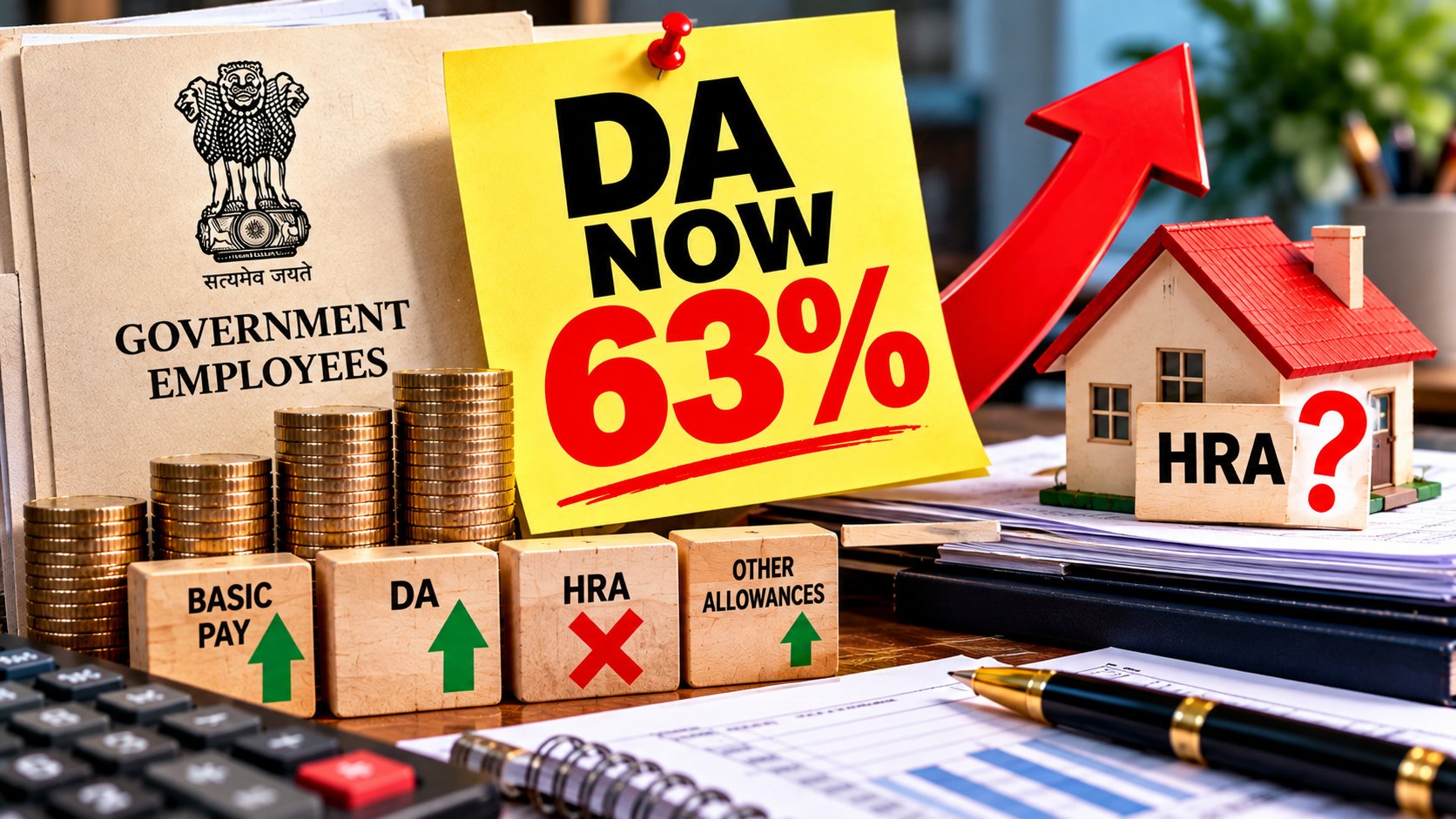
The Union Cabinet raised dearness allowance and dearness relief from 60% to 63% with effect from July 1, 2026. House rent allowance stays at 30%, 20% and 10% of basic pay, because its final DA-linked step was triggered at 50% in January 2024.
The announcement landed on October 28, just ahead of Diwali: a 3 percentage point increase in dearness allowance for central government employees and dearness relief for pensioners, backdated to July 1. Within hours, the same question was being asked in staff WhatsApp groups across the country. If DA has gone up again, does house rent allowance go up with it? Last time DA crossed a milestone, in January 2024, HRA jumped for everyone.
This time the answer is no. Understanding why tells you a lot about how central government pay actually works between pay commissions, which allowances are tied to DA and which are frozen, and what the 8th Pay Commission now has on its plate. It also tells you exactly how much more will reach your bank account, level by level.
What the Cabinet Actually Approved on October 28
According to Business Standard, citing the government’s press release, the Union Cabinet raised DA and DR by 3 percentage points, from 60% to 63% of basic pay and basic pension, effective retrospectively from July 1, 2026. The paper put the beneficiaries at about 48.5 lakh employees and 69 lakh pensioners and the annual cost at ₹10,016 crore. Other reports gave the figures as 48.54 lakh employees and 68.71 lakh pensioners, with a cost of ₹10,016.10 crore.
The increase follows the formula based on the 7th Central Pay Commission’s recommendations, which links DA to the All India Consumer Price Index for Industrial Workers. Revisions take effect twice a year, from January 1 and July 1, though the Cabinet usually approves them a few months later. The previous step, to 60% from January 2026, was approved in April.
The Two-Trigger Rule That Froze Your HRA
The 7th Pay Commission rationalised HRA to 24%, 16% and 8% of basic pay for X, Y and Z cities, and recommended that these rise to 27%, 18% and 9% when DA crossed 50%, and to 30%, 20% and 10% when DA crossed 100%. The government accepted a more generous version. Its Department of Expenditure order of July 7, 2017 (OM No. 2/5/2017-E.II(B)) moved the triggers down to DA of 25% and 50%.
Both triggers have now been used. DA crossed 25% when it was restored to 28% from July 1, 2021, after the pandemic-era freeze, lifting HRA to 27/18/9. It crossed 50% on January 1, 2024, lifting HRA to 30/20/10. The order contains no third step, so DA at 53%, 58%, 63% or even 80% leaves the HRA percentage untouched. Only a new pay commission, implemented by the government, can change it.
What people actually get wrong: many employees believe HRA is a percentage of basic pay plus DA. It is not. HRA is calculated on basic pay alone. So even when DA rises, the base on which HRA is worked out does not change; only an annual increment or a promotion raises the rupee HRA figure.
What Rises With DA and What Stays Put
DA does feed into some other pay components, which is why the “everything goes up” belief persists. The difference lies in whether an allowance is defined as a fixed amount plus DA, as a percentage of basic pay, or as a sum linked to a one-time DA milestone.
Moves with every DA step
- Dearness allowance itself: 3% of basic pay more from July 2026
- Dearness relief on pension: 3% of basic pension more
- Transport allowance, which is paid with DA on top
- NPS and similar contributions that use basic plus DA as their base
Did not move this time
- HRA percentages: frozen at 30/20/10 since January 2024
- Allowances raised by 25% on DA crossing 50% in 2024
- Basic pay and pay matrix cells, until the 8th CPC
- Pension formula of 50% of last basic pay
Transport allowance: the quiet gainer
Transport allowance is the clearest example of an allowance that follows DA. Under the 7th CPC structure, it is paid as a fixed sum plus DA on that sum. The base rates commonly cited for higher transport allowance cities are ₹7,200 for Level 9 and above, ₹3,600 for Levels 3 to 8 and ₹1,350 for Levels 1 and 2. A 3 percentage point DA increase adds 3% of the base sum each month.
| Pay level band (higher TPTA city) | Base transport allowance | With DA at 60% | With DA at 63% | Monthly increase |
|---|---|---|---|---|
| Level 9 and above | ₹7,200 | ₹11,520 | ₹11,736 | ₹216 |
| Levels 3 to 8 | ₹3,600 | ₹5,760 | ₹5,868 | ₹108 |
| Levels 1 and 2 | ₹1,350 | ₹2,160 | ₹2,201 | ₹41 |
| Level 9+ (other cities) | ₹3,600 | ₹5,760 | ₹5,868 | ₹108 |
| Levels 3 to 8 (other cities) | ₹1,800 | ₹2,880 | ₹2,934 | ₹54 |
The base transport allowance rates are as commonly published under the 7th CPC; the DA-inclusive figures are our calculation. Check your own pay slip, since departments and special categories may differ.
Your Level-by-Level Gain, With HRA Alongside
The table shows what the 3 percentage point DA increase means at the entry pay of each level from 1 to 10, and the HRA that stays unchanged. Arrears are shown for four months, July to October, which reports expect to be paid with the November salary. Employees above the entry cell of their level gain proportionally more.
| Level | Entry basic pay | Extra DA a month | Arrears, 4 months | HRA X city (30%) | HRA Y city (20%) | HRA Z city (10%) |
|---|---|---|---|---|---|---|
| 1 | ₹18,000 | ₹540 | ₹2,160 | ₹5,400 | ₹3,600 | ₹1,800 |
| 2 | ₹19,900 | ₹597 | ₹2,388 | ₹5,970 | ₹3,980 | ₹1,990 |
| 3 | ₹21,700 | ₹651 | ₹2,604 | ₹6,510 | ₹4,340 | ₹2,170 |
| 4 | ₹25,500 | ₹765 | ₹3,060 | ₹7,650 | ₹5,100 | ₹2,550 |
| 5 | ₹29,200 | ₹876 | ₹3,504 | ₹8,760 | ₹5,840 | ₹2,920 |
| 6 | ₹35,400 | ₹1,062 | ₹4,248 | ₹10,620 | ₹7,080 | ₹3,540 |
| 7 | ₹44,900 | ₹1,347 | ₹5,388 | ₹13,470 | ₹8,980 | ₹4,490 |
| 8 | ₹47,600 | ₹1,428 | ₹5,712 | ₹14,280 | ₹9,520 | ₹4,760 |
| 9 | ₹53,100 | ₹1,593 | ₹6,372 | ₹15,930 | ₹10,620 | ₹5,310 |
| 10 | ₹56,100 | ₹1,683 | ₹6,732 | ₹16,830 | ₹11,220 | ₹5,610 |
Figures are our calculation using 7th CPC entry pay for each level. HRA columns are identical before and after the DA hike. The ₹540 and ₹876 figures for Levels 1 and 5 match those reported in news coverage of the decision.
The Widening Gap Between DA and HRA
Because DA keeps climbing while HRA is fixed, the share of DA in take-home pay grows every six months. Take a Level 6 employee at entry pay of ₹35,400 in an X city. Their HRA has been ₹10,620 since January 2024. Their DA has risen from ₹17,700 at 50% to ₹22,302 at 63%.
Worked example (our calculation): the same Level 6 employee in Delhi, an X city, gets ₹1,062 more DA a month from July 2026 and ₹4,248 in arrears for July to October. HRA stays at ₹10,620. Transport allowance at the ₹3,600 base rises by ₹108, to ₹5,868. Total monthly gain: ₹1,170. If HRA had followed DA in the same proportion, it would have to rise by about ₹531, but no rule provides for that.
Staff associations have argued that rents in large cities have outpaced a frozen HRA percentage. That argument is now part of the representations before the 8th Pay Commission, as press reports of its stakeholder meetings in August 2026 indicate.
From the 2017 Order to the 8th Pay Commission
- July 7, 2017Department of Expenditure sets HRA at 24/16/8% with steps at DA of 25% and 50%.
- July 1, 2021DA restored to 28% after the pandemic freeze, crossing 25%; HRA moves to 27/18/9%.
- January 1, 2024DA reaches 50%; HRA moves to 30/20/10%, the final step.
- July 1, 2025DA rises to 58%, approved by the Cabinet on October 1, 2025.
- November 3, 2025Finance Ministry notifies terms of reference for the 8th Pay Commission.
- January 1, 2026DA rises to 60%, approved in April 2026.
- August 20268th CPC holds stakeholder interactions in Delhi on August 7 and 10.
- October 28, 2026Cabinet approves DA of 63% with effect from July 1, 2026; HRA unchanged.
- Around May 20278th CPC report due, 18 months after its constitution, as reported.
Your City Class Matters More Than Any DA Step
With HRA percentages frozen, the single biggest lever on the HRA amount is the classification of the city where you are posted. Central government HRA classes follow population: X cities are generally those with a population of 50 lakh or more, Y cities those between 5 lakh and 50 lakh, and Z the rest, based on census figures and the government’s classification orders. Moving from a Y city to an X city lifts HRA from 20% to 30% of basic pay overnight.
For a Level 7 employee at entry pay of ₹44,900, that shift is worth ₹4,490 a month, more than three times the ₹1,347 gained from the latest DA increase. A transfer the other way costs the same amount. This is why HRA questions often have little to do with DA and much more to do with postings, which is worth remembering when weighing a transfer request.
Pensioners and state employees see a different picture
Pensioners do not receive HRA at all, so for them the 63% decision is entirely about dearness relief. On a basic pension of ₹9,000 the increase is ₹270 a month, and on ₹30,000 it is ₹900, according to reported examples. Family pensioners receive the same percentage on their family pension.
State government employees follow their own state’s DA and HRA rules. Many states track the central DA rate with a lag of several months, and some use different HRA triggers or fixed amounts. A central announcement therefore does not by itself change anything on a state employee’s pay slip until the state issues its own order.
Could the 8th Pay Commission Reset HRA?
Every pay commission so far has revised HRA alongside basic pay. When a new pay matrix is introduced, accumulated DA is usually folded into the new basic pay, DA is reset to zero, and HRA percentages are set afresh, often with a new set of DA triggers. The 7th CPC did exactly this, which is why HRA fell from 30/20/10% of the old basic to 24/16/8% of a much higher new basic in 2016.
The same pattern is likely to repeat, though nothing has been announced. A lower HRA percentage on a higher basic pay can still mean more rupees, which is why the headline percentage alone is misleading. The terms of reference cover pay, allowances and allowance rationalisation, so HRA rates and any future DA triggers fall within the commission’s remit.
What to do between now and the next revision
- Check that your November 2026 salary shows DA at 63% and a separate arrears line covering July to October.
- Confirm your city’s HRA classification, since a move between X, Y and Z classes changes HRA far more than any DA step.
- If you are under the old tax regime and live in rented accommodation, keep rent receipts and the landlord’s PAN where annual rent exceeds ₹1 lakh for the HRA exemption.
- Pensioners should look for dearness relief at 63% on basic pension and arrears in their bank’s pension credit.
- Track official orders from the Department of Expenditure rather than social media claims about HRA revisions.
A pay-slip checklist for November
Questions Employees Are Searching For
Will HRA increase after DA becomes 63%?
No. HRA was linked to DA only at the 25% and 50% milestones under the July 2017 order. Both have been crossed, so HRA stays at 30%, 20% and 10% of basic pay for X, Y and Z cities.
When will the 63% DA arrears be paid?
The increase is effective from July 1, 2026. Reports expect arrears for July to October to be paid with the November 2026 salary, once the Department of Expenditure issues its order.
How much will my salary increase with the 3% DA hike?
Your DA rises by 3% of your basic pay each month. At ₹18,000 basic pay, that is ₹540 a month; at ₹35,400, it is ₹1,062; at ₹56,100, it is ₹1,683.
Is HRA calculated on basic pay plus DA?
No. For central government employees, HRA is calculated on basic pay only. A DA increase does not change the HRA amount; annual increments and promotions do.
Do pensioners get the 63% dearness relief?
Yes. Dearness relief for central government pensioners also rises from 60% to 63% of basic pension from July 1, 2026. A ₹9,000 basic pension rises by ₹270 a month.
When will HRA be revised next?
Most likely when the 8th Pay Commission’s recommendations are implemented. Pay commissions usually reset basic pay, restart DA and set new HRA rates. Its report is expected around May 2027, but no implementation date is fixed.
Which allowances increase with DA?
Allowances paid as a fixed amount plus DA, such as transport allowance, rise with every DA increase. Allowances set as a percentage of basic pay, such as HRA, or raised once when DA crossed 50%, do not.
Will DA be merged with basic pay at 50%?
No such merger has happened. DA has continued to rise above 50% under the 7th CPC formula. Any merger would normally come with the 8th Pay Commission’s new pay structure.
The Short Version
DA is now 63% from July 1, 2026, approved on October 28, adding 3% of basic pay a month plus four months of arrears. HRA does not rise, because the 2017 order linked it to DA only at 25% and 50%, both already crossed; it stays at 30%, 20% and 10% of basic pay. Transport allowance, which carries DA, rises slightly. The next real change to HRA is likely to come only with the 8th Pay Commission, whose report is expected around May 2027.