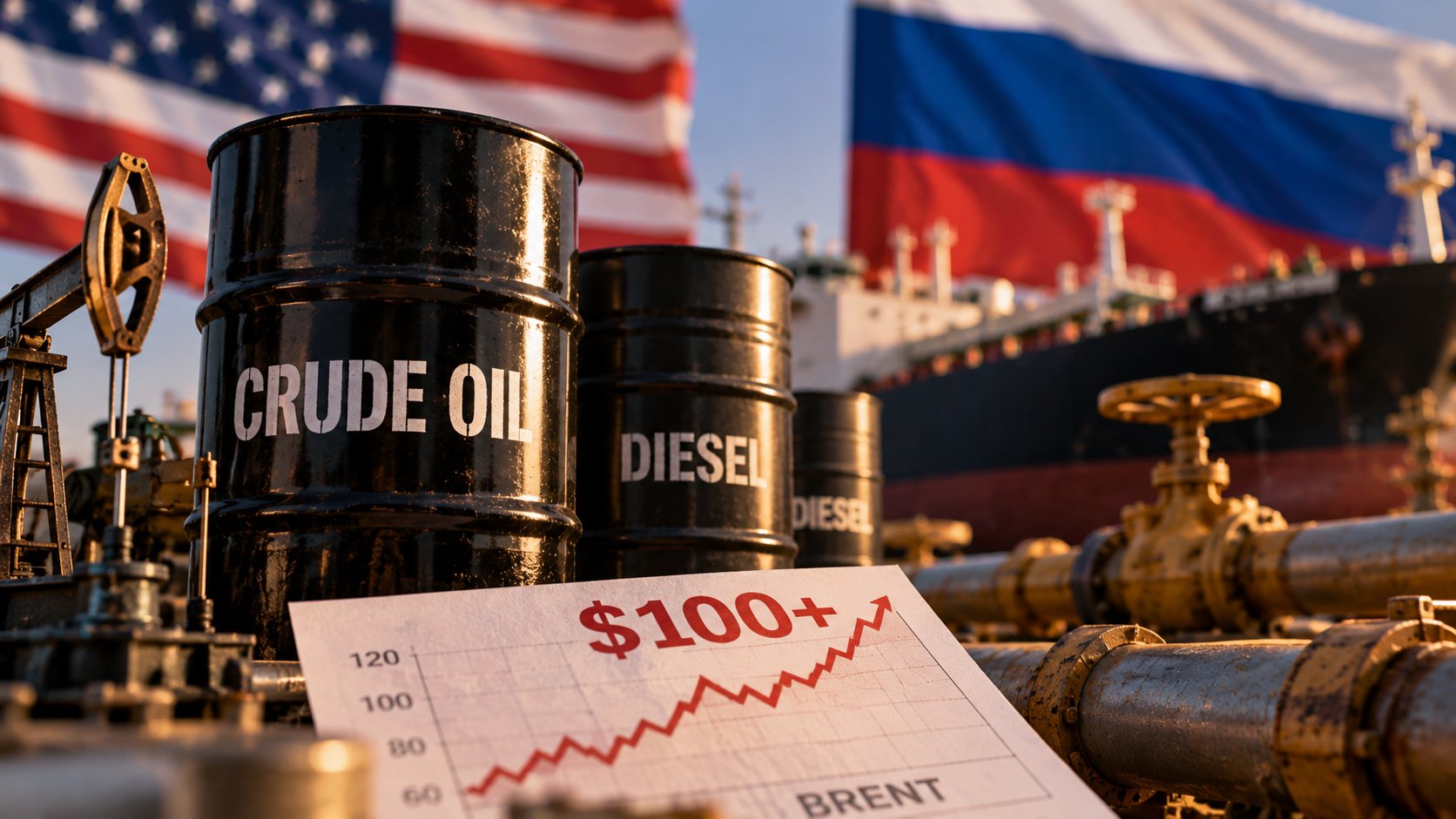
Why Did Trump Ease Sanctions on Russian Diesel — and Why Is Crude Still Above $100?
Energy · Oil Markets · October 2026
Why Did Trump Ease Sanctions on Russian Diesel — and Why Is Crude Still Above $100?
On 9 October 2026, Washington authorised Russian diesel sales until April 2027, a sharp turn after a year of pressure on Russian energy. Brent barely moved, trading between about $103 and $107 a barrel since. Here is why, and what it means for fuel prices and India.
For more than a year, the message from Washington was consistent: buyers of Russian energy would pay a price. The US sanctioned Rosneft and Lukoil, Russia’s two biggest oil companies, in October 2025, and put extra tariffs on Indian goods over India’s Russian crude purchases. Then, on Friday 9 October 2026, President Donald Trump thanked Vladimir Putin and announced that Russian diesel would flow back onto world markets.
The reaction was immediate. Ukraine called it a gift to the Kremlin. Lawmakers in both US parties objected. Yet oil prices, which the move was meant to calm, hardly budged: Brent crude traded at about $104 that day and was back above $106 by Tuesday. To understand why, you have to look at what exactly was eased, how much fuel is involved, and what else is pushing prices up.
What We Know
- On 9 October 2026, the US Treasury issued a temporary general licence allowing the sale, delivery and import of Russian-origin diesel until 7 April 2027.
- Trump said Russia would supply 300,000 tonnes immediately, 500,000 tonnes in November, then 1 million tonnes, with 3 million more to follow.
- On 11 October, Trump announced that Russia and Ukraine had agreed to stop attacking each other’s energy infrastructure.
- Brent closed at $106.65 on 12 October and traded near $105.60 to $106.20 on 13 and 14 October.
What Is Still Unclear
- How the licence fits with the 2022 US law banning Russian oil imports; officials have not explained.
- Whether sanctions on Rosneft and Lukoil crude exports will also be eased.
- Whether the extra US tariffs on India over Russian oil will change.
- Whether the energy ceasefire is holding; Ukraine said attacks continued after it was announced.
A U-Turn, but Only on One Fuel
The word “U-turn” is fair, with a caveat. After a year of tightening, Washington has for the first time actively opened the door to a Russian energy product, and the president personally credited Putin. “I want to thank President Putin, to be honest with you,” Trump said on 9 October, according to the National Herald. Asked whether this would embolden Moscow, he replied: “Well, no; we need oil for the world and this is diesel which is what we need.”
The caveat is scope. The licence reported by RFE/RL and others covers diesel, a refined fuel, not crude oil. It is temporary, running about six months. And it sits alongside new legislation Trump signed weeks earlier that lets the administration impose tariffs of up to 100% on countries buying Russian oil and gas. Washington is now easing one product while keeping the power to punish others for buying Russian crude.
Why diesel, and why now
Diesel is the fuel that moves trucks, ships, farm machinery and much of industry, so its price feeds directly into the cost of food and goods. RFE/RL reported that diesel futures were still more than 110% higher than at the start of the year even after falling about 4% on the announcement. US diesel hit a record $6.52 a gallon in September, according to Al Jazeera. With US midterm elections on 3 November 2026 and surveys showing voters blame the administration for fuel prices, the timing is not hard to read. Academic Alexey Muraviev told Al Jazeera the deal could let Trump claim a win on energy prices before the vote.
Why Crude Barely Noticed
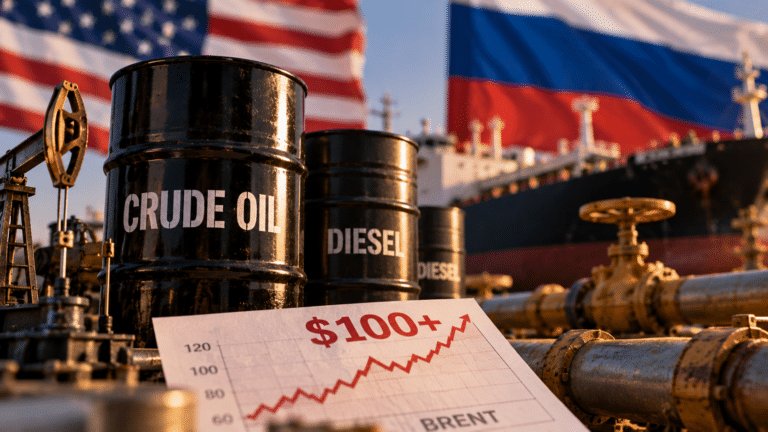
If the goal was cheaper oil, the first week was disappointing. Brent traded near $104 on 9 October and closed at $106.65 on 12 October, its highest since 15 September, according to a Reuters-based report. It eased to about $105.60 on 13 October and was quoted near $106.19 on 14 October. Reported figures differ by source and time of day; some put Brent near $103 during trading on 12 October.
The reason is scale and source. Russian diesel helps the market for refined products, but crude prices are being driven by the war involving Iran, now in its eighth month since US and Israeli strikes began on 28 February 2026. About one-fifth of world oil passes through the Strait of Hormuz, and tanker attacks near it continue. Houthi attacks on Saudi installations have added to the risk. Shipping and insurance costs have reached more than a third of cargo value, according to the same Reuters-based report.
How big is 4.8 million tonnes, really?
A tonne of diesel is roughly 7.45 barrels, a standard industry conversion. The 4.8 million tonnes Trump described is therefore about 36 million barrels, delivered over several months. That is meaningful for diesel, but small next to the 100 million barrels of emergency oil and diesel reserves the G7 agreed to release the week before, and smaller still against a world market that uses roughly 100 million barrels of oil every day.
From Sanctions to Licence: How Policy Swung
- March 2022The US bans Russian oil and energy imports; the Ending Importation of Russian Oil Act follows.
- August 2025Trump imposes additional tariffs on Indian goods over Russian oil purchases.
- October 2025The US sanctions Rosneft and Lukoil, citing a lack of serious peace efforts.
- 28 February 2026US and Israeli strikes on Iran begin the war that has kept oil prices elevated.
- 5 March 2026A 30-day waiver lets India buy Russian oil stranded at sea; it is later widened to all buyers until 11 April.
- September 2026US diesel reaches a record $6.52 a gallon; Trump urges Ukraine to stop striking Russian refineries.
- 9 October 2026Treasury licence for Russian diesel to 7 April 2027; Trump announces the supply deal with Putin.
- 11 October 2026Trump announces an energy ceasefire between Russia and Ukraine; Kyiv says it learned of it from the news.
The pattern is not a clean reversal so much as a series of exceptions driven by prices. Each time the Iran war pushed fuel costs higher, Washington loosened its grip on Russian energy a little: first a stranded-cargo waiver for India in March, then a broader one, now a six-month diesel licence. Susannah Streeter of Wealth Club told Al Jazeera that “Trump is caught between his geopolitical ambitions and the domestic political consequences of expensive energy.”
The Backlash in Kyiv and Washington
Ukraine’s response was blunt. President Volodymyr Zelenskyy wrote that “gifts to Putin will not bring peace or any benefit to the civilized world,” RFE/RL reported. Ukraine’s sanctions commissioner, Vladyslav Vlasiuk, argued that the waiver showed the Iran conflict, not Ukrainian strikes on Russian refineries, was the main driver of diesel prices.
In Washington, criticism crossed party lines. Republican Representative Don Bacon accused the president of “moral blindness” toward Putin. Democratic Senator Richard Blumenthal, a co-author of the bipartisan Russia sanctions bill, called the decision “a stain on our nation’s character” and warned that “Congress is watching.” The legal question is concrete: the 2022 Ending Importation of Russian Oil Act bars Russian oil imports unless the president certifies conditions on Ukraine, and officials have not explained how the licence fits that law.
What It Means for India
India is the country most exposed to both halves of this story. It imports most of the crude it uses, so $100-plus oil feeds straight into the import bill, the rupee and inflation. And it has been under direct US pressure for buying Russian crude, which Russian suppliers have sold at a discount.
A diplomatic opening
Analysts quoted by the South China Morning Post on 13 October said the diesel licence could strengthen New Delhi’s hand. If Washington itself now buys and licenses Russian fuel to manage prices, India’s argument that its Russian crude purchases are about energy security, not politics, becomes harder to dismiss. The National Herald noted, however, that the licence does not revoke the tariff authority or exempt India, and no change to tariff policy had been announced.
The price problem has not gone away
The more immediate issue for India is the crude price itself. At the start of October, Brent near $99 to $102 was already one of the five pressures behind the Nifty’s slide to a 52-week low, alongside foreign selling and the RBI’s rate rise to 5.50%. With Brent back above $105, that pressure has not eased.
| Area | Effect of $100-plus crude | Effect of the diesel licence | Net direction for India |
|---|---|---|---|
| Crude import bill | Higher; every $10 a barrel adds billions of dollars a year | Little direct effect | Pressure up |
| Rupee | Weaker as dollar demand for oil rises | Little direct effect | Pressure up |
| Global diesel prices | Higher with crude and refinery outages | Some relief as Russian supply returns | Some relief |
| Petrol and diesel retail prices | Pressure on oil marketing companies | Indirect, through product prices | Depends on government and OMCs |
| US tariff dispute | Not affected | Strengthens India’s argument | Possible leverage |
| Inflation and interest rates | Keeps RBI cautious | Too small to change the outlook | Pressure up |
Where Oil Goes From Here: Four Scenarios
Forecasts vary widely because the outcome depends on war, not economics. The rail sets out four broad cases with the price levels analysts have discussed. They are scenarios, not predictions.
Two other numbers shape the outlook. OPEC has cut its 2026 forecast for growth in oil demand to 400,000 barrels a day, from 1.4 million at the start of the year, as high prices damp consumption. And Russia’s deputy prime minister, Alexander Novak, said Moscow could raise fuel supplies from October as refineries return from maintenance. Both point lower over time. The war points higher today.
What to Watch in the Next Six Months
- The first diesel cargoes. Check whether the 300,000 tonnes actually ship in October and 500,000 in November, as Trump described.
- The energy ceasefire. Further strikes on refineries or power plants would undercut the deal within weeks.
- Congress. Any challenge under the 2022 import ban could narrow or end the licence before 7 April 2027.
- Hormuz and the Red Sea. Tanker attacks matter more to Brent than any Russian product.
- India’s tariff talks. Any change to US tariffs over Russian crude would be the clearest sign of a wider shift.
- Brent above or below $100 on a weekly close
- Diesel futures against their 4% post-deal fall
- Tranche deliveries: 300k, 500k, then 1M tonnes
- Licence expiry date of 7 April 2027
- US midterm result on 3 November 2026
- Rupee and India’s monthly oil import bill
Frequently Asked Questions
Did Trump lift sanctions on Russian oil?
Not broadly. On 9 October 2026 the US Treasury issued a temporary licence allowing transactions in Russian-origin diesel until 7 April 2027. Reports did not indicate that sanctions on Russian crude oil or on Rosneft and Lukoil were lifted.
Why did Trump ease sanctions on Russian diesel?
To bring down fuel prices. Diesel futures were more than 110% higher than in January, and US diesel hit a record $6.52 a gallon in September, ahead of midterm elections on 3 November 2026.
How much diesel will Russia supply under the deal?
Trump said 300,000 tonnes immediately, 500,000 tonnes in November, then 1 million tonnes, followed by a further 3 million tonnes depending on Russian refineries. That is about 4.8 million tonnes, or roughly 36 million barrels.
Why are oil prices still above $100?
Mainly because of the war involving Iran, attacks near the Strait of Hormuz, Houthi strikes on Saudi facilities and record shipping costs. Russian diesel helps refined fuel markets but does little to crude supply.
What is the Brent crude price today?
Brent traded between about $103 and $107 a barrel between 9 and 14 October 2026, closing at $106.65 on 12 October. Check a live market source for the current price.
Will petrol and diesel prices fall in India?
Not because of this deal alone. Retail prices in India depend on crude costs, the rupee, taxes and oil marketing companies’ decisions. With Brent above $100, the pressure on prices is upward, not downward.
How does the deal affect US tariffs on India?
It does not change them directly. Analysts say it could strengthen India’s argument against tariffs over Russian crude purchases, but no change in US tariff policy has been announced.
Is the Russian diesel deal legal under US law?
Lawmakers have questioned it. The Ending Importation of Russian Oil Act of 2022 bans Russian oil imports unless the president certifies certain conditions on Ukraine. Officials have not explained how the licence fits that law.
The Short Version
Trump has reversed course on one Russian fuel. A US Treasury licence lets Russian diesel flow until 7 April 2027, and Russia is to supply about 4.8 million tonnes. It is a political U-turn after a year of sanctions and tariffs, and it drew criticism from Kyiv and both US parties. But it is narrow: diesel, not crude, and temporary. Brent stayed between about $103 and $107 because the Iran war and Gulf shipping risks dominate supply. For India, the deal offers diplomatic leverage, not cheaper oil.