BRICS 2026 New Delhi Declaration: What the 140-Paragraph Text Commits To, and What It Leaves Open
World · Diplomacy · 18th BRICS Summit, New Delhi
BRICS 2026 New Delhi Declaration: What the 140-Paragraph Text Commits To, and What It Leaves Open
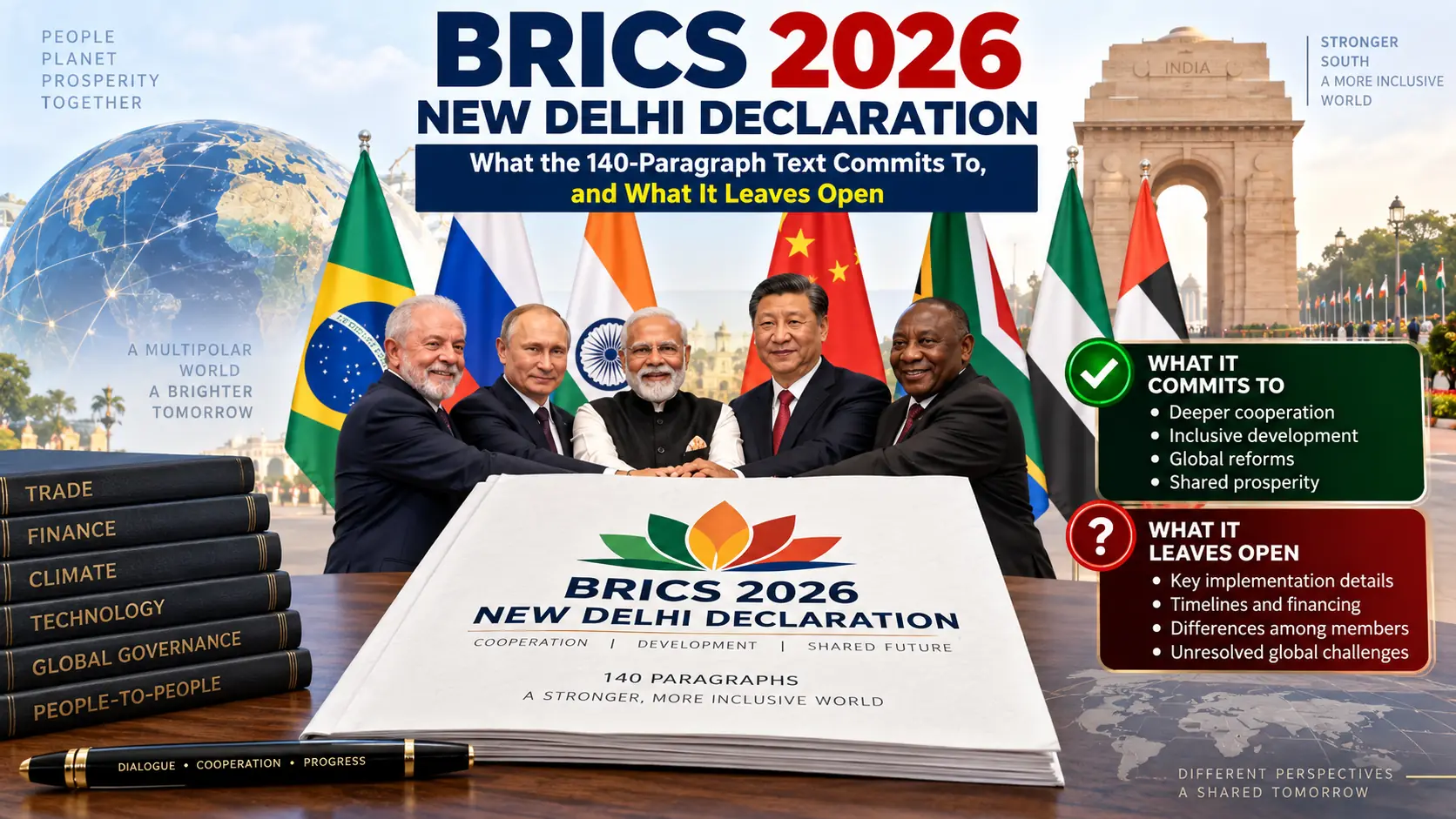
Leaders of the expanded BRICS grouping adopted the declaration by consensus on 12 September 2026 at Bharat Mandapam, on the first day of a two-day summit chaired by India.
Consensus documents rarely make news on their own. This one did, because almost nobody expected it. A BRICS foreign ministers’ meeting in the same city in May 2026 had broken up without a joint communique, leaving India to issue a chair’s statement instead, after members split over the war involving Iran. Four months later, with Iran and the United Arab Emirates sitting in the same room, eleven delegations signed off on a single 140-paragraph text. The interesting question is not whether they agreed. It is what they agreed to, and how much of it is binding.
Four Hundred Meetings, Thirty Cities, One Sheet of Paper
A BRICS declaration is not drafted at the summit. It is assembled over a year by sherpas working from ministerial outcomes, and the New Delhi text records its own paper trail: the leaders welcomed over four hundred meetings and engagements in thirty cities across India during the 2026 chairship, at the level of ministers, parliamentarians, agency heads, officials, experts and business.
India took the chair on 1 January 2026, succeeding Brazil, under the theme “Building for Resilience, Innovation, Cooperation and Sustainability”. It was India’s fourth turn, after 2012, 2016 and 2021. The summit itself ran at Bharat Mandapam in Pragati Maidan, the venue that hosted the 2023 G20 summit and which can hold up to 7,000 delegates in a single configuration.
The Arithmetic That Makes This Bloc Difficult to Dismiss
Scale is the argument BRICS makes about itself, and the numbers largely support it. Data cited by the Indian government during its chairship put the eleven listed members at 49.5 per cent of world population in 2026, roughly 3.9 billion people. On purchasing-power-parity terms, IMF-based estimates put the bloc at about 41 per cent of global output against roughly 28 per cent for the G7, a crossover that happened around 2020. Measured at market exchange rates rather than PPP, the BRICS share is materially lower, closer to 35 per cent.
The weakness sits inside the same table. China accounts for about 48.5 per cent of the bloc’s combined output and India for 20.7 per cent. Russia contributes 8.2 per cent, Indonesia 6 per cent, Brazil 5.7 per cent and Saudi Arabia 3.2 per cent.
The concentration problem, in one line of arithmetic
Add the two largest members and the picture changes: 48.5 plus 20.7 equals 69.2 per cent of the bloc’s output sitting in China and India alone. The remaining nine listed members share the other 30.8 per cent. That is why every BRICS financial initiative is written on a voluntary, opt-in basis. A rule that binds the group would in practice be a rule written by two capitals, and the other nine know it.
Membership Grew Faster Than the Machinery Did
BRICS began as four countries meeting in 2006, held its first leaders’ summit in 2009, and added South Africa in 2010. The expansion of 2024 and 2025 more than doubled it. By 2026, official BRICS and Indian government material listed eleven members and ten partner countries.
That mismatch is the backdrop to India’s institutional proposals. BRICS still has no permanent secretariat. Each chair inherits a year of unfinished work, and there has been no standing mechanism to check whether last year’s commitments were carried out.
How the Two Days Actually Ran
The declaration was adopted on day one, not day two. That detail matters: the text was settled among members before partner countries and outreach guests arrived, which is how BRICS has handled expansion without letting the drafting table grow to twenty-one seats.
What the Declaration Asks For, and How Hard It Asks
Reading a consensus text usefully means separating three registers: language that reaffirms an existing position, language that commissions work, and language that creates something. The New Delhi text contains all three, and the proportions tell you more than the headlines do.
| Issue | What the text asks for | Country named? | Binding? | Where it goes next |
|---|---|---|---|---|
| UN Security Council | Comprehensive reform, greater developing-country representation | No | No | Restated at UNGA; China and Russia again back Brazil and India aspirations |
| IMF quotas | 16th Review increases to take effect without delay, realignment under the 17th Review | No | No | IMF quota negotiations, 17th General Review |
| WTO appeals | Immediate restoration of a two-tier binding dispute settlement system and new Appellate Body members | No | No | Geneva negotiations; support for Ethiopia and Iran accession |
| Unilateral tariffs | Serious concern at rising tariff and non-tariff measures inconsistent with WTO rules | No | No | BRICS Informal Consultative Framework |
| West Asia | Maximum restraint, protection of civilians, long-term settlement through dialogue | No | No | National positions explicitly preserved |
| Cross-border payments | Continued study of interoperability and local-currency settlement, with no single model imposed | Not applicable | No | BRICS Payment Task Force |
| Terrorism | Zero tolerance, action on financing, safe havens and cross-border movement | No | No | Counter-Terrorism Working Group and its five subgroups |
On finance, the declaration encourages the New Development Bank to expand local-currency financing and diversify funding, and notes continued technical work on a New Investment Platform, a multilateral guarantees initiative and amendments to the Contingent Reserve Arrangement treaty. Russia hosted the bank’s eleventh annual meeting in Moscow on 14 and 15 May 2026.
The de-dollarisation claim, corrected
The declaration does not establish a common BRICS currency, and it does not commit members to abandoning the dollar. What it does is endorse continued work by the BRICS Payment Task Force on making national payment and financial-messaging systems interoperable, and on settling trade and investment in local currencies where members choose to. The text is explicit that there is no one-size-fits-all approach. Reporting from the summit noted that sharper proposals for moving away from the dollar were avoided.
Energy, Climate and AI: Where the Language Was Least Hedged
Three areas got firmer treatment than the geopolitics did, largely because members’ interests align there. On energy, the declaration states plainly that fossil fuels will continue to play an important role in the world’s energy mix, particularly for emerging and developing economies, while committing to a just, orderly, equitable and inclusive transition consistent with the Paris Agreement and the principle of common but differentiated responsibilities. It backs technological neutrality across renewables, bioenergy, nuclear, hydropower, hydrogen and storage, and endorses guiding principles on smart grids.
On climate policy it takes a sharper line than the transition language suggests, explicitly opposing carbon border adjustment mechanisms as unilateral, discriminatory and protectionist, and arguing that such measures penalise developing economies for emissions they did not historically produce. It also welcomes the Tropical Forest Forever Facility launched at the Belem climate summit and supports Ethiopia’s COP32 presidency.
On artificial intelligence, the members commit to implementing the BRICS Leaders’ Statement on the Global Governance of Artificial Intelligence, acknowledge India’s AI Impact Summit of February 2026, and note the Shanghai meeting on global AI governance. The technology paragraphs also cover quantum research, digital public infrastructure, a proposed repository of digital public infrastructure solutions, a BRICS Incubator Network and further consideration of a Startup Innovation Fund. A dedicated paragraph flags intellectual property risks in AI training data, including misappropriation of heritage and cultural knowledge that is thinly represented in existing models.
The Paragraph Nobody Expected to Survive Drafting
The hardest language was on West Asia. BRICS now contains Iran and the United Arab Emirates, whose positions diverged sharply during the 2026 conflict, and the May foreign ministers’ meeting had already failed over exactly this. The compromise, in paragraph 28 of the text, calls for maximum restraint while explicitly recalling members’ respective national positions, urges protection of civilians and civilian infrastructure, and stresses the need to keep global trade, supply chains and energy flowing.
On Gaza, the text notes UN Security Council Resolution 2803, expresses concern at continued violence despite the October 2025 ceasefire, opposes forced displacement of Palestinians, and restates support for Palestinian full UN membership and a two-state outcome on 1967 borders with East Jerusalem as capital. It reaffirms support for UNRWA. On Ukraine, it records differing national positions and welcomes mediation efforts, which is diplomatic shorthand for an issue on which the bloc has no common line.
On the sidelines the same day, Iran’s president and the UAE’s representative held talks that Reuters described as the highest-level meeting between the two since the 2026 war began. That bilateral, rather than any clause in the declaration, was the concrete de-escalation signal from New Delhi.
What “consensus” means in practice here
BRICS decisions require agreement from every member, and there is no voting. A single delegation can hold a paragraph. That is why contested language either disappears, or survives in a hedged form that preserves national positions, as the West Asia paragraph does. It also explains why the group condemned unilateral tariffs and sanctions in general terms without naming the United States: naming would have required eleven capitals to accept the diplomatic cost.
India’s Four Proposals, Ranked by How Far They Travelled
As chair, India used its interventions to push process rather than rhetoric. The proposals below were made by the Indian prime minister at the summit sessions, and are recorded in official readouts rather than as commitments in the declaration itself.
Alongside these, India offered to host a BRICS Risk Lab at the GIFT City International Financial Services Centre in Gujarat, as part of wider discussion on a shared insurance and reinsurance capability.
Ten Cities, Ten Tracks: Where the Year’s Work Actually Happened
The declaration’s substantive annexes trace back to ministerial meetings held across India through 2026. The geography is itself a chairship strategy, spreading summit preparation well beyond Delhi.
| City | Track | Outcome carried into the declaration |
|---|---|---|
| Chandigarh | 16th Health Ministers’ Meeting | Early warning subgroup on mass infectious diseases; tuberculosis cooperation |
| Indore | 16th Agriculture Ministers’ Meeting | BRICS AGRIN network on agro-inputs and genetic resources |
| Bhubaneswar | 13th Education Ministers’ Meeting | Skills and technical education cooperation alliance work |
| Nagpur | Transport Ministers’ Meeting | Logistics Supply-Chain Cooperation Framework; Urban Mobility Hub |
| Kochi | Women Ministerial Meeting | Women’s Digital Capacity Building Guidelines |
| Agra | Inaugural SME Forum | Framework for cooperation in the SME Working Group |
| Jaipur | MSME finance consultations | Jaipur Consensus on studying an invoice discounting mechanism |
| Chennai | Science and Technology Ministers | Chennai Consensus; BRICS Science and Research Repository |
| Bengaluru | Heads of Space Agencies | Space debris mitigation; terms of reference for a BRICS Space Council |
| Guwahati | Heads of Anti-Drug Agencies | Guwahati Declaration on operational anti-narcotics cooperation |
What We Know
Confirmed by the official text and agency reporting
- The declaration was adopted unanimously on 12 September 2026, during the closed plenary at Bharat Mandapam.
- It contains 140 numbered paragraphs and is titled “Building for Resilience, Innovation, Cooperation and Sustainability”.
- It records over 400 chairship meetings across 30 Indian cities during 2026.
- It calls for UN Security Council, IMF, World Bank and WTO reform, and opposes unilateral coercive measures without naming any state.
- It condemns the 22 April 2025 attack in Jammu and Kashmir, in which 26 people were killed.
- It endorses the BRICS Mission for Healthy Lifestyle and a 2026 to 2029 roadmap, with NIMHANS coordinating a mental-health centres-of-excellence network.
- It supports China’s 2027 chairship and the 19th summit being held in China.
What Is Still Unclear
- Saudi Arabia’s status. Official BRICS and Indian listings count eleven members including Riyadh, but Saudi Arabia has not publicly confirmed completing accession, and at New Delhi it was represented by its foreign minister with invitee status.
- Whether India’s continuity mechanism and decisions repository will be formally adopted, and by whom they would be staffed.
- What the Seafarers Emergency Support Network would cost, who would run it, and when it might begin operating.
- Whether the BRICS Grain Exchange, the New Investment Platform and the Startup Innovation Fund move beyond study-group status under the 2027 chairship.
- How quickly, if at all, IMF members outside BRICS will engage on quota realignment in the 17th General Review.
- Whether payment-system interoperability produces a working cross-border corridor, or remains a technical workstream.
Decoder: The Terms That Carry the Weight
| Term in the text | What it means | Why it matters |
|---|---|---|
| EMDCs | Emerging markets and developing countries | The category BRICS uses to argue for redistributed votes in global institutions |
| Unilateral coercive measures | Sanctions not authorised by the UN Security Council, including secondary sanctions | The formulation that lets members criticise sanctions without naming the sanctioning state |
| 17th General Review of Quotas | The IMF’s next scheduled reassessment of member voting shares | The concrete forum where BRICS reform rhetoric is tested |
| Two-tier binding dispute settlement | A WTO system with a panel stage and a functioning appeals body | The WTO’s top appeals body has been unable to function for years because of blocked appointments |
| Contingent Reserve Arrangement | A BRICS currency-swap safety net between central banks | The bloc’s existing crisis facility, now being amended for faster response |
| Troika | The previous, current and incoming chairs acting together | India’s proposed substitute for a permanent secretariat |
| Partner country | A state participating in BRICS engagements without full membership | Ten countries hold this status, including Belarus, Kazakhstan, Malaysia, Nigeria and Vietnam |
| Carbon border adjustment | Import levies tied to the carbon content of goods | The declaration explicitly opposes such measures as discriminatory |
Six Things Readers Get Wrong About This Summit
Frequently Asked Questions
What is the BRICS 2026 New Delhi Declaration?
It is the consensus outcome document of the 18th BRICS Summit, adopted unanimously by the leaders of the member countries on 12 September 2026 at Bharat Mandapam in New Delhi. It runs to 140 numbered paragraphs under the theme “Building for Resilience, Innovation, Cooperation and Sustainability” and covers global governance reform, regional conflicts, trade and finance, energy, climate, technology, health, agriculture and people-to-people cooperation.
When and where was the 18th BRICS Summit held?
It ran from 12 to 13 September 2026 at Bharat Mandapam, the convention centre at Pragati Maidan in New Delhi, under India’s chairship. A BRICS Business Forum was held at the same venue on 11 September. The declaration was adopted at the end of the closed plenary on the first day, before partner countries joined for the open plenary on the second day.
Did BRICS agree to launch a common currency in 2026?
No. The declaration does not create a common BRICS currency and does not commit members to dropping the dollar. It acknowledges the work of the BRICS Payment Task Force on interoperability between national payment and messaging systems and on settling trade and investment in local currencies, while stating there is no single approach that fits all members. It also encourages the New Development Bank to expand local-currency lending.
Which countries are BRICS members in 2026?
Official BRICS and Indian government listings for 2026 name eleven members: Brazil, China, Egypt, Ethiopia, India, Indonesia, Iran, Russia, Saudi Arabia, South Africa and the United Arab Emirates. Ten partner countries are also listed, including Belarus, Bolivia, Cuba, Kazakhstan, Malaysia, Nigeria, Thailand, Uganda, Uzbekistan and Vietnam. Saudi Arabia’s own position on formal accession has remained unconfirmed.
What did the declaration say about the conflict in West Asia?
It expressed deep concern at the escalation, called for maximum restraint while recalling members’ respective national positions, and urged protection of civilians and civilian infrastructure and respect for sovereignty and territorial integrity. It pressed for a long-term settlement through dialogue and diplomacy, and stressed keeping trade, supply chains and energy flowing. On Gaza it backed humanitarian access and support for UNRWA.
Did BRICS criticise United States tariffs by name?
No country was named. The declaration voiced serious concern about rising unilateral tariff and non-tariff measures inconsistent with WTO rules, and condemned unilateral coercive measures including sanctions not authorised by the UN Security Council. Commentary from the summit noted that the criticism of unilateral war, tariffs and sanctions was framed without direct attribution, which is what consensus among eleven capitals required.
What did India propose as BRICS chair at the New Delhi summit?
India proposed a continuity and implementation mechanism under which the Troika of previous, current and incoming chairs would follow up on decisions, a secure digital repository recording each decision with its nodal point and timeframe, a Seafarers Emergency Support Network linking maritime authorities and diplomatic missions, and negotiation-support training for Global South officials. It also offered to host a BRICS Risk Lab at GIFT City.
Who hosts the next BRICS summit after New Delhi?
China. The declaration records support for China’s BRICS chairship in 2027 and for the 19th BRICS Summit being held there. The chairship rotates annually, which is precisely the churn that India’s proposed Troika-based continuity mechanism is designed to manage, since BRICS has no permanent secretariat to carry work across presidencies.
The Short Version
Eleven delegations that could not agree on a communique in May signed a 140-paragraph consensus text in September. The achievement was the signature itself. The content is mostly reaffirmation and commissioned study: reform demands aimed at the UN, IMF, World Bank and WTO, hedged language on West Asia that preserves national positions, criticism of tariffs and sanctions with no country named, and payment cooperation that stops well short of a currency. India’s contribution was procedural, aimed at giving a bloc that doubled in size the machinery to follow through. Whether any of it moves will be visible next year in China.