Government Sold IDBI Bank: What Happens to Your Savings Account, FD, Loan and Money Now?
Your Money · IDBI Bank · Customer Guide
Government Sold IDBI Bank: What Happens to Your Savings Account, FD, Loan and Money Now?
The government and LIC are selling control of IDBI Bank to Canada’s Fairfax. For customers, accounts, deposits and loans continue as they are. Here is what stays the same, what could change later, and how your money is protected.
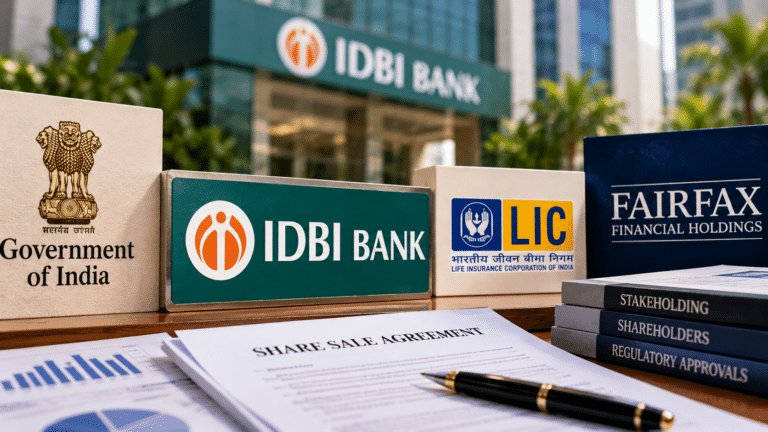
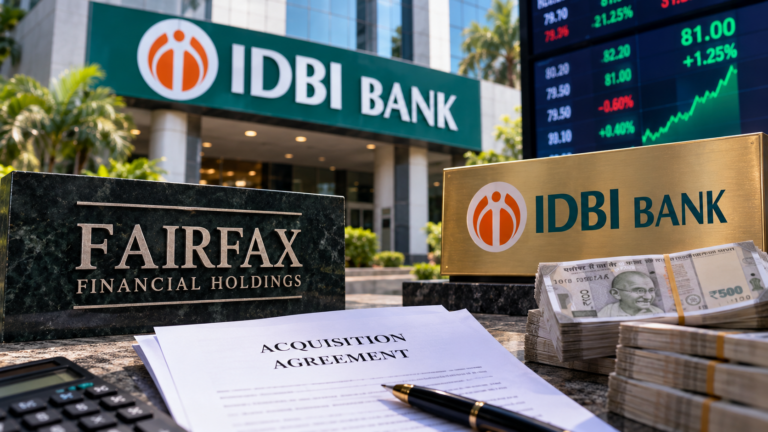
If you have a salary account, a fixed deposit or a home loan with IDBI Bank, the news on Wednesday probably came as a jolt. The Cabinet approved the sale of 60.72% of the bank to a company owned by Fairfax Financial Holdings, the Canadian group led by Prem Watsa. Messages on family groups quickly turned to the obvious questions. Is my money safe? Will my account number change? Should I move my savings?
The short answer is that nothing about your account changes because of the approval. A sale of shares changes who owns the bank, not the contracts the bank has with you. But “nothing changes today” is not the whole story either. Over the next year or two, a new owner can change products, fees, rates on new deposits and the way the bank looks and works. This guide sets out, product by product, what is fixed, what could move and what you should actually do.
What We Know
- The Cabinet approved the sale of 60.72% of IDBI Bank to Fairfax on 14 October 2026; the government keeps 15% and LIC 19%.
- The government’s FAQs say a change in shareholding does not by itself end existing accounts, deposits or loans.
- Fairfax must use the IDBI name and logo for three years, according to Business Today.
- DICGC insurance covers up to ₹5 lakh per depositor per bank, including interest.
What Is Still Unclear
- When RBI will approve the deal and when Fairfax will take control.
- Whether savings account conditions, minimum balances or service charges will change later.
- Plans for branches, ATMs and the mobile app after the change.
- Whether CSB Bank, also owned by Fairfax, will be merged into IDBI.
Why a Share Sale Does Not Touch Your Account
A bank is a company. When you open an account, your contract is with the company, IDBI Bank Limited, not with its shareholders. When shares change hands, the company stays the same legal entity, with the same licence, the same balance sheet and the same obligations to depositors and borrowers. This is why the government’s FAQs, as reported by PTI, say a change in shareholding does not by itself end existing accounts, fixed deposits or loans.
Madan Sabnavis, chief economist at Bank of Baroda, told Business Standard it would be “business as usual” for depositors and borrowers. IDBI also remains a scheduled commercial bank regulated by RBI, which supervises it in exactly the same way before and after the sale.
This is a sale, not a rescue
Many people’s fears come from memories of bank rescues, when RBI froze withdrawals while a failing bank was restructured or merged. IDBI’s situation is different. It is profitable and well capitalised, and it is being sold by its owners, not rescued by the regulator. There is no moratorium, no withdrawal limit and no merger order. Those tools are used when a bank is in trouble; nothing like that has been announced or is needed here.
A capital adequacy ratio of 26.92% means the bank holds far more capital against its loans than regulators require, and net bad loans of 0.16% mean almost all problem loans have already been provided for. These numbers describe a bank that is being sold from a position of strength.
Product by Product: What Stays and What Could Change
The table covers the products most IDBI customers hold. “After completion” means once Fairfax formally takes over, which is expected this financial year if RBI approves. “Could change later” covers changes the new owner is allowed to make with proper notice.
| Product | Now, after approval | After completion | Could change later | What you should do |
|---|---|---|---|---|
| Savings and current account | No change | Same account number | Minimum balance, fees, with notice | Nothing; read any notices |
| Fixed deposit | No change | Contracted rate runs to maturity | Rates on new FDs and renewals | Compare rates before renewal |
| Recurring deposit | No change | Instalments and rate as agreed | Rates on new RDs | Keep paying instalments |
| Home or personal loan | No change | Agreement continues | Pricing of new loans; floating rates follow benchmark | Keep paying EMIs on time |
| Debit card, UPI, net banking | No change | Continue to work | App or card design, gradually | Use only official app updates |
| Cheque book and IFSC | No change | No change announced | Only if a merger or rename occurs | Wait for formal notice |
| Locker | No change | Agreement continues | Charges, with notice | Keep locker agreement copy |
| NRI accounts | No change | Continue under FEMA rules | Product terms, with notice | Nothing immediate |
Your fixed deposit is a contract
The interest rate on an existing fixed deposit is locked in when you open it and runs to maturity. Business Standard notes that an existing FD’s contracted rate does not change automatically because of the share sale. What can change is the rate offered on new deposits or when your FD comes up for renewal. Breaking an FD early to move it elsewhere would usually cost you a premature-withdrawal penalty, typically a deduction from the interest rate, which the sale gives you no reason to pay.
Your loan does not get repriced by a takeover
Home, personal and vehicle loans continue under their existing agreements. If your loan is on a floating rate, it will continue to reset according to its benchmark and reset schedule, whether that is the repo rate or the bank’s own lending rate. The ownership change does not trigger a reset. Keep paying EMIs on time; a missed payment counts against your credit score regardless of who owns the bank.
Cheques, cards, lockers and auto-debits carry on
Your chequebook, debit card, UPI handle, net-banking login and locker are all tied to the bank, and the bank continues to exist; only its shareholders change. Cheques you have issued will be honoured as usual, and standing instructions such as SIPs, insurance premiums and utility bills linked to your IDBI account keep running. Locker agreements stay with the branch that issued them. If the bank ever changes its IFSC codes, for example after a merger, it would have to give notice, and RBI practice in past bank mergers has been to keep old codes and cheques working for a transition period.
How Much of Your Money Is Insured
Deposit insurance through the Deposit Insurance and Credit Guarantee Corporation, an RBI subsidiary, covers up to ₹5 lakh per depositor per bank, including principal and interest. It applies to savings, current, fixed and recurring deposits. The limit is per depositor per bank, not per account: all your deposits held in the same capacity at IDBI are added together.
The rail is a general guide, not specific to IDBI, and applies to any bank. The point is not that IDBI is risky; its numbers suggest it is not. It is that the ₹5 lakh limit has always applied, before and after the sale, and anyone with large balances in one bank should know where the line is.
It also helps to remember who supervises the bank. IDBI is regulated by the Reserve Bank of India under the Banking Regulation Act, and that does not change with a new owner. Before any private buyer can take control, RBI has to judge it fit and proper. After completion, the bank will face the same capital, liquidity and inspection rules as every other private bank. For a depositor, the regulator is the real safety net, and it stays in place throughout.
What Could Change Over the Next Two Years
New owners usually want to put their stamp on a bank. The government’s FAQs give no roadmap for branches, ATMs, digital banking, charges or products, PTI reported. The Week noted that the name, apps, internet banking and product range might change gradually over time. Here is the likely sequence, based on what has been reported.
- 14 Oct 2026Cabinet approves sale. No change for customers.
- Before completionRBI fit-and-proper review of Fairfax; compliance roadmap.
- By 31 Mar 2027Completion expected this financial year, if approved.
- First 3 yearsIDBI name and logo must be retained, as reported.
- Within 2 yearsDecision on CSB Bank: merge into IDBI or exit, as reported.
- OngoingNew products, rates and digital changes, with notice.
The CSB Bank question
Fairfax already owns about 40% of CSB Bank. Business Today reported that within two years of signing the share purchase agreement, Fairfax must either merge CSB into IDBI or exit CSB. If a merger happens, CSB customers would move to IDBI, and some IDBI customers might see branch or system changes. Any merger would need its own approvals and customer notices, and existing deposits would carry over on their terms.
The Real Risk: Fraud Riding on the Headlines
The most likely way an IDBI customer loses money in the coming weeks is not the sale. It is a fraudster using the sale as a pretext. Business Standard and The Week both warned customers not to respond to unsolicited messages asking them to update details, transfer money or share passwords or OTPs.
- Do nothing hasty. Do not close accounts or break FDs because of the sale; the penalties would cost you, the sale would not.
- Check your DICGC position. Add up your deposits at IDBI by capacity; if any capacity exceeds ₹5 lakh, decide calmly whether to spread it.
- Read official notices only. Changes to fees, rates or apps must come through the bank’s official channels with notice.
- Compare before renewing FDs. When an IDBI FD matures, compare its new rate with other banks before rolling it over.
- Keep paying loans as usual. EMIs, standing instructions and auto-debits continue unchanged.
- Update the app only from official stores. Ignore links sent by SMS or WhatsApp.
- Account number and IFSC noted for reference
- Deposits per capacity checked against ₹5 lakh
- FD maturity dates noted for renewal decisions
- Nominee details up to date on all accounts
- Locker agreement copy kept at home
- Bank’s official helpline saved in your phone
- OTP and PIN never shared, by phone or message
- Cybercrime helpline 1930 saved for emergencies
A Note for Senior Citizens and NRIs
Senior citizens often hold larger fixed deposits and rely on interest for income. Existing FDs, including senior citizen rate premiums already contracted, continue unchanged until maturity. At renewal, compare the new rate with other banks and with options such as the Senior Citizens Savings Scheme. If a single person’s deposits at IDBI exceed ₹5 lakh, spreading them across family capacities or banks gives fuller insurance cover, as it would at any bank.
Non-resident Indians with NRE or NRO accounts and FCNR deposits at IDBI can continue as before. These accounts are governed by FEMA rules, which do not change with the bank’s ownership. NRI customers should be especially alert to messages claiming that the sale requires re-documentation, since fraudsters often target customers who cannot easily visit a branch.
Pensioners whose pension is credited to an IDBI account do not need to take any action. The account, the mandate and the pension credit continue as before. The one practical step worth taking for every customer, but especially for older ones, is checking that nominee details are correct on each account and FD. A nomination makes it far easier for family to claim deposits, and it has nothing to do with the sale; it is simply good housekeeping that a headline like this is a useful reminder to do.
Frequently Asked Questions
Is my money safe in IDBI Bank after the sale to Fairfax?
Yes, the sale does not change your deposits. IDBI remains an RBI-regulated bank, its capital adequacy was 26.92% and net NPA 0.16% in June 2026, and DICGC insurance covers up to ₹5 lakh per depositor per bank.
Will my IDBI Bank account number change?
No change has been announced. A share sale does not alter account numbers. Changes to IFSC or account details would only follow a merger or rename, and would be formally notified in advance.
Will the interest rate on my IDBI FD change?
Not on existing FDs; the contracted rate runs to maturity. Rates for new FDs and renewals may change in future, as they can at any bank.
Should I withdraw money from IDBI Bank?
There is no reason to withdraw because of the sale. Breaking FDs early would cost you a penalty. If any of your deposits in one capacity exceed ₹5 lakh, you may choose to spread them, as with any bank.
Will IDBI Bank change its name after the Fairfax deal?
Fairfax is reported to be required to keep the IDBI name and logo for three years. Any later change would be announced officially.
What happens to my IDBI home loan after the sale?
Your loan agreement continues unchanged. Floating rates keep resetting according to their benchmark and schedule. Keep paying EMIs as usual.
Is IDBI Bank still a government bank?
No. IDBI has been a private sector bank since January 2019. After the sale, Fairfax will be its promoter, and the government and LIC will be minority shareholders with no board seats.
How much money is insured in a bank in India?
DICGC insures up to ₹5 lakh per depositor per bank, including principal and interest, across savings, current, fixed and recurring deposits held in the same capacity.
The Short Version
The government and LIC are selling control of IDBI Bank to Fairfax, but your account, FD and loan continue exactly as they are. A share sale changes the owner, not your contract with the bank. IDBI remains RBI-regulated, financially strong, and covered by DICGC insurance up to ₹5 lakh per depositor. Over time the new owner may change rates on new deposits, fees or apps, with notice. Do not break deposits, do not panic, and above all ignore any message asking you to update details or share an OTP because of the sale.