Railway Staff Get the 78-Day Bonus, but the DA Hike Is Still Pending: What Central Employees Will Actually Receive This Diwali
Railway Staff Get the 78-Day Bonus, but the DA Hike Is Still Pending: What Central Employees Will Actually Receive This Diwali
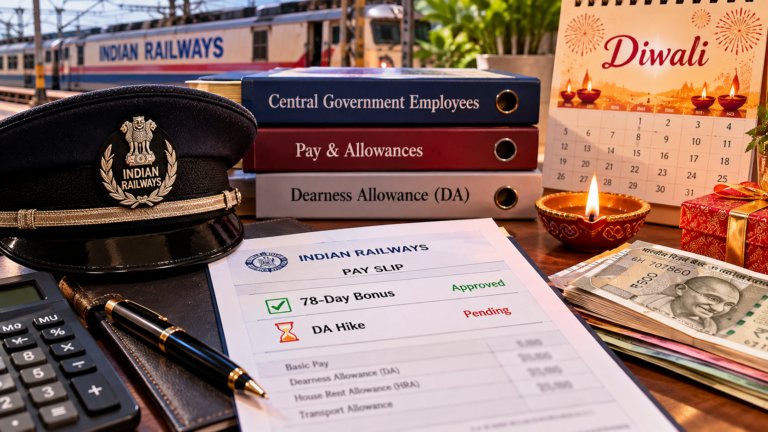
The Cabinet cleared a productivity linked bonus of up to ₹17,951 for about 11.4 lakh railway employees on 14 October 2026. The July 2026 dearness allowance increase, which the formula puts at 3 points, has not yet been announced.
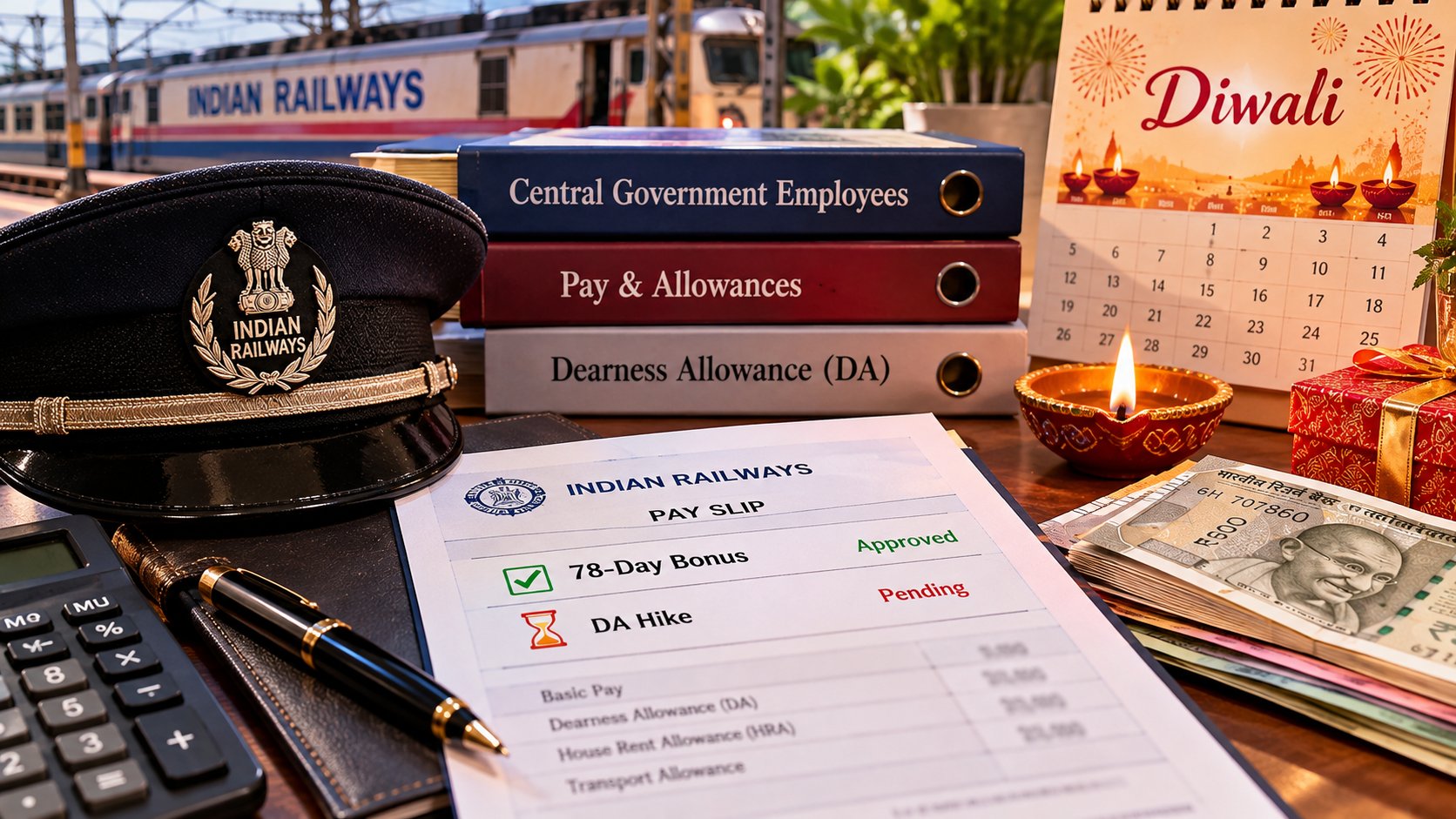
For railway employees, Wednesday brought the news they wait for every autumn. The Union Cabinet approved a productivity linked bonus equal to 78 days’ wages for about 11.4 lakh non-gazetted staff, from track maintainers and loco pilots to station masters and clerks. The money is expected to reach accounts before Dussehra on 20 October.
For everyone else on the central government payroll, the same meeting was a disappointment. Nearly 50 lakh employees and 68 lakh pensioners have been waiting for the second dearness allowance instalment of 2026, due from 1 July. It was not on the agenda. That leaves two questions in every staff WhatsApp group: why does a “78-day” bonus come to only ₹17,951, and when will DA actually go up? This guide answers both, with the arithmetic.
Quick Summary
Railway staff will get up to ₹17,951 as their Diwali bonus; the DA hike is due but not yet declared. The bonus is 78 days’ pay calculated on a notional ₹7,000 monthly wage, not on actual salary, which is why it stops at ₹17,951. The July 2026 DA, by the standard formula, works out to 63% from the current 60%, worth ₹540 a month at the lowest basic pay of ₹18,000. Whenever it is announced, arrears will run from 1 July 2026.
What We Know
- The Cabinet approved a 78-day productivity linked bonus for railway employees on 14 October 2026, at a cost of ₹2,009.61 crore.
- About 11.4 lakh non-gazetted employees are covered, with a maximum of ₹17,951 each.
- DA and DR currently stand at 60% of basic pay and pension, effective from 1 January 2026.
- All 12 monthly CPI-IW figures for the July 2026 calculation have been published, the last on 31 July.
- No DA decision was taken at the 14 October Cabinet meeting.
What Is Still Unclear
- The date on which the Cabinet will approve the July 2026 DA and DR increase.
- Whether the hike will be paid with the October salary or later, and how many months of arrears that implies.
- Whether the government will raise the ₹7,000 bonus wage ceiling, as unions have demanded.
- The status of the separate 30-day ad hoc bonus order for other central staff this year.
Why 78 Days of Pay Comes to Only ₹17,951
The phrase “78 days’ wages” sounds like two and a half months of salary. For a loco pilot earning ₹60,000 a month, that would be about ₹1.5 lakh. The actual payment is a fraction of that, because the bonus is not calculated on real pay. It is calculated on a notional monthly wage ceiling of ₹7,000, a figure that, according to railway unions, has not been revised since 2014-15.
The calculation is simple. The ₹7,000 ceiling is converted into a daily rate using an average month of about 30.4 days, and that daily rate is multiplied by 78. The result is the ₹17,951 figure that appears in the government’s announcement. Because almost every non-gazetted railway employee now earns well above ₹7,000 a month, almost everyone gets the same maximum amount, whether they are a newly joined track maintainer or a senior section engineer.
That ceiling is now the main grievance. The Indian Railway Technical Supervisors Association has asked for it to be raised to at least ₹18,000, the minimum basic pay under the 7th Pay Commission, which would lift the 78-day bonus to about ₹46,184. CPI(M) MP John Brittas, writing to Railway Minister Ashwini Vaishnaw, cited a CITU demand for a ceiling of ₹28,440. The government has not acted on either, and this year’s approval again uses ₹7,000.
Who qualifies, and who does not
The bonus covers non-gazetted railway employees: track maintainers, loco pilots, train managers, station masters, supervisors, technicians, helpers, pointsmen, ministerial staff and other Group C employees. Gazetted officers are not covered. In past years the scheme has also excluded RPF and RPSF personnel, who are covered by separate arrangements. Employees who joined during the year generally receive a proportionate amount, so the exact payout depends on months of service in 2025-26.
The word “productivity” is not decoration. Railways tie the bonus to the previous year’s performance, and the government’s note this year cited a record 1,670 million tonnes of freight loading and nearly 7.41 billion passengers in 2025-26. In practice, the 78-day figure has been the same for more than a decade, so the link is symbolic rather than a sliding scale.
A Ritual That Arrives Before Dussehra Every Year
The railway bonus has become one of the most predictable decisions on the government’s calendar. Each year the Cabinet approves it in late September or October, and the money is paid before the Puja and Dussehra holidays. What changes is the headcount and the bill, which move with the number of eligible staff.
| Approved on | Year covered | Employees | Total outlay | Days | Maximum each |
|---|---|---|---|---|---|
| 18 Oct 2023 | 2022-23 | 11.07 lakh | ₹1,968.87 cr | 78 | ₹17,951 |
| 3 Oct 2024 | 2023-24 | 11.72 lakh | ₹2,028.57 cr | 78 | ₹17,951 |
| 24 Sep 2025 | 2024-25 | 10.91 lakh | ₹1,865.68 cr | 78 | ₹17,951 |
| 14 Oct 2026 | 2025-26 | 11.4 lakh | ₹2,009.61 cr | 78 | ₹17,951 |
| Freight basis | 2025-26 | 1,670 MT loaded | 7.41 bn passengers | n/a | Record year |
The flat ₹17,951 across four years tells its own story. Inflation has steadily eroded what the bonus buys. In the same period, dearness allowance alone has risen from 42% to 60% of basic pay, a sign of how much prices have moved while the bonus formula stood still.
The DA Hike That Missed This Meeting
Dearness allowance is revised twice a year, from 1 January and 1 July, to compensate employees for inflation. Pensioners get the same increase as dearness relief. The January 2026 instalment was approved on 18 April 2026, raising DA from 58% to 60% at an annual cost of ₹6,791.24 crore, according to the PIB release, benefiting about 50.46 lakh employees and 68.27 lakh pensioners.
The July instalment is now overdue by the usual calendar. Upstox reported that the Cabinet skipped a DA decision on 14 October, as it had at the previous meeting. Employees should not read anything ominous into this. DA is not discretionary in the way a bonus is: it follows a formula, and the government has paid every instalment since the pandemic freeze of 2020-21 ended. The only real question is timing.
How the formula lands on 63%
The 7th Pay Commission formula takes the 12-month average of the All India Consumer Price Index for Industrial Workers, published by the Labour Bureau, converts it to the older 2001 base with a linking factor of 2.88, and measures how far it sits above the base value of 261.42. The fraction is dropped.
The June 2026 release showed CPI-IW inflation at 4.76% year on year, against 2.55% a year earlier, driven by food prices. That acceleration matters less for July than for what follows. The 63.76% result leaves a comfortable cushion above 63%, so 3 points is the consensus expectation. But the higher readings from April onward also feed the next calculation, for January 2027, which is why that instalment may not be as small as January 2026’s 2 points.
When the July DA Has Arrived in Past Years
History gives a reasonable guide to the timing. In each of the last three years the July instalment came between the start of October and the Diwali week, sometimes in the same Cabinet meeting as the railway bonus and sometimes on its own.
- 18 Oct 2023DA raised 4 points to 46%, same meeting as the railway bonus.
- 16 Oct 2024DA raised 3 points to 53%, two weeks after the bonus.
- 1 Oct 2025DA raised 3 points to 58%, one week after the bonus; cost ₹10,083.96 crore a year.
- 18 Apr 2026January instalment: 2 points, to 60%.
- 14 Oct 2026Railway bonus approved; DA not taken up.
- 20 Oct 2026Dussehra; bonus expected in accounts before this date.
- 8 Nov 2026Diwali; the window in which past July hikes have usually landed.
If the pattern holds, the announcement could come at one of the Cabinet meetings before Diwali. If it slips beyond that, nothing is lost: the increase is backdated to 1 July regardless of when it is approved, and the gap is paid as arrears. The delay affects when you get the money, not how much.
The Money Maths for Each Pay Level
A 3-point DA increase is calculated on basic pay alone, not on gross salary. So the gain is 3% of your basic, not 3% of your take-home. The table below applies 3% to common 7th Pay Commission entry basics and estimates arrears for July to October, assuming the hike is paid with the November salary. If it is paid earlier or later, the arrears change by one month’s gain for each month of difference.
| Pay level | Basic pay | DA at 60% | DA at 63% | Gain a month | Arrears, 4 months |
|---|---|---|---|---|---|
| Level 1 | ₹18,000 | ₹10,800 | ₹11,340 | ₹540 | ₹2,160 |
| Level 4 | ₹25,500 | ₹15,300 | ₹16,065 | ₹765 | ₹3,060 |
| Level 6 | ₹35,400 | ₹21,240 | ₹22,302 | ₹1,062 | ₹4,248 |
| Level 7 | ₹44,900 | ₹26,940 | ₹28,287 | ₹1,347 | ₹5,388 |
| Level 10 | ₹56,100 | ₹33,660 | ₹35,343 | ₹1,683 | ₹6,732 |
| Level 11 | ₹67,700 | ₹40,620 | ₹42,651 | ₹2,031 | ₹8,124 |
What Employees Commonly Get Wrong
Every festive season brings the same confusions, often amplified by forwarded messages that mix up schemes and years.
The bonus for central staff outside railways
Railway employees are not the only ones who get a festive bonus. In recent years the Finance Ministry has issued a separate order granting an ad hoc, non-productivity linked bonus equal to 30 days’ emoluments to eligible Group C and non-gazetted Group B central government employees, using the same ₹7,000 ceiling. That works out to a maximum of about ₹6,908. Employees should check whether this year’s Department of Expenditure order has been issued before counting on it, since it is separate from the Cabinet’s railway decision.
Pensioners and the Dearness Relief Gap
Pensioners do not receive the railway bonus, but they receive the July increase as dearness relief at the same rate as serving employees. At the minimum central government pension of ₹9,000, a 3-point rise adds ₹270 a month. A pensioner drawing a basic pension of ₹40,000 would gain ₹1,200 a month. For older pensioners on fixed incomes, the arrears matter as much as the monthly rise, because they arrive as a lump sum ahead of the festive season if the order comes in time.
How This Fits With the 8th Pay Commission
The festive payouts are arriving at an unusual moment. The 8th Pay Commission has been set up to revise central pay and pensions, and its recommendations are expected to take effect from a date the government is yet to finalise. Until it reports and the government accepts the recommendations, DA continues under the 7th Pay Commission formula, which is why the July 2026 instalment is still due.
When a new pay structure arrives, accumulated DA is normally folded into the new basic pay and the DA count restarts from zero. That is what happened in 2016, when 125% DA was absorbed into the 7th Pay Commission pay matrix. So every DA instalment now has a second life: it raises current pay and also enters the base that the next commission will build on. The productivity linked bonus is a separate question, and unions are likely to press the commission to revisit the ₹7,000 ceiling as well.
What to Do Before the Festive Week
- Check your bonus credit. Railway staff should see up to ₹17,951 before 20 October; a lower figure usually reflects part-year service.
- Do not budget the DA arrears yet. Until the Cabinet approves it, the date of payment is uncertain.
- Calculate your own gain. Multiply your basic pay by 3%; that is your monthly DA increase if 63% is confirmed.
- Watch the payslip month. Arrears will appear as a separate line, usually in the first salary after the order.
- Plan for tax. Bonus and arrears are taxable salary; check whether your TDS for the year needs adjusting.
- Ignore unofficial “orders”. Rely on PIB releases and Department of Expenditure office memoranda, not forwarded images.
- Basic pay noted from the latest payslip
- 3% of basic calculated as monthly DA gain
- Bonus of up to ₹17,951 checked by 20 October
- Arrears of 3 to 5 months expected, from 1 July
- Pensioners: DR arrears verified with the bank
- Tax regime and TDS reviewed for the extra income
- Ad hoc 30-day bonus order checked, if not railway
- Official PIB release saved for the DA order
Frequently Asked Questions
How much is the railway bonus in 2026?
The Cabinet approved a productivity linked bonus equal to 78 days’ wages on 14 October 2026. The maximum is ₹17,951 per eligible employee, for about 11.4 lakh non-gazetted railway staff, at a total cost of ₹2,009.61 crore.
Why is the railway bonus only ₹17,951 if it is 78 days of pay?
The bonus is calculated on a notional monthly wage ceiling of ₹7,000, not on actual salary. Seventy-eight days at that ceiling works out to ₹17,951, so most employees get the same maximum.
When will the railway bonus be paid?
The bonus is expected to be paid before Dussehra, which falls on 20 October 2026, in line with past years. Exact credit dates depend on each railway zone’s payroll processing.
Has the DA hike from July 2026 been announced?
Not as of 15 October 2026. The Cabinet did not take up DA at its 14 October meeting. DA remains at 60% until the July 2026 increase is approved.
How much will DA increase from July 2026?
Based on the 7th Pay Commission formula and CPI-IW data for July 2025 to June 2026, DA is expected to rise by 3 points, from 60% to 63%. The final figure is set by the Cabinet.
Will I get DA arrears if the hike is announced late?
Yes. The increase takes effect from 1 July 2026 whatever the approval date, and the difference for the months already paid is credited as arrears, usually with the next salary.
How much will my salary increase with a 3% DA hike?
Multiply your basic pay by 3%. At a basic of ₹18,000 the gain is ₹540 a month; at ₹44,900 it is ₹1,347; at ₹56,100 it is ₹1,683, before tax.
Do pensioners get the railway bonus or the DA hike?
Pensioners do not receive the productivity linked bonus. They receive the same percentage increase as dearness relief, so a 3-point rise adds ₹270 a month on the minimum pension of ₹9,000.
The Short Version
Railway employees have their Diwali bonus: 78 days’ wages, capped at ₹17,951 because it is calculated on a ₹7,000 notional wage, for 11.4 lakh non-gazetted staff, expected before 20 October. The bigger, broader payout is still waiting. The July 2026 DA hike, which the inflation formula puts at 3 points to 63%, was not approved at the 14 October Cabinet meeting. Past years suggest it could still come before Diwali on 8 November. Whenever it arrives, it is backdated to 1 July, so the delay costs you time, not money.