Nasdaq Falls on AI Fears While Nifty IT Jumps 11% — Can Indian IT Stocks Keep Rallying?
Markets · IT Stocks · India and US, October 2026
Nasdaq Falls on AI Fears While Nifty IT Jumps 11% — Can Indian IT Stocks Keep Rallying?
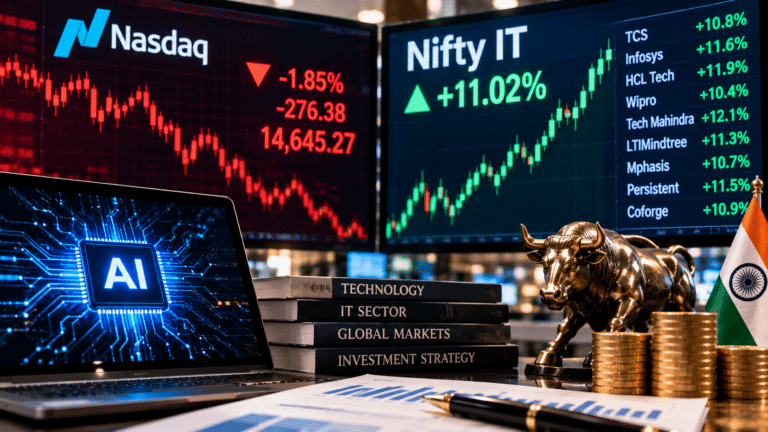
US tech had its worst day since July on 14 October as investors dumped AI infrastructure stocks. Indian IT went the other way, rising about 11% in five sessions on better results and a rotation of money. Here is why, and what decides whether it lasts.
- CoreWeave, 14 Oct-15%
- Oracle, 14 Oct-9%
- Kospi, 15 Oct-8%
- HCLTech, 5 sessions+14%
- TCS, 5 sessions+13.7%
- Nifty IT, 15 Oct+2.28%
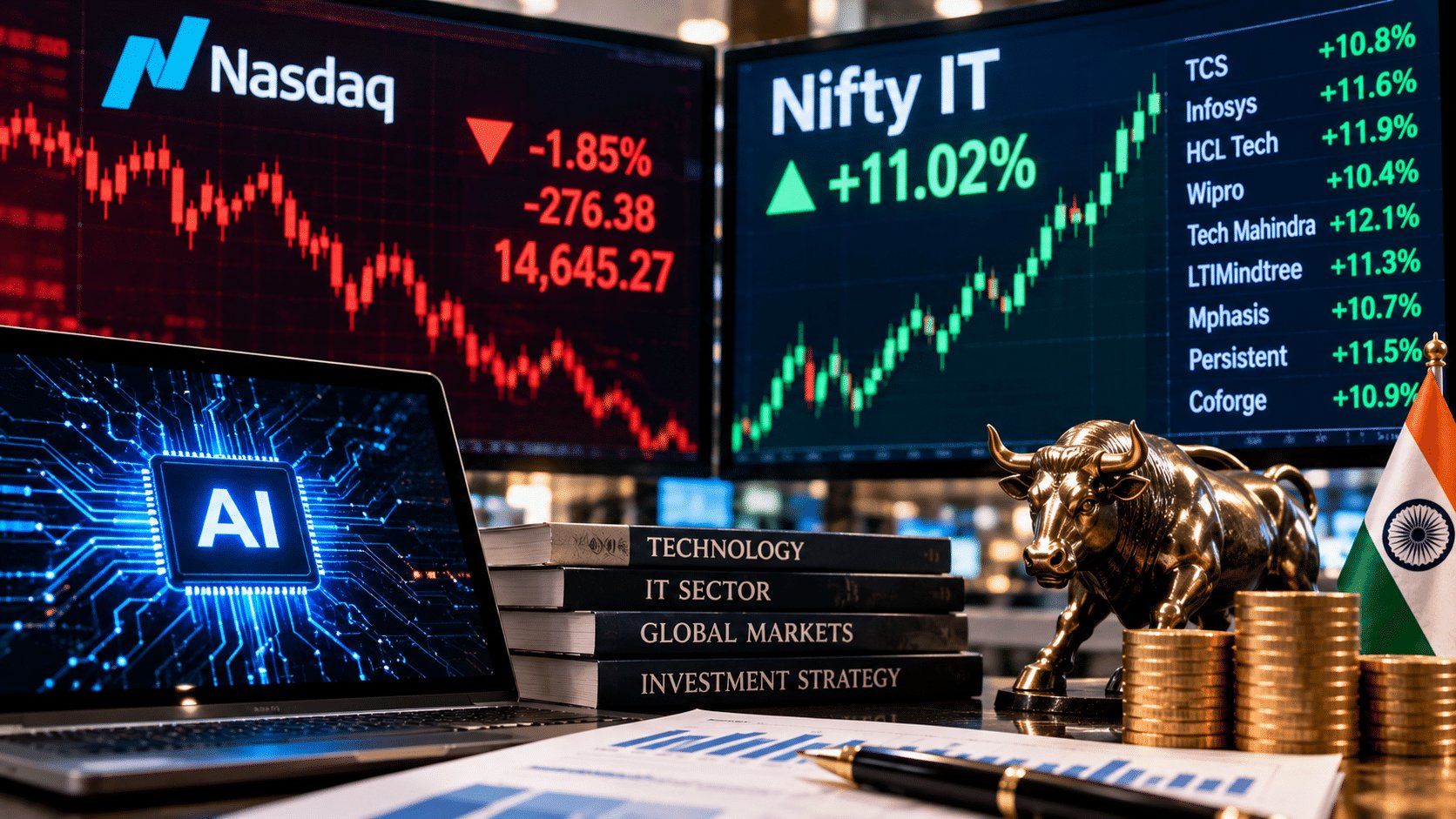
For two years the rule was simple. When the Nasdaq sneezed, Indian IT caught a cold. Both trade on the same theme, technology spending by American companies, and both are owned by the same global funds. So when the Nasdaq Composite slid on Wednesday 14 October in its worst session since July, Indian IT investors braced for another bad morning.
It did not come. The Nifty IT index rose 2.28% on Thursday to 30,858, its fourth gain in five sessions, taking its rise over that stretch to nearly 11%. HCLTech, TCS, Infosys and Tech Mahindra were among the top gainers on the Nifty 50. The question now on every investor’s screen is whether this is the start of a recovery for a sector down more than a quarter this year, or a short bounce that the next US shock will erase.
What We Know
- The Nasdaq and S&P 500 had their biggest one-day fall since July on 14 October; the Nasdaq was more than 4% below last week’s record by 15 October.
- CoreWeave fell 15% on 14 October and Oracle nearly 9%, on worries about AI infrastructure debt.
- The Nifty IT index rose 2.28% to 30,858 on 15 October, up nearly 11% in five sessions.
- HCLTech raised its FY27 revenue growth guidance to 2.5% to 4% in constant currency.
What Is Still Unclear
- Whether the Federal Reserve will raise rates again after hotter US inflation data.
- Whether foreign investors are buying Indian IT or only cutting short positions.
- How Infosys, Wipro and Tech Mahindra’s Q2 results and guidance will land.
- Whether US clients will cut discretionary IT spending in 2027.
What Actually Broke on the Nasdaq
The selloff was not a broad collapse of American business. It was concentrated in companies building and financing artificial intelligence infrastructure, with an inflation scare on top. On Thursday morning the Nasdaq Composite was down 1.06% at 26,409.80, near a one-month low, while the Dow was up 0.32% at 51,785.06, supported by defensive healthcare and consumer staples stocks, according to a Reuters report carried by Business Recorder.
Two triggers at once
The first was debt. Investors have grown nervous about how AI data centres are being financed. “The repricing of CoreWeave’s debt suggests that investors are becoming less willing to finance AI infrastructure growth,” Charu Chanana, chief investment strategist at Saxo, told Reuters. The second was inflation. US consumer prices rose at the fastest pace in five months and producer prices by the most in four and a half years, and traders raised bets that the Federal Reserve under Chair Kevin Warsh would raise rates again, even though it held them in October.
Asia felt it hardest. South Korea’s Kospi fell 8% on Thursday and triggered a trading halt, with Samsung Electronics and SK Hynix each down about 10%, Kotak Neo reported. SK Hynix is now nearly 60% below its June peak. The MSCI Asia Pacific index fell 3.1%.
Why Indian IT Went the Other Way
Indian IT firms are not AI infrastructure companies. They do not build chips, own data centres or borrow heavily to fund them. They sell services: software maintenance, cloud migration, consulting and, increasingly, AI implementation. That difference is why a selloff aimed at AI hardware and its financing did not hit them in the same way.
The rotation trade
For most of 2026 the market treated AI as a threat to Indian IT: if software agents can write code and run support desks, clients may need fewer outsourced engineers. Money flowed out of Indian IT and into the companies building AI. Kotak Neo noted that foreign investors had been selling Indian shares while adding AI-linked exposure elsewhere. When AI stocks started falling, some of that money looked for sectors that had already been punished, and Indian IT, down more than 25% this year, fit the description.
Results that beat a low bar
The rotation needed a reason, and HCLTech supplied it. Its September-quarter net profit rose 21.2% to ₹5,132 crore, ahead of the ₹4,963 crore expected in a CNBC-TV18 poll. It raised its FY27 revenue growth guidance to 2.5% to 4% in constant currency, from 1% to 4%, and its advanced AI revenue grew 78% year on year to $219 million. It also added 6,450 employees, its biggest quarterly hiring in 16 quarters. TCS reported annualised AI revenue above $3 billion, more than 10% of its total.
The Hole the Rally Is Climbing Out Of
Context matters. An 11% rise sounds large, but it starts from a deep low. Outlook Money reported that the Nifty IT index was still more than 26% below its 52-week high, reached in early February 2026, and trading near levels last seen about three years ago. Individual stocks have fared even worse this year.
The Nifty IT figure of minus 23% comes from Kotak Neo’s report of 13 October, before the latest two days of gains. The recovery maths are unforgiving: a stock down 26% needs to rise about 35% just to get back to where it started the year. Even the strongest five-session run in months has recovered less than half of that ground for most names.
The AI question has not gone away
The deeper debate about Indian IT is not settled by one good week. The worry that drove this year’s fall was structural: if generative AI tools let clients automate testing, maintenance and support, the volume of billable work could shrink even as each project becomes more valuable. The Q2 numbers offer evidence on both sides. HCLTech and TCS are growing AI revenue quickly, and HCLTech hired at its fastest pace in four years. Yet TCS’s overall growth of 0.5% shows that new AI work is not yet large enough to offset slower traditional business. Accenture, the sector’s global bellwether, has outlined a three-year plan to move closer to $100 billion in annual revenue through legacy technology overhauls, a sign that the largest clients still need help modernising old systems. That is the kind of work Indian firms win.
Will the Rally Continue? Four Things That Decide It
There is no reliable way to predict a sector’s next move. What can be done is to identify the factors that would make a recovery more or less likely, and watch them.
1. US interest rates
Hotter US inflation raises the odds of another Federal Reserve rate rise. Higher rates make borrowing dearer for American companies and usually lead them to delay discretionary technology projects, which is where Indian IT earns its higher margins. The US 10-year Treasury yield was at about 5.07% on Thursday, a three-week low, as money moved into bonds, but still high by the standards of the past decade.
2. Earnings and guidance
HCLTech’s raised guidance was the trigger. TCS, by contrast, grew revenue just 0.5% in constant currency quarter on quarter, slightly below expectations, though the CNBC-TV18 report also cited $9.6 billion of deal wins. Wipro and Tech Mahindra were due to report later on 15 October, with Infosys’s results expected soon. Ajit Mishra of Religare Broking told Outlook Money that TCS’s AI revenue and deals were “reinforcing confidence in demand for AI-led services,” but cautioned that the rally does not confirm a sustained recovery in IT spending.
3. Foreign investor flows
Foreign portfolio investors have sold a net ₹3.08 lakh crore of Indian shares in 2026, much of it to buy AI-linked stocks abroad. If that trade unwinds, Indian IT, a large and liquid sector, is a natural destination. But Kotak Neo’s experts cautioned that a reversal is “not guaranteed.”
4. Valuations
The fall this year has made Indian IT cheaper. “The correction has improved entry valuations across IT stocks,” Mishra said. Cheaper is not the same as cheap if growth stays near zero, which is why analysts quoted by Outlook Money advised selective, staggered buying rather than aggressive entry. Ravi Singh of Master Capital Services warned that valuations alone may not sustain a recovery.
Q2 Scorecard: Where Each Major Stands
| Company | Price, 15 Oct | Year to date | Latest signal | What to watch |
|---|---|---|---|---|
| HCLTech | ₹1,372.60, up 3.4% | Not reported | Profit up 21.2%; guidance raised to 2.5 to 4% | Margins at 17.5 to 18.5% range |
| TCS | ₹2,362, up 2.5% | -26% | 0.5% cc growth; AI revenue above $3 billion | Deal wins converting into revenue |
| Infosys | ₹1,113.95, up 2.4% | -31% | Q2 results pending | FY27 guidance revision |
| Wipro | ₹173.84, up 1.7% | -34% | Q2 results due 15 October | Return to revenue growth |
| Tech Mahindra | ₹1,622.80, up 3% | Positive | Q2 results due 15 October | Margin turnaround progress |
| LTIMindtree | Not reported | -29% | Rose with the sector | Large deal ramp-ups |
Prices are intraday levels reported by Kotak Neo and CNBC-TV18 on 15 October 2026 and will differ from closing prices.
What Investors Can Do Now
- Do not chase a five-day move. After an 11% jump, short-term pullbacks are common; staggering purchases over 4 to 8 weeks reduces timing risk.
- Read guidance, not just profit. A raised revenue outlook, like HCLTech’s, says more about the next year than a single quarter’s profit beat.
- Watch the cause of US moves. AI-valuation selloffs have helped Indian IT this week; recession-driven selloffs would not.
- Check your existing exposure. Large-cap and index funds usually already hold a sizeable IT weight; check your fund factsheets before adding directly.
- Keep a long horizon. Recovering a 26% fall needs a 35% rise; that usually takes quarters, not sessions.
- Nifty IT holding above its pre-rally level for 2 or more weeks
- 2 or more of the top 5 firms raising FY27 guidance
- Foreign investors net buyers of IT for a full month
- US Fed holding rates at its next meeting
- AI revenue growth above 50% a year at large firms
- Deal wins converting into revenue within 2 to 3 quarters
Five Sessions That Turned Indian IT
- 8 OctTCS reports Q2: profit ₹13,884 crore, 0.5% constant-currency growth, AI revenue above $3 billion.
- 13 OctNifty IT rises nearly 5% as HCLTech jumps over 7% after results; Kospi falls 5.46%.
- 14 OctNasdaq and S&P 500 have worst day since July; CoreWeave falls 15%, Oracle nearly 9%.
- 15 OctNifty IT up 2.28% to 30,858, nearly 11% in five sessions; Kospi falls 8%.
- NextWipro, Tech Mahindra and Infosys results, US Fed commentary, Indian market reaction.
Frequently Asked Questions
Why is the Nasdaq falling in October 2026?
Investors sold AI infrastructure and chip stocks on worries about how AI data centres are financed, after CoreWeave fell 15% and Oracle nearly 9% on 14 October. Hotter US inflation data also raised expectations of further Federal Reserve rate rises.
Why are Indian IT stocks rising when the Nasdaq is falling?
The selloff targeted AI hardware and its financing, not IT services. Money rotated from AI stocks into sectors that had already fallen, such as Indian IT, and strong HCLTech results and raised guidance gave investors a reason to buy.
How much has the Nifty IT index risen recently?
It rose 2.28% to 30,858 on 15 October 2026, its fourth gain in five sessions, for a rise of nearly 11% over that period. It is still more than 26% below its February 2026 high.
Is it a good time to buy Indian IT stocks?
Valuations are lower after a steep fall, and results from HCLTech were encouraging, but growth at TCS remains weak and US rates may rise. Many analysts suggest selective, staggered buying rather than investing all at once.
What were HCLTech’s Q2 FY27 results?
Net profit rose 21.2% to ₹5,132 crore and revenue 11.5% to ₹35,620 crore. HCLTech raised its FY27 revenue growth guidance to 2.5% to 4% in constant currency and reported advanced AI revenue of $219 million, up 78% year on year.
How did TCS perform in Q2 FY27?
TCS reported net profit of ₹13,884 crore and revenue of ₹73,188 crore, up 1.3% quarter on quarter. Constant-currency growth was 0.5%, slightly below estimates, and annualised AI revenue crossed $3 billion.
How do US interest rates affect Indian IT stocks?
Indian IT earns much of its revenue from US clients. Higher US rates raise borrowing costs and often lead companies to delay discretionary technology projects, which can slow revenue growth for Indian IT firms.
Which Indian IT stocks have fallen most in 2026?
As of 15 October 2026, Wipro was down about 34% for the year, Infosys 31%, LTIMindtree 29% and TCS 26%, according to CNBC-TV18. Tech Mahindra was reported as positive for the year.
The Short Version
The Nasdaq’s fall this week was about AI infrastructure debt and valuations, plus an inflation scare, not a collapse in IT services demand. That let Indian IT rally nearly 11% in five sessions, helped by HCLTech’s raised guidance and money rotating out of AI stocks. But the sector is still more than 26% below its February high, TCS grew just 0.5% last quarter, and a Fed hike or US budget cuts could reverse the move. A recovery is possible, not proven. Staggered buying and close attention to guidance make more sense than chasing the bounce.