Is No-Cost EMI Really Free? The GST, Fees and Lost Discounts Hidden in ‘0%’ Offers — and When It Still Makes Sense
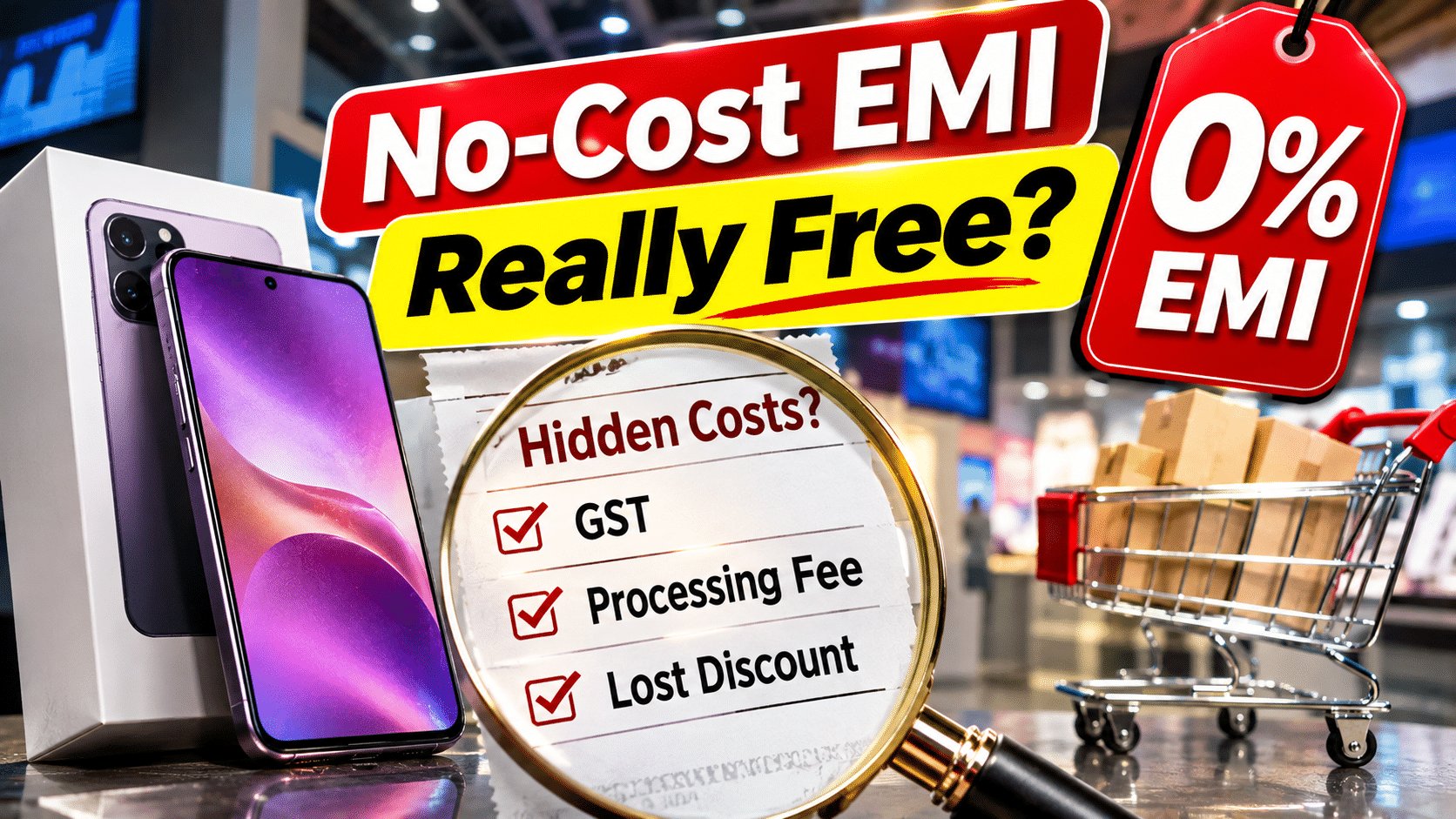
No-cost EMI is not an interest-free loan. The bank charges interest and the seller refunds it as a discount, but you still pay 18% GST on that interest, a processing fee and, often, the price of a cash discount you gave up.
What the banner says
₹744What a ₹60,000, 6-month no-cost EMI can actually cost (our calculation)
The phone costs ₹60,000. The checkout page offers “No-Cost EMI: ₹10,000 a month for 6 months.” Six times ten thousand is sixty thousand, so it looks like the bank is lending you the money for free. Then the card statement arrives with a line for interest, a line for an interest discount, a processing fee and a GST charge you never saw at checkout.
No-cost EMI is one of the most effective marketing ideas in Indian retail, and one of the least understood. It is not a scam, and sometimes it is genuinely the cheapest way to pay. But it is never free. This piece explains exactly how the money moves, what each hidden cost is worth in rupees, and the simple test that tells you at checkout whether the offer is good.
What “No-Cost” Actually Means on Paper
On September 25, 2013, the RBI issued a notification telling banks to stop zero percent interest schemes on consumer goods, saying the concept “is non-existent,” Business Standard reported at the time. The RBI noted that in such schemes the interest was often “camouflaged” and recovered through processing fees, and said that where a discount exists, the loan should be based on the discounted price rather than hidden in a lower interest rate.
Today’s no-cost EMI is the industry’s answer to that rule. The bank lends you the full price at its normal card EMI rate. The seller or brand then gives you an upfront discount equal to the total interest, so the EMIs add up to the original price. Business Today’s example illustrates it: on a ₹30,000 product with ₹1,500 of interest over three months, the price is discounted to ₹28,500 and the interest on that brings the total back to ₹30,000.
What the advert implies
- The bank lends at 0%
- Total paid equals the price
- No fees, no tax
- Same as paying cash, just slower
What actually happens
- The bank charges 10% to 26% a year, depending on issuer and customer
- The seller funds a discount equal to the interest
- 18% GST is charged on the interest and not refunded
- A processing fee plus GST is often added
The Four Hidden Costs, in Rupees
1. GST on interest that never reached you
Interest on a card EMI is a financial service, and the bank charges 18% GST on it. Under a no-cost EMI the interest is refunded as a discount, but the GST on that interest is not, indiaemi.com’s explainer notes. On ₹60,000 over six months at 16%, the interest is ₹2,831 and the GST about ₹510 by our calculation.
2. Processing fees, plus GST on those
Most banks charge a processing fee on EMI conversions, with GST on top, and do not usually waive it for no-cost offers. Issuer terms compiled by indiaemi.com show wide variation: HDFC up to ₹999, SBI Card 1% or ₹2,000 whichever is less, ICICI up to 2%, Axis 2% with a ₹250 minimum and Kotak up to 3.5%, each plus GST. Some no-cost EMI offers instead carry a small flat fee such as ₹199.
3. The discount you gave up
Retailers and card issuers often run instant discounts for full payment that are not available, or are smaller, on EMI. When the no-cost EMI’s discount is merely funding interest, the real comparison is with the lowest full-payment price, not the sticker price.
4. Credit limit and credit score
The whole purchase amount is usually blocked on your card limit at once and released as you pay EMIs. A ₹60,000 purchase on a ₹1 lakh limit uses 60% of the limit immediately, which can weigh on your credit score while it lasts. Miss an EMI and many issuers cancel the no-cost benefit and charge full interest and late fees.
What Issuers Charge Behind the Banner
The interest rate under a no-cost EMI matters because GST is calculated on it: the higher the rate, the higher the GST you pay. Issuer terms compiled by indiaemi.com show the range.
What shoppers often get wrong: they compare the no-cost EMI total with the sticker price and conclude it is free. The right comparison is with the best price you could pay today in full, after every instant discount and cashback. If full payment is ₹2,000 cheaper and the EMI’s hidden cost is ₹744, the EMI costs you ₹2,744.
The Money Maths Across Purchases and Tenures
The hidden cost grows with both the price and the tenure, because GST is charged on a bigger interest bill. The table shows our calculation for three purchase sizes, at 16% interest with a ₹199 fee plus GST, and no lost discount.
| Purchase price | 3 months | 6 months | 9 months | 12 months |
|---|---|---|---|---|
| ₹30,000 | ₹379 (1.26%) | ₹490 (1.63%) | ₹601 (2.00%) | ₹714 (2.38%) |
| ₹60,000 | ₹524 (0.87%) | ₹744 (1.24%) | ₹968 (1.61%) | ₹1,194 (1.99%) |
| ₹1,00,000 | ₹717 (0.72%) | ₹1,084 (1.08%) | ₹1,456 (1.46%) | ₹1,833 (1.83%) |
| Annualised cost, ₹60,000 | 5.24% | 4.25% | 3.87% | 3.67% |
| Annualised cost, ₹30,000 | 7.59% | 5.60% | 4.81% | 4.39% |
Percentages in brackets are the hidden cost as a share of the price. Annualised cost divides the hidden cost by the average balance outstanding over the tenure. For small purchases, the flat fee weighs heavily, which is why a ₹30,000 item over 3 months has the highest annualised cost in the table.
Worked example (our calculation): a ₹60,000 phone is offered as no-cost EMI for 6 months, or for ₹57,000 with a ₹3,000 instant discount if paid in full. Under the EMI, you pay ₹60,000 plus ₹744 in GST and fees, or ₹60,744. Paying in full costs ₹57,000. The “free” EMI costs ₹3,744 more, an effective price premium of about 6.6%. Had both options carried the same ₹3,000 discount, the EMI would cost just ₹744 more, which may be worth it to keep ₹57,000 in your savings for six months.
When No-Cost EMI Is Genuinely Worth It
No-cost EMI can be a sensible choice. The decision comes down to three numbers: the hidden cost, any discount you lose, and what your money earns elsewhere in the meantime.
- Ask at checkout for the exact processing fee and the interest rate used, since GST depends on both.
- Check whether the same instant discount or cashback applies to full payment and to EMI.
- Prefer the shortest tenure you can comfortably afford; the hidden cost rises with tenure.
- Make sure the EMI fits within your monthly budget so that no instalment is missed.
- Read the statement after the first EMI and confirm the interest discount has been credited.
When to walk away
Skip the EMI if paying in full gets a bigger discount than the EMI’s hidden cost, if the purchase would push card utilisation above about a third of your limit for months, or if you are financing something you could not otherwise afford. The RBI’s concern in 2013 was that such schemes “lure and exploit vulnerable customers,” and that risk is highest when an EMI turns a want into a monthly obligation.
Does Keeping Your Cash Invested Beat the Hidden Cost?
The strongest argument for no-cost EMI is that your money can earn something while you pay in instalments. That argument can be tested with arithmetic.
Opportunity-cost test (our calculation): on a ₹60,000 purchase over 6 months, the money you would have spent upfront is released gradually, so on average about ₹35,000 stays in your account over the period. At an assumed 6% a year in a savings or liquid option, that earns about ₹1,050 before tax. Against a hidden cost of ₹744, the EMI comes out about ₹306 ahead. For someone in the 30% tax slab, the post-tax earning is about ₹735, so the two options roughly break even. Any lost cash discount tips the result decisively towards paying in full.
In other words, a no-cost EMI with no lost discount is close to neutral for most people, slightly positive for those whose spare cash earns well and is taxed lightly, and clearly negative once a full-payment discount is on the table. It is rarely the windfall the banner suggests.
Who Actually Pays for the “Free” Interest
The interest discount has to come from somewhere. It is usually funded by the brand, the retailer or the marketplace as a sales cost, in the same way a cashback or exchange offer is. That has two consequences for shoppers.
- The price may not be the lowest available. A seller funding no-cost EMI may offer smaller instant discounts or no further price cuts on the same product.
- Availability is selective. No-cost EMI is often limited to certain products, brands, cards and tenures, which steers buyers towards those options.
- Terms can change at checkout. The fee, interest rate and eligible tenures are often shown only on the last payment screen.
None of this makes the offer dishonest. It means the “no-cost” label describes how the interest is offset, not the total cost to you. The only reliable way to judge it is to compare the final amount you will pay, including GST and fees, with the lowest price you could pay today.
No-cost EMI is still debt
Whatever the cost, an EMI is a loan that commits future income. Using it to buy something you need and could afford anyway is one thing; using it to stretch into a more expensive model is another. If several EMIs are running at once, the monthly total matters more than any single offer, and a missed instalment can turn a near-free loan into an expensive one.
Every EMI Statement Line, Decoded
| Statement line | What it is | Refunded under no-cost EMI? | Typical size on ₹60,000, 6 months |
|---|---|---|---|
| Principal | The purchase price financed | Not applicable | ₹60,000 over 6 EMIs |
| Interest | Bank’s normal EMI interest | Yes, via upfront or monthly discount | ₹2,831 at 16% |
| Interest discount or cashback | Seller-funded credit equal to interest | This is the refund | Minus ₹2,831 |
| GST on interest | 18% tax on the interest charged | No | ₹510 |
| Processing fee | One-time conversion fee | Usually no | ₹199 or more |
| GST on processing fee | 18% tax on the fee | No | ₹36 on a ₹199 fee |
| Foreclosure charge | Fee for closing the EMI early | No | Varies by issuer |
| Late fee and full interest | Charged if an EMI is missed | No; may cancel the offer | Varies by issuer |
How the Rules Around EMI Offers Developed
- Sep 25, 2013RBI tells banks to stop zero-percent EMI schemes and keep fees uniform.
- 2013RBI also bars extra charges on debit card payments at merchants.
- Jul 1, 2017GST introduced; financial services including card interest taxed at 18%.
- Mar 2025Business Today explains how no-cost EMI interest is offset by discounts.
- Jul to Sep 2026HDFC SmartEMI rates range from 10.08% to 24.96%, averaging 19.69%.
A Checkout Checklist for No-Cost EMI
Questions Shoppers Are Asking
Is no-cost EMI really free?
No. The bank charges interest, which the seller offsets with a discount, but you still pay 18% GST on that interest and usually a processing fee plus GST. On a ₹60,000 purchase over 6 months, that is about ₹744 by our calculation.
Why is GST charged on no-cost EMI?
Because the bank still charges interest, which is a taxable financial service at 18%. The discount refunds only the interest, not the GST on it.
What is the processing fee on no-cost EMI?
It varies. Some offers charge a flat fee such as ₹199 plus GST; standard EMI conversions can carry up to ₹999 or 1% to 3.5% of the amount, depending on the card issuer.
Does no-cost EMI affect my credit score?
It can. The full amount is usually blocked on your card limit, raising utilisation, and a missed EMI can attract late fees, full interest and a negative credit record.
Is it better to pay in full or use no-cost EMI?
Pay in full if the full-payment price is lower by more than the EMI’s GST and fees. If prices are the same, a short no-cost EMI can be reasonable for keeping cash invested, provided you never miss an instalment.
Did the RBI ban zero percent EMI?
In September 2013, the RBI told banks to stop zero-percent interest schemes on consumer goods, saying zero percent interest does not exist. Today’s no-cost EMI works by charging interest and offsetting it with a seller-funded discount.
Can I close a no-cost EMI early?
Usually yes, but issuers may charge a foreclosure fee, and any remaining interest discount may be lost. Check your card’s EMI terms before closing.
What happens if I miss a no-cost EMI payment?
Many issuers cancel the no-cost benefit and charge full interest and late fees, and the missed payment can hurt your credit score. Setting up auto-debit avoids this.
The Short Version
No-cost EMI is a real loan dressed as a discount. The bank charges interest; the seller refunds it; you still pay 18% GST on that interest, a processing fee and GST on the fee. On ₹60,000 over 6 months, that is about ₹744. The larger hidden cost is often a full-payment discount you forgo. Compare with the best full-payment price, keep tenures short, never miss an EMI, and remember the RBI’s own words: zero percent interest does not exist.