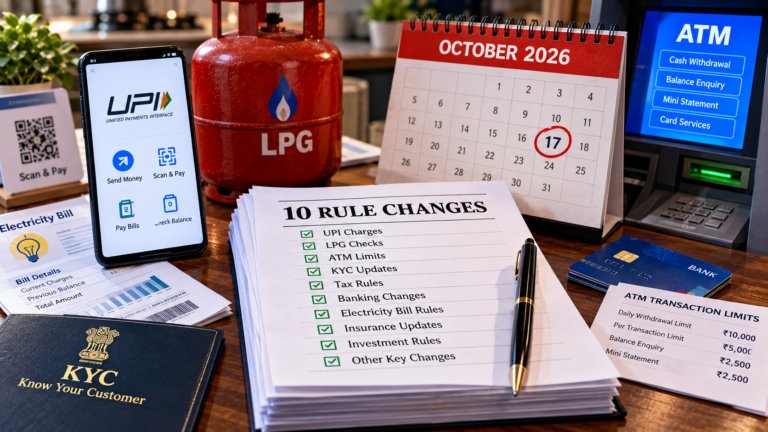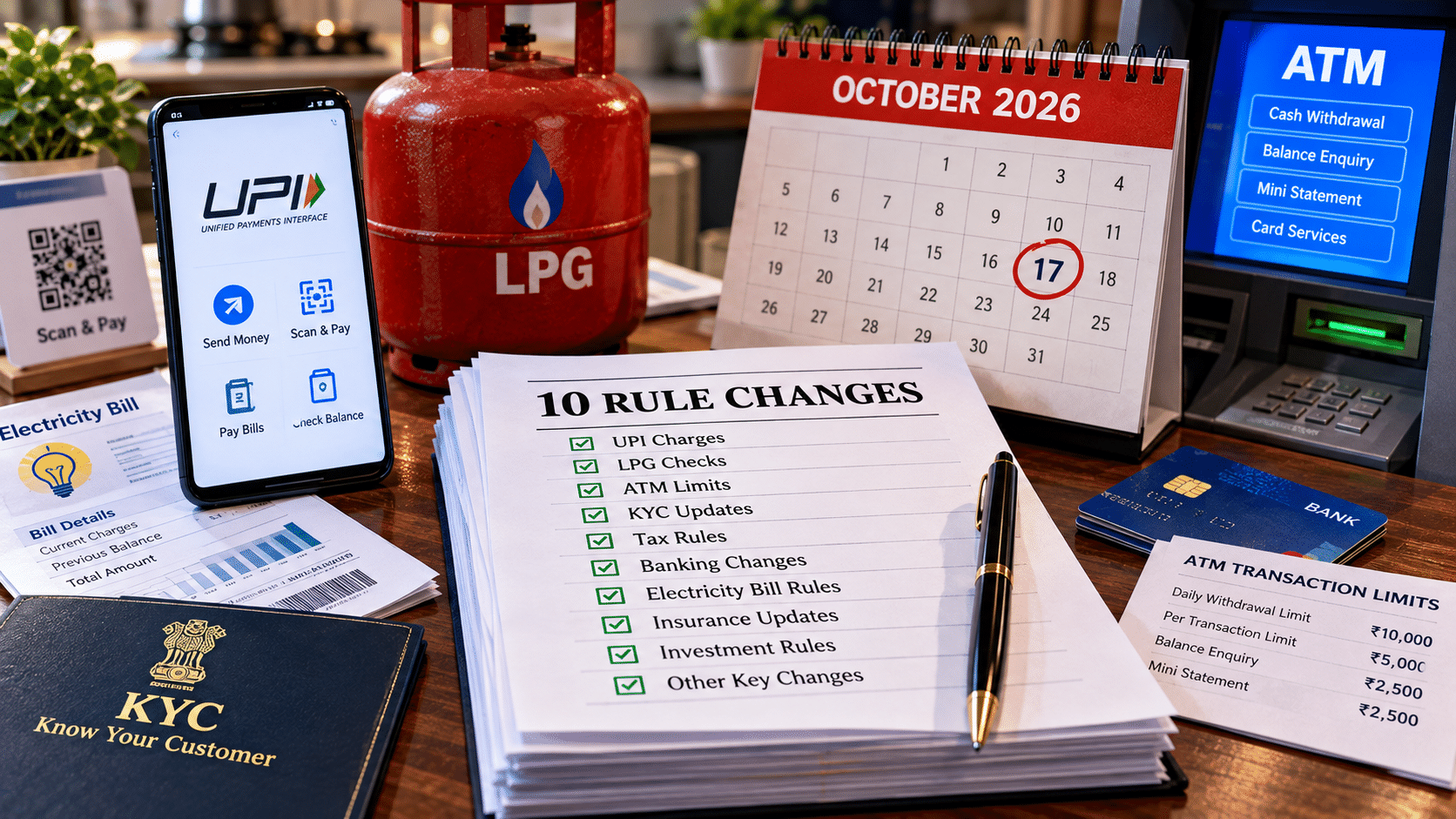
The 10 Rule Changes Already Shaping Your Money by 17 October — UPI Charges, LPG Checks, ATM Limits and More
No single new rule starts on 17 October. But ten changes that took effect on 1 and 15 October now apply to payments, cooking gas, ATM use, NPS, NRI property deals, exports and travel in Delhi-NCR.
Messages titled “10 new rules from 17 October” are circulating on WhatsApp this week. We went looking for the rules behind them. The honest finding: there is no batch of national rules that switches on on 17 October. What exists is a cluster of changes that began on 1 October, plus one large one, the new UPI merchant fee, that started on 15 October.
That distinction matters less than it sounds. By Saturday, all ten of these changes will be live, and several touch everyday money: what a shop pays when you scan its QR code, whether your subsidised gas cylinder can be booked, how many free ATM withdrawals you get, and what your NPS account costs. This guide sets out each rule, who it affects, what it costs, and what to do about it.
Quick Summary
Ten changes are in force by 17 October, but none of them adds a charge to ordinary UPI payments by consumers. Merchants now pay a 0.4% fee on UPI payments above ₹2,000, capped at ₹300. Subsidised LPG needs biometric Aadhaar authentication. SBI salary accounts get 5 free other-bank ATM transactions instead of 10. NRI property buyers no longer need a TAN. In Delhi-NCR, vehicles without a valid PUC certificate can be refused fuel.
What We Know
- UPI merchant discount rate applies from 15 October 2026 on specified payments above ₹2,000, paid by merchants.
- Biometric Aadhaar authentication for subsidised LPG refills became mandatory on 1 October.
- RBI’s bulk deposit rate disclosure rules and FEMA export amendments took effect on 1 October.
- PFRDA’s revised NPS charge structure and CBDT’s PAN-based TDS route for NRI property took effect on 1 October.
- Delhi-NCR’s “No PUCC, No Fuel” rule and Delhi’s Pink Saheli card requirement began on 1 October.
What Is Still Unclear
- The full list of sectors that pay the flat ₹5 UPI fee, and the concessional rate for schools and colleges.
- How strictly the PUC fuel rule is enforced outside Delhi’s 500 camera-equipped stations.
- The content of the new airfare rules the Centre has told the Supreme Court it will publish.
- Whether merchants will quietly pass the UPI fee on through prices, despite being barred from surcharging.
The Ten Changes at a Glance
Before the detail, here is the whole set on one screen. The “from” column is the date each rule actually began, not the date in the forwarded messages.
| Rule | From | Who it hits | Key number | What to do |
|---|---|---|---|---|
| 1. UPI merchant fee | 15 Oct | Merchants | 0.4%, cap ₹300 | Nothing, as a consumer |
| 2. SBI ATM limits | 1 Oct | SBI salary and BSBD accounts | 5 free; ₹23 + GST after | Use SBI ATMs |
| 3. LPG Aadhaar check | 1 Oct | Subsidised LPG users | 27.43 crore done | Authenticate once |
| 4. Commercial LPG price | 1 Oct | Hotels, eateries | ₹2,810 in Delhi | Expect menu pass-through |
| 5. Bulk FD rate disclosure | 1 Oct | Deposits of ₹3 crore or more | Published by 10 am | Check the bank website |
| 6. NPS charges | 1 Oct | NPS subscribers | ₹200 per PRAN; 0.20% a year | Consider e-NPS |
| 7. NRI property TDS | 1 Oct | Buyers from NRIs | PAN, not TAN | File Form 141 |
| 8. Export realisation | 1 Oct | Exporters | 15 to 9 months | Tighten collections |
| 9. No PUC, no fuel | 1 Oct | Delhi-NCR vehicles | 500 camera pumps | Renew PUC |
| 10. Pink Saheli card | 1 Oct | Women on Delhi buses | 19 lakh users | Get the card |
Your Phone Wallet: UPI and ATMs
Rule 1UPI is still free for you, but not for every shop
In force from 15 October 2026The biggest change of the month is the merchant discount rate, or MDR, on UPI. According to NPCI’s FAQ of 15 September, merchants now pay 0.4% on specified person-to-merchant payments above ₹2,000, capped at ₹300 per transaction. Payments of ₹2,000 or less carry no fee, and NPCI says those make up more than 95% of UPI merchant transaction volume. Person-to-person transfers remain free at any amount.
Small merchants receiving up to ₹1 lakh a month through UPI QR codes are exempt entirely. Railways, telecom, insurance and fuel payments above ₹2,000 attract a flat ₹5 instead, and capital-market payments such as mutual fund purchases pay 0.02%, also capped at ₹300. Crucially, merchants are not allowed to pass the MDR on to customers as a surcharge.
Why now? UPI has run at zero MDR for years, and banks and payment apps have argued that the infrastructure costs money to run. The new structure keeps everyday small payments free while charging larger merchants on bigger tickets, which is where card networks have always charged. Brokers have raised cost concerns about the fee with SEBI and NPCI, according to industry reports, and capital-market payments carry a far lower rate.
Rule 2SBI halves free ATM visits for salary accounts
In force from 1 October 2026State Bank of India has cut free transactions at other banks’ ATMs for all salary package accounts from 10 a month to 5, Outlook Money reported, and non-financial transactions such as balance checks now count toward that limit. Each extra cash withdrawal costs ₹23 plus GST and each extra non-financial transaction ₹11 plus GST. Basic savings bank deposit account holders get 4 free cash withdrawals a month at other banks’ ATMs, after which each costs ₹15 plus GST.
The simple fix is to use SBI’s own ATMs, where salary account holders keep their free usage, or to check balances in the YONO app rather than at a machine. A balance check at another bank’s ATM is now a wasted free transaction.
Your Kitchen: Two LPG Changes
Rule 3No biometric check, no subsidised refill
In force from 1 October 2026The Petroleum and Natural Gas Ministry made biometric Aadhaar authentication mandatory for booking subsidised domestic LPG refills from 1 October, News On Air reported. The aim is to stop diversion of subsidised cylinders to commercial use and weed out duplicate connections. 27.43 crore consumers have already completed it and need do nothing further. Those who have not can authenticate when the cylinder is delivered, at the distributor’s showroom, or through the oil marketing companies’ mobile apps.
The Delhi High Court is hearing challenges to the requirement, and has asked the government how it will handle elderly people and persons with disabilities whose fingerprints may not register. If a family member struggles with fingerprint authentication, the distributor’s showroom is the place to ask about alternatives.
Rule 4Commercial cylinders cost more for the festive season
In force from 1 October 2026Oil companies raised the price of the 19 kg commercial LPG cylinder by ₹62.50 in Delhi to ₹2,810, Angel One reported, with increases of up to about ₹71.50 in other cities. Domestic 14.2 kg cylinder prices were unchanged. This does not affect household budgets directly, but restaurants, sweet shops and caterers buy commercial cylinders, and the increase lands just as festive demand peaks.
Your Savings, Pension and Property
Rule 5Big deposits get published, same-day rates
In force from 1 October 2026RBI’s revised deposit interest rules require banks to publish their bulk deposit rates on their websites by 10 am each working day, with a grace period to 10:10 am, and to offer the same rate for similar deposits accepted on the same day across branches. For scheduled commercial banks and small finance banks, a single term deposit of ₹3 crore or more is generally a bulk deposit. The rules do not require banks to raise or cut any FD rate, and existing deposits keep their contracted rates.
Rule 6NPS fees now follow your PRAN
In force from 1 October 2026PFRDA’s revised charge structure sets a one-time onboarding charge of ₹200 per PRAN when joining through a point of presence, collected as ₹50 a quarter, or ₹100 for fully digital onboarding, Outlook Money reported. An annual charge of 0.20% of assets applies across schemes, deducted through the NAV, with dormant accounts exempt. The headline fee amounts are largely unchanged from March; what changed is that they now apply per PRAN rather than per new account. Subscribers who join and contribute directly through e-NPS pay no point-of-presence charges.
Rule 7Buying a flat from an NRI no longer needs a TAN
In force from 1 October 2026When a resident buys property from a non-resident seller, the buyer must deduct tax at source. Until now, that meant applying for a separate Tax Deduction Account Number just for one transaction. From 1 October, resident individuals and HUFs can use their PAN instead, reporting the deduction in a new Schedule E of Form 141 and issuing Form 132 to the seller, Business Standard reported. The obligation to deduct, deposit and certify the tax is unchanged; only the paperwork is lighter.
Rule 8Exporters get six fewer months to bring money home
In force from 1 October 2026RBI’s FEMA amendments cut the period for realising export proceeds from 15 months to 9 months, India Briefing reported, and from 18 months to 12 months for exports invoiced or settled in rupees. Exporters on RBI’s caution list as of 30 September stay under their existing orders. For small exporters, this tightens working capital: invoices that could earlier be chased for over a year now need to be collected within three quarters.
If You Live in Delhi-NCR: Two Travel Rules
Rule 9No valid PUC certificate, no petrol or diesel
In force from 1 October 2026Under the revised Graded Response Action Plan, vehicles without a valid Pollution Under Control certificate can be refused fuel across the National Capital Region. In Delhi, enforcement runs through 500 fuel stations equipped with automatic number plate recognition cameras, the Sunday Guardian reported. The revised plan lists 48 actions across four stages, 25 of them in Stage I, which are triggered as air quality worsens.
Rule 10Free bus rides for women now need a smart card
In force from 1 October 2026Women travelling free on DTC and cluster buses in Delhi must now tap a Pink Saheli smart card on the e-ticketing machine; the paper pink ticket ended on 30 September after an extension, PTI reported via ThePrint. Around 19 lakh women had used the card by mid-September. Those without one pay the regular fare, and the government has set up 50 authorised centres to issue cards.
What Comes Next on the Calendar
Several further changes are due in the coming weeks. None is in force yet, so treat these as dates to watch rather than rules to follow.
- 1 Oct9 of the 10 changes above take effect
- 15 OctUPI merchant fee of 0.4% begins
- 17 OctAll 10 changes live; nothing new starts
- 19 OctLIC’s 3 new plans open for sale
- Within 2 weeksCentre to publish airfare rules, it told the Supreme Court
- 1 NovNon-BS-VI petrol and diesel vehicles from outside Delhi barred
- 16 NovSupreme Court hearing on the airfare rules
- 10 Dec to 20 JanFull construction and demolition ban in Delhi-NCR
Where the Forwarded Messages Go Wrong
The pattern is familiar. Each month, real changes get bundled into a numbered list with a single date attached, and the date often drifts. The useful habit is to check the issuing body for each item: NPCI for UPI, the Petroleum Ministry for LPG, RBI for deposits and exports, PFRDA for NPS, CBDT for tax, and the Delhi government or CAQM for local rules.
Your listTen minutes this weekend
- LPG biometric authentication done, once per connection
- PUC certificate valid, if you drive in Delhi-NCR
- Other-bank ATM use kept to 5 a month on SBI salary
- Balance checks moved to app, not ATM
- NPS contributions routed via e-NPS to avoid PoP fees
- Seller’s residency checked before buying from an NRI
- Pink Saheli card collected from one of 50 centres
- UPI receipts above ₹2,000 checked for any surcharge
Frequently Asked Questions
What new rules start from 17 October 2026 in India?
No major national rule starts specifically on 17 October. The changes being shared took effect on 1 October, such as LPG Aadhaar authentication, SBI ATM limits and NPS charges, or on 15 October, the UPI merchant fee. All are in force by 17 October.
Is UPI payment chargeable from October 2026?
Not for consumers. From 15 October, merchants pay a 0.4% fee on specified UPI payments above ₹2,000, capped at ₹300. Payments of ₹2,000 or less and person-to-person transfers are free, and merchants may not add a surcharge.
Do I need to do Aadhaar authentication for my LPG cylinder?
Yes, if you want subsidised domestic refills and have not done it. It can be done at delivery, at the distributor or through the oil company app. The 27.43 crore consumers who have already authenticated need not repeat it.
How many free ATM transactions does SBI allow now?
From 1 October, SBI salary package accounts get 5 free transactions a month at other banks’ ATMs, down from 10. Extra cash withdrawals cost ₹23 plus GST. Basic savings accounts get 4 free cash withdrawals at other banks’ ATMs.
What are the new NPS charges from October 2026?
A one-time onboarding charge of ₹200 per PRAN through a point of presence, or ₹100 for fully digital onboarding, plus an annual asset-based charge of 0.20%. Dormant accounts are exempt from the asset charge.
Do I need a TAN to buy property from an NRI now?
No. From 1 October, resident individuals and HUFs can use their PAN to deduct and report TDS through Schedule E of Form 141, and issue Form 132 to the seller. TDS must still be deducted and deposited on time.
Can I get petrol without a PUC certificate in Delhi?
Under the No PUCC, No Fuel rule in force across Delhi-NCR from 1 October, vehicles without a valid PUC certificate can be refused fuel. Delhi enforces it at 500 stations with number plate cameras.
Is the Pink Saheli card mandatory for free bus travel in Delhi?
Yes. Since 1 October, women must tap a Pink Saheli smart card for free travel on DTC and cluster buses. Paper pink tickets ended on 30 September, and women without the card pay the regular fare.
The Short Version
There is no new rule that switches on on 17 October, but ten changes from 1 and 15 October are all live by then. The ones most people will notice: UPI stays free for you while bigger merchants pay up to 0.4%; subsidised LPG needs a one-time biometric Aadhaar check; SBI salary accounts get only 5 free other-bank ATM uses; NPS fees now apply per PRAN; and NRI property buyers can use PAN instead of TAN. Delhi-NCR residents also face PUC checks at fuel pumps and a smart card requirement for free bus travel.