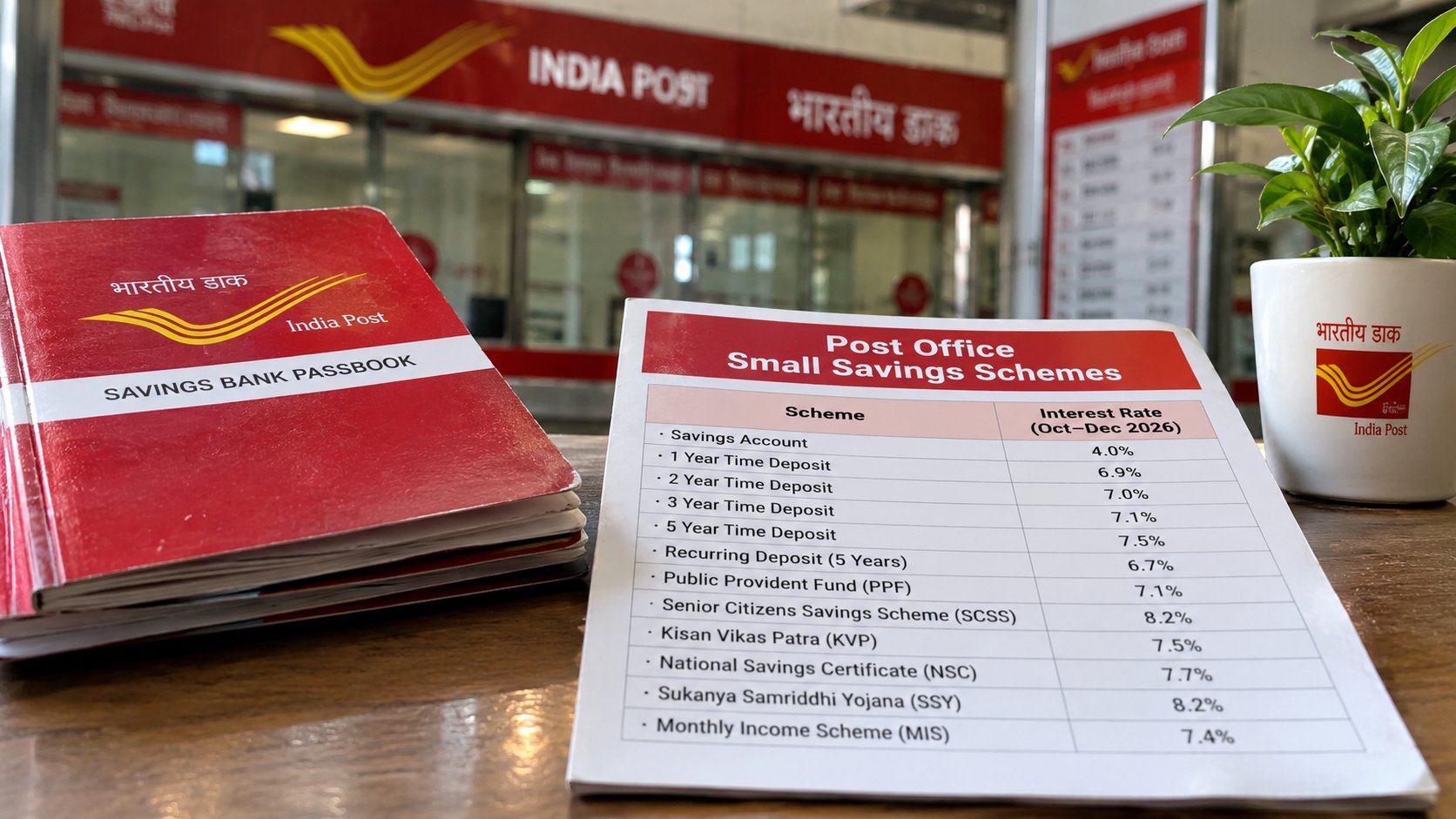
Post Office Small Savings Scheme Rates Stay Put for October to December 2026 — Which Ones Lock In and Which Ones Float?
Small Savings · Q3 FY 2026-27
Post Office Small Savings Scheme Rates Stay Put for October to December 2026 — Which Ones Lock In and Which Ones Float?
The Finance Ministry has left every post office small savings rate unchanged for the quarter that began on 1 October 2026. Senior citizens and Sukanya accounts keep the top rate of 8.2%, while PPF stays at 7.1%.
If you walked into a post office this week expecting a new rate chart on the wall, you would have found the old one still in place. On 30 September 2026 the government confirmed that interest on the Public Provident Fund, National Savings Certificate, Senior Citizens Savings Scheme and the rest of the small savings basket will not change for the October to December quarter. That sounds like a non-event. It is not, because an unchanged rate means something quite different depending on which scheme holds your money.
Some of these schemes freeze your rate on the day you deposit. Others reset every three months for everyone, including people who opened their accounts a decade ago. Knowing which is which decides whether this quarter is a window worth using or just another line in your passbook.
Quick Summary
All post office small savings scheme interest rates for 1 October to 31 December 2026 are the same as in the previous quarter. The highest rate is 8.2% on the Senior Citizens Savings Scheme and Sukanya Samriddhi Yojana, the National Savings Certificate pays 7.7%, PPF pays 7.1%, and the savings account stays at 4.0%. Fixed-tenure schemes lock today’s rate for their full term; PPF and Sukanya do not.
The Rate Card That Refused to Move
Small savings rates are reviewed once every quarter by the Department of Economic Affairs in the Finance Ministry. According to the notification reported by PTI on 30 September 2026, the rates for the third quarter of FY 2026-27 “shall remain unchanged” from those notified for July to September 2026. The schemes are operated mainly through post offices, and several are also available at authorised banks.
The freeze is now a long one. The last time any rate in this basket moved was for the January to March 2024 quarter, when the three-year time deposit and Sukanya Samriddhi were nudged up. Every quarterly review since April 2024 has ended the same way: no change.
What We Know
- The Finance Ministry issued its quarterly notification on Wednesday, 30 September 2026, keeping all small savings rates unchanged.
- The rates apply from 1 October 2026 to 31 December 2026, the third quarter of FY 2026-27.
- The Senior Citizens Savings Scheme and Sukanya Samriddhi Yojana both pay 8.2% a year.
- The National Savings Certificate pays 7.7%, Kisan Vikas Patra pays 7.5% and matures in 115 months, and the Monthly Income Scheme pays 7.4%.
- PPF remains at 7.1% and the post office savings account at 4.0%.
- Time deposits pay 6.9% for one year, 7.0% for two, 7.1% for three and 7.5% for five; the five-year recurring deposit pays 6.7%.
Twelve Rates, One Ladder: Where Each Scheme Sits
Seen side by side, the spread between the top and bottom of the ladder is 4.2 percentage points. The gap among the long-term options is much narrower: from PPF at 7.1% to the two 8.2% schemes is only 1.1 points, and that gap is partly explained by who is allowed to open each account.
The full rate card with tenure and payout pattern
The rate alone never tells the whole story. How often interest is compounded or paid out, and how long the money stays committed, matter just as much.
| Scheme | Rate (p.a.) | Interest pattern | Tenure | Rate type |
|---|---|---|---|---|
| Post Office Savings Account | 4.00% | Calculated daily, credited annually | No fixed term | Floats |
| 1-Year Time Deposit | 6.90% | Compounded quarterly, paid annually | 1 year | Locks |
| 2-Year Time Deposit | 7.00% | Compounded quarterly, paid annually | 2 years | Locks |
| 3-Year Time Deposit | 7.10% | Compounded quarterly, paid annually | 3 years | Locks |
| 5-Year Time Deposit | 7.50% | Compounded quarterly, paid annually | 5 years | Locks |
| 5-Year Recurring Deposit | 6.70% | Compounded quarterly | 5 years | Locks |
| Senior Citizens Savings Scheme | 8.20% | Paid quarterly | 5 years | Locks |
| Monthly Income Scheme | 7.40% | Paid monthly | 5 years | Locks |
| National Savings Certificate | 7.70% | Compounded annually, paid at maturity | 5 years | Locks |
| Public Provident Fund | 7.10% | Compounded annually | 15 years | Floats |
| Kisan Vikas Patra | 7.50% | Compounded annually | 115 months | Locks |
| Sukanya Samriddhi Yojana | 8.20% | Compounded annually | 21 years from opening | Floats |
The Detail Most Savers Miss: Does Your Rate Lock or Float?
This is the part that turns a quiet announcement into a decision. Small savings schemes fall into two families, and the quarterly notification affects them in opposite ways.
The practical consequence is simple. A retiree opening an SCSS account in November 2026 keeps 8.2% for five years even if the scheme rate is cut in January 2027. A PPF holder, by contrast, has 7.1% guaranteed only until the next review, on the full balance built up over the years.
Who gains from acting this quarter
Only savers who were already planning a fixed-tenure deposit. If you have a lump sum earmarked for SCSS, NSC, KVP, the Monthly Income Scheme or a time deposit, opening it by 31 December 2026 secures a known rate. If your money sits in PPF or Sukanya, the calendar gives you no edge.
What people get wrong about a rate freeze
An unchanged rate is not a reason to lock away money you may need. Fixed-tenure schemes carry premature-closure conditions and penalties, and losing access to cash usually costs more than a quarter-point difference in interest. Decide the tenure first and the rate second.
Why 7.5% Is Not Always 7.5%: The Compounding Effect
Two schemes on the card show the same headline number, 7.5%, yet do not earn the same amount in a year. Kisan Vikas Patra compounds once a year. The five-year time deposit compounds every quarter, which lifts what it actually pays over twelve months.
The arithmetic is short. A quarterly-compounded rate of 7.5% means 1.875% is added four times a year, and 1.01875 multiplied by itself four times gives 1.0771. So the five-year time deposit pays an effective 7.71% a year, or about Rs 7,714 on every Rs 1 lakh, which is the amount credited annually.
The Senior Citizens Savings Scheme and the Monthly Income Scheme work differently again. Their interest is paid out to you, quarterly and monthly respectively, and is not added back to the deposit. They are income products, so the stated rate is what you receive; nothing compounds unless you reinvest the payouts yourself.
How Long Until Your Money Doubles?
Kisan Vikas Patra is the only scheme that states its doubling time outright: 115 months, or 9 years and 7 months. The same test can be applied to every accumulating scheme, and it shows how wide the gap really is between the bottom of the ladder and the top.
Notice that the five-year time deposit, reinvested each time at the same rate, would double a little faster than Kisan Vikas Patra despite the identical headline rate. That is the quarterly compounding at work again.
What a Deposit Actually Pays: A Payout Lookup
Percentages are abstract. The table below converts this quarter’s rates into rupees for five deposit sizes across the four schemes people most often compare for a lump sum.
| Deposit | SCSS payout per quarter | MIS payout per month | NSC value after 5 years | KVP value after 115 months |
|---|---|---|---|---|
| Rs 1 lakh | Rs 2,050 | Rs 617 | Rs 1,44,903 | Rs 2,00,000 |
| Rs 5 lakh | Rs 10,250 | Rs 3,083 | Rs 7,24,517 | Rs 10,00,000 |
| Rs 9 lakh | Rs 18,450 | Rs 5,550 | Rs 13,04,130 | Rs 18,00,000 |
| Rs 15 lakh | Rs 30,750 | Rs 9,250 (joint account only) | Rs 21,73,551 | Rs 30,00,000 |
| Rs 30 lakh | Rs 61,500 | Above scheme limit | Rs 43,47,101 | Rs 60,00,000 |
Worked example: one cell, by hand
Take Rs 9 lakh in the Monthly Income Scheme. Annual interest is 9,00,000 multiplied by 7.4%, which is Rs 66,600. Divide by 12 and the monthly payout is Rs 5,550. Put the same Rs 9 lakh in SCSS and the yearly interest is Rs 73,800, paid as Rs 18,450 every quarter, which works out to Rs 6,150 a month on average. The senior citizen scheme pays Rs 600 a month more on this amount, but only eligible depositors can open it.
What regular saving adds up to
For monthly savers, a recurring deposit of Rs 5,000 a month for five years means Rs 3,00,000 paid in. At 6.7% compounded quarterly it matures at about Rs 3,56,829. In PPF, a deposit of Rs 1.5 lakh at the start of each year for 15 years totals Rs 22.5 lakh and would grow to roughly Rs 40.68 lakh if 7.1% held throughout, which it may not, because that rate floats.
From the Last Revision to the Next Review: A Timeline
How the government arrives at these numbers
The framework dates to the Shyamala Gopinath Committee, which recommended linking small savings rates to government bond yields of similar maturity, with a mark-up of 25 to 100 basis points. In practice the government also weighs other factors at each review, which is why the notified rates have not always followed the formula.
Tax in the Picture: Section 123 and the Regime Question
Interest is only half the return; tax treatment is the other half. Since 1 April 2026 the deduction savers knew as Section 80C is found in Section 123 of the Income-tax Act, 2025. The ceiling is still Rs 1.5 lakh a year, and it is still available only to those who choose the old tax regime.
- Deposits in PPF, Sukanya Samriddhi, the National Savings Certificate, the Senior Citizens Savings Scheme and the five-year time deposit qualify for the deduction under the old regime.
- PPF and Sukanya Samriddhi go further: their interest and maturity proceeds are tax-free.
- Interest from SCSS, the Monthly Income Scheme, time deposits and recurring deposits is taxable at your slab rate.
- Kisan Vikas Patra, the Monthly Income Scheme and the shorter time deposits carry no deduction on the amount invested.
For someone in the 30% slab, a taxable 7.5% shrinks to roughly 5.2% after tax, while PPF’s tax-free 7.1% stays 7.1%. That is why the lowest-looking long-term rate on the card is often the strongest in the hand for higher-bracket savers.
Matching a Scheme to a Goal
No single scheme wins on every count. The useful question is what the money is for and when it is needed.
Before you fill in the form
Two checks save trouble later. First, read the premature-closure rule for the scheme you choose, because each one treats early exits differently and some allow none in the first year. Second, add a nominee and keep your Aadhaar and PAN details updated on the account, since payouts and maturity credits depend on them. Every scheme here is backed by the Government of India, so the choice is about access and tax, not safety.
What Is Still Unclear
- The January to March 2027 rates. Nothing has been indicated. The next notification is expected around the end of December 2026, and it could go either way or stay flat again.
- How long the freeze has officially run. News reports differ on the count: PTI described this as the tenth straight unchanged quarter, while Business Today called it the ninth. What is not in dispute is that the last revision applied to the January to March 2024 quarter.
- Mahila Samman Savings Certificate. Some published rate lists for this quarter still show this two-year scheme at 7.5% compounded quarterly. It was introduced as a limited-period scheme with a deposit window ending 31 March 2025, so ask your post office whether new accounts are being accepted before planning around it.
- The wider interest-rate direction. Whether bank deposit rates and bond yields rise or fall over the coming months will shape the next small savings review, and that cannot be known today.
Frequently Asked Questions
What are the post office small savings scheme interest rates for October to December 2026?
For 1 October to 31 December 2026: SCSS 8.2%, Sukanya Samriddhi 8.2%, NSC 7.7%, Kisan Vikas Patra 7.5% (matures in 115 months), five-year time deposit 7.5%, Monthly Income Scheme 7.4%, PPF 7.1%, three-year time deposit 7.1%, two-year 7.0%, one-year 6.9%, five-year recurring deposit 6.7% and the savings account 4.0%. All are unchanged from the previous quarter.
Did the government change any small savings rate in October 2026?
No. The Finance Ministry notification of 30 September 2026 says the rates for the third quarter of FY 2026-27 remain unchanged from those notified for the second quarter. The last revision took effect in the January to March 2024 quarter.
Which post office scheme gives the highest interest rate right now?
The Senior Citizens Savings Scheme and Sukanya Samriddhi Yojana share the top rate of 8.2%. Both have eligibility conditions: SCSS is meant for people aged 60 and above, with some retirees eligible earlier, and Sukanya is opened in the name of a girl child below 10. For everyone else, the National Savings Certificate at 7.7% is the highest.
Is the PPF interest rate fixed for 15 years once I open the account?
No. The PPF rate floats. Whatever rate is notified for a quarter applies to the entire balance of every account, old or new. The current 7.1% is assured only up to 31 December 2026. Sukanya Samriddhi works the same way, so check the notification each quarter.
If rates are cut next quarter, will my existing NSC or SCSS earn less?
No. For the National Savings Certificate, Kisan Vikas Patra, SCSS, the Monthly Income Scheme and time deposits, the rate on the day of opening stays for the full original tenure. A later revision affects only accounts opened after it takes effect, so keep your certificate or passbook showing the opening date.
How much will Rs 1 lakh in a National Savings Certificate become after five years?
At 7.7% compounded annually, Rs 1 lakh grows to about Rs 1,44,903 at the end of five years. Interest is not paid out along the way; it accumulates and is paid with the principal at maturity. A Rs 10,000 certificate becomes about Rs 14,490.
How many months does Kisan Vikas Patra take to double money?
A Kisan Vikas Patra bought between 1 October and 31 December 2026 doubles in 115 months, which is 9 years and 7 months, at 7.5% compounded annually. The doubling period is fixed at the time of purchase and does not change with later notifications.
When will small savings interest rates be reviewed next?
Rates are reviewed every quarter. The notification for January to March 2027 is expected around the end of December 2026. Until it is issued, the current rates continue. Check the Department of Economic Affairs or India Post websites for the official order.
The Short Version
Nothing on the post office rate card changed on 1 October 2026, and that is the news. SCSS and Sukanya Samriddhi lead at 8.2%, NSC follows at 7.7%, and PPF holds at 7.1%. If you were already planning a fixed-tenure deposit, you have until 31 December 2026 to secure these rates for its full term. If your savings are in PPF or Sukanya, the rate will simply follow each quarter’s notification. Pick the scheme by purpose and tenure, then check the tax treatment, and only then compare the rate.