Post Office Monthly Income Scheme 2026: Can You Really Get ₹18,500 a Month — and Who Actually Qualifies?
Post Office Monthly Income Scheme 2026: Can You Really Get ₹18,500 a Month — and Who Actually Qualifies?
The Post Office MIS pays 7.4% a year for October to December 2026. A monthly payout of ₹18,500 needs ₹30 lakh, which is more than any one person or couple is allowed to deposit. Here is the real maths, the limits, and the combinations that do get you there.
The message usually looks the same: a smiling couple, a post office logo, and a promise of ₹18,500 every month for five years. For a retired couple worrying about household bills, or a family planning for a parent’s expenses, a guaranteed monthly cheque from the government sounds like exactly the answer.
The Post Office Monthly Income Scheme is real, backed by the Government of India, and genuinely pays a fixed amount every month. But the ₹18,500 figure hides a detail most forwards leave out. It needs ₹30 lakh in deposits, and the scheme’s limits mean a single person can put in at most ₹9 lakh and a couple, between them, at most ₹18 lakh. This guide explains what the scheme actually pays at each deposit level, why ₹18,500 is out of reach for most households through MIS alone, and the legitimate combinations that can get you close to it.
Quick Summary
Yes, ₹18,500 a month is possible, but not from one MIS account, and not for one couple through MIS alone. At the current 7.4%, ₹18,500 a month needs ₹30 lakh. The MIS caps each individual at ₹9 lakh across all their accounts, so ₹30 lakh needs at least four adults, for example two joint accounts of ₹15 lakh. A couple’s maximum is ₹18 lakh, or ₹11,100 a month. A senior citizen couple can reach ₹18,500 by adding the Senior Citizen Savings Scheme.
What We Know
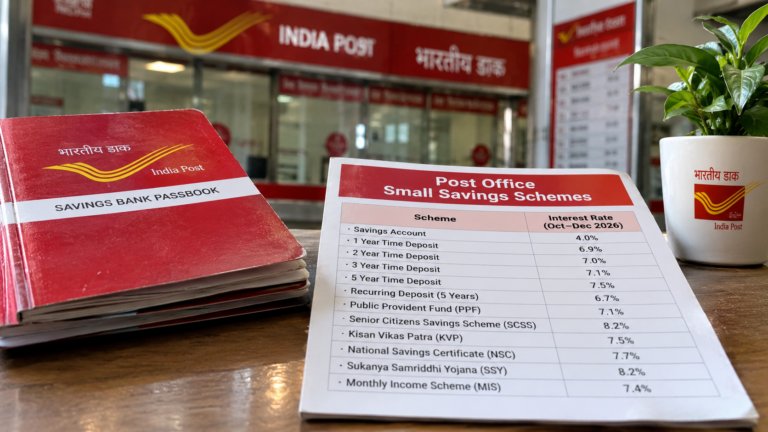
- On 30 September 2026, the Finance Ministry kept small savings rates unchanged for October to December 2026, with MIS at 7.4%.
- The minimum deposit is ₹1,000; the maximum is ₹9 lakh in a single account and ₹15 lakh in a joint account.
- Interest is paid every month for five years; the rate is fixed for the full term at the rate on the opening date.
- Premature closure is not allowed in the first year; after that, 2% or 1% of the deposit is deducted.
- Interest is fully taxable at your slab rate, with no Section 80C deduction on the deposit.
What Is Still Unclear
- Who first circulated the ₹18,500 figure, and which combination of accounts it assumed.
- What the MIS rate will be for January to March 2027, due to be announced by the end of December.
- Whether the higher interest-rate cycle after the RBI’s 7 October hike will lift small savings rates.
- One listing shows a ₹9.5 lakh single limit; India Post’s published limit remains ₹9 lakh.
The ₹18,500 Promise, Taken Apart
The scheme pays simple interest at an annual rate, split into 12 equal monthly payments. So the monthly income is always the deposit multiplied by 7.4%, divided by 12. That gives ₹617 a month for every ₹1 lakh. To reach ₹18,500, you need 30 times that, or ₹30 lakh. There is no bonus, no compounding and no hidden multiplier; the number comes from the deposit alone.
The problem is the ceiling. Since April 2023, the Post Office allows up to ₹9 lakh in a single account and ₹15 lakh in a joint account. The rule that matters most is less known: an individual can hold no more than ₹9 lakh across all their MIS accounts, and in a joint account each holder’s share is treated as equal. A couple with a ₹15 lakh joint account each holds ₹7.5 lakh, leaving ₹1.5 lakh of room each for single accounts. Their combined maximum is therefore ₹18 lakh, which pays ₹11,100 a month.
- ₹617Monthly income per ₹1 lakh at 7.4%
- ₹5,550Monthly on the ₹9 lakh single maximum
- ₹11,100Monthly on a couple’s ₹18 lakh maximum
- ₹18,500Monthly on ₹30 lakh, needing four adults
So where does ₹18,500 come from? It is exactly double the ₹9,250 a joint account pays at its ₹15 lakh limit. Two joint accounts of ₹15 lakh each would pay ₹18,500 between them, but because each person can hold only ₹9 lakh, those two accounts need four different adults, such as two couples, or parents with two adult children. That is a legitimate family arrangement, but the money is then shared income across four people, not a pension for one couple.
Why the limit is per person, not per account
The cap exists because small savings schemes are meant for ordinary savers, and the government pays above-market rates on them. Without a per-person limit, wealthy depositors could open many joint accounts and capture a large share of the subsidy. Post offices check the PAN and Aadhaar of each holder, so an attempt to exceed the limit through multiple accounts can be caught. The excess deposit would usually be refunded with only savings account interest, so it is not worth trying.
Five Routes to ₹18,500 a Month — and Who Each One Suits
If ₹18,500 a month is a genuine goal, there are honest ways to get there. Each depends on how many adults are involved, their ages and how much money the family has. The table compares the main routes using current rates.
| Route | Who it needs | Total deposit | Payout timing | Monthly equivalent |
|---|---|---|---|---|
| Two MIS joint accounts at ₹15 lakh | Four adults, each within ₹9 lakh | ₹30 lakh | Monthly | ₹18,500 |
| Couple’s full MIS plus SCSS | Couple, at least one aged 60 or above | ₹18 lakh MIS plus ₹10.83 lakh SCSS | Monthly and quarterly | ₹11,100 plus ₹7,400 |
| SCSS alone | One person aged 60 or above | ₹27.07 lakh | Quarterly, ₹55,500 | ₹18,500 |
| Bank FD, monthly payout, senior | Senior citizen, at SBI’s 7.05% for 5 to 10 years | ₹31.49 lakh | Monthly | ₹18,500 |
| Bank FD, monthly payout, regular | Anyone, at SBI’s 6.05% for 5 to 10 years | ₹36.69 lakh | Monthly | ₹18,500 |
For most retired couples, the second route is the practical one. They can each hold ₹9 lakh in MIS, for ₹11,100 a month, and one spouse aged 60 or above can put about ₹10.83 lakh into the Senior Citizen Savings Scheme at 8.2%, which pays ₹22,200 every quarter, equal to ₹7,400 a month. Together that reaches ₹18,500 a month on about ₹28.83 lakh. SCSS allows up to ₹30 lakh per person, so there is room to spare.
The Senior Citizen Savings Scheme quietly beats MIS
For anyone aged 60 or above, SCSS pays 8.2% against MIS’s 7.4%, allows up to ₹30 lakh per person, and offers a Section 80C deduction of up to ₹1.5 lakh on the deposit under the old tax regime. The trade-off is that SCSS pays quarterly rather than monthly. For a retiree, the simplest fix is to keep two or three months of expenses in a savings account, so quarterly receipts can cover monthly bills. On ₹10 lakh, SCSS earns ₹82,000 a year against ₹74,000 in MIS, an extra ₹8,000.
Where the RBI floating rate bonds fit
The RBI Floating Rate Savings Bonds pay 0.35 points above the NSC rate, currently 7.7%, giving 8.05%. They have no upper limit and are backed by the government, but they have a seven-year lock-in for most investors and pay interest every six months. They suit savers who have exhausted MIS and SCSS limits and can wait longer for their money.
What ₹18,500 Is Really Worth After Tax
MIS interest is fully taxable at your income tax slab. The scheme does not deduct TDS for resident depositors, according to India Post’s scheme guidance, so you must declare the interest yourself and pay any tax due. That catches many first-time investors at filing time.
For many retirees, the tax picture is gentler than this chart suggests. Under the new tax regime, income up to ₹12 lakh effectively pays no tax because of the rebate, and senior citizens under the old regime can claim up to ₹50,000 of deposit interest as a deduction under Section 80TTB. But someone with a pension plus MIS income in a higher slab keeps only about ₹12,728 of each ₹18,500 month.
The inflation clock is always running
The monthly MIS payout never changes during the five years. Prices do. Retail inflation was 5.54% in September 2026. If inflation stayed at that level, the buying power of a fixed ₹18,500 would fall to about ₹17,529 in a year, ₹15,737 in three years and ₹14,128 by the end of the five-year term. The deposit itself is also returned at its original value, so it buys less than when you put it in.
- Today₹18,500Monthly payout in today’s money
- Year 1₹17,529Buying power at 5.54% inflation
- Year 3₹15,737About 15% less than at the start
- Year 5₹14,128About 24% less by maturity
This is not a reason to avoid MIS, but it is a reason not to treat it as a complete retirement plan. A household that relies only on fixed payouts will feel steadily poorer over 10 or 20 years. Most financial planners suggest pairing fixed income with some growth assets, such as a balanced or equity fund, sized to the household’s comfort with risk.
Opening an MIS Account: From Form to First Payout
The process is simple and can be done at any post office. Existing India Post Payments Bank customers can open some accounts digitally. Here is how the timeline usually runs.
- Day 0Visit with KYCAadhaar, PAN and 2 photographs, plus the account form
- Day 0Deposit funds₹1,000 minimum, in multiples of ₹1,000
- Month 1First interestPaid one month after opening, then every month
- Years 1 to 5Monthly incomeCredited to your post office savings account
- Year 5MaturityDeposit returned in full after 5 years
Link the payout to a post office savings account
MIS interest is credited to a post office savings account, from where you can transfer it to your bank or set up a standing instruction. Interest left there earns only the savings rate of 4%. Some savers use a recurring deposit at the post office to reinvest the monthly income automatically. That turns MIS into a compounding plan, though the RD is a separate account with its own rules.
Need the Money Early? The Exit Penalty Map
MIS is designed to be held for five years, and the rules penalise early exits. The deduction is taken from the principal, not just from interest already paid.
- Year 0 to 1Exit not allowedLockedNo premature closure in the first 12 months, except on the depositor’s death.
- Years 1 to 32% of the deposit deducted₹30,000On a ₹15 lakh joint account; ₹18,000 on ₹9 lakh.
- Years 3 to 51% of the deposit deducted₹15,000On a ₹15 lakh joint account; ₹9,000 on ₹9 lakh.
Where the “Guaranteed Income” Story Goes Wrong
MIS is one of the safest products available to Indian savers, but a few misunderstandings come up again and again.
How safe is the money really?
MIS deposits are a direct obligation of the Government of India, which sets the rate each quarter and stands behind repayment. Unlike a bank FD, there is no ₹5 lakh insurance cap, because the government itself is the borrower. That makes MIS one of the few places where an amount above ₹5 lakh carries no credit risk. The remaining risks are inflation, tax and the opportunity cost of locking money for five years.
The rate has been flat for over three years
The MIS rate was 6.6% from April 2020, rose to 7.1% in January 2023 and to 7.4% from April 2023, when the deposit limits were also raised. It has stayed at 7.4% since. With the RBI raising the repo rate to 5.50% on 7 October 2026 and inflation at 5.54%, some savers expect higher small savings rates in coming quarters. But the government sets these rates on its own formula and timing, and no change has been announced. Anyone opening an account now locks 7.4% for five years, whatever happens next.
- Check each adult’s total MIS holdings stay within ₹9 lakh
- Remember a joint account splits equally between holders
- Seniors: compare SCSS at 8.2% before choosing MIS at 7.4%
- Keep 2 to 3 months of expenses in a savings account
- Declare MIS interest in your tax return every year
- Do not plan to exit in the first year; it is not allowed
- Add a nominee when you open the account
- Open only at a post office or India Post’s own channels
Frequently Asked Questions
Can I get ₹18,500 a month from the Post Office Monthly Income Scheme?
Only with a ₹30 lakh deposit, which is above what one person or one couple can hold. At 7.4%, a couple’s maximum of ₹18 lakh pays ₹11,100 a month. Reaching ₹18,500 needs four adults or a combination with the Senior Citizen Savings Scheme.
What is the Post Office MIS interest rate for October to December 2026?
7.4% a year, paid monthly. The government left it unchanged on 30 September 2026. The rate is fixed for five years at the level on the day you open the account.
What is the maximum investment in Post Office MIS?
₹9 lakh in a single account and ₹15 lakh in a joint account. An individual’s total across all MIS accounts, including their equal share of joint accounts, cannot exceed ₹9 lakh.
How much monthly income will I get on ₹15 lakh in Post Office MIS?
₹9,250 a month at 7.4%, before tax. On ₹9 lakh in a single account, the monthly income is ₹5,550.
Is Post Office MIS interest taxable?
Yes. It is taxed at your slab rate, and the deposit does not qualify for Section 80C. The post office does not deduct TDS for resident depositors, so you must declare the interest in your return.
Can I close a Post Office MIS account before 5 years?
Not in the first year. Between one and three years, 2% of the deposit is deducted; after three years, 1% is deducted.
Is Post Office MIS better than SCSS for senior citizens?
For most seniors, SCSS pays more: 8.2% against 7.4%, with a ₹30 lakh limit and a Section 80C benefit. MIS pays monthly, while SCSS pays quarterly. Many retirees use both.
Is Post Office MIS safe?
Yes. Deposits are backed by the Government of India, with no insurance cap. The risks are inflation, tax and the five-year lock-in, not default.
The Short Version
The Post Office MIS pays 7.4% for October to December 2026, which is ₹617 a month for every ₹1 lakh. ₹18,500 a month needs ₹30 lakh, but each person can hold only ₹9 lakh, so a couple tops out at ₹18 lakh and ₹11,100 a month. Families can reach ₹18,500 with four adults, or a senior couple can combine maximum MIS with about ₹10.83 lakh in SCSS at 8.2%. The income is fixed, government-backed and taxable, and its buying power shrinks with inflation, so treat it as one part of a retirement plan, not the whole of it.