Car Loan Interest Rates Across 25 Indian Banks — and Why the Cheapest Rate Is Rarely the Cheapest Loan
Money · Car Loans · India · August 2026
Car Loan Interest Rates Across 25 Indian Banks — and Why the Cheapest Rate Is Rarely the Cheapest Loan
The spread between the cheapest and dearest car loan on the Indian market right now is roughly 6.65 percentage points. On a ₹5 lakh loan over five years that is a difference of ₹1,651 every month and about ₹99,000 across the term, which is a used hatchback’s worth of interest decided by nothing more than which bank you walked into.
So comparing rates matters. But the advertised rate is a starting rate, offered to the strongest profiles, and it is only one line in a cost stack that also contains processing fees, tenure, loan-to-value limits and foreclosure terms. This piece lays out all 25 banks side by side, then shows the three decisions that move your total cost more than the rate does.
Quick Summary
Public sector banks hold the cheapest published rates, starting at 7.35% (UCO Bank), while large private banks start between 8.15% and 9.00%. The RBI repo rate has been unchanged at 5.25% since December 2025, so floating rates are stable for now. The rate you are offered depends mostly on your CIBIL score. And tenure costs more than rate: stretching a ₹8 lakh loan from five years to seven adds about ₹75,700 in interest.
What the rate table can and cannot tell you
Every rate below is a starting rate: the floor a bank publishes, reserved for borrowers with strong credit scores, stable salaried income and often an existing relationship with the lender. Several banks publish a range instead, and the top of those ranges tells you as much as the bottom. Punjab and Sind Bank starts at 7.50% but runs to 14%. IndusInd Bank starts at 8.00% and runs to around 20%.
The macro backdrop is unusually quiet. The Monetary Policy Committee held the repo rate at 5.25% on 5 August 2026, a unanimous decision and the fourth consecutive hold, with the last move being a cut from 5.50% in December 2025. For anyone on a repo-linked floating car loan, that means EMIs have not moved and are unlikely to move sharply in the immediate term.
All 25 banks, ranked by published starting rate
EMIs are calculated on a ₹5 lakh loan over five years on a monthly reducing balance, so they are directly comparable. Where a bank does not publish a retail car loan rate, that is stated rather than estimated.
| Bank | Sector | Starting rate p.a. | EMI on ₹5L / 5 yr | Note |
|---|---|---|---|---|
| UCO Bank | Public | 7.35% | ₹9,983 | Lowest published rate |
| Canara Bank | Public | 7.45% | ₹10,007 | 50% processing fee waiver to 30 Sep 2026 |
| Bank of Maharashtra | Public | 7.45% | ₹10,007 | 0.25pp concession for existing customers |
| Union Bank of India | Public | 7.50% | ₹10,019 | Processing fee capped near ₹1,000 |
| Punjab & Sind Bank | Public | 7.50% | ₹10,019 | Range runs to 14%; Apna Vahan Sugam fee concession |
| Indian Bank | Public | 7.50% | ₹10,019 | Among the lowest PSU starting rates |
| Indian Overseas Bank | Public | 7.55% | ₹10,031 | Nil processing fee |
| Punjab National Bank | Public | 7.60% floating | ₹10,043 | Fixed option from 8.60% |
| Bank of Baroda | Public | 7.60% floating | ₹10,043 | Fixed option from 8.50% |
| Bank of India | Public | 7.60% | ₹10,043 | Fee up to 0.25% of loan |
| Federal Bank | Private | 7.60% | ₹10,043 | Cheapest private bank; fee up to 1%, max ₹50,000 |
| IDBI Bank | Public | 7.75% floating | ₹10,078 | Fixed option from 8.65% |
| IndusInd Bank | Private | 8.00% | ₹10,141 | Range runs to about 20%; tenure capped at 60 months |
| HDFC Bank | Private | 8.15% | ₹10,174 | Fee ₹3,500 to ₹8,000; documentation ₹650 |
| ICICI Bank | Private | 8.35% | ₹10,222 | Step-up and flexible EMI structures |
| Central Bank of India | Public | 8.60% | ₹10,282 | Up to 90% of on-road price; fee up to 0.5%, max ₹20,000 |
| State Bank of India | Public | 8.80% | ₹10,331 | Largest branch network; up to 85-90% funding |
| Axis Bank | Private | 8.95% | ₹10,367 | Fast digital sanction for existing customers |
| Kotak Mahindra Bank | Private | 9.00% | ₹10,379 | Highest starting rate among large private banks |
| Bandhan Bank | Private | About 9.05% | ₹10,391 | Up to 90% on-road, ₹1 lakh to ₹1 crore; sources differ, verify |
| RBL Bank | Private | 12.00% to 14.00% fixed | ₹11,122 to ₹11,634 | Priced by car segment |
| Jammu & Kashmir Bank | Private | RLLR + 0.75% floating | Depends on RLLR | Fixed option at RLLR + 0.25% |
| Yes Bank | Private | Not published | Contact bank | Rate quoted on application |
| South Indian Bank | Private | Not published | Contact bank | Rate quoted on application |
| City Union Bank | Private | Not published | Contact bank | Rate quoted on application |
Read this before you screenshot the table
These are published starting rates as at 22-23 August 2026, gathered from bank schedules and aggregator compilations. They change without notice, sometimes weekly. Three banks in this list do not publish a retail car loan rate at all, and one (Bandhan) is quoted differently by different sources, which is exactly why the only rate that matters is the one in a written sanction letter with your name on it.
The public-private gap, and what it actually costs
Twelve of the thirteen cheapest lenders here are public sector banks. Federal Bank is the single private lender competing at PSU pricing. The gap between the cheapest PSU and the largest private banks is roughly 0.8 to 1.65 percentage points, which sounds small and is not.
Private banks do not compete on headline rate; they compete on speed, digital sanction and dealer-desk presence. That is a real benefit if you are buying this weekend. It is worth roughly ₹18,000 to ₹38,000 over five years on a ₹8 lakh loan, and you should decide consciously whether the convenience is worth that.
Fixed against floating: the choice hidden in the footnote
Four banks in the table publish both. PNB starts at 7.60% floating or 8.60% fixed, Bank of Baroda at 7.60% floating or 8.50% fixed, IDBI at 7.75% floating or 8.65% fixed, and J&K Bank prices off its repo-linked lending rate either way. The fixed option costs about one percentage point more.
That premium buys certainty. With the repo rate at 5.25% and held four meetings running, a floating borrower today is paying less and carrying the risk that rates rise later. Over a five-year car loan that risk is genuinely modest, because the loan is short and the balance falls fast. Over the seven-year tenures banks now push, it matters more.
Why car loans behave differently from home loans
Most private banks price car loans as fixed and most PSU banks as floating. On a home loan, a floating rate matters enormously because the tenure is twenty years and the balance stays high. On a five-year car loan against a depreciating asset, the tenure and the down payment shape your outcome far more than the fixed-floating choice does. Do not spend your negotiating energy here.
Your rate is set by your credit score, not the table
The published floor assumes a CIBIL score above 750. Below that, banks apply risk-based pricing that can add a full percentage point or more, and below 700 many will decline outright rather than reprice.
Best floor rate
Floor or near it
+0.25 to 0.50pp
+1 to 2pp
Often declined
Two mechanical points. Several banks offer women borrowers a concession of 0.05 to 0.25 percentage points, worth asking about explicitly because it is rarely volunteered. And multiple applications in quick succession each trigger a hard enquiry, so shortlist on published rates first and apply to two or three lenders, not eight.
Tenure is the expensive decision, not the rate
Banks now advertise tenures up to 84 months, and some up to eight years. The longer tenure lowers the EMI, which is what the finance desk will show you. Here is what it does to the total.
₹25,124
₹19,587
₹16,279
₹14,085
₹12,529
Moving from five years to seven cuts the EMI by ₹3,750 and adds ₹75,707 of interest. But the interest is not the real problem. The real problem is that a car loses value faster than a long loan repays.
Worked example: the window where you owe more than the car is worth
Take a ₹10 lakh on-road car with ₹1.5 lakh down, financed at 8.15%. Assume 25% depreciation in year one and 15% a year after, on an ex-showroom base of about ₹8.93 lakh — these are assumptions, and they are the ones driving the result.
On a seven-year loan, the EMI is ₹13,312. You are underwater — owing more than the car would fetch — for 47 months, until month 50. At the worst point, around month 16, you are short by about ₹86,872.
On a five-year loan, the EMI is ₹17,296. You are underwater for 14 months, until month 20, and the worst shortfall is about ₹36,796.
That gap is what you still owe if the car is stolen or written off, because insurance pays the car’s value, not your loan balance. The seven-year tenure does not just cost more interest. It keeps you exposed for four years instead of eighteen months.
Dealer finance, flat rates and the “0% interest” offer
The dealer’s finance desk earns a commission on the loan it arranges, which is why it is offered so enthusiastically. That does not make it a bad deal, but it does mean the quote needs converting before you can compare it with anything in the table above.
Dealer and manufacturer schemes routinely quote a flat rate, where interest is charged on the full original principal for every year of the loan rather than on the falling balance. It is not the same number as a bank’s reducing-balance rate and it is never close.
Converting a flat rate: the arithmetic
A scheme quoting 5% flat on ₹8 lakh over five years charges ₹2,00,000 of interest — 5% of the full ₹8 lakh, every year, for five years. The EMI is ₹16,667.
Run that EMI back through a reducing-balance calculation and the true rate is 9.15% p.a., which is 1.83 times the quoted figure. That “5%” scheme is more expensive than every bank in the top twenty of our table.
The same logic applies to “0% interest” offers, which are typically funded by a smaller cash discount on the car. Ask for two quotes in writing: the price with the scheme, and the price if you pay cash or bring your own financing. The difference is the real interest.
The features that matter after the rate
| Feature | Why it matters | What good looks like | Where to check |
|---|---|---|---|
| Loan-to-value | Sets your down payment | Funding on on-road price, not ex-showroom | Sanction letter, margin clause |
| Processing fee | Upfront, non-refundable | Nil to ₹2,000; some PSUs waive entirely | Schedule of charges |
| Foreclosure charge | Cost of closing early | Nil after 12-24 months | Loan agreement, prepayment clause |
| Part-payment rules | Lets you cut interest mid-term | Free after 12 months, no cap | Loan agreement |
| Maximum tenure | Longer is not better | Take the shortest EMI you can service | Product page |
| Rate type | Fixed certainty vs floating saving | Floating on PSU, fixed on private, usually | Sanction letter |
| Existing-customer concession | Free basis points | 0.25pp at several PSU banks | Ask the branch directly |
| Documentation charge | Small and easy to miss | Under ₹1,000 | Schedule of charges |
Five moves, ranked by what they save
How to run the process
- Work out the on-road price first. Ex-showroom plus GST-inclusive price, road tax, registration, insurance and accessories, commonly 10 to 20% above the ex-showroom figure. Budget from this number, never the advertised one.
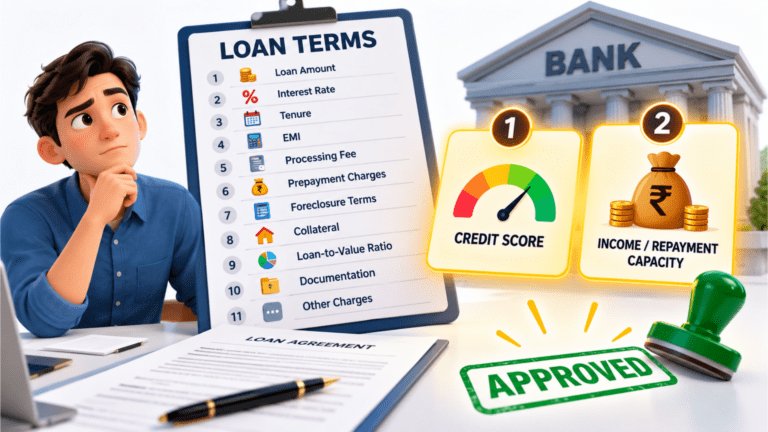
- Check your CIBIL score before applying anywhere. It determines which band of the table you actually qualify for, and checking it yourself costs nothing and triggers no enquiry.
- Shortlist three lenders from the table, weighting your own bank, since existing-customer concessions are real and rarely advertised.
- Ask each for a written sanction stating rate, rate type, processing fee, documentation charge, foreclosure terms and part-payment rules. A verbal rate is not a rate.
- Take the dealer’s quote too, then convert any flat or subvented figure to reducing balance before comparing.
- Choose the shortest tenure you can service, then check what the EMI does to your monthly budget alongside fuel, insurance, servicing and parking.
- Confirm the hypothecation and NOC process before signing, so closing the loan and clearing the RC later is not a surprise.
The affordability check most buyers skip
On ₹90,000 net monthly income with ₹10,000 of existing EMIs, a lender applying a 50% FOIR will allow around ₹35,000 of car EMI — roughly a ₹17.2 lakh loan over five years at 8.15%, or a ₹21.5 lakh on-road budget with 20% down.
That is the maximum a lender may allow, not what is sensible. The EMI is typically a third to a half of the true monthly cost of owning the car once fuel, insurance, servicing and depreciation are counted. Borrowing to the ceiling is how buyers end up with a car they can finance but cannot afford to run.
Habits that keep the total down
Frequently asked questions
Which bank has the lowest car loan interest rate in India right now?
Among published starting rates in late August 2026, UCO Bank is lowest at 7.35% p.a., followed by Canara Bank and Bank of Maharashtra at 7.45% and Union Bank of India, Punjab and Sind Bank and Indian Bank at 7.50%. These are floor rates for strong credit profiles, and they change frequently, so confirm with the bank before applying.
Why is SBI’s car loan rate higher than smaller public sector banks?
SBI publishes a starting rate of 8.80%, above several smaller PSU banks. Rate is only one part of its offer: it has the largest branch and dealer network, high funding levels of around 85 to 90% of on-road price, and long tenures. Smaller banks compete harder on headline rate precisely because they cannot compete on reach.
Are public sector bank car loans always cheaper than private banks?
On published starting rates, mostly yes: twelve of the thirteen cheapest lenders here are PSU banks. Federal Bank is the exception, competing at 7.60%. But PSU banks apply stricter eligibility and slower processing, and your offered rate depends on your credit profile. A strong private bank customer can beat a weak PSU applicant.
Should I choose a fixed or floating car loan rate?
Fixed costs roughly one percentage point more at the banks publishing both. With the repo rate held at 5.25% and a car loan running only five years against a falling balance, the risk floating carries is modest. Choose fixed if you want certainty and are taking a long tenure; the choice matters far less than tenure or down payment.
How much interest does a longer car loan tenure actually cost?
On ₹8 lakh at 8.15%, three years costs ₹1,04,482 in interest, five years ₹1,76,716 and seven years ₹2,52,423. Stretching from five to seven years cuts the EMI by ₹3,750 but adds ₹75,707. It also extends the period during which you owe more than the car is worth, from 14 months to 47.
Is a dealer’s 0% or 5% flat interest scheme cheaper than a bank loan?
Usually not. A 5% flat rate on ₹8 lakh over five years works out to 9.15% on a reducing balance, about 1.83 times the quoted number, which is dearer than most banks in this list. “0% interest” schemes are typically funded by a smaller cash discount. Ask for the scheme price and the cash price in writing and compare the difference.
What CIBIL score do I need for the lowest car loan rate?
Generally 750 or above for the published floor rate. Between 700 and 749 expect roughly 0.25 to 0.50 percentage points more, and between 650 and 699 anywhere from one to two points more. Below 650 many banks decline rather than reprice, leaving NBFC finance at materially higher rates as the alternative.
How much down payment should I make on a car loan?
Banks fund 80 to 100% of price depending on lender and profile, but the minimum is rarely the right answer. Twenty to twenty-five per cent of the on-road price lowers your loan-to-value, may earn a better rate, and materially shortens the period spent underwater on the loan. Keep your emergency fund separate from the down payment.
Can I get a car loan rate reduced after taking it?
On a floating loan, your rate moves with the benchmark automatically. On a fixed loan it does not, but you can refinance with another lender or foreclose and re-borrow. Check the foreclosure charge first: many lenders levy nil after 12 to 24 months, which makes a switch viable if rates have moved meaningfully.
The short version
Published starting rates run from 7.35% at UCO Bank to 14% at the top of some ranges, and public sector banks hold almost all the cheap end. But the table sets your ceiling, not your rate: your CIBIL score decides which band you land in, and your tenure decides what the loan actually costs. Shorten the term, put more down, get three written sanctions, and convert every dealer quote to a reducing-balance figure before you compare it. Do those four things and you will beat a borrower who spent all their effort hunting the lowest advertised number.