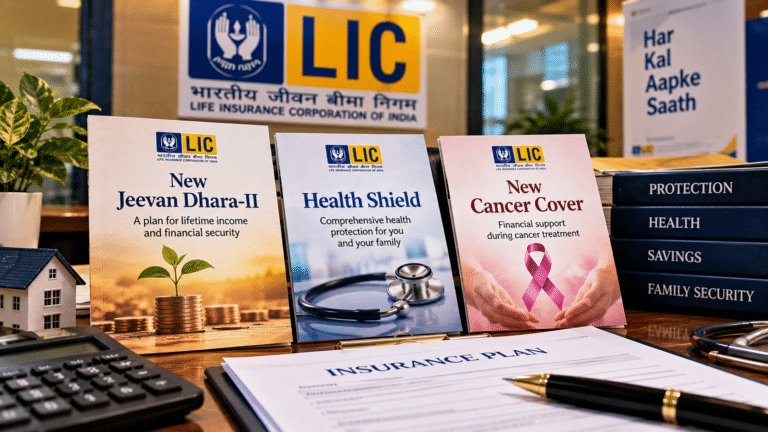
LIC's 3 New Plans From 19 October: New Jeevan Dhara-II, Health Shield and New Cancer Cover — What Each Pays and Who It Suits
LIC’s 3 New Plans From 19 October: New Jeevan Dhara-II, Health Shield and New Cancer Cover — What Each Pays and Who It Suits
LIC opens sales of a deferred pension plan, a fixed-benefit family health plan and a revamped cancer policy on 19 October 2026. Premiums, payouts and waiting periods, taken from LIC’s own brochures.
If an LIC agent has called you this week, you already know the pitch: three new plans, on sale from Monday, 19 October. One promises a pension for life. One pays cash every day you are in hospital. One pays out if you are diagnosed with cancer. LIC chief executive R. Doraiswamy launched them in Mumbai on 13 October.
The press release tells you what the plans are. It does not tell you what they cost, how much they actually pay, or what the fine print excludes. Those details sit in the sales brochures LIC posted on its website on 14 October, and they change the picture considerably. This guide pulls out the numbers, works through real examples, and sets out who should consider each plan and who should not.
Quick Summary
All three are fixed-benefit plans with guaranteed rates and no market link, and none of them replaces a regular health policy or term cover. New Jeevan Dhara-II turns savings into a guaranteed pension, with implied returns of roughly 5% to 6.5% a year before tax in our calculations, depending on option and lifespan. Health Shield pays fixed amounts per hospital day and per surgery, not your actual bill. New Cancer Cover pays up to 245% of the sum assured over time, for a premium of ₹4,700 a year at age 20 for ₹50 lakh of cover.
What We Know
- All three plans are non-participating and non-linked: no bonuses, no market exposure.
- They can be bought from 19 October 2026 through agents, brokers and other intermediaries, or directly on licindia.in.
- Plan numbers are 892, 907 and 908, with UINs 512N398V01, 512N369V01 and 512N370V01.
- Health Shield and New Cancer Cover guarantee premiums for the full policy term.
- Buying online without an intermediary earns a 7.5% to 10% premium rebate on the two health plans.
What Is Still Unclear
- Whether LIC will withdraw the older Jeevan Dhara-II (Plan 872) and Cancer Cover (Plan 905) from sale.
- The full premium tables for every age; brochures publish only sample ages.
- How quickly Health Shield claims will be settled, and how large the network for Quick Cash advances will be.
- Claim experience: being new products, none has a settlement record yet.
Three Plans, Three Very Different Jobs
The plans are launched together, but they are not a bundle. Business Standard’s explainer made the point bluntly: the three products serve different needs and should not be treated as interchangeable. The table below sets out the basics side by side, drawn from the brochures.
| Feature | New Jeevan Dhara-II | Health Shield | New Cancer Cover |
|---|---|---|---|
| Type | Deferred annuity, savings | Fixed-benefit health, pure risk | Fixed-benefit cancer, pure risk |
| Entry age | 18 to 65 or 70, minus deferment | 18 to 65; children 90 days to 20 | 18 to 65 |
| Term | Deferment 1 to 15 years, then for life | 15 years; adults covered to 80 at most | 10 to 15 years |
| Premium | Regular or single; minimum ₹11,000 a year | Yearly or half-yearly, guaranteed | Yearly or half-yearly, guaranteed |
| Cover size | Minimum annuity ₹1,000 a month | Daily benefit ₹2,500 to ₹10,000 | ₹15 lakh to ₹50 lakh |
| Waiting period | None; deferment instead | 90 days; 2 years for 23 conditions | 180 days |
| Money back? | Depends on option | No maturity or surrender value | No maturity or surrender value |
The last row is the one most buyers overlook. Health Shield and New Cancer Cover are pure-risk plans: if you never claim, you get nothing back, just as with term insurance. That keeps premiums low, and it is the right design for protection. It is worth knowing before an agent describes either plan as an “investment”.
New Jeevan Dhara-II: A Pension You Buy in Advance
A deferred annuity works in two phases. First you pay, either every year or in one lump sum. Then, after a deferment period of your choosing, LIC pays you a fixed income for life. The rate is locked on the day you buy, which is the plan’s core appeal: if interest rates fall over the next decade, your pension does not.
The new version is easier to enter than the Plan 872 it succeeds. According to a TradeBrains comparison, minimum entry age falls from 20 to 18, the shortest deferment for regular premiums falls from 5 years to 2, and the minimum age at which the pension can start falls to 30 for every option, from 35 or 31 earlier. The brochure lists 11 annuity options, from a plain life annuity to versions that return premiums at death or in instalments after age 75 or 80.
The return hiding inside the annuity
Annuity figures look generous until you account for the wait and, for some options, the fact that your capital never comes back. We ran the brochure’s own illustration through a simple internal-rate-of-return calculation. A 60-year-old who pays ₹10 lakh under Option 10 with a 5-year deferment gets ₹91,100 a year from 65, and the purchase price returns to the nominee at death. If the annuitant lives to 80, the implied return is about 5.8% a year; to 90, about 6.3%. That is before tax: annuity income is taxed at your slab rate.
For a 45-year-old paying ₹50,000 a year for 10 years under Option 1, the ₹51,975 pension recovers the ₹5 lakh paid in under 10 years. But since nothing returns at death under this option, the implied return depends heavily on lifespan: about 4.9% if the annuitant dies at 75, rising to about 6.4% at 90. The plan is a hedge against living long, not a way to beat fixed deposits.
Health Shield: Cash Per Day, Not Your Hospital Bill
Health Shield is the most interesting of the three, and the most likely to be misunderstood. It is not a mediclaim policy. It does not reimburse your bill. Instead, you pick an Initial Daily Benefit between ₹2,500 and ₹10,000, and every benefit is a fixed multiple of that number. One policy can cover you, your spouse, your parents and your children aged 90 days to 20 years, for 15 years, at premiums guaranteed for the whole term.
| Benefit | Formula | At ₹5,000 daily benefit | Limits |
|---|---|---|---|
| Hospital cash, ward | 1 × daily benefit per day | ₹5,000 a day | 30 days in year 1, then 90 a year; 900 lifetime |
| Hospital cash, ICU | 2 × daily benefit per day | ₹10,000 a day | Within the same day limits |
| Major surgery | 20% to 100% of 100 × daily benefit | ₹1 lakh to ₹5 lakh | 100% a year; 10 times lifetime |
| Day care procedure | 5 × daily benefit | ₹25,000 | 3 a year; 30 lifetime |
| Other surgery | 2.5 × daily benefit per day | ₹12,500 a day | 15 days in year 1, then 45 a year |
| Medical management | 2.5 × daily benefit per event | ₹12,500 | Dengue, malaria, pneumonia, TB, hepatitis A; 2 a year |
| Stay over 30 days | 10 × daily benefit | ₹50,000 | Once a year; 10 lifetime |
| No claim benefit | +10% of initial benefit | +₹500 a day | Every 3 claim-free years, no cap |
Major surgeries are graded into four categories. A coronary bypass sits in Category 1 and pays 100% of the surgical sum assured; a pacemaker implant is Category 2 at 60%; multi-stent angioplasty is Category 3 at 40%; Category 4 pays 20%. For Category 1 or 2 surgery in a network hospital, LIC may advance half the surgical benefit while you are still admitted, which it calls Quick Cash.
The exclusions that matter most
Read three lines of the brochure carefully. Pre- and post-hospitalisation costs are not covered, so the tests before admission and the medicines after discharge are yours. Pregnancy and childbirth are excluded. And stays under 24 hours earn no hospital cash, except for listed day-care procedures, dialysis and radiotherapy. There is also a 90-day general waiting period for illness, and a 2-year wait for 23 named conditions including cataract, hernia, kidney stones and knee replacement not caused by an accident.
New Cancer Cover: Bigger Minimums, a Higher Ceiling
LIC has sold a cancer policy since 2017. The new Plan 908 keeps the basic structure, 25% on early-stage diagnosis and 100% on major-stage, followed by 1% of the sum assured every month for 10 years. What changes is the arithmetic around it. Most importantly, the major-stage payout is now the full 100% even if an early-stage claim was paid earlier. In the old plan, the early payment was deducted.
| Feature | Old Cancer Cover (905) | New Cancer Cover (908) | Effect |
|---|---|---|---|
| Minimum entry age | 20 | 18 | Wider |
| Policy term | 10 to 30 years | 10 to 15 years | Shorter |
| Premium guarantee | First 5 years | Full term | Better |
| Major stage after early claim | 100% minus early payout | Full 100% | Better |
| Maximum total payout | 220% of sum insured | 245% of sum assured | Higher |
| Minimum sum assured | ₹10 lakh | ₹15 lakh to ₹35 lakh by age | Costlier entry |
The minimum cover now depends on age: ₹35 lakh for entrants aged 18 to 34, ₹30 lakh for 35 to 40, ₹20 lakh for 41 to 50 and ₹15 lakh for 51 to 65. The maximum stays at ₹50 lakh. Under the increasing option, the sum assured rises by 10% of the base each year for five years, to 150%, until a cancer is diagnosed.
Two conditions limit that promise. There is a 180-day waiting period: a cancer diagnosed in the first six months pays nothing and ends the policy. And any cancer or pre-cancerous condition diagnosed or treated in the 36 months before buying is excluded, so the plan cannot be bought after symptoms appear.
From Launch to First Claim: The Dates That Count
- 13 Oct 2026LIC announces the 3 plans in Mumbai
- 14 Oct 2026Sales brochures posted on licindia.in
- 19 Oct 2026Plans open for sale, online and offline
- Day 30Free-look period ends on all 3 plans
- Day 90Health Shield illness waiting period ends
- Day 180New Cancer Cover waiting period ends
- Year 2Health Shield specific-condition wait ends
- Year 3First Health Shield check-up and no-claim step-up
Who Should Look at Which Plan
None of these plans is a must-buy. Each fills a specific gap, and the right question is whether you have that gap. This ladder is our suggested order of priorities, not LIC’s.
- First: ₹5 to 10 lakhA regular indemnity health policy that pays actual bills. Without it, neither health plan here is enough.
- Then: ₹35 to 50 lakhNew Cancer Cover, if there is a family history of cancer or your income would stop during treatment.
- Then: ₹2,500 to ₹5,000 a dayHealth Shield, to cover income loss and costs your mediclaim does not, such as travel and caregiving.
- Later: 5 to 15 years outNew Jeevan Dhara-II, once emergency funds, EPF, PPF and NPS are in place and you want guaranteed income.
Mistakes Buyers Make With Plans Like These
There is also a tax point. Individual life and health insurance premiums have been exempt from GST since 22 September 2025, so the brochure premiums are close to what you will pay. Health Shield and New Cancer Cover premiums may qualify for a deduction under Section 80D in the old tax regime, while annuity income from New Jeevan Dhara-II is taxable at your slab rate.
- Existing health cover of at least ₹5 lakh confirmed
- Free-look window of 30 days noted
- Online rebate of 7.5% to 10% compared with agent price
- Waiting periods of 90 days, 180 days and 2 years understood
- Pre-existing conditions disclosed in full, 36-month look-back
- Annuity option chosen: with or without return of capital
- Pension start age between 30 and 70 checked
- Premium affordable for all 10 to 15 years
Frequently Asked Questions
What are LIC’s 3 new plans launched in October 2026?
LIC’s New Jeevan Dhara-II (Plan 892), a deferred pension plan; LIC’s Health Shield (Plan 907), a fixed-benefit family health plan; and LIC’s New Cancer Cover (Plan 908), a cancer insurance plan. All three go on sale on 19 October 2026.
Is LIC Health Shield a mediclaim policy?
No. Health Shield pays fixed amounts, such as ₹2,500 to ₹10,000 per hospital day and a set lump sum per surgery, regardless of the actual bill. It works best alongside a regular health policy, not instead of one.
What is the premium for LIC New Cancer Cover?
For ₹50 lakh of level cover over 10 years, LIC’s brochure shows yearly premiums of ₹4,700 for a 20-year-old man, ₹15,200 for a 35-year-old woman and ₹25,400 for a 50-year-old man, before any online rebate.
What is the waiting period in LIC’s New Cancer Cover?
180 days from the start or revival of the policy. A cancer diagnosed in that period pays nothing and ends the policy. Cancers diagnosed or treated in the 36 months before buying are excluded.
How much pension does LIC New Jeevan Dhara-II pay?
It depends on age, option and deferment. LIC’s brochure shows a 60-year-old paying ₹10 lakh once, with a 5-year deferment, receiving ₹91,100 a year for life from age 65, with the ₹10 lakh returned to the nominee at death.
Who can be covered under LIC Health Shield?
The principal insured, spouse and parents aged 18 to 65 at entry, and children aged 90 days to 20 years. The policy term is 15 years, and cover cannot run beyond age 80 for adults or 35 for children.
Can I buy LIC’s new plans online?
Yes. All three can be bought on licindia.in from 19 October 2026. Buying online without an intermediary earns a 10% rebate on Health Shield, 7.5% to 10% on New Cancer Cover, and a higher annuity rate on New Jeevan Dhara-II.
Do LIC Health Shield and New Cancer Cover return premiums at maturity?
No. Both are pure-risk plans with no maturity benefit, surrender value or loan facility. If no claim is made, nothing is paid back, which is why the premiums are relatively low.
The Short Version
LIC’s three new plans go on sale on 19 October 2026. New Jeevan Dhara-II locks in a lifetime pension today, with implied pre-tax returns of roughly 5% to 6.5% depending on how long you live. Health Shield pays fixed cash per hospital day and per surgery for the whole family, which is useful as a top-up but no substitute for mediclaim. New Cancer Cover now pays the full sum assured even after an early-stage claim, up to 245% in total, but requires at least ₹15 lakh to ₹35 lakh of cover. Read the waiting periods and exclusions, compare the online price, and use the 30-day free look.