Dailyfinancial Explains: Unexpected Advantages of Personal Loans for Women You Didn’t Know About
Loan | Women and Money | India 2026
Dailyfinancial Explains: Unexpected Advantages of Personal Loans for Women You Didn’t Know About
Twelve structural benefits of an unsecured personal loan that go far beyond quick cash, from building an independent credit identity to protecting long-term savings, explained with the fine print that lenders rarely put in the brochure.
UPDATED JULY 2026 ● 13 MIN READ ● REVIEWED AGAINST RBI FAIR PRACTICES CODE AND PUBLISHED BANK AND NBFC DISCLOSURES
Ask most Indian households what a personal loan is for and the answer arrives almost instantly: a wedding, a hospital bill, a home renovation, or a gap between one salary and the next. None of those answers are wrong. All of them are incomplete, and for women borrowers in particular, they miss the part of the story that actually compounds over a lifetime. A personal loan is one of the very few credit products in this country that a woman can apply for, qualify for, draw down, and repay entirely in her own name, with no jewellery pledged, no property mortgaged, and no male family member’s income sitting anywhere on the application form. That single structural detail, an unsecured facility underwritten purely on an individual’s own documented income and repayment behaviour, is what turns an ordinary borrowing product into something quietly consequential for anyone building financial independence rather than simply covering a bill.
This guide deliberately looks past the obvious use cases. It walks through the advantages that rarely make it into mainstream coverage, drawing on how banks and non-banking financial companies actually structure these products for women applicants, what the Reserve Bank of India’s fair practices framework requires of every regulated lender, and where the fine print tends to work in a woman borrower’s favour if she knows to ask for it. Nothing here is an argument for borrowing simply because you can. A personal loan is still debt, it still carries a real interest cost, and it deserves to be taken only when the underlying need and the repayment capacity both genuinely stack up. Treat what follows as the fuller picture, so that any decision you make about this product is made with all the information rather than half of it.
Methodology | How This Guide Was Built
The advantages below were compiled by comparing publicly disclosed personal loan terms across India’s major public sector banks, private banks, and RBI-registered NBFCs, cross-referencing published eligibility criteria and special-scheme disclosures aimed at women applicants, and reviewing the Reserve Bank’s fair practices code and grievance redressal framework for retail lending as it stands in mid-2026. Interest rates, processing fee waivers, insurance add-on pricing, and women-specific schemes vary substantially by lender and are revised frequently, and no single bank offers every benefit described in this article. Confirm current terms directly with the lender before applying. This is a landscape overview intended to help you ask sharper questions at the application stage, not a guarantee that any particular institution will extend any particular benefit to your profile.
Advantage 01 | You Borrow Entirely on Your Own Income, With No Asset and No Guarantor
The single most overlooked advantage of a personal loan is also the most fundamental one. It is unsecured. A woman with a stable salary credit or a documented self-employment income can apply, qualify, and repay without pledging gold, without mortgaging property, without breaking a fixed deposit, and without listing a spouse, father, or brother as a co-applicant. This matters far more than it initially sounds, because several of the credit products marketed most aggressively to Indian households work precisely by drawing on assets that are frequently registered in a male family member’s name or held as undivided household jewellery. Gold loans are the clearest example. A personal loan sidesteps that dependency completely, and in doing so it changes who holds the decision-making power over the borrowing.
→ No jewellery, property, or deposit is placed at risk if repayment becomes difficult later in the tenure.
→ Eligibility is assessed on your own salary slips, bank statements, or income tax returns rather than on aggregate household income.
→ Because there is no security backing the loan, the interest rate is higher than any secured alternative, so the amount should be sized strictly to what your own income can comfortably service.
Advantage 02 | Several Lenders Run Preferential Pricing Specifically for Women
A meaningful number of banks and NBFCs price personal loans more favourably for women applicants, usually through a marginal interest rate concession, a reduced or fully waived processing fee, or a lighter documentation requirement for salaried women in defined income brackets. These schemes are not universal, they are not always displayed prominently on the rate comparison page, and the saving on a typical loan size tends to be modest rather than dramatic. They exist because lenders are actively trying to grow their women borrower base, which remains structurally under-penetrated relative to the working women population. A modest concession compounded across a three or five year tenure is still real money that stays in your account rather than the lender’s.
→ Processing fee waivers and reductions are considerably more common than headline interest rate discounts and are worth asking about explicitly.
→ Concessions are frequently seasonal, tied to festive campaigns or International Women’s Day promotions, so timing an application can matter.
→ Always ask the loan officer directly whether a women applicant scheme applies to your profile, because online aggregator listings usually surface only the standard rate card.
Advantage 03 | It Is One of the Fastest Routes to an Independent Credit Identity
Credit bureaus in India build a score around an individual’s own borrowing and repayment record, never a household’s. A woman who has never held a loan in her own name, perhaps because family credit needs were historically routed through a father, husband, or brother, effectively begins adult life with a thin or entirely absent credit file. That absence becomes a real obstacle later. A modest, cleanly repaid personal loan is among the quickest ways to establish that file, because unlike a premium credit card, which many first-time applicants struggle to obtain without a pre-existing score, personal loans are often accessible to salaried applicants with limited prior credit history, particularly at the bank where the salary account already sits.
The value of that credit identity extends well beyond the loan itself. It is precisely what a lender examines years later when the same woman applies for a home loan, a business loan, or a premium card entirely in her own name. A documented history of on-time personal loan repayment is the single most persuasive piece of evidence a thin-file applicant can bring to that future conversation, and it cannot be manufactured retrospectively.
Advantage 04 | The Money Arrives With No Restrictions on How You Use It
Home loans must go toward property, education loans toward tuition and associated costs, and vehicle loans toward the vehicle being financed, with the lender frequently disbursing funds directly to the seller or institution rather than into the borrower’s hands. A personal loan is credited straight to the applicant’s own bank account with no end-use restriction attached whatsoever. The same facility can therefore fund a professional certification course, seed a small home-based business, cover a medical procedure that insurance excluded, and absorb a relocation cost, all within a single financial year and without separate applications for each purpose.
That flexibility matters disproportionately for women who are self-employed, running a business from home, returning to work after a career break, or moving between sectors, because those situations rarely map neatly onto the purpose-bound categories around which most other loan products are designed.
Advantage 05 | Digital-First Approval Removes the Friction That Historically Discouraged Women Applicants
A substantial share of personal loan applications today are processed end to end through mobile apps and net banking portals, with electronic KYC, digital income verification, and paperless sanction letters replacing what once required repeated branch visits during working hours. For a woman balancing employment against household responsibilities, that shift is not a convenience, it is often the difference between applying and not applying at all. It removes the need to take leave, to travel to a branch, or to hand the paperwork to a family member to handle on her behalf. Many lenders now disburse approved personal loans within a day or two of final verification, against the multi-week timelines that were routine for secured products a decade ago.
Advantage 06 | A Co-Applicant Can Strengthen Eligibility Without Surrendering Ownership
Women newer to the workforce, in a lower income band, or without an extended employment history sometimes fall short of a lender’s eligibility threshold on their own numbers. Most banks permit a co-applicant, commonly a spouse or parent, to be added so that the combined income and credit profile clears the bar, without that arrangement changing who the loan is actually drawn by and repaid by in practice. Used deliberately, this allows a woman to access a loan amount matched to her genuine need while remaining the person building the repayment record and managing the account.
! A co-applicant is jointly and severally liable for the full outstanding amount. Any missed instalment damages both credit scores, not only the primary applicant’s, so this should be a considered decision on both sides.
Advantage 07 | Optional Loan Protection Insurance Shields the Family From the Liability
A growing number of lenders offer an optional loan protection policy at the point of sanction, covering the outstanding balance in the event of the borrower’s death and, depending on the specific product, in cases of critical illness or involuntary job loss. For a woman who is the primary or a substantial contributor to household income, this quietly neutralises a genuine risk, namely that an unpaid personal loan becomes a burden her family must absorb during an already difficult period. This add-on is optional and it does add to the total cost of borrowing, so compare the premium against a standalone term or credit protection policy rather than accepting the bundled version by default at the counter.
Advantage 08 | A Clean Record Unlocks Top-Ups and Balance Transfers as Your Income Grows
Lenders routinely offer existing personal loan customers with an unblemished repayment record a top-up facility on terms better than a fresh application would command, alongside the option to move an existing high-cost loan to a competing lender at a lower rate, an arrangement commonly called a balance transfer. For a woman whose income has risen since the original sanction, through a promotion, a salary revision, or a business that has scaled, this means the cost of that early borrowing does not remain frozen at the terms she qualified for years earlier. The mechanism explicitly rewards a good repayment history with better future pricing, which is exactly the kind of long-run advantage that only materialises if the loan was managed carefully from the first instalment onward.
Advantage 09 | It Can Consolidate Costlier Debt Into a Single Cheaper Instalment
Revolving credit card balances typically carry an effective annual cost far above what a personal loan charges, and informal borrowing from local lenders can be costlier still while offering no consumer protection whatsoever. Consolidating several such balances into one personal loan converts a set of expensive, open-ended, minimum-payment obligations into a single fixed instalment with a defined end date. The interest saving is often substantial, but the structural benefit is arguably greater, since a closed-end loan has a maturity date and a repayment schedule, whereas revolving credit can be carried indefinitely while the balance quietly grows.
→ Consolidation only works if the cleared cards are then used with discipline, otherwise the balances rebuild on top of the new loan.
→ Compare the total interest payable over the full personal loan tenure against the projected cost of continuing the existing balances, not just the two headline rates.
Advantage 10 | A Fixed EMI Imposes Budgeting Structure That Revolving Credit Never Does
Most personal loans in India are priced at a fixed rate for the full tenure, which means the monthly instalment is known on day one and does not move with policy rate changes. That predictability is genuinely useful for household planning, because the obligation can be built into a monthly budget with certainty rather than estimated. For borrowers who have previously relied on credit cards, where the minimum due fluctuates and the payoff horizon is effectively open-ended, the shift to a fixed instalment with a fixed number of payments often produces better financial habits as a side effect of the product structure itself.
Advantage 11 | It Protects Long-Term Savings From Being Broken Prematurely
When an unexpected expense lands, the instinctive response in many households is to break a fixed deposit, redeem mutual fund units, withdraw from a provident fund, or pledge gold. Each of those choices carries a hidden cost that rarely gets calculated at the moment of panic, whether that is a penalty on premature deposit closure, an exit load and tax event on redemption, the permanent loss of compounding on a retirement corpus, or the risk of losing jewellery entirely if a gold loan sours. A personal loan sized appropriately can bridge a short-term gap while leaving those long-horizon assets untouched and still compounding. The arithmetic will not always favour borrowing, particularly for very small amounts, but for a meaningful expense against a long-dated investment, the loan is frequently the cheaper option once the foregone compounding is properly accounted for.
Advantage 12 | Regulated Lending Carries Consumer Protections That Informal Borrowing Does Not
Borrowing from a bank or an RBI-registered NBFC brings a set of protections that borrowing from a family network or an unregistered lender simply does not offer. Regulated lenders are bound by the Reserve Bank’s fair practices code, which governs disclosure of all charges before sanction, restricts recovery practices, and mandates a formal grievance redressal channel with escalation to the RBI Ombudsman scheme if a complaint remains unresolved. Every borrower is also entitled to a written sanction letter setting out the rate, tenure, and complete fee schedule. For a woman borrowing independently, that documented, enforceable framework is a form of protection in its own right, and it is one of the strongest arguments for staying entirely within the regulated system even when an informal alternative appears faster or cheaper on the surface.
Comparison | Personal Loan Against the Alternatives Women Consider First
Every credit option trades off differently on collateral, speed, cost, and how much it contributes to an independent financial identity. The table below places a personal loan alongside the alternatives most Indian women weigh before applying.
| Credit Option | Collateral Needed | Builds Independent Credit File | Relative Cost | Typical Speed |
|---|---|---|---|---|
| Personal Loan | None | Strong, fully in own name | Moderate to high | Same day to a few days |
| Gold Loan | Jewellery pledged | Limited | Lower | Very fast |
| Credit Card Balance | None | Strong, but needs an existing score to obtain | Highest | Instant, revolving |
| Loan Against Fixed Deposit | Deposit held as security | Limited | Low | Very fast |
| Borrowing From Family | None | None, no bureau reporting | Variable | Immediate |
Checklist | What to Verify Before You Sign Anything
Every advantage listed above only materialises if the loan itself is well structured. Run any offer through these checks before accepting it.
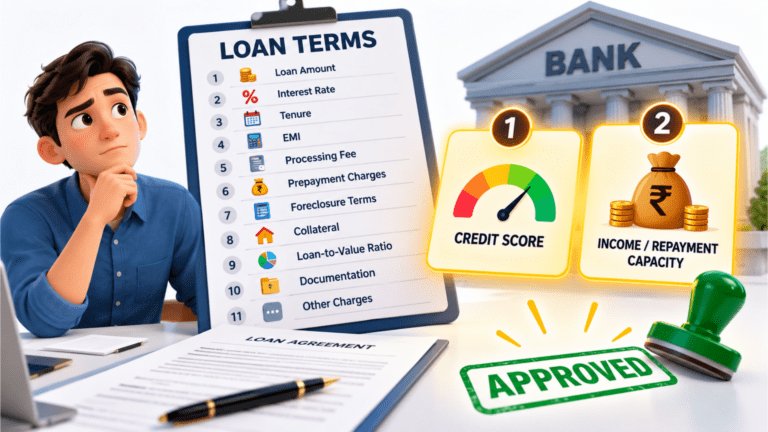
→ The all-in annual cost, not the headline rate. Processing fees, documentation charges, insurance add-ons, and prepayment penalties together can shift the real cost of borrowing well above the advertised number.
→ Prepayment and foreclosure terms. If your income is likely to rise, confirm in writing whether the loan can be closed early and what that costs, since this varies widely between lenders.
→ Whether a women applicant scheme exists at all. This is rarely surfaced by default in online rate comparisons and almost always has to be raised by the applicant directly.
→ Your total EMI to income ratio. A widely used guideline keeps all combined instalment obligations below roughly forty percent of monthly take-home pay, though your own comfortable ceiling may sit lower than that.
→ Whether the insurance add-on is genuinely optional. It must be, under fair practices norms, and you are entitled to decline it without the sanction being withdrawn.
→ The lender’s regulatory standing. Confirm it is a scheduled bank or an RBI-registered NBFC, since this determines the grievance redressal route available to you if something goes wrong.
FAQ | Frequently Asked Questions
Does taking a personal loan actually improve a woman’s credit score?
It can, but only through disciplined repayment. Paying every instalment on schedule gradually builds a positive record with the credit bureaus, while delayed or missed payments damage the score exactly as they would on any other loan. The credit-building benefit comes from consistent repayment behaviour over time, not from the act of borrowing itself, and a defaulted loan leaves a worse file than no loan at all.
Are women-specific interest rate discounts available at every bank?
No. These schemes vary considerably between lenders, are revised periodically, and are frequently absent from the first rate shown on a comparison website. The only reliable way to establish whether one applies to your profile is to ask the lender directly during the application conversation and to get the concession reflected in the written sanction letter.
Can a homemaker with no independent income get a personal loan?
Most lenders require a documented income source to sanction an unsecured personal loan, so a homemaker without independent income will typically need a co-applicant, usually a spouse, whose income and credit profile the lender can assess. Some NBFCs offer small-ticket loans against alternative qualifying criteria, and secured options such as a loan against a fixed deposit held in her own name may be more accessible, but these are exceptions rather than the standard route.
Can a personal loan taken for one purpose be used for something else later?
Yes. Personal loans carry no end-use restriction once disbursed, so the funds sit in the borrower’s own account and can be allocated across multiple needs as circumstances change. This differs fundamentally from purpose-bound products such as education or vehicle loans, where disbursal is commonly tied directly to the institution or seller involved.
What happens to the loan protection insurance if the loan is foreclosed early?
Treatment varies by insurer and by lender. Some policies provide a pro-rated refund of the unused premium on early foreclosure while others provide none at all. Read that specific clause in the policy document before opting in, rather than assuming it behaves the same way as a standalone term insurance policy would.
Is it better to take one large loan or split borrowing across two lenders?
For most borrowers a single loan is simpler and cheaper, since two loans mean two sets of processing fees and two instalments to track, and multiple simultaneous applications can temporarily depress a credit score through repeated hard enquiries. Splitting rarely offers an advantage on an unsecured product the way it can with a large retirement corpus, so unless one lender cannot sanction the full amount required, consolidating into one facility is usually the better structure.
| The Bottom Line
A personal loan will never be a glamorous financial product, and it should never be taken casually, but reducing it to nothing more than an expensive way to fund a wedding or an emergency misses what it does structurally for a woman borrower. It is one of the very few credit facilities that can be built entirely around her own income, her own repayment record, and her own name on the sanction letter, with no asset pledged and no family member’s signature required to make it happen. Used deliberately, sized to an amount her income genuinely supports, and repaid on schedule, it stops being about the immediate cash and becomes about the credit identity, the protected long-term savings, and the financial flexibility it leaves behind once the final instalment clears.
Before applying anywhere, do three things. Compare the all-in annual cost across at least three lenders rather than the advertised rate alone. Ask each one explicitly whether a women applicant scheme applies to your profile and insist on seeing it in the sanction letter. Read the prepayment clause closely, because that single paragraph determines whether a rising income can be turned into an early exit or leaves you locked into terms you have outgrown. Those three checks will protect you more effectively than any single feature described in this article.