CMF Clip Pro Open-Ear Earbuds Price, Specs and Real-World Verdict: What $99 Actually Buys You in 2026
CMF Clip Pro Open-Ear Earbuds Price, Specs and Real-World Verdict: What $99 Actually Buys You in 2026
Nothing’s budget sub-brand just clipped its way into the most crowded corner of the audio market. Here is a full breakdown of the hardware, the claims worth trusting, the claims worth waiting on, and how the Clip Pro stacks up against buds costing three times as much.
CMF, the affordable arm of Nothing, has launched its first open-ear earbuds. The Clip Pro clamps onto the outer ear rather than sealing the canal, uses an unusually large 10.8mm driver for the format, and puts a physical control dial on the charging case. At $99 it lands well under the established clip-on players, and its LDAC support is rare at the price. Sound quality claims remain unverified until independent testing.
Why clip-on earbuds suddenly matter
For roughly a decade the entire wireless earbud industry moved in one direction: seal the ear canal tighter, cancel more of the outside world, push the noise floor lower. That arms race produced genuinely remarkable products, and it also produced a very common complaint. Wear sealed earbuds for four or five hours and your ear canals ache. Wear them in a city and you cannot hear a bus, a bicycle bell, or the colleague standing behind your desk. Wear them at work and you spend half your day pulling one out.
Open-ear designs answer that complaint by refusing the seal entirely. The clip-on subcategory, popularised commercially by Bose and then chased hard by Huawei, Sony, Shokz and Anker’s Soundcore division, hangs the driver just outside the ear canal and lets ambient sound flow in unobstructed. You lose isolation and you lose some bass. You gain all-day comfort and situational awareness, which for runners, cyclists, parents and open-plan office workers turns out to be a trade many people are happy to make.
What has been missing is a genuinely affordable entry that does not feel like a compromise on components. Most sub-$100 clip-ons have shipped with small drivers, SBC-only codec support and no meaningful app control. That is the gap the CMF Clip Pro is aimed squarely at, and on paper it is aimed well.
The headline numbers
Manufacturer-stated specifications, August 2026
Design and fit: a titanium spine doing quiet, important work
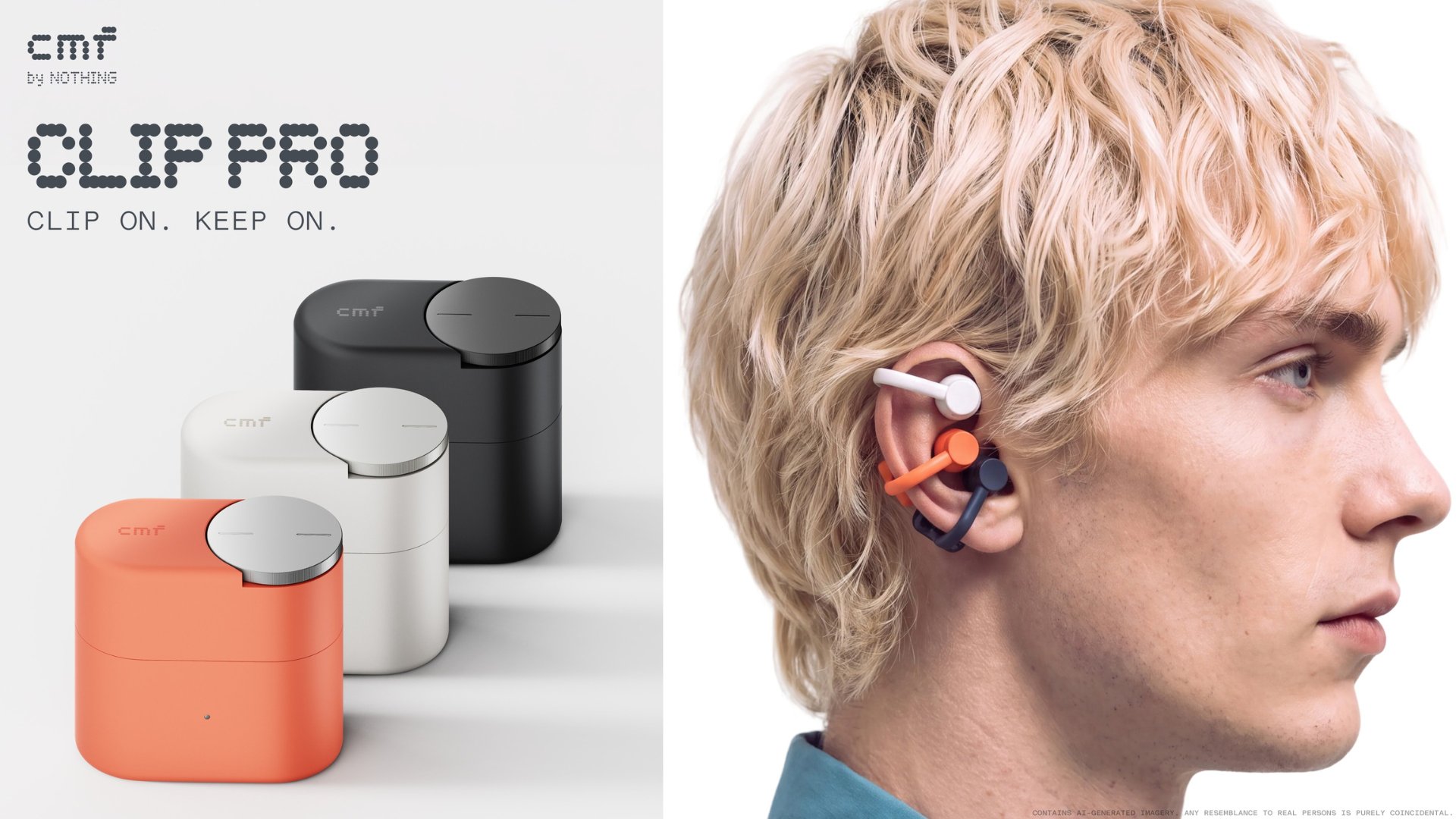
The Clip Pro follows the now-familiar cuff shape. A driver capsule sits in front of the ear canal, a battery capsule counterweights it behind the ear, and a flexible bridge joins the two around the outer edge of the ear. What separates good clip-ons from bad ones is almost entirely down to that bridge, because it determines both clamping pressure and how well the driver stays aimed at the canal when you move.
CMF has built its C-bridge around a titanium wire core wrapped in a soft outer layer. Titanium is the right material choice here for reasons that are not marketing: it has a high elastic limit, meaning it can be bent repeatedly toward a new shape and still spring back to a consistent tension rather than fatiguing into looseness the way cheaper steel wire does. In practice that should mean you can manually adjust the curvature to suit your ear once, and expect the fit to hold across months of use rather than weeks.
The company describes the result as a three-point clip design, distributing pressure across multiple contact areas rather than pinching at a single spot. This is the correct engineering answer to the most common complaint about the category. Single-point clamping is what causes the dull ache that shows up around hour three of wear, and spreading load is the only real fix short of reducing mass.
On mass, there is a discrepancy worth flagging honestly. CMF’s own materials and most outlets covering the launch list each earbud at 5.9 grams, and one specification sheet gives 5.92 grams. At least one respected audio publication reported 6.5 grams in its launch coverage. The difference is small enough not to change the wearing experience meaningfully, but it is the kind of inconsistency that gets copied across the internet unchallenged, so treat the sub-6-gram figure as the likely correct one and expect final confirmation once retail units are independently weighed. For context, either figure puts the Clip Pro among the lightest clip-ons available.
Three colours launch alongside: Dark Grey, Light Grey and Coral. The Coral finish is the one CMF is pushing in promotional imagery, and it is consistent with the brand’s habit of treating consumer electronics as visible objects rather than things to hide. An IP54 rating covers dust ingress and splashing water, which is adequate for sweat and light rain but is not a swimming or heavy-downpour rating.
The Smart Dial: a genuinely good idea, again
CMF’s signature hardware quirk returns. The charging case carries a physical rotating dial, and it is not decorative. You can use it to adjust volume, control playback, answer incoming calls and initiate pairing, all without unlocking a phone or tapping at a bud hanging off your ear.
It is worth being specific about why this matters more on an open-ear product than it did on CMF’s previous in-ear models. Clip-on earbuds have very little surface area for touch controls, and what surface there is sits on a component that is deliberately held in light tension against your ear. Tapping it tends to either miss or shift the fit. CMF has hedged sensibly by giving each earbud its own physical button, which is more reliable than capacitive touch when your hands are wet, cold or gloved, and then offloading the fiddlier adjustments to the dial on the case.
The practical scenario is a commuter with the case in a coat pocket, adjusting volume by feel. That is a real improvement over the industry standard of either shouting at a voice assistant or excavating a phone. Whether the dial has satisfying detents and a well-judged rotation resistance is something only hands-on time will settle, but the concept is sound and CMF has now iterated on it across multiple products.
Sound: an unusually large driver and a bass problem to solve
Open-ear designs face one unavoidable physics problem. Bass reproduction depends heavily on pressurising a sealed volume of air in the ear canal. Remove the seal and low frequencies dissipate into the room. Every manufacturer in this category is therefore engaged in some form of compensation, usually through a combination of driver size, tuned porting and aggressive low-end equalisation.
CMF’s answer starts with hardware. The Clip Pro uses a 10.8mm dual-magnetic dynamic driver with a TPU diaphragm, which the company positions as larger than the drivers in most competing clip-ons. Dual-magnet configurations increase flux density in the voice coil gap, which broadly translates to better motor control and more headroom before distortion sets in, and TPU diaphragms are chosen for their internal damping characteristics. Layered on top is a processing feature CMF calls Ultra Bass Technology, described as intelligently boosting low frequencies while limiting the distortion that boosting normally introduces.
Treat that last claim with appropriate scepticism until measured. Software bass enhancement in open designs is a well-trodden path and the results vary from genuinely convincing to obviously synthetic. The honest position today is that CMF has specified the hardware correctly and made a software claim that cannot be evaluated from a press release.
Codec support is where the Clip Pro looks genuinely unusual for the money. It carries Hi-Res Audio certification and supports LDAC alongside AAC and SBC. LDAC at this price point is rare, and on a compatible Android device it raises the ceiling on available detail. It is worth noting the practical caveat: in an open-ear product where ambient noise is flowing into your ears by design, the audible benefit of a higher-bitrate codec is smaller than it would be on sealed buds. The specification is real; the perceptible gain depends entirely on your listening environment.
There is also a leakage control feature called Sound Seal, adjustable in the Nothing X app, intended to limit how much of your audio spills out to people nearby. You can apply it to calls only, or to everything. Any open-ear earbud leaks audibly at high volume, so this is mitigation rather than elimination, but the ability to scope it to calls is a thoughtful touch for anyone taking meetings in shared spaces.
Battery behaviour, visualised
Manufacturer-stated figures, moderate volume
Bars scaled against the 32.5-hour maximum. Real-world runtime falls with LDAC enabled and at high volume; budget 20 to 30 percent below stated figures for heavy use.
Calls, connectivity and the software layer
Four microphones handle voice pickup, paired with a dedicated voice processing unit for noise reduction. Open-ear form factors have a structural advantage on calls that is often overlooked: because nothing is occluding your ear, you hear your own voice naturally and tend to speak at a normal volume, which usually produces a cleaner signal than the over-loud speech that sealed earbuds induce. Whether the beamforming is good enough to survive wind and traffic is, again, a testing question.
Connectivity is current rather than cutting-edge, and appropriately so. Bluetooth 5.4 with dual-device connection lets the Clip Pro hold simultaneous links to, for example, a laptop and a phone. Google Fast Pair and Microsoft Swift Pair cover fast setup on Android and Windows respectively. A Low Latency Mode is included for gaming and video, which matters more than usual here since open-ear buds are frequently used for casual media rather than critical listening.
The Nothing X app handles equalisation, control remapping, Sound Seal configuration and firmware updates. CMF’s track record on post-launch firmware has been reasonable across the Buds line, which is a meaningful consideration on a product whose most contested feature is a software bass algorithm that may well improve after release.
Full specification sheet
CMF Clip Pro / announced 4 August 2026
| Form factor | Open-ear clip-on, three-point contact design |
| Driver | 10.8mm dual-magnetic dynamic, TPU diaphragm |
| Codecs | LDAC, AAC, SBC |
| Certification | Hi-Res Audio |
| Bridge | Flexible C-bridge with titanium wire core |
| Weight | 5.9g per earbud (6.5g reported by one outlet) |
| Microphones | Four, with VPU-based call noise reduction |
| Battery | 10 hrs buds / 32.5 hrs with case / 10-min charge for 4 hrs |
| Bluetooth | 5.4, dual-device connection |
| Pairing | Google Fast Pair, Microsoft Swift Pair |
| Controls | Smart Dial on case, physical button on each earbud |
| Durability | IP54 dust and water resistance |
| App | Nothing X (EQ, Sound Seal, controls, firmware) |
| Colours | Dark Grey, Light Grey, Coral |
| Price | $99 US / £79 UK |
Price and availability, market by market
The Clip Pro was announced on 4 August 2026 and carries a list price of $99 in the United States and £79 in the United Kingdom. Coverage at launch indicated a discount of roughly $20 during the opening sales window, bringing the effective early price close to $79. It is also worth noting that the on-sale date moved: CMF initially indicated open sales would begin on 4 August, then revised that to 15 August, which is a detail some early coverage still has wrong.
Rollout timeline
The India omission is notable given that CMF built much of its early momentum in that market, and it follows reports that Nothing has been reshaping its product roadmap under cost pressure. Buyers in unlisted markets should expect grey-market pricing to sit meaningfully above the official figure, without regional warranty coverage.
How it compares to the established clip-ons
The clearest way to understand the Clip Pro’s positioning is to look at what else you can buy. Bose’s Ultra Open Earbuds have been the critical reference point for the category, praised repeatedly for comfort and for producing more convincing low-end than the format usually allows, at a list price of $299 that frequently discounts to around $199. Soundcore’s AeroClip has become the value favourite among reviewers, with a 12mm driver, eight hours of bud runtime and around 32 hours total, listed at $169.99 but routinely available closer to $99 to $110. At the entry level, Soundcore’s C50i sits near $70 and has dipped considerably lower.
List price comparison
Manufacturer list prices, US market
Street prices differ substantially. The AeroClip has sold near $99 and the Bose near $199 during promotions, which compresses the gap considerably.
| Specification | CMF Clip Pro | Soundcore AeroClip |
|---|---|---|
| List price | $99 | $169.99 |
| Driver | 10.8mm dual-magnet | 12mm |
| Buds battery | 10 hrs | 8 hrs |
| Total battery | 32.5 hrs | 32 hrs |
| Fast charge | 10 min for 4 hrs | 10 min for 3 hrs |
| Codecs | LDAC, AAC, SBC | AAC, SBC |
| Durability | IP54 | IP55 |
| Case controls | Smart Dial | None |
| Microphones | 4 with VPU | 4 with AI processing |
Coral values mark the stronger figure on paper. Specification advantages do not automatically translate into better listening.
Read that table carefully and the pattern is clear. The Clip Pro wins on price, codec support, battery and control hardware. It loses on driver diameter and marginally on ingress protection. What the table cannot tell you is which one sounds better, because tuning matters more than any single specification, and the AeroClip has the considerable advantage of having actually been reviewed at length. Specification sheets are a starting point for a buying decision, not the conclusion.
Who should buy it, and who should not
What we still do not know
Responsible coverage of a product that has been announced but not yet independently tested requires saying plainly what remains unverified. Frequency response has not been measured, so the effectiveness of Ultra Bass Technology is unknown. Leakage at typical listening volumes has not been quantified, so Sound Seal cannot be assessed. Real-world battery under LDAC, which is materially more power-hungry than AAC, has not been tested against the stated ten hours. Call quality in wind has not been trialled. Long-term retention of clamping force in the titanium bridge cannot be known for months.
None of that is a criticism of the product. It is simply the difference between a specification and a result, and any coverage presenting launch figures as a verdict is overstating its evidence. This article will be updated once measured data is available.
Frequently asked questions
Does the CMF Clip Pro have noise cancellation?
No, and that is intentional rather than an omission. Open-ear earbuds are designed to let ambient sound reach your ears. Active noise cancellation requires a sealed canal to work against, so it is structurally incompatible with this form factor. If isolation is your priority, a sealed in-ear model is the correct product category.
Will people around me hear my music?
At low and moderate volume, generally not in normal environments. At high volume in a quiet room, yes. This is true of every open-ear design. The Sound Seal feature in the Nothing X app is intended to reduce spill, and can be applied to calls only or to all audio, but no software feature eliminates leakage from an unsealed driver.
Do they work with iPhone?
Yes, over AAC and SBC, with full access to the Nothing X app for equalisation and controls. LDAC is an Android feature, so iPhone users lose the codec advantage that is one of the Clip Pro’s more distinctive specifications. Google Fast Pair is likewise Android-only, though standard Bluetooth pairing works normally.
Are they suitable for running and the gym?
The form factor is well suited to it. The clip design does not rely on canal pressure to stay in place, the IP54 rating handles sweat, and the physical buttons work when your fingers are damp. The awareness benefit matters most for outdoor running near traffic. For swimming, they are not appropriate.
How does the Smart Dial work?
It is a rotating physical control built into the charging case that adjusts volume, controls playback, answers calls and initiates pairing. It functions while the case is in your pocket, which is its main practical advantage over touch controls on the earbuds themselves.
Is the Clip Pro launching in India?
No. CMF confirmed at launch that India is not among the release markets, despite the brand’s strong presence there. The US, UK and Japan go first on 15 August 2026, with Europe and other markets following on 15 September.
The verdict
The CMF Clip Pro is the most aggressively specified clip-on earbud yet offered at $99, and the specification choices show real understanding of the category rather than box-ticking. A titanium bridge addresses the fit problem that ruins cheap clip-ons. Physical buttons plus a case-mounted dial address the control problem that plagues all of them. LDAC and a 10.8mm driver address the perception that budget open-ear means budget components. Ten hours per charge is class-leading.
What remains open is the only thing that ultimately decides whether an earbud is good: how it sounds, and how it feels after five hours. CMF has earned enough goodwill with the Buds line to make optimism reasonable, and the price leaves considerable room for imperfection. If you have been waiting for a low-risk way into open-ear listening, this is the most compelling entry point currently announced. If you need the sound quality settled before you spend, wait for measured reviews after 15 August. Either way, the category just got significantly more competitive at the bottom of the market, which is good news for everyone shopping in it.
Specifications in this article are drawn from CMF’s launch materials and corroborated across independent launch coverage from SoundGuys, Gizmochina, 9to5Google and Gizmodo. Comparison pricing for competing models reflects published list prices and documented promotional pricing at time of writing. Where sources conflict, both figures are stated rather than resolved silently. No unit has been independently tested by this publication; this article covers announced specifications and will be updated with measured findings.