UPI Is Free for Consumers, Merchants Will Pay — So Who Really Absorbs the 0.4% UPI MDR From October 15?
Digital Payments · UPI MDR · India, September 2026
UPI Is Free for Consumers, Merchants Will Pay — So Who Really Absorbs the 0.4% UPI MDR From October 15?
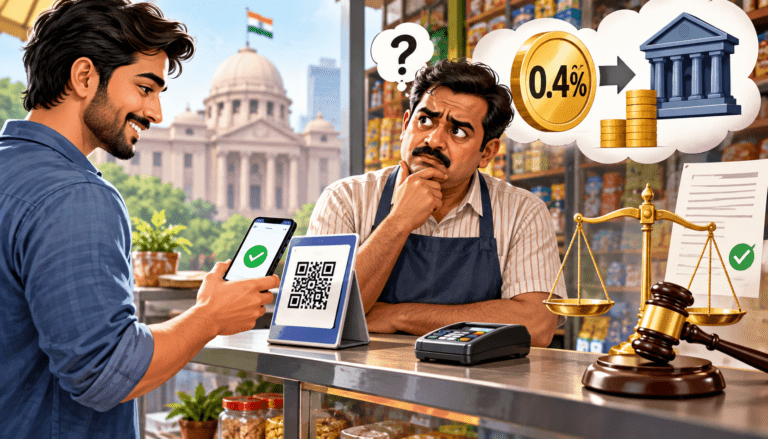
A 0.4% merchant discount rate on person-to-merchant UPI payments above ₹2,000 takes effect on October 15, 2026. Consumers are not billed, but the cost has to land somewhere.
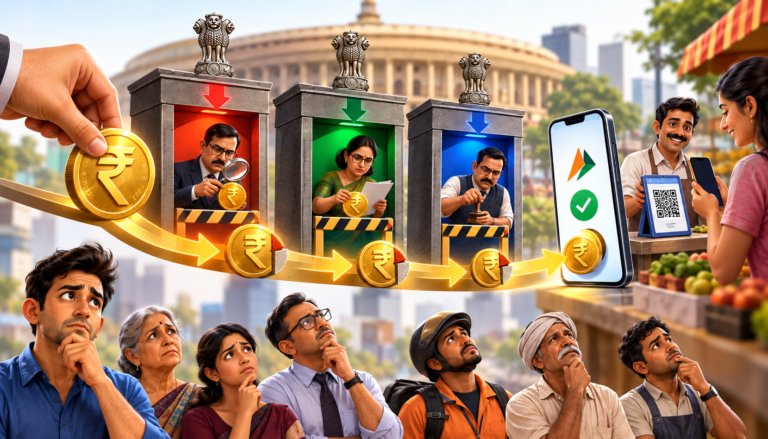
“UPI is free for consumers. Retailers will pay.” That one-line summary of the government’s position sounds tidy. It is also where the real conversation begins, because a cost that is moved off the customer’s screen does not vanish. It is deducted from a shopkeeper’s settlement, it sits on a thin margin, and it quietly shapes what that shopkeeper does next.
The official line is precise: the charge is levied on merchants, not customers, and merchants are barred from adding it to the bill. The economic question is broader. When one party in a transaction is told it must absorb a cost, the rest of the chain rarely stays untouched. This article walks through the numbers, the choices retailers actually have, and the question India has not yet answered openly: who should pay for the country’s most successful piece of digital public infrastructure?
Quick Summary
From October 15, 2026, UPI payments to merchants above ₹2,000 carry a 0.4% MDR, capped at ₹300. Person-to-person transfers and all merchant payments of ₹2,000 or less stay free, and small merchants receiving up to ₹1 lakh a month via QR are exempt. Customers are not charged directly, but on a retailer earning a 2.5% net margin, the fee equals roughly 16% of the profit on each eligible sale.
What We Know So Far
Confirmed facts
- NPCI issued its circular on September 15, 2026, setting a 0.4% MDR on eligible person-to-merchant UPI payments above ₹2,000, effective October 15.
- The MDR is capped at ₹300 per transaction, which is reached at a bill of ₹75,000.
- Railways, telecom, insurance, fuel and utility payments above ₹2,000 pay a flat ₹5 per transaction instead of 0.4%.
- Mutual funds and stockbroking payments attract 0.02%, also capped at ₹300.
- Person-to-person UPI transfers remain free regardless of amount.
- Merchants categorised as P2PM, receiving up to ₹1 lakh a month, pay no MDR on any payment.
- Finance Minister Nirmala Sitharaman has said the charge is not a tax, cess or surcharge, the money does not go to the government, and it will not be passed on to customers.
What Is Still Unclear
Open questions before October 15
- Whether the GST Council, meeting on October 7, will change the 18% GST that applies to the MDR fee itself.
- How acquiring banks will verify that a merchant stays under the ₹1 lakh monthly threshold, and how often that classification is reviewed.
- How NPCI and banks will detect disguised surcharges, such as cash-only discounts, when the invoice price stays unchanged.
- How the proposed small-merchant fund, reported at 5% of MDR collections, will be governed and spent.
- Whether trader bodies’ demands for a rollback or a higher threshold will produce any change before the start date.
The Scale Behind a “Small” 0.4%
UPI is no longer a convenience layer; it is the backbone of Indian retail payments. The government has reported that UPI processed 24,162 crore transactions worth about ₹314 lakh crore in FY2025-26, accounting for roughly 85% of India’s digital payment volume. In August 2026 alone, it handled 24.51 billion transactions worth ₹29.82 lakh crore.
Here is the detail that explains why a threshold of ₹2,000 matters so much. The Chamber of Trade and Industry (CTI), citing UPI data, says payments above ₹2,000 are only around 4% of transactions by count but about ₹131 lakh crore by value. A fee that touches very few payments can still touch a very large amount of money.
The ecosystem expects the fee to generate a pool of almost ₹20,000 crore a year. That number is the real headline. It tells you this is not a token charge but a structural shift in how UPI is financed.
How a Free Network Lost Its Free Ride
UPI did carry merchant charges in its early years. In January 2020, the law was amended to make UPI and RuPay debit card payments free for both users and merchants. Banks and apps were then compensated through an annual government incentive scheme, paid to acquiring banks and shared with issuing banks, app providers and payment service provider banks.
The trouble was the gap between those subsidies and the cost of running a network that now handles close to 800 million payments a day. Cabinet data shows the payout rising sharply, then shrinking in budget terms.
The timeline that led to October 15
- Jan 2020Zero MDR for UPI and RuPay debit begins, with banks compensated through incentives.
- Apr 2024Cabinet approves a ₹1,500 crore scheme paying 0.15% on small-merchant UPI payments up to ₹2,000.
- Jun 2025Finance Ministry calls reports of UPI MDR false and baseless.
- Aug 4 to 8, 2026Taxation and Other Laws (Amendment) Bill, 2026 amends Section 10A of the Payment and Settlement Systems Act and passes Parliament.
- Sep 14 and 15, 2026Gazette notification protects UPI up to ₹2,000; NPCI issues the MDR circular a day later.
- Oct 7, 2026GST Council is expected to take a view on the 18% GST on MDR.
- Oct 15, 2026The 0.4% MDR on eligible payments above ₹2,000 takes effect.
The Fee Schedule Every Shopkeeper Should Memorise
The framework is layered. What a merchant pays depends on three things: who is paying (a person or a business), how much, and which sector the merchant belongs to. A common misconception is that every UPI payment now costs the shop money. It does not. A ₹500 grocery payment attracts zero MDR, as does any merchant payment of ₹2,000 or less.
| Category | Up to ₹2,000 | Above ₹2,000 | Cap | Who pays |
|---|---|---|---|---|
| Person to person | Free | Free | Not applicable | Nobody |
| Small merchant (P2PM, up to ₹1 lakh a month) | Free | Free | Not applicable | Nobody |
| Regular merchant (P2M) | Free | 0.4% | ₹300 | Merchant |
| Railways, telecom, insurance, fuel, utilities | Free | ₹5 flat | ₹5 | Merchant |
| Mutual funds and stockbroking | Free | 0.02% | ₹300 | Merchant |
Why 0.4% Feels Like Much More on a Shop Counter
Percentages of revenue hide the real bite. Kumar Rajagopalan, CEO of the Retailers Association of India, has said retailers make gross margins of about 18 to 19%, and after expenses, net margins of 2 to 3% if they are lucky. Measured against profit rather than sales, 0.4% is not small at all.
| Bill amount | MDR | 18% GST on MDR | Net profit at 2.5% | MDR as share of profit |
|---|---|---|---|---|
| ₹2,000 | ₹0 | ₹0 | ₹50 | 0% |
| ₹2,500 | ₹10 | ₹1.80 | ₹62.50 | 16% |
| ₹5,000 | ₹20 | ₹3.60 | ₹125 | 16% |
| ₹10,000 | ₹40 | ₹7.20 | ₹250 | 16% |
| ₹50,000 | ₹200 | ₹36 | ₹1,250 | 16% |
| ₹1,50,000 | ₹300 | ₹54 | ₹3,750 | 8% |
Worked example: a hardware store in a tier-2 town
A shop sells a ₹10,000 water pump over UPI. The acquiring bank deducts ₹40 as MDR, plus ₹7.20 GST on that fee, before settlement. If the owner’s net margin is 2.5%, the sale earned ₹250 in profit. The fee takes ₹40 of it, or 16%. If the shop is GST-registered and can claim input tax credit on the ₹7.20, the burden stays at 16%; if it cannot, the total bite rises to about 18.9%. Repeat that across 300 such sales a year and the shop gives up ₹12,000 to ₹14,160, which for many small owners is a month of rent.
This is also why the ticket-size cap matters less to small shops than it sounds. The ₹300 ceiling helps jewellers, car dealers and furniture sellers. A kirana store, pharmacy or electronics counter lives in the ₹2,001 to ₹20,000 range, where the full 0.4% applies to every rupee.
Four Doors Open to Every Retailer
A retailer facing a new fee has only a handful of responses, and none of them is neutral for the wider economy. Each one moves the cost to a different pocket.
Absorbing the cost
Larger retailers with stronger margins are expected to swallow the fee. The Retailers Association has said big merchants may not worry much, while small ones will think twice. Absorption is the outcome the policy is designed for, but it is not free: it comes out of reinvestment, staff costs or owner income.
Raising prices without saying so
NPCI has barred merchants from adding MDR to the customer’s bill. That rule controls the invoice, not the shelf. Manoranjan Sharma, chief economist at Infomerics Ratings, has pointed out that a general price increase, a smaller discount, or a payment-linked fee can shift MDR to consumers even when the invoice never mentions it. He also flagged a plausible two-tier structure: the same headline price, with different discounts depending on how you pay.
Walking away from UPI for large bills
Petrol pump dealers sought an exemption and threatened to stop accepting UPI from October 15, before clarifying that they would continue to accept it. The episode shows how quickly acceptance can become a bargaining chip. CTI has written to the Finance Minister on behalf of what it describes as 6 crore shopkeepers, traders and entrepreneurs, estimating that UPI payments above ₹2,000 could fall by up to 50%.
The Cash Question Nobody Wants to Say Out Loud
India spent years moving shoppers from cash to digital. Every incentive, every QR sticker and every zero-MDR rule pushed in one direction. The concern now is that a shopkeeper doing simple arithmetic could conclude that, for large bills, cash is cheaper.
That matters beyond convenience. Digital receipts create a record that supports lending, credit scoring and tax compliance. A payment that shifts back to cash leaves no such record. Former NITI Aayog Vice-Chairman Rajiv Kumar illustrated the threshold problem on X: a tea stall or juice seller earning ₹5,000 a day crosses ₹1 lakh a month and falls outside the small-merchant exemption. He called the result a huge incentive to shift back to cash.
The important nuance
NPCI has clarified that even when a merchant crosses ₹1 lakh a month and is reclassified as P2M, MDR applies only to individual payments above ₹2,000. That tea stall’s ₹20 and ₹50 payments remain free. The cash risk is real, but it is concentrated in higher-value sales, not everyday small purchases.
So the honest version of the worry is narrower than “UPI will die”. It is that the most valuable slice of digital retail, the bigger bills that carry the most tax relevance, is exactly the slice now priced. Whether that nudges behaviour meaningfully is an empirical question the first few months of data will answer.
The Case the Government and Industry Are Making
There is a serious argument on the other side, and it deserves a fair hearing. Running UPI at India’s scale costs money: servers, fraud detection, settlement, customer service and security. With subsidies shrinking, the alternative to MDR was an under-funded network, or a hidden cross-subsidy from banks’ other customers.
Supporters also stress that UPI remains far cheaper than cards. EY India’s Ranadurjay Talukdar has described the framework as a move from subsidising adoption to building sustainable infrastructure, protecting consumers, small merchants and the bulk of low-value payments. MobiKwik’s Upasana Taku has said MDR gives payment firms a reason to keep acquiring and servicing merchants, which they previously did at a loss.
The comparison cuts both ways, though. Cards were never the benchmark for the kirana owner. UPI replaced cash at those counters precisely because it cost nothing, and Rajagopalan has noted that many small shops either refused cards or asked customers to pay extra for them.
So Who Should Pay for India’s Payment Rails?
Strip away the slogans and there are five candidates. Each already pays something, directly or indirectly, and each option has a trade-off.
The strongest version of a shared model would protect the merchants most likely to drift back to cash, not only those under an arbitrary monthly receipts line. Critics argue ₹1 lakh is too low; the government argues that the ₹2,000 per-payment line already shields everyday purchases. Both can be partly right, which is why the design of the threshold may matter more than the rate.
What Retailers and Shoppers Can Do Before October 15
- Check how your acquiring bank has classified your QR: P2PM or P2M. The classification decides whether you pay anything.
- Pull three months of UPI statements and count payments above ₹2,000. Multiply their value by 0.4% to see your real monthly cost.
- If you are GST-registered, confirm with your accountant how to claim input tax credit on the 18% GST charged on MDR.
- Compare UPI with your card terminal costs before deciding to push customers anywhere. For most large bills UPI stays cheaper than cards.
- As a shopper, watch for a different price or discount depending on payment mode. Surcharging for MDR is barred under NPCI rules, and you can raise it with the merchant’s bank.
Frequently Asked Questions
Will customers have to pay charges on UPI from October 15, 2026?
No. The MDR is deducted from the merchant’s settlement, and the Finance Ministry has said customers will not be charged. Person-to-person transfers remain free at any amount. Merchants are barred from adding the fee to the bill, though economists note costs can still show up indirectly through prices.
What is the UPI MDR rate and which transactions does it apply to?
It is 0.4% on eligible person-to-merchant UPI payments above ₹2,000, capped at ₹300 per transaction. Railways, telecom, insurance, fuel and utility payments above ₹2,000 pay a flat ₹5, and mutual fund and broking payments pay 0.02%, also capped at ₹300.
Is a ₹500 UPI payment to a shop charged MDR?
No. All merchant payments of ₹2,000 or less are free for both the customer and the merchant. NPCI data indicates more than 95% of merchant UPI transactions by volume fall at or below this level, so most everyday purchases are unaffected.
Which small merchants are exempt from UPI MDR?
Merchants in the P2PM category receiving up to ₹1 lakh a month through UPI pay no MDR on any payment, whatever its size. If receipts cross ₹1 lakh, the bank reclassifies the merchant as P2M, and MDR then applies only to individual payments above ₹2,000.
Can a shopkeeper add the UPI MDR to my bill?
No. NPCI has barred merchants from passing MDR on to buyers as a surcharge. If a shop adds a separate UPI fee, you can ask it to remove the charge and raise a complaint with the merchant’s bank or through your UPI app.
Is GST charged on UPI MDR?
Yes. GST at 18% applies to the MDR fee, not to the value of the purchase. Registered merchants can generally offset it through input tax credit. The GST Council, meeting on October 7, 2026, is expected to take a view on this levy.
Does the government earn money from UPI MDR?
According to the Finance Minister and government sources, no. The fee goes to ecosystem participants, reportedly 40% to the customer’s bank, 30% to the payment gateway, 20% to the UPI app and 10% to the app’s sponsor bank, with a small-merchant fund also proposed.
Why did India bring back MDR on UPI after making it free in 2020?
The government says it wants a sustainable funding model. Incentive payouts peaked at ₹3,631 crore in FY2023-24, well below the cost of running a network that processed about ₹314 lakh crore in FY2025-26. The MDR is expected to create a pool of nearly ₹20,000 crore a year.
The Short Version
UPI is still free for the customer and for more than 95% of merchant payments. From October 15, 2026, merchants pay 0.4%, up to ₹300, on UPI payments above ₹2,000, while small shops under ₹1 lakh a month stay exempt. The fee is not a tax and does not reach the government. But saying “retailers will pay” describes who writes the cheque, not who ultimately bears the cost. On a 2.5% net margin, 0.4% is about 16% of profit, and that pressure can show up as thinner margins, quieter price rises or a nudge towards cash. The real test is not whether UPI survives. It is whether India can fund its payment rails without pushing the next rupee back into a drawer.