Gold Loans Up 83% as Credit Card Dues Grow Just 3.6%: What India's 2026 Debt Shift Says About Household Finances
Personal Finance · RBI Credit Data · India, August 2026
Gold Loans Up 83% as Credit Card Dues Grow Just 3.6%: What India’s 2026 Debt Shift Says About Household Finances
RBI sectoral data for August 2026 shows bank loans against jewellery hitting Rs 5.6 lakh crore while card balances barely moved. Here is what is behind the swing, and what it means for your next loan.
Walk past any gold loan branch in Chennai, Lucknow or Jaipur this year and you would have noticed something the national data has now confirmed. The queue is longer, the customers are more varied, and many of them are people who, two years ago, would simply have reached for a credit card. Indian households have not stopped borrowing. They have changed what they borrow against. The question worth asking is whether that shift is a sign of financial good sense, quiet stress, or simply the side effect of a gold price that has climbed nearly 30% in a year.
Quick Summary
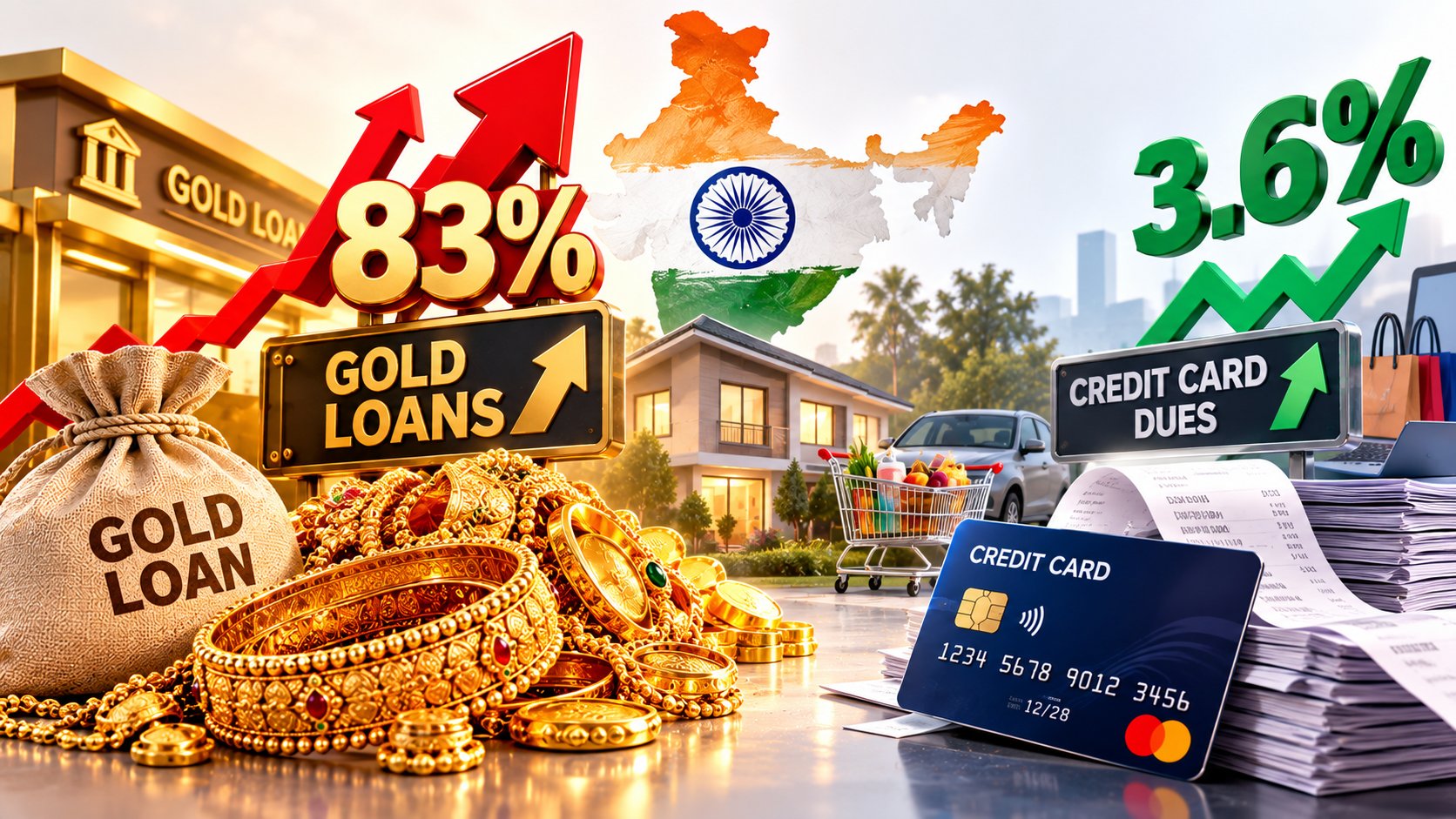
Bank loans against gold jewellery stood at Rs 5.6 lakh crore in August 2026, up 83.2% year on year, while credit card outstandings grew only 3.6% to about Rs 3 lakh crore. Between April and August, banks added nearly 21 times more gold-backed credit than card credit. Higher gold prices, a more generous loan-to-value cap from April 2026 and tighter lender appetite for unsecured debt all point the same way.
What We Know
- RBI sectoral data shows bank gold jewellery loans at Rs 5.6 lakh crore in August 2026, against roughly Rs 3 lakh crore a year earlier, a rise of 83.2%.
- Credit card outstandings rose 3.6% to about Rs 3 lakh crore, and consumer durable loans grew just 2.4% to Rs 23,295 crore.
- Overall bank credit is growing strongly, at roughly 19% year on year, so the card slowdown is not part of a wider credit freeze.
- The RBI’s tiered loan-to-value rules for gold loans took effect on 1 April 2026, allowing up to 85% on loans of Rs 2.5 lakh or less.
- 24-carat gold traded at Rs 1,47,888 per 10 grams on 30 September 2026, compared with about Rs 1,14,500 a year earlier.
The Two Growth Rates That Do Not Belong in the Same Economy
Put the two headline numbers side by side and they look like they were taken from different countries. One form of consumer credit is growing faster than almost anything else on a bank’s books. The other is barely keeping pace with inflation. Both are borrowed by broadly the same people: salaried workers, small traders, self-employed families who need money within days rather than weeks.
Notice the second bar. Loans against fixed deposits, another secured product where the borrower pledges their own asset, grew 43.2%. That pattern matters more than any single figure. Across the board, households and lenders are leaning toward credit that is backed by something the borrower already owns.
Following the Money: Where Every New Rupee of Credit Went
Growth rates can flatter small bases, so the cleaner test is the rupee amount added. Between April and August 2026, banks extended roughly Rs 10.3 lakh crore of fresh credit across the economy. Gold loans alone absorbed Rs 98,096 crore of that, almost exactly the same amount as home loans, which added Rs 98,858 crore. Credit cards added Rs 4,740 crore.
Personal loans as a whole made up 33.9% of all incremental bank credit in that period. Gold loans were therefore close to three in every ten rupees of new retail lending, a share that would have seemed implausible in 2023, when the product was often treated as a niche for farmers and small shopkeepers.
Year-on-year growth readings reported alongside these values: 125% in November 2025, 105.5% in May 2026 and 83.2% in August 2026. The pace is cooling even as the stock keeps rising.
How the Story Unfolded: A 15-Month Timeline
- Jun 2025The RBI issues final directions on lending against gold and silver, setting tiered LTV caps and a 12-month limit on bullet repayment loans.
- Sep 202524-carat gold trades near Rs 1,14,500 per 10 grams in Indian markets.
- Nov 2025Bank gold loans reach about Rs 3.5 lakh crore, up roughly 125% year on year.
- Mar 2026Card outstandings sit at about Rs 3.1 lakh crore, essentially flat over FY26, even as card spends rise 12% to Rs 23.6 lakh crore.
- Apr 2026The new gold loan LTV framework takes effect. Card issuers move to faster credit bureau reporting, cut to 7 to 14 days.
- Jun 2026The RBI Financial Stability Report notes gold loans have become the largest non-housing retail segment, growing at a 42.4% annual rate since March 2024.
- Aug 2026Bank gold loans hit Rs 5.6 lakh crore. Card dues grow 3.6%. Monthly card spends dip 2.8% to Rs 2.02 lakh crore.
- Sep 202624-carat gold closes the month at Rs 1,47,888 per 10 grams.
Why the Jewellery Box Became India’s Cheapest Credit Line
Three forces are pushing in the same direction, and it helps to separate them, because each tells you something different about household finances.
Force one: the same necklace now borrows far more
A gold loan is sized by the value of the pledged jewellery. When gold rises 29% in a year, every family that already owns gold gets an automatic increase in borrowing power without buying a single gram. The RBI’s own stability report observed that growth was driven largely by existing borrowers, and that loan-to-value ratios actually fell during the boom. In plain terms, people are borrowing more rupees, but against gold that is worth even more, so the safety cushion has widened rather than thinned.
Force two: the rules got friendlier for small borrowers
Before April 2026, the general cap was 75% of the gold’s value. Under the new framework, loans up to Rs 2.5 lakh can go to 85%, and loans between Rs 2.5 lakh and Rs 5 lakh to 80%. That ten-point jump lands exactly on the ticket sizes most households use for school fees, medical bills or a working capital gap.
| Jewellery (22K) | Value at 30 Sep 2026 | LTV cap now | Max loan now | Max loan a year ago (75%) | Change |
|---|---|---|---|---|---|
| 10 g | Rs 1,35,465 | 85% | Rs 1,15,145 | Rs 78,719 | +46% |
| 20 g | Rs 2,70,930 | 85% | Rs 2,30,290 | Rs 1,57,438 | +46% |
| 40 g | Rs 5,41,860 | 80% | Rs 4,33,488 | Rs 3,14,875 | +38% |
| 100 g | Rs 13,54,650 | 75% | Rs 10,15,988 | Rs 7,87,188 | +29% |
Indicative maximums only. Year-ago value derived from 24K at Rs 1,14,500 per 10 g, scaled to 22K purity. Lenders use their own purity tests, net weight after stones and a trailing average price, so actual offers are usually lower.
Force three: lenders and borrowers both cooled on unsecured credit
Card issuers spent much of 2024 and 2025 dealing with rising write-offs. Industry analysis of bureau data puts card write-offs at 8.1% of balances in March 2026, up from 5.8% two years earlier. Faster reporting to credit bureaus since April 2026 means a missed card payment now shows up on your record within one to two weeks. For a lender, a loan backed by gold in its own vault is simply a safer bet. For a borrower, it is often much cheaper.
Meanwhile, the Plastic Has Quietly Hit a Ceiling
The card slowdown is not a story of people abandoning cards. The number of cards in force rose to 124.05 million in August 2026 from 112.34 million a year earlier, an increase of about 10.4%. People are still swiping, and FY26 spends rose nearly 12%. What has slowed is the balance carried from month to month, which is the part that earns issuers interest and costs households the most.
When spending grows faster than balances, more people are paying in full. That is healthy at the household level. It also suggests the marginal borrower who once used a card to bridge a cash gap at 3% or more a month is finding that gap filled elsewhere, very often at the gold loan counter.
Side by Side: What You Actually Pay for Each Kind of Credit
Gold loan
- Typical rate
- 9% to 24% a year
- Collateral
- Jewellery
- Bullet tenure cap
- 12 months
- Speed
- Same day
Card revolve
- Typical rate
- 36% to 45% a year
- Collateral
- None
- Interest-free window
- 20 to 50 days
- Speed
- Instant
| Feature | Bank gold loan | NBFC gold loan | Credit card revolve | Personal loan |
|---|---|---|---|---|
| Indicative annual rate | 9% to 12% | 11% to 24% | 36% to 45% | 10.5% to 24% |
| Cost of Rs 1 lakh for 6 months | Rs 4,500 to 6,000 | Rs 5,500 to 12,000 | Rs 18,000 to 22,500 | Rs 5,250 to 12,000 |
| Credit score needed | Low weight | Low weight | Already holding card | Usually 700 plus |
| What you risk | Jewellery at auction | Jewellery at auction | Score damage, collections | Score damage, collections |
| Main trap | Margin call if gold falls | Higher rate, renewal fees | Minimum-due spiral | Processing fee, prepay charge |
Rate ranges are indicative of published lender rates in 2026 and vary by profile. Six-month cost uses simple interest at the range ends and excludes fees and GST on card interest.
The Number to Watch If You Have Pledged Gold
A gold loan only stays cheap while gold holds its value. If prices fall sharply, your loan-to-value ratio climbs, and lenders can ask for more gold, part repayment, or eventually move to auction after notice. Here is how a price correction moves your effective LTV, depending on how hard you borrowed at the start.
| Gold price fall | Started at 60% LTV | Started at 75% LTV | Started at 85% LTV |
|---|---|---|---|
| 5% | 63.2% | 78.9% | 89.5% |
| 10% | 66.7% | 83.3% | 94.4% |
| 15% | 70.6% | 88.2% | 100.0% |
| 20% | 75.0% | 93.8% | 106.2% |
| 25% | 80.0% | 100.0% | 113.3% |
Effective LTV equals starting LTV divided by one minus the price fall. Excludes accrued interest, which pushes the ratio higher on bullet loans.
Strength or Stress? Reading the Shift Honestly
There is an optimistic reading. Households are swapping 40% card debt for 9% to 24% secured debt, paying more card bills in full, and borrowing against an asset whose value has risen faster than their loans. Lower LTVs across the system, flagged by the RBI, mean the cushion is real. That looks like financial literacy catching up with Indian borrowing.
There is also a cautious reading. Consumer debt has climbed from about 39.2% of GDP in March 2021 to roughly 45.5% by September 2025, according to bureau-based analysis. Pledging family gold is often a last-resort move, and strong growth in states with little tradition of gold lending, such as Uttar Pradesh, where loans rose more than 120% in the year to June 2026, may reflect cash-flow pressure as much as price gains. The RBI’s stress tests also show some gold-focused NBFCs would slip below capital minimums under severe scenarios.
The fair conclusion is that both are true at once. The shift is rational at the level of each household, and it concentrates more of India’s consumer credit on a single commodity price.
What Is Still Unclear
- How much of the 83.2% growth is higher gold prices and how much is more gold being pledged. RBI data reports rupee values, not tonnage.
- Whether the card slowdown reflects banks tightening approvals or customers choosing to borrow less. Both are plausible, and issuers have not published a breakdown.
- How gold loan repayment holds up if prices correct by 15% or more, a scenario the current boom has not yet faced.
- The exact headline credit growth rate. Reports cite figures between 18.8% and 19.1% depending on whether merger effects and food credit are included.
Six Habits for Borrowing Well in a Gold-Loan Year
Frequently Asked Questions
Why are gold loans growing so fast in India in 2026?
Three reasons combine. Gold prices rose about 29% in a year, so the same jewellery supports larger loans. RBI rules from April 2026 raised the LTV cap to 85% for loans up to Rs 2.5 lakh. And lenders prefer secured credit after rising card write-offs. Bank gold loans reached Rs 5.6 lakh crore in August 2026.
Why has credit card borrowing slowed in India?
Card balances grew only 3.6% in the year to August 2026, even though cards in force rose about 10%. Issuers have tightened approvals after higher defaults, bureau reporting is now faster, and many borrowers are moving short-term needs to cheaper gold loans. More cardholders also appear to be paying their bills in full.
Is a gold loan cheaper than a credit card?
Usually, by a wide margin. Bank gold loans typically cost 9% to 12% a year and NBFC loans 11% to 24%, while revolving card balances often cost 36% to 45% a year plus GST on interest. On Rs 1 lakh for six months, the difference can exceed Rs 12,000. Compare total cost including processing fees before switching.
How much gold loan can I get on 10 grams of gold in 2026?
At the 22-carat rate of Rs 1,35,465 per 10 grams on 30 September 2026 and the 85% cap, the theoretical maximum is about Rs 1,15,145. Actual offers are lower because lenders test purity, deduct stones and use a trailing average price. Ask the lender for the valuation sheet before signing.
What are the new RBI gold loan LTV rules?
From 1 April 2026, loans up to Rs 2.5 lakh can be up to 85% of gold value, loans from Rs 2.5 lakh to Rs 5 lakh up to 80%, and larger loans up to 75%. Bullet repayment loans must be repaid within 12 months, and auction reserve prices must be at least 90% of market value.
What happens to my gold loan if gold prices fall?
Your effective LTV rises. A loan taken at 85% LTV crosses 100% if gold falls about 15%. Lenders may then ask for extra gold or part repayment, and can auction after giving notice. Borrowing at 60% LTV gives you room to absorb a 25% price fall without breaching 80%.
Does the rise in gold loans mean Indian households are in financial stress?
Not on its own. Much of the growth comes from higher gold prices and existing borrowers, and the RBI reports falling LTV ratios. However, consumer debt has risen to about 45.5% of GDP, and very fast growth in some states may reflect cash-flow strain. The data supports caution rather than alarm.
Should I take a gold loan to pay off credit card debt?
It can make sense if you have a revolving card balance, can repay the gold loan within 12 months and borrow well below the LTV cap. The interest saving on Rs 1 lakh is roughly Rs 2,300 a month. Close or limit the card afterwards, or the balance may simply build up again.
The Short Version
India is not borrowing less. It is borrowing differently. Bank gold loans rose 83.2% to Rs 5.6 lakh crore in August 2026, while card balances grew 3.6%, and in five months banks added almost 21 rupees of gold-backed credit for every rupee of card debt. Higher gold prices, an 85% LTV cap for small loans and lender caution on unsecured credit explain most of it. For individual borrowers, swapping 40% card interest for a 9% to 24% gold loan is often smart. The risk is concentration: a large slice of household credit now rides on a single price. Borrow below the cap, pay interest monthly, and plan the exit before you pledge.