11 Loan Terms to Understand Before You Sign — and the Two That Decide Your Approval
Personal Finance · Borrowing · India
11 Loan Terms to Understand Before You Sign — and the Two That Decide Your Approval
A plain-language decoder for the words that appear in every Indian loan agreement, with the rules that changed in 2024, 2025 and 2026, the arithmetic behind each one, and the thresholds lenders apply but never publish.
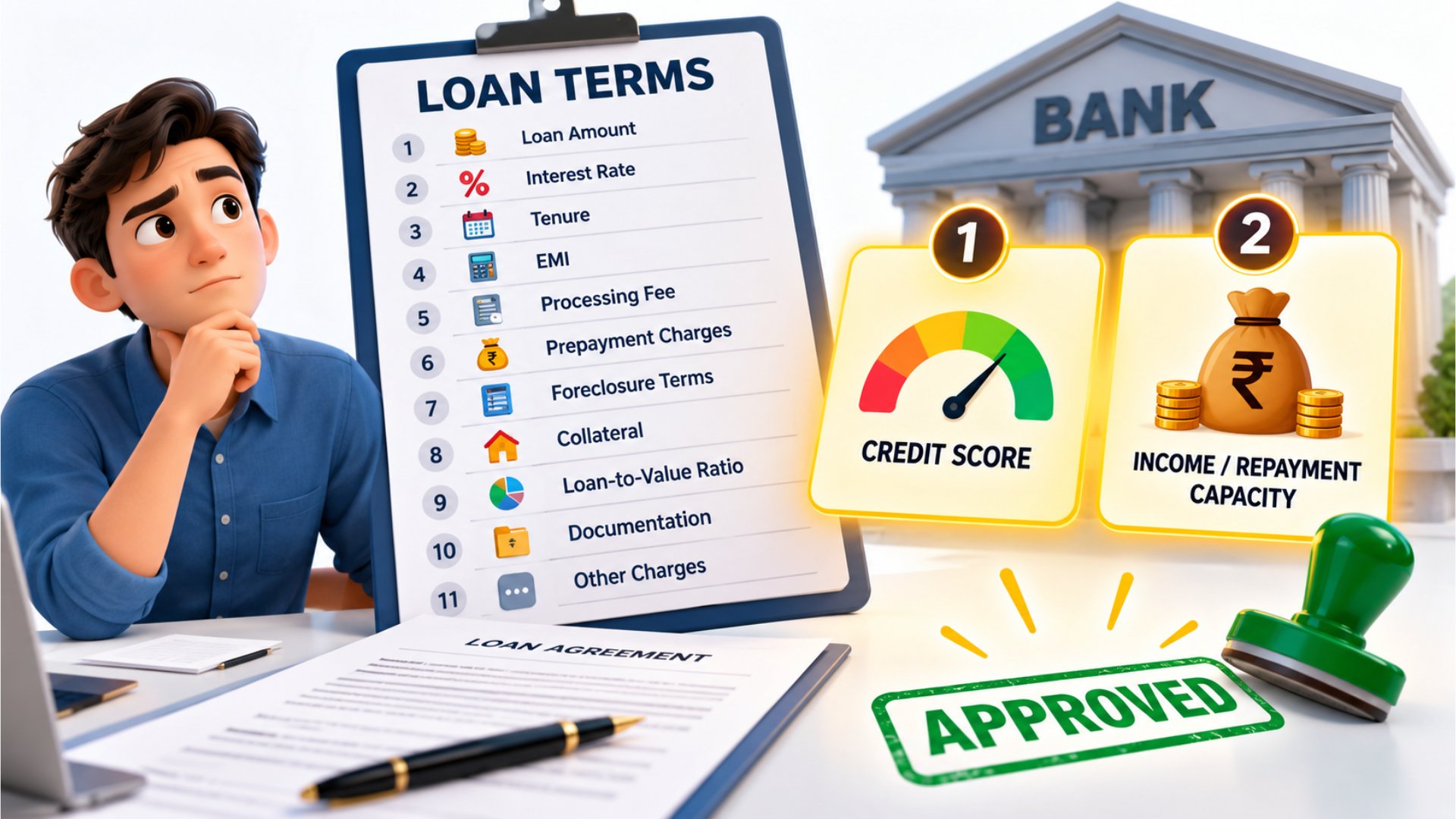
The sanction letter arrives, the relationship manager says congratulations, and somewhere in the eleven pages there are about a dozen words doing all the real work. Most borrowers sign without knowing which of those words costs them money and which one simply describes a process. That gap is expensive. Two of these terms decide whether you are approved at all, one decides whether walking away early is free or costs four per cent of your outstanding balance, and one decides whether your property papers come back in thirty days or thirty months.
What follows is the working definition of each term, the rule that governs it in 2026, and the number attached to it. Nothing here requires a finance degree. All of it appears in documents you will be asked to sign.
Quick Summary
Eleven terms run through almost every Indian retail loan. FOIR and DTI decide approval, and most lenders cap fixed obligations somewhere between 40% and 55% of net income. Fixed versus floating now decides your exit cost: under the RBI’s Pre-payment Charges on Loans Directions, 2025, floating-rate loans to individuals for non-business purposes sanctioned or renewed from 1 January 2026 carry no prepayment or foreclosure charge and no lock-in, while fixed-rate loans still commonly attract 2% to 5% plus GST. And the NDC is a deadline, not a courtesy: lenders must release original property documents and clear the registry charge within 30 days of full repayment or pay ₹5,000 per day of delay.
Why the paperwork got shorter while the stakes got bigger
India has never borrowed at this scale. RBI’s sectoral deployment data puts total outstanding bank credit at roughly ₹215 lakh crore as of May 2026, growing about 18% over the preceding twelve months, which is close to ₹32 lakh crore of fresh credit added in a single year. Within that, the personal loans bucket that RBI uses, which folds in housing, vehicle, credit card and unsecured borrowing, has expanded from around ₹30 lakh crore in FY2021 to more than ₹70 lakh crore by May 2026. Housing alone accounts for about ₹33.7 lakh crore.
Two things happened alongside that growth. Loan journeys went digital, with sanction sometimes landing in minutes. And the regulator responded by standardising disclosure, because speed without comprehension is how mis-selling happens. The result is a borrower who reads less and signs faster, inside a rulebook that is more protective than most people realise.
The last figure changed borrower behaviour most. TransUnion CIBIL reported in March 2026 that 183 million Indians now monitor their own credit information, turning a once-a-loan activity into routine financial hygiene. A borrower who arrives knowing their own score negotiates differently.
What We Know: the confirmed rules behind these eleven words
Four regulatory changes in the last three years reshaped what these terms mean in practice. Each has a date and a published notification behind it.
- Key Fact Statement, mandatory from 1 October 2024. Every new retail and MSME term loan must come with a standardised KFS showing the all-inclusive Annual Percentage Rate. RBI’s notification of 15 April 2024 states that fees not disclosed in the KFS cannot be charged later without the borrower’s explicit consent.
- Penal charges, reset from 1 April 2024. Lenders may levy penal charges, not penal interest. The charge cannot be added to the principal and compounded, must be reasonable and proportionate, and must be disclosed upfront.
- Document release, from 1 December 2023. All original movable and immovable property documents must be returned, and the charge removed from the relevant registry, within 30 days of full repayment or settlement. Delay attributable to the lender is compensated at ₹5,000 for each day.
- Prepayment charges, from 1 January 2026. The Pre-payment Charges on Loans Directions, 2025, issued 2 July 2025, bar prepayment and foreclosure charges on floating-rate loans to individuals for non-business purposes, irrespective of the source of funds, with no minimum lock-in period.
- Fortnightly bureau reporting, from 1 January 2025. Lenders report to credit bureaus on the 15th and the last day of each month rather than monthly, so a closure or a missed EMI now surfaces on your report far faster than it used to.
Principal is the smallest number on the page
Principal is the amount you borrow, excluding interest. It sounds like the number that matters, and over a long tenure it is comfortably the smaller half of what you repay. A ₹10 lakh loan at 9% repaid over five years costs about ₹2.46 lakh in interest. The same principal at the same rate stretched to 25 years costs about ₹15.18 lakh, more than the loan itself.
EMI ₹20,758
EMI ₹12,668
EMI ₹10,143
EMI ₹8,997
EMI ₹8,392
There is a second trap inside the word. The principal on which interest is charged is the sanctioned amount, not the amount that lands in your account. Processing fees, GST and any bundled insurance are typically deducted at disbursal. You receive less and pay interest on more, which is precisely why the KFS reports an APR rather than a headline rate.
Worked example: the gap between the headline and the truth
Ravi is sanctioned ₹5 lakh at 11% for five years. The lender charges a 2% processing fee of ₹10,000 plus ₹1,800 GST, and a bundled insurance premium of ₹12,000 is financed into the loan. Ravi receives ₹4,76,200. His EMI of ₹10,871 is calculated on the full ₹5,00,000. Total repayment is ₹6,52,273, a total cost of ₹1,76,073. The effective APR is 13.15%, not 11% — a gap of 2.15 percentage points that exists entirely in the fine print.
Fixed or floating: one word that now decides your exit cost
A fixed interest rate stays constant for the tenure or for a defined fixed period. A floating interest rate moves with an external benchmark, which for most retail loans sanctioned since October 2019 is the RBI repo rate. The repo rate stands at 5.25% after four cuts through 2025 totalling 125 basis points, and the Monetary Policy Committee held it there on 5 August 2026.
The old way of choosing between them was about predictability. That is no longer the whole story. Since 1 January 2026, the choice also determines whether leaving early is free. Under the Pre-payment Charges on Loans Directions, 2025, a floating-rate loan taken by an individual for a non-business purpose and sanctioned or renewed on or after that date cannot attract a prepayment or foreclosure charge, regardless of the amount, the lender, whether you repay in part or in full, or whether the money came from your savings or from a competing bank’s balance transfer. No lock-in may be imposed.
Fixed-rate loans are outside that protection. And almost every personal loan in India is fixed rate, as are most NBFC vehicle and consumer durable loans. This is the single most misreported fact in Indian loan coverage: the rule did not abolish foreclosure charges for everyone. It abolished them for a defined category, and the category is defined by that one word in your sanction letter.
The mistake that costs the most
People read a headline about prepayment charges being scrapped, assume it covers their 14% personal loan, and budget nothing for exit. Then the foreclosure statement arrives with a 4% charge plus 18% GST on the charge. Before you plan any early closure, find the words “fixed” or “floating” in your sanction letter and, for loans taken before 2026, check the sanction date. Those two facts settle the question.
FOIR and DTI: the two ratios that approve or reject you
FOIR, the Fixed Obligation to Income Ratio, is the share of your net monthly income already committed to fixed outgoings: existing EMIs, credit card minimum dues, and at many lenders, rent. The proposed EMI is added before the test is applied. DTI, the Debt-to-Income ratio, is the broader cousin: total monthly debt obligations measured against gross monthly income.
The practical difference matters. FOIR uses take-home pay and is what an Indian underwriter actually computes; DTI uses gross income and is the number you will see in global personal finance writing. On the same salary, your DTI will look flattering and your FOIR will look strict, because gross income includes tax and deductions that never reach you.
Comfortable
Approvable
Bank ceiling
NBFC zone
Likely reject
Here is the arithmetic that follows. On net income of ₹80,000 with ₹18,000 of existing EMIs and a lender cap of 50%, the headroom for a new EMI is ₹22,000. At 11% over five years, that supports a loan of roughly ₹10.1 lakh. Clear a ₹6,000 car EMI first and the headroom rises to ₹28,000, which supports about ₹12.8 lakh at the same terms. Nothing about your income changed. Only the ratio did.
Part payment, prepayment, foreclosure: one idea, three price tags
Part payment or prepayment means paying a lump sum over and above your EMI, which reduces outstanding principal and therefore all future interest. Foreclosure means clearing the entire outstanding and closing the account before the scheduled maturity. The mechanics are the same; only the scale differs.
What decides the benefit is timing, not size. Early in an amortisation schedule almost your entire EMI is interest, so a rupee of principal repaid then removes many rupees of future interest. Late in the schedule there is little interest left to remove.
One instruction changes the outcome by lakhs, and most borrowers give the wrong one. When you make a part payment, the lender will ask whether to reduce the EMI or reduce the tenure. Reducing the tenure keeps your outgoing the same and removes the maximum interest. Reducing the EMI feels like relief and preserves most of the interest you were trying to escape.
Before you foreclose a fixed-rate loan, run the subtraction
Take a ₹5 lakh personal loan at 14% for five years, EMI ₹11,634, closed after 18 months. Outstanding principal is ₹3,84,558. A 4% foreclosure charge is ₹15,382 plus ₹2,769 GST, so ₹4,02,709 closes the account today. Continuing costs ₹1,04,075 in interest across the remaining 42 EMIs. Closing still wins by about ₹85,924. The charge matters, but it rarely reverses the answer on a high-rate loan closed in the first half of its tenure.
The same ₹5 lakh at five different prices
The final cost of a loan is set less by which product you choose than by which risk band the lender puts you in. The spread one lender offers two different borrowers routinely exceeds the spread between lenders.
The table below is the one worth keeping. It gives the EMI on every ₹1 lakh borrowed, so you can price any loan in your head. Multiply the cell by the number of lakhs.
| Tenure | At 8% | At 9% | At 10% | At 12% | At 14% |
|---|---|---|---|---|---|
| 1 year | ₹8,699 | ₹8,745 | ₹8,792 | ₹8,885 | ₹8,979 |
| 2 years | ₹4,523 | ₹4,568 | ₹4,614 | ₹4,707 | ₹4,801 |
| 3 years | ₹3,134 | ₹3,180 | ₹3,227 | ₹3,321 | ₹3,418 |
| 5 years | ₹2,028 | ₹2,076 | ₹2,125 | ₹2,224 | ₹2,327 |
| 7 years | ₹1,559 | ₹1,609 | ₹1,660 | ₹1,765 | ₹1,874 |
| 10 years | ₹1,213 | ₹1,267 | ₹1,322 | ₹1,435 | ₹1,553 |
An ₹18 lakh loan at 10% for seven years: ₹1,660 multiplied by 18, which is ₹29,880 a month. Check that against your FOIR headroom before you visit a single branch.
Co-applicant or guarantor: two signatures, two very different risks
A co-applicant is a joint borrower. Their income is clubbed with yours to improve eligibility, their credit profile is assessed alongside yours, and the loan appears on their credit report from day one. Every EMI counts inside their FOIR, which means agreeing to co-apply can quietly shrink someone’s own borrowing capacity for years. In property lending, a co-applicant need not be a co-owner, but a co-owner is almost always required to be a co-applicant. Tax deductions on a housing loan flow only to a person who is both co-owner and co-borrower.
A guarantor signs a different promise. Under Section 128 of the Indian Contract Act, 1872, the liability of a surety is co-extensive with that of the principal debtor unless the contract provides otherwise. In plain terms, if the borrower defaults, the lender may pursue the guarantor for the full amount without first exhausting every remedy against the borrower. The guarantee also sits on the guarantor’s credit report and reduces their own eligibility while it is live.
People agree to be a guarantor as a social favour and discover it as a financial commitment. Settle three questions in writing before signing: what exactly is guaranteed, for how long, and what triggers release.
Penalty charges after the 2024 reset
A penalty charge is what the lender levies when you breach a material term: a late EMI, a bounced instruction, a missed covenant. Since 1 April 2024 the framework is specific. Lenders may charge penal charges but not penal interest. The charge cannot be capitalised into the principal, so no interest accrues on the penalty itself. It must be reasonable, proportionate to the breach, and disclosed in the loan agreement and the Key Fact Statement.
That last point is the usable one. Combined with the KFS rule, a charge that does not appear in your KFS cannot be applied later without your explicit consent. If a charge shows up on a statement and you cannot find it in the KFS, you have a concrete basis for a written query rather than a vague complaint. Bounce charges levied by your own bank on a failed mandate are separate and sit outside the lender’s schedule, which is why a single missed EMI can generate two distinct debits.
The NDC is not a formality, it is a deadline with a price tag
A No Dues Certificate is the lender’s written confirmation that the loan is fully repaid and nothing remains outstanding. On an unsecured loan it is the last document you need. On a secured loan it is only the first of three things that must happen, and the other two are the ones people forget to chase.
The 30-day clock is not advisory. RBI’s directions, effective for releases falling due on or after 1 December 2023, require regulated entities to release all original movable and immovable property documents and remove charges registered with any registry within 30 days of full repayment or settlement. Where the delay is attributable to the lender, compensation runs at ₹5,000 for each day. If originals are lost or damaged, the lender must help you obtain certified copies at its own cost, with an additional 30 days allowed before the daily compensation begins to accrue.
What people get wrong here is treating the NDC as the finish line. A loan can be marked closed by the lender while the lien still sits against your property at the registry, and you will only discover it years later when a buyer’s lawyer runs a search. Ask specifically for the charge satisfaction confirmation, not just the certificate.
The eleven-term decoder, in one table
Every term in one place, with the thing it actually decides and the specific question to ask before you sign.
| Term | What it means | What it decides | Ask the lender |
|---|---|---|---|
| 1. Principal | Amount borrowed, excluding interest | Base for every interest calculation | What lands in my account after fees? |
| 2. Fixed rate | Rate constant through the tenure | EMI certainty, and exit charges apply | Is it fixed for the full tenure? |
| 3. Floating rate | Rate linked to an external benchmark | EMI moves, and exits may be free | Which benchmark, and what is the reset date? |
| 4. FOIR | Fixed obligations over net income | Approval and sanctioned amount | What is your FOIR cap for my profile? |
| 5. DTI | Total debt over gross income | Overall debt burden assessment | Is rent counted in my obligations? |
| 6. Co-applicant | Joint borrower, liable from day one | Eligibility, and their future borrowing | Does this reduce their own eligibility? |
| 7. Guarantor | Surety with co-extensive liability | Who pays if the borrower defaults | What event releases the guarantee? |
| 8. Part payment | Lump sum over and above the EMI | How much future interest disappears | Tenure reduction or EMI reduction? |
| 9. Foreclosure | Full closure before maturity | Cost of exiting early | What charge applies, and is there a lock-in? |
| 10. Penalty charge | Fee for a material breach | Cost of a late or bounced EMI | Is every charge listed in the KFS? |
| 11. NDC | Written proof of zero dues | Release of documents and lien | When is the registry charge cleared? |
Six checks that cost nothing and change the offer
If the lender gets it wrong, the escalation order matters
Complaints fail more often from being raised in the wrong place than from being wrong on the merits. The sequence below is the one that produces records a regulator can act on.
What Is Still Unclear
Several things a borrower would reasonably want to know are simply not published, and no article can supply them honestly.
- Foreclosure charges on fixed-rate loans have no published ceiling. The commonly observed range is 2% to 5% of outstanding plus GST, but it is a contractual term, not a regulated maximum. Only your agreement tells you your number.
- FOIR caps are internal. Lenders do not disclose the threshold they apply, and it varies by income band, employer category and product. The bands in this piece describe common practice, not policy.
- Employer grading is invisible. Many lenders price differently by internal employer category, which can shift a rate by half a percentage point or more. Borrowers cannot see the list they are being graded against.
- Dual and special rate loans sit in a grey zone. Whether the 2026 prepayment protection applies depends on whether the loan is on a floating rate at the moment of repayment, which is a question to put to the lender in writing.
- Bureau refresh timing varies. Fortnightly reporting sets the submission cadence, not the date a specific bureau updates a specific report. Closure can reasonably take one to two cycles to appear.
Frequently asked questions
Which of these 11 loan terms actually decides whether I get approved?
FOIR does most of the work, with DTI as the broader view of the same idea. Lenders add your proposed EMI to your existing fixed obligations and test the total against your net monthly income, commonly capping it between 40% and 55%. Credit score decides your price and FOIR decides your amount. If you are near the ceiling, clearing one small existing EMI before applying moves the decision more than any negotiation will.
Are foreclosure charges banned in India from 2026?
Only for a defined category. The Pre-payment Charges on Loans Directions, 2025 bar prepayment and foreclosure charges on floating-rate loans taken by individuals for non-business purposes, sanctioned or renewed on or after 1 January 2026, with no lock-in and regardless of the source of funds. Fixed-rate loans, which includes almost every personal loan, are outside this protection and can still carry charges of roughly 2% to 5% plus GST.
What is the difference between FOIR and DTI in simple terms?
FOIR measures fixed obligations against your net take-home income and is the ratio Indian underwriters actually compute. DTI measures total monthly debt against gross income and is the version used in global personal finance writing. On the same salary your DTI looks better than your FOIR, because gross income includes tax and deductions you never receive. When a lender asks about your ratios, they mean FOIR.
How long does a bank have to return property documents after loan closure?
Thirty days from full repayment or settlement, for releases falling due on or after 1 December 2023. Within that window the lender must return all original movable and immovable property documents and remove the charge registered with any registry. Where the delay is attributable to the lender, compensation is ₹5,000 for each day of delay. If documents are lost, an additional 30 days is allowed to arrange certified copies at the lender’s cost.
Should I reduce my EMI or my tenure when I make a part payment?
Reduce the tenure in almost every case. On a ₹30 lakh home loan at 8.5% over 20 years, a ₹2 lakh part payment at the end of year one removes 34 EMIs and saves about ₹6.85 lakh net of the amount paid, because your monthly outgo stays the same and the whole benefit goes into killing interest. Reducing the EMI feels better immediately and preserves most of the interest you were trying to avoid.
Is a guarantor liable if the borrower stops paying?
Yes. Under Section 128 of the Indian Contract Act, 1872, a surety’s liability is co-extensive with that of the principal debtor unless the contract says otherwise. The lender may pursue the guarantor for the full outstanding without first exhausting every remedy against the borrower. The guarantee also appears on the guarantor’s credit report and reduces their own borrowing capacity while it remains live.
Can a lender charge a fee that is not in the Key Fact Statement?
Not without your explicit consent. RBI’s April 2024 notification made the KFS mandatory for all new retail and MSME term loans sanctioned on or after 1 October 2024, and states that fees and charges not mentioned in it cannot be levied at any stage during the loan term. The KFS also carries the all-inclusive APR, which is the only number that makes two offers genuinely comparable.
What is the difference between an NDC and an NOC after closing a loan?
In everyday use lenders treat them as the same document: written confirmation that nothing is outstanding. What matters more is what comes after it. On a secured loan, closure requires the original documents back, the registry charge satisfied, including at CERSAI where applicable, and the account reported as closed to the credit bureaus. Getting the certificate while the lien stays registered is a common and expensive oversight.
The short version
Principal is what you borrow and the smaller half of what you repay. Fixed or floating now decides both your EMI stability and whether early exit is free, and the 1 January 2026 protection covers floating-rate individual borrowers only. FOIR and DTI decide approval, with most lenders stopping between 40% and 55% of net income. Part payment made early is worth several times the same amount made late, and tenure reduction beats EMI reduction. Co-applicants and guarantors carry real, reportable liability. Penalty charges must be disclosed and cannot be compounded. And the NDC starts a 30-day clock worth ₹5,000 a day if the lender misses it.