New EPF Withdrawal Limits: How Many Times Can You Withdraw PF — and What Stays Locked?
EPF · Partial Withdrawals · India 2026
New EPF Withdrawal Limits: How Many Times Can You Withdraw PF — and What Stays Locked?
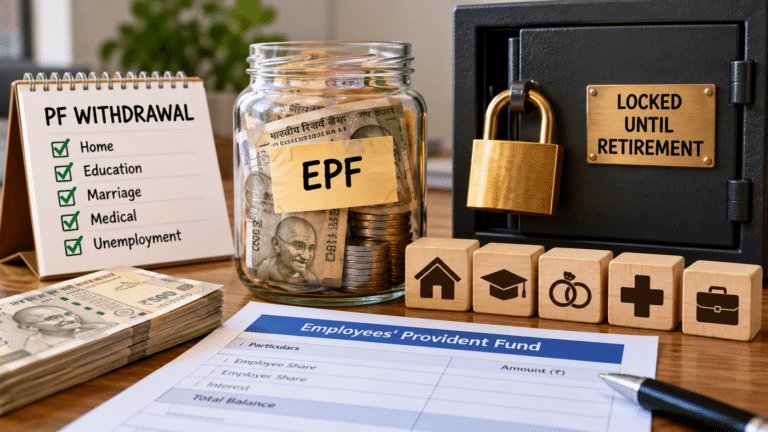
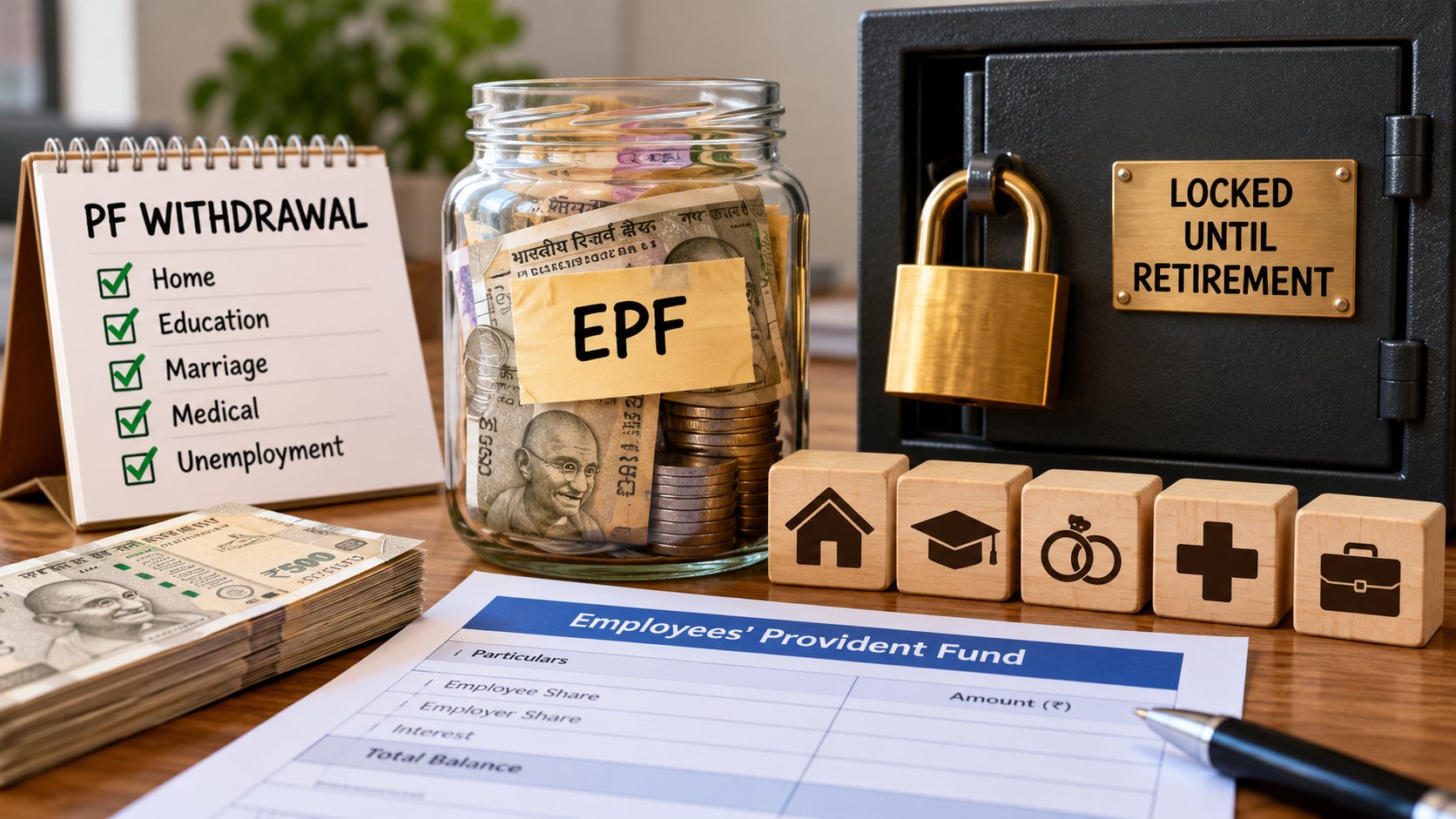
The EPF Scheme, 2026, notified on 29 June 2026, puts a count on every type of partial withdrawal and keeps 25% of your balance out of reach until you leave service. But for most members, access is actually easier than before.
A message doing the rounds says you “can no longer withdraw from PF again and again”. If you have been dipping into your EPF account for a wedding, a hospital bill and then a home loan instalment, that sounds alarming. It is partly true. Since 29 June 2026, every partial withdrawal is counted against a fixed limit, and a quarter of your balance can no longer be touched while you are still working.
But the full picture is closer to the opposite of the headline. The new scheme cut the waiting period from five or seven years to one, raised the number of education and marriage withdrawals sharply, and lets you include the employer’s share. What changed is that access is now rule-bound and counted. Here is exactly how it works, and what it costs to use it often.
Quick Summary
You can still withdraw repeatedly, but not without limit. Education withdrawals are capped at 10 times over your membership, marriage at 5, housing at 5, and “special circumstances” at 2 a year. Illness has no stated cap. In every case, 25% of your contributions and interest must stay in the account. All members started from zero on 29 June 2026, so withdrawals under the old scheme do not count.
What We Know
- The EPF Scheme, 2026 was notified as G.S.R. 525(E) on 29 June 2026, replacing the 1952 Scheme.
- Thirteen old withdrawal provisions are merged into three categories: essential needs, housing, and special circumstances.
- A minimum balance of 25% of contributions plus interest must remain after any partial withdrawal.
- Each purpose has a lifetime or annual count, and all counts restarted on 29 June 2026.
What Is Still Unclear
- Exactly how the Commissioner will use the discretion the scheme gives in sanctioning withdrawals.
- How the Income-tax Act, 2025, which still refers to the 1952 Scheme, will be read for the new scheme; no CBDT clarification was found.
- Whether EPFO will publish a count of remaining withdrawals in the member passbook.
- Details of the simplified guidelines reported in September 2026.
The Rule Behind the Viral Line
The phrase “again and again” refers to Paragraph 46 of the new scheme. Under it, each type of partial withdrawal has a maximum number of uses. Once you have used your five marriage withdrawals, for example, the sixth will not be allowed however much money is in the account.
The old scheme also had limits, but they were scattered across 13 separate provisions with different service conditions and amount formulas. Marriage and education together were limited to three times in a member’s lifetime, according to a TaxSocial analysis of the old and new schemes. The new scheme gives each purpose its own count and is far more generous on most of them.
So the viral line is accurate in one narrow sense: there is now a ceiling on repetitions for each purpose, and a floor below which the balance cannot fall. It is misleading if read to mean withdrawals have become harder overall. For most purposes, they have become easier to reach and more frequent.
Three Doors and Their Counters
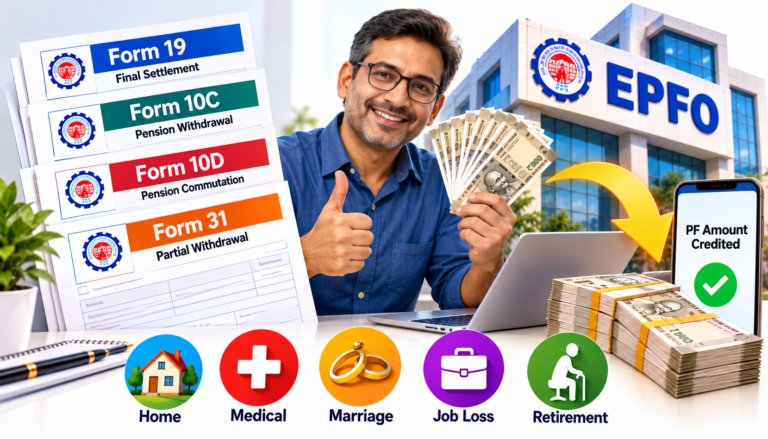
The 2026 Scheme sorts every partial withdrawal into one of three categories. Each needs at least 12 months of total membership, and each allows up to 100% of what the scheme calls your “Eligible Member Balance”, which is explained in the next section.
| Category | Purposes covered | Membership needed | Count limit | Reason needed |
|---|---|---|---|---|
| Illness | Treatment of self or family | 12 months | No cap stated | Yes |
| Education | Self or family | 12 months | 10 times in membership | Yes |
| Marriage | Self or family | 12 months | 5 times in membership | Yes |
| Housing | Site, purchase, construction, loan repayment, renovation | 12 months | 5 times, all housing purposes combined | Yes |
| Special circumstances | Any hardship | 12 months | 2 times per financial year | No |
The housing count is shared
Under the old scheme, buying a site, building a house and repaying a home loan were separate provisions. Now they share one counter of five. A member who withdraws for a plot, then for construction, then twice for loan repayment, has one housing withdrawal left for the rest of their working life.
Special circumstances need no reason
The most flexible door is the new special circumstances category. The 1952 Scheme required a specific cause, such as a natural calamity, a lockout or continuous unemployment, and rejected claims that did not fit, according to TaxSocial. The 2026 Scheme asks for no reason. The cap is two withdrawals in each financial year.
Illness is the one door without a counter
Medical treatment for yourself or a family member has no stated limit on the number of withdrawals. That reflects how unpredictable illness is: a chronic condition can need money several times in one year. The 25% floor still applies, so even an unlimited count cannot empty the account. For repeated medical costs, health insurance remains the better first line, because each withdrawal still shrinks the eligible balance and the retirement pot behind it.
The 25% That Never Leaves
The real restriction is not the count but the floor. Paragraph 46 sets a Minimum Balance of 25% of all contributions, both the employee’s and employer’s, plus interest credited up to the date of withdrawal. That amount stays in the account and is not reduced by withdrawals. The Eligible Member Balance is whatever sits above it.
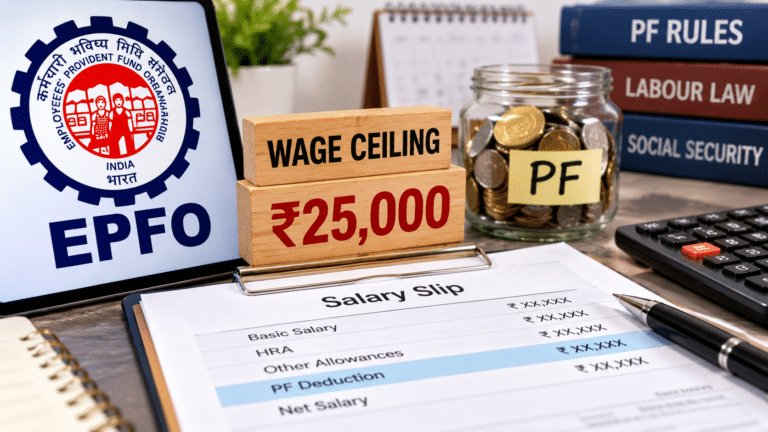
New money reopens the door slowly. With the wage ceiling now at ₹25,000, a member contributing at the ceiling adds ₹3,000 of their own and ₹917 of the employer’s EPF share each month. Only 75% of that, about ₹2,938, becomes withdrawable, because a quarter is added to the floor.
Why the Floor Exists at All
The Employees’ Provident Fund is meant to fund retirement. Over the years, it has increasingly been used as an emergency account, especially after pandemic-era withdrawal windows. A fund drawn down repeatedly in a worker’s thirties and forties can leave very little at 58, when the money is meant to be needed most.
The 25% floor is the board’s compromise. It allows broad, faster access, with a 12-month wait instead of 5 to 7 years, while guaranteeing that a quarter of everything credited stays invested and earning interest. The count limits work the same way. They do not prevent emergencies from being met, but they stop the account from becoming a revolving door.
The last change is easily missed. Under the old scheme, marriage and education withdrawals were capped at 50% of the member’s own share. Now the Eligible Member Balance includes the employer’s contributions too, so the amount that can come out in one go is often far higher than before.
What Each Withdrawal Costs at 58
The visible cost of a withdrawal is the cash taken out. The invisible cost is the interest it would have earned until retirement. EPF credited 8.25% for 2024-25. If that rate held, a rupee withdrawn early would have grown many times by the time you turn 58.
That is the strongest argument for treating EPF as a last resort rather than a first one. A ₹2 lakh withdrawal at 30 would, on the same assumption, have grown to about ₹18.4 lakh by 58. The count limits matter less than this arithmetic. Even one avoidable withdrawal can cost a retirement more than five well-justified ones taken late.
Four Members, Four Different Ceilings
The same rules play out very differently depending on age, balance and what the money is for. These four cases use the Paragraph 46 limits and the 25% floor. The names are illustrative; the arithmetic follows the scheme as summarised by TaxSocial and Zoho.
Anil, 29, a hospital bill
Anil has ₹3 lakh in EPF after six years of work. His eligible balance is ₹2.25 lakh. A ₹1.5 lakh hospital bill for his father uses the illness category, which has no stated cap. He is left with ₹1.5 lakh, of which only ₹75,000 is still withdrawable. The count is not his problem; the shrinking eligible balance is.
Meena, 38, two children in school and college
Meena expects fee payments every year for the next decade. The education category allows 10 withdrawals over her membership, so a withdrawal each year for ten years uses the whole count. If she takes two in one year, she will run out a year early. For her, timing and batching fees matters more than the amount.
Ravi, 42, building a house
Ravi has ₹12 lakh, so his floor is ₹3 lakh and he can withdraw up to ₹9 lakh. He takes ₹4 lakh for a plot and ₹4 lakh for construction. That leaves ₹4 lakh, of which only ₹1 lakh is available, and three of his five housing withdrawals remain. A later loan repayment or renovation will draw from the same count.
Sana, 24, leaving a first job at month ten
Sana has not completed 12 months of membership, so no partial withdrawal is possible while she works. If she leaves before 12 months, Paragraph 46(5) allows her to withdraw up to her eligible balance on that date. Full settlement of everything, including the 25%, would need 12 continuous months without covered employment.
Money Sources Worth Trying Before EPF
Because each EPF withdrawal both uses a count and gives up long-term compounding, it is worth asking whether another source fits first. A separate emergency fund of three to six months of expenses, held in a savings account or sweep deposit, keeps EPF for retirement. Health insurance reduces the chance that a hospital bill becomes a withdrawal at all.
For planned spending, such as a wedding or college fees, a recurring deposit started two or three years ahead spreads the cost. For housing, a home loan carries tax benefits under the old regime and keeps EPF compounding, though the interest cost has to be weighed against the 8.25% EPF rate. A loan against a fixed deposit or gold is usually faster than an EPF claim, but carries interest.
None of these is free. The point is that EPF is the one pot that compounds at a government-declared rate, with limited access by design. Using it last, rather than first, is usually the cheaper choice over a working life.
Partial Withdrawal or Full Settlement?
Partial withdrawals happen while you remain a member. Full settlement closes the account, and its rules are different. Paragraph 49 allows full settlement on retirement after 55, permanent incapacity, migration abroad, retrenchment or a voluntary retirement scheme. Leaving a job permits full settlement only after a continuous period of at least 12 months without covered employment.
A woman resigning to marry is exempt from the 12-month wait. A member who settles fully and later rejoins is treated as a fresh member and must meet the 12-month rule again. Tax also differs: partial withdrawals during service are generally not taxed under recognised-fund rules, while a final settlement before 5 years of continuous service can be taxable, with 10% TDS on payments of ₹50,000 or more where it applies.
From Board Meeting to New Scheme
Before You File Your Next Claim
Frequently Asked Questions
How many times can I withdraw from EPF under the new rules?
Up to 10 times for education, 5 for marriage, 5 for housing across all housing purposes, and 2 times a year for special circumstances. Illness has no stated cap. Counts started from zero on 29 June 2026.
How much of my PF can I withdraw at once?
Up to 100% of your Eligible Member Balance, which is your balance minus a 25% minimum balance. On a first withdrawal, that is about 75% of the total.
What is the 25% minimum balance rule in EPF?
25% of all contributions, employee and employer, plus interest must stay in the account after any partial withdrawal. It grows as new money is credited and cannot be withdrawn while you remain in service.
Do my old PF withdrawals count against the new limits?
No. Paragraph 46(6) of the 2026 Scheme resets the counts from 29 June 2026, so withdrawals under the 1952 Scheme are not counted.
How long do I need to work before withdrawing PF?
12 months of total membership for all partial withdrawals, down from 5 years for housing and 7 years for marriage and education under the old scheme.
Can I withdraw PF without giving a reason?
Yes, under special circumstances, which needs no reason or documents, but only twice in a financial year.
When can I withdraw my full EPF balance?
On retirement after 55, permanent incapacity, migration abroad, retrenchment or a voluntary retirement scheme, or after at least 12 continuous months without covered employment.
Is EPF partial withdrawal taxable?
Partial withdrawals during service are generally not taxed under recognised-fund rules. A final settlement before 5 years of continuous service can be taxable unless an exception applies. Tax references to the new scheme await clarification.
The Short Version
You can still withdraw from EPF many times, but each purpose now has a count: 10 for education, 5 for marriage, 5 for housing, 2 a year for special circumstances, with illness uncapped. A quarter of your balance always stays locked while you work. Access is easier than before, starting after just 12 months. The real limit is arithmetic: every early withdrawal gives up years of compounding.