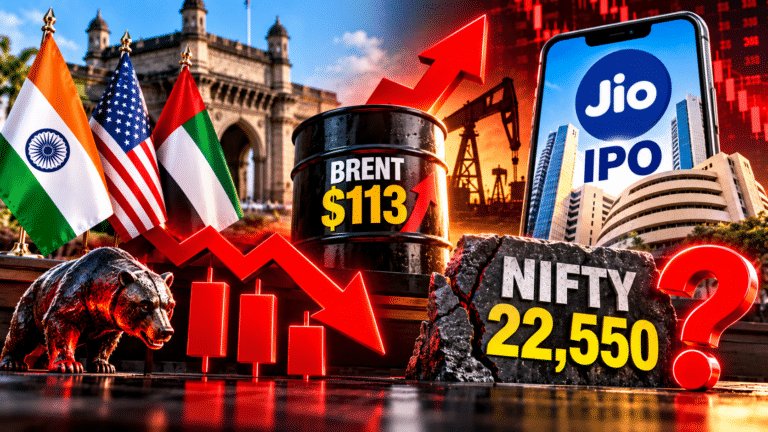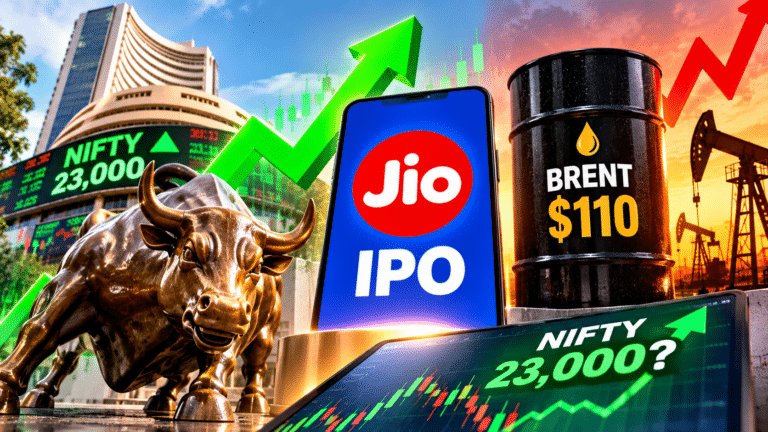
Sensex Closed Flat at 74,314.59 While Nifty Rose to 23,270.60 — What the Split Verdict of 17 September 2026 Signals for the Next Move
The Indian stock market on Thursday, 04-06-2026 is being shaped by a classic push-pull battle: soft global cues, mixed sector leadership, and a domestic economy that still looks stronger than most major peers. For investors searching for fresh Indian stock market trends, the key story is not just where BSE Sensex and NSE Nifty 50 are trading today, but whether India’s growth, inflation, and RBI policy backdrop can keep earnings momentum intact in 2026.
Indian Market Overview
Indian benchmarks have entered June 2026 with a cautious tone after recent weakness, even though the longer-term structure remains constructive for quality large caps and select sector leaders. Recent market trackers showed Nifty around the 23,500 zone and Sensex around the mid-74,000s, while Bank Nifty hovered near 53,100 after a sharp intraday and closing swing, suggesting traders are still reacting to global cues and profit booking in index heavyweights.
Investor sentiment is best described as “selectively bullish, broadly defensive.” Bank Nifty has already shown breakout behavior earlier in 2026, but the latest sessions show that higher valuations and uneven breadth are making traders more selective, especially in IT and other high-beta names. The broader message is that the market is still healthy, but not willing to reward weak earnings or expensive valuations without confirmation.
What the indices are signaling
- BSE Sensex remains a flagship indicator of domestic liquidity and blue-chip stability, but recent readings show it has been vulnerable to global selling pressure and sector rotation.
- NSE Nifty 50 is still the cleaner trend indicator for market breadth, and the near-term price action suggests consolidation rather than a straight-line breakout.
- Nifty Bank trend remains the most important leadership signal in 2026 because banking stocks have carried a large share of index support during earlier bullish phases.
Key Economic Drivers
India’s macro backdrop is still one of the strongest in the world, but markets are now more focused on whether growth can stay strong without reigniting inflation. The latest available estimates point to India’s full-year GDP growth at 7.6% in FY2026, while earlier government and media estimates for FY2026 also clustered around the 7.4% range, reinforcing the view that India remains a top growth market globally.
CPI inflation has been unusually benign in recent updates, and that matters because low inflation supports real income, margins, and policy flexibility. RBI commentary and policy reporting show the repo rate has been held at 5.25% in 2026, with a neutral stance, while inflation forecasts have been revised lower in multiple policy updates, including projections that kept the central bank comfortable with a wait-and-watch approach.
Unemployment is the one macro data point that deserves careful attention because it affects consumption and credit quality. India’s unemployment rate rose to 5.2% in April 2026 from 5.1% in March, and while that is not alarming by itself, it can still make investors more cautious on consumer discretionary and small-cap names if it persists.
Macro impact on markets
- India GDP growth remains a medium-term tailwind for equities because it supports earnings compounding across banks, industrials, consumption, and select capex names.
- CPI inflation staying contained is positive for valuations because it reduces the risk of aggressive monetary tightening.
- RBI repo rates at 5.25% suggest policy is supportive but not ultra-loose, which favors quality balance sheets over speculative momentum.
- Unemployment data matters for FMCG, retail, housing finance, and consumer durables because they depend heavily on steady household demand.
NIFTY Today in Detail
The current Nifty setup is best understood through levels, sentiment, and sector confirmation rather than one number alone. Recent live market reporting showed Nifty slipping below 23,450 and earlier even moving toward the 23,200–24,000 consolidation band, which means traders are treating 23,400 and 23,200 as practical support zones in the very near term.
Point-wise view
- The index has lost short-term momentum after a series of weak closes, which points to profit booking rather than a structural breakdown.
- Support is appearing in the lower consolidation band, which means value buyers are not absent, only more selective.
- Resistance remains near recent breakdown levels, so every rebound is likely to face supply from traders booking prior gains.
- Bank stocks remain the key stabilizer; if banks recover, Nifty usually improves even when IT is weak.
- A narrow market, where a few stocks rise while the index stays flat, usually signals caution rather than panic.
Nifty behavior to watch today
- Opening gap direction after global cues.
- Whether Nifty recovers and holds above the intraday pivot zone.
- Breadth across advances versus declines.
- Bank Nifty strength or weakness, because it often leads index direction.
- IT sector drag, which has recently been one of the heavier pressure points.
Sensex vs Nifty 50
Sensex and Nifty 50 often move together, but their composition makes them react differently to sector rotations and heavyweight stock movements. Sensex is more concentrated in select large caps, while Nifty 50 gives a broader read on the market, so a divergence between the two often hints at index-heavy stock leadership rather than broad buying.
| Metric | BSE Sensex | NSE Nifty 50 |
|---|---|---|
| Market signal | Large-cap sentiment and heavyweight leadership | Broader benchmark sentiment |
| Recent trend | Under pressure, with recent weak closes | Consolidating near the 23,200–24,000 band |
| Current character | Defensive, selective buying | Range-bound with downside pressure |
| Main sensitivity | Financials, IT, consumer giants | Financials, IT, autos, metals, consumables |
| What confirms strength | Broad advance with bank participation | Break above resistance with sector breadth |
The practical takeaway is simple: if Sensex rises on a handful of heavyweights while Nifty breadth stays weak, the move is less durable. If Nifty regains support with bank and auto participation, the rally becomes much more credible.
Latest News Highlights
The biggest latest market news theme is the conflict between strong domestic macro fundamentals and soft global risk appetite. Global market dashboards showed weak Asian sentiment, with GIFT Nifty down sharply, Nikkei in the red, and US futures mixed to lower, which can quickly influence Indian opening momentum even when domestic fundamentals stay solid.
Top market drivers
- US futures showed pressure in Nasdaq and S&P futures, which usually hurts Indian IT and high-valuation growth names first.
- Nikkei weakness signaled cautious Asian risk appetite, making India’s opening tone more defensive.
- GIFT Nifty traded lower, implying a softer start for local benchmarks if overnight sentiment stays unchanged.
- Recent domestic closes showed IT majors such as Tech Mahindra and HCL Tech under pressure, pulling the index down.
Immediate impact
- Export-heavy IT names usually face valuation compression when global tech sentiment weakens.
- Private banks tend to cushion the market when broader sectors are weak, but only if credit and deposit trends remain solid.
- Pharma and defensives often attract rotation during volatile sessions because investors look for earnings stability.
- Volatility in global indices can create intraday whipsaws even when domestic earnings remain unchanged.
Foreign Indices That Matter
Foreign indices influence Indian markets through risk appetite, currency expectations, export demand, and sector sentiment. The most relevant ones for Indian investors are the US benchmarks, Japan’s Nikkei, and Europe’s key indices, especially when they move sharply before the Indian open.
Sector Performance India 2026
Sector performance in India during 2026 is still being led by banks, while IT has been more vulnerable, and pharma plus defensives have been acting as cushion sectors. Earlier in the year, Nifty Bank had already broken to fresh highs and showed strong bullish continuation, but the most recent sessions show that even the strongest sector can pause when the broader market turns risk-off.
Top 10 Stocks to Watch
The best 2026 stock ideas in a market like this should combine earnings visibility, balance-sheet comfort, and a catalyst that can survive volatility. The list below is framed as bluechip stock picks and quality ideas to watch, not guaranteed returns, because valuation and earnings trends can shift fast.
| Stock | Why it stands out | Valuation / yield note | Trigger to watch |
|---|---|---|---|
| HDFC Bank | Defensive banking scale with quality franchise | Generally premium valuation, but supported by return consistency. | Deposit growth and margin stability. |
| ICICI Bank | Strong private-bank momentum | Typically higher quality earnings visibility than many peers. | Loan growth and asset quality. |
| SBI | Public-sector scale with valuation support | Often trades at lower multiples than private banks. | Credit expansion and re-rating. |
| Bharti Airtel | Telecom monetization and cash flow potential | Quality growth with structural tailwinds. | ARPU expansion and subscriber mix. |
| Reliance Industries | Diversified earnings engine | Large-cap ballast with sector optionality. | Retail, digital, energy execution. |
| Larsen & Toubro | Capex and infrastructure proxy | Strong execution story rather than yield play. | Order inflow and government capex. |
| Coal India | Dividend and cash generation play | Screen data shows high dividend yield and low P/E profile. | Output stability and payout visibility. |
| ONGC | Energy exposure with income appeal | Low P/E and meaningful dividend yield. | Crude trajectory and production discipline. |
| Sun Pharma | Pharma leader with defensive qualities | Usually commands premium for consistency. | US formulations and specialty growth. |
| Tata Consumer | Consumption and branded growth | Demand-led story with structural branding benefits. | Volume growth and margin expansion. |
Top Gainers and Losers in the Indian Stock Market – June 4, 2026
The Indian stock market on Thursday, June 4, 2026, is showing a clear story of sector rotation and profit booking: while banking, healthcare, and power stocks are among the top gainers, the IT sector is taking the biggest hit. Yesterday’s closing data (from NSE, as of 03-Jun-2026 16:00) gives us the most reliable snapshot of which stocks are leading the market up and down.
Below is a detailed, point-wise breakdown of today’s top gainers and losers, their percentage moves, and what’s driving them.
📈 Top 10 Gainers (NSE) – With Rationale
| Rank | Stock | Last Price (₹) | % Change | Why It’s Gaining |
|---|---|---|---|---|
| 1 | Apollo Hospitals | 8,299.00 | +2.59% | Strong earnings momentum and defensive healthcare appeal amid market volatility. |
| 2 | TMPV (Tata Motors PV) | 398.00 | +2.00% | High volume (86.38 lakh shares); likely driven by auto demand optimism. |
| 3 | Indigo Airlines (InterGlobe) | 4,550.10 | +1.88% | Aviation recovery plays; strong travel demand in 2026. |
| 4 | Max Healthcare | 965.00 | +1.72% | Defensive sector rotation; stable earnings in healthcare. |
| 5 | SBI (State Bank of India) | 971.50 | +1.55% | Banking recovery; high volume (2,79 lakh shares) shows institutional interest. |
| 6 | ICICI Bank | 1,243.40 | +1.37% | Strong private bank; consistent growth in credit and deposits. |
| 7 | ONGC | 268.25 | +1.21% | Energy sector with high dividend yield; crude price support. |
| 8 | Power Grid | 284.75 | +0.92% | Defensive utility stock; stable cash flows and dividend appeal. |
| 9 | Kotak Mahindra Bank | 382.45 | +0.90% | Banking recovery; high volume (1.48 crore shares). |
| 10 | Trent | 4,242.00 | +0.75% | Retail fashion growth story; earlier seen index inclusion buzz. |
Bonus gainers with strong momentum
- HDFC Bank: +0.63% (massive volume: 3.61 crore shares) – defensive banking anchor.
- Axis Bank: +0.51% – private bank recovery.
- Tata Steel: +0.47% – metal sector bounce.
- Coal India: +0.43% – high dividend yield and low P/E.
- Bharti Airtel: +0.37% – telecom growth story.
- Maruti: +0.12% – auto leadership.
📉 Top 10 Losers (NSE) – With Rationale
Other notable losers
- SBI Life Insurance: −1.12% – insurance sentiment.
- Tata Consumer: −1.00% – consumer demand caution.
- Dr Reddy’s: −0.95% – pharma sector rotation.
- HDFC Life: −0.91% – insurance weakness.
- Ultracemco (Ultratech Cement): −0.89% – infra/cement softness.
- Nestle India: −0.83% – FMCG premium name; valuation pressure.
- Adani Ports: −0.71% – port/infra name; global trade caution.
- Bajaj Finance: −0.60% – NBFC profit booking.
- Hindalco: −0.56% – metal sector softness.
- Eicher Motors: −0.51% – auto midcap; demand caution.
Stock Recommendations for Today
Today’s stock recommendations should prioritize balance-sheet strength, sector catalysts, and lower downside risk rather than aggressive momentum chasing. In a choppy market, the best approach is to combine one growth leader, one defensive income name, and one macro-linked cyclical exposure.
Conservative basket
- HDFC Bank for stability and index support.
- Sun Pharma for defensive earnings visibility.
- Coal India for dividend and cash-flow appeal.
Moderate-risk basket
- ICICI Bank for stronger growth quality.
- Bharti Airtel for structural telecom growth.
- L&T for capex participation.
Aggressive basket
- Select small and midcap names only on earnings visibility.
- Theme-led plays in defence, renewables, and platform businesses.
- Avoid momentum stocks without profits or credible guidance.
Pros and cons
- Pros: better downside protection, cleaner earnings visibility, and easier portfolio balance.
- Cons: lower short-term excitement than speculative stocks, and some high-quality names may look expensive.
- Best use: staggered buying on dips instead of one-shot allocation.
Diversified Portfolio View
A diversified 2026 portfolio should reflect India’s growth story while staying realistic about volatility. For most investors, a blend of banking, pharma, consumption, infrastructure, and one income-producing PSU or energy name works better than crowding into one hot theme.
| Risk appetite | Suggested mix | Objective |
|---|---|---|
| Conservative | 40% large-cap banks, 25% pharma, 20% FMCG, 15% dividend PSU/energy | Capital preservation with reasonable compounding. |
| Balanced | 30% banking, 20% consumption, 15% pharma, 15% infrastructure, 20% selective growth | Growth with controlled volatility. |
| Aggressive | 25% banking, 20% infra/capex, 20% telecom/technology, 20% thematic bets, 15% cash | Higher upside, higher drawdown risk. |
The biggest portfolio mistake in 2026 is likely to be overpaying for excitement while ignoring earnings quality. The smarter play is to buy leadership only when the fundamentals and the technical trend both agree.
Final Thought
The Indian stock market trends for 04-06-2026 point to a market that is still fundamentally strong but tactically cautious, with global weakness, IT underperformance, and index consolidation keeping traders on alert. India’s growth backdrop remains enviable, CPI inflation is still manageable, and RBI policy is stable, which means the bigger 2026 story still favors quality Indian equities, especially banks, select bluechips, pharma, and dividend-supported names.
For investors reading the tape correctly, the message is not “buy everything,” but “buy leadership with discipline.” If Nifty Bank regains momentum and global cues stabilize, the next durable leg of the rally could broaden beyond banks into capex, consumption, and selected large-cap growth names.