Jio Platforms IPO Opens 21 October: Is India's Biggest Issue Worth Its ₹10.3 Lakh Crore Price?
Jio Platforms IPO Opens 21 October: Is India’s Biggest Issue Worth Its ₹10.3 Lakh Crore Price?
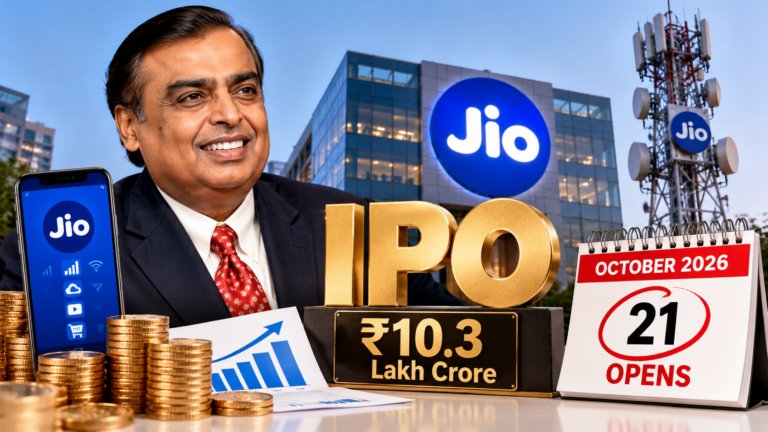
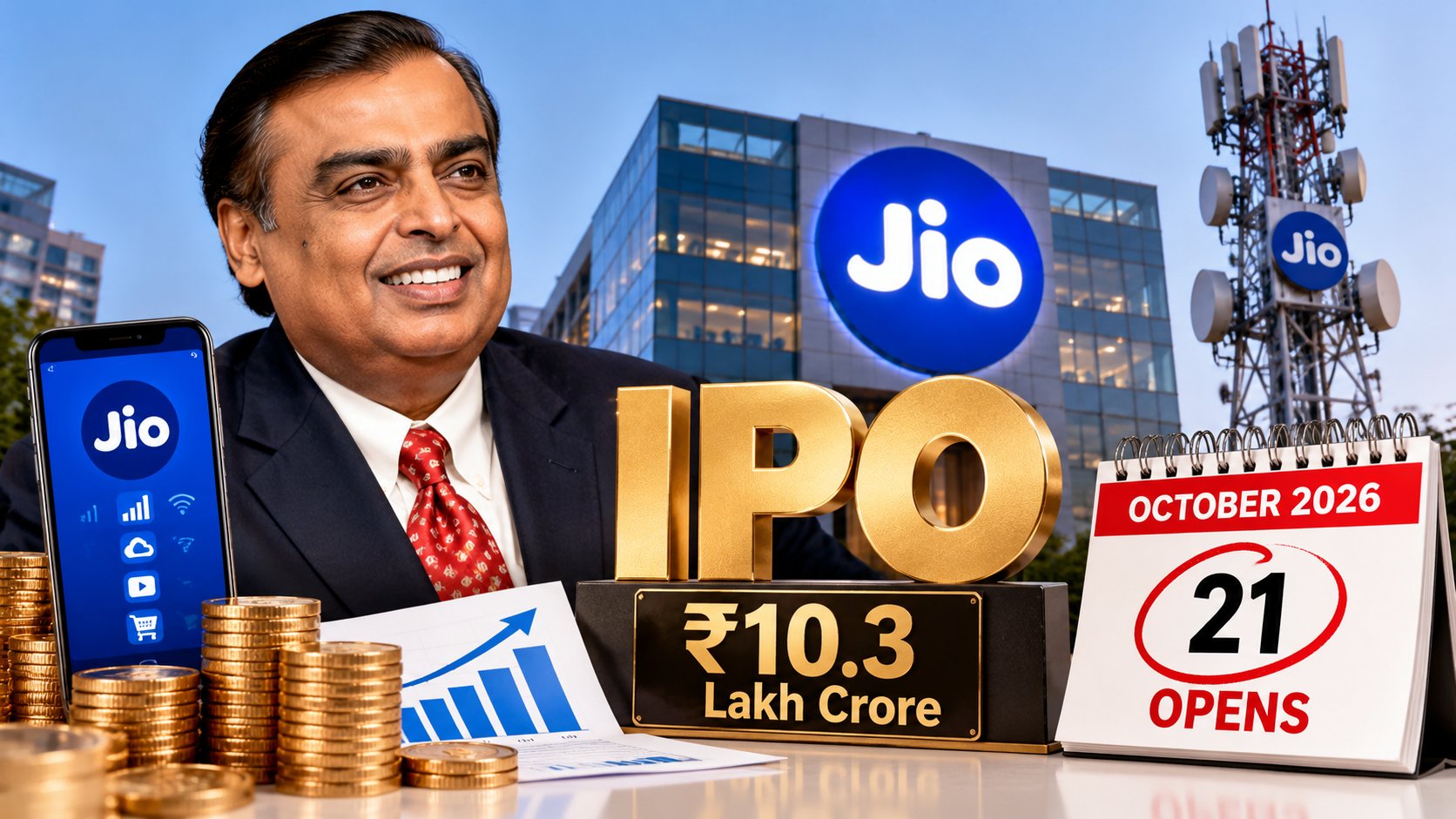
Jio Platforms is raising ₹30,213 crore through an all-fresh issue priced at ₹1,065 to ₹1,119 a share. Institutions bid about ₹2.5 lakh crore in the anchor round. The subscription window runs from 21 to 23 October 2026.
Most people who will read about this IPO have a Jio SIM in their phone, or know someone who does. They know its network, its recharge prices and its app. Very few of them have ever looked at it as a balance sheet. From Wednesday, they can buy a piece of it, and that changes the question from “is Jio good?” to “is Jio good at ₹1,119 a share?”
Those are different questions. A great business can be a poor investment if you pay too much, and an ordinary one can reward investors bought cheaply enough. This article sets out what the issue offers, what the anchor demand does and does not tell you, how the price compares with Bharti Airtel and what a retail application realistically looks like.
Quick Summary
Demand is not in doubt; the price is the question. At ₹1,119, Jio Platforms is valued at about ₹10.3 lakh crore, or 34.3 times its FY26 profit of ₹30,053 crore after the new shares. That is below the 40.7 times DSIJ gives for Bharti Airtel, though Upstox puts both near 34 to 35 times. Jio’s return on net worth is 9.42% against Airtel’s 20.32%. Most of the money raised, ₹27,500 crore, goes to repay debt, not to new growth. Retail applicants should expect a lottery-style allotment if demand is heavy.
What We Know
- The issue is 27 crore fresh shares worth up to ₹30,213 crore, with no offer for sale by existing shareholders.
- The price band is ₹1,065 to ₹1,119, and the retail lot is 12 shares.
- Subscription runs from 21 to 23 October 2026, with allotment expected on 26 October.
- Reports say the ₹8,110 crore anchor book drew about ₹2.5 lakh crore of bids from global funds, sovereign investors, Indian mutual funds and insurers.
What Is Still Unclear
- The final anchor allocation list and price, which had not been fully published in the reports we reviewed.
- The listing date, given as 28 October in most listings and 29 October in one.
- How retail and non-institutional investors will subscribe once the issue opens.
- How tariff changes and competition will move ARPU over the next two years.
A Record Before the Doors Even Open
If it completes as planned, the issue will be India’s largest IPO by amount raised. Outlook Money lists Hyundai Motor India’s ₹27,870 crore issue of October 2024 and LIC’s ₹21,008 crore issue of May 2022 as the two biggest before it. 5paisa adds the NSE’s ₹22,562 crore issue of 2026. All three of those were offers for sale, where existing owners sold shares and the company received nothing.
Jio’s issue is different in structure. Every rupee raised goes to the company. Reliance Industries, Meta and Google, which held 66.43%, 9.98% and 7.73% before the issue according to 5paisa, are not selling. That matters because a fresh issue dilutes existing owners but strengthens the company, whereas an offer for sale only changes who owns it.
It is also a landmark for the Reliance group, which reports describe as returning to the IPO market after roughly two decades. For many retail investors who have only ever held Reliance Industries shares, this is the first chance to own a part of the telecom and digital business directly.
What 30 Times Anchor Demand Really Signals
Anchor investors are large institutions that commit money a day or two before the public issue opens, at a price within the band. India TV News reported that the ₹8,110 crore anchor book attracted bids of about ₹2.5 lakh crore, a multiple of about 30.8 times. Names reported as bidding or showing interest include BlackRock, Capital Group, Fidelity, GIC of Singapore, the Abu Dhabi Investment Authority, Norway’s Norges Bank, SBI and HDFC mutual funds, and LIC.
That is a strong vote of confidence, but it is worth reading carefully. Anchor bids are often inflated because institutions know they will be scaled down, so a fund that wants ₹500 crore of stock may bid for several times that. The multiple measures appetite at a known price, not a forecast of where the shares will trade. Large anchor books have preceded both strong and weak listings in the past.
The structure also includes an employee quota of up to ₹500 crore with a ₹54 discount per share, according to Outlook Money. Reliance Industries shareholders who held shares on 14 October 2026 can apply in a separate ₹2,500 crore reserved category, which can improve their odds of an allotment compared with the general retail pool.
The Business You Use, Seen as a Set of Accounts
Jio Platforms’ restated accounts, as summarised by Chittorgarh, show steady growth. Total income rose from ₹1,10,175 crore in FY24 to ₹1,49,759 crore in FY26. Profit after tax rose from ₹21,434 crore to ₹30,053 crore over the same period. EBITDA margin was 51.9% in FY26 and 53.3% in the June 2026 quarter.
The weaker number is the return on the capital tied up in the business. Jio’s return on net worth was 9.42% in FY26, against 20.32% for Bharti Airtel, according to a DSIJ review. Telecom networks are expensive to build, and Jio’s net worth of ₹3.34 lakh crore is large relative to its profit. Spectrum payments and finance costs also weigh: finance costs more than doubled from ₹4,048 crore in FY24 to ₹8,653 crore in FY26.
Where the IPO money goes
Of the ₹30,213 crore, up to ₹27,500 crore is earmarked to prepay borrowings of Reliance Jio Infocomm, the main operating subsidiary. That is about 91% of the issue. Total borrowings were ₹70,781 crore in March 2026, so the repayment would cut reported debt by about 39%, to roughly ₹43,281 crore. Deferred spectrum liabilities of about ₹1,04,514 crore, which DSIJ notes sit outside reported borrowings, are not affected.
Lower debt should reduce interest costs and lift profit, so the IPO is not just a pass-through. But investors should not mistake the proceeds for expansion capital. The growth case rests on tariffs, home broadband, enterprise services and new businesses, not on the cash from this issue.
Jio Against Airtel: The Comparison That Sets the Price
With only three private telecom operators, the obvious benchmark is Bharti Airtel. On subscribers Jio is ahead. On revenue per user, margins and returns, Airtel is ahead. The question for an investor is whether Jio’s price reflects that difference.
| Measure | Jio Platforms | Bharti Airtel | What it tells you |
|---|---|---|---|
| Subscribers | 535 million | 490 million in India | Jio has the larger base |
| ARPU a month | ₹215 | ₹264 | Airtel earns about 23% more per user |
| EBITDA margin | 53.2% | 57.4% in India | Airtel converts more revenue to profit |
| Return on net worth | 9.42% | 20.32% | Airtel earns twice as much on its capital |
| Price to earnings | 33.3x to 34.3x | 40.7x | Jio is priced lower, but not cheaply |
| Free cash flow, FY26 | ₹14,157 crore | ₹76,683 crore | Airtel generates far more spare cash |
| PEG ratio | 2.2 | 0.84 | Jio’s price assumes more growth per unit of earnings |
Figures are from Upstox and DSIJ, dated 16 October 2026, for the June 2026 quarter or FY26 as stated. The two sources give slightly different P/E figures; our own calculation, using a post-issue market value of ₹10,30,491 crore and FY26 profit of ₹30,053 crore, is 34.3 times.
The ARPU gap is the most important single number for the long-term case. Each ₹10 increase in Jio’s monthly revenue per user, spread across 535 million subscribers, adds about ₹6,420 crore of annual revenue. That is why tariff increases matter so much to the valuation, and also why they carry a risk: higher prices can raise churn, which DSIJ puts at 1.67% a month in the FY26 exit quarter.
Five Risks That Live in the Fine Print
Every prospectus lists risks, and most readers skip them. For an issue this large, they deserve ten minutes. The DSIJ review draws out several that bear directly on the price, and none of them shows up in the experience of using Jio as a customer.
Spectrum dues that sit outside the debt figure
Telecom companies buy spectrum at auction and often pay in instalments over many years. Jio’s deferred spectrum payment liabilities stood at about ₹1,04,514 crore, larger than its reported borrowings of ₹70,781 crore. These obligations are real cash outflows even though they are not labelled as loans. An investor comparing Jio’s balance sheet with another company’s should count them.
Dependence on the Reliance group
DSIJ notes that Jio received ₹1,12,935 crore of revenue in advance from Reliance group subsidiaries in FY26, reflecting how much of its distribution and customer handling runs through group companies. Related-party arrangements are disclosed and approved, but they tie the listed company’s fortunes to decisions made elsewhere in the group. Minority shareholders have less say over those decisions than the promoter does.
Government charges on every rupee
Licence fees and spectrum usage charges absorbed about 7.97% of FY26 revenue, according to the same review. Any change in these charges, up or down, flows straight to profit. Regulation by the Department of Telecommunications and TRAI also shapes tariffs, interconnection and spectrum pricing, so policy risk is a permanent feature of the investment.
A three-player market can still turn
India’s mobile market has settled into three private operators, which has allowed tariff increases. But a rival’s aggressive pricing could slow the ARPU climb on which the valuation rests. Churn of 1.67% a month is low for the industry, yet small changes across 535 million customers move revenue meaningfully.
The improving side of the ledger
The risks come with real strengths. Net leverage fell from 0.88 times in FY24 to 0.36 times in FY26, and operating cash flow of ₹77,556 crore in FY26 was about 2.6 times reported profit, DSIJ reports. Jio also took 78.62% of 5G fixed wireless broadband additions in the June 2026 quarter. A balanced reading is that this is a strong, cash-generating business carrying long-dated obligations, being sold at a full price.
Great Business, Good Price? A Framework for Your Decision
There is no single right answer, because applicants have different goals. A practical way to think about the issue is to decide first what you want from it. The scale below separates the three common reasons people apply.
One point applies to every group. If you already own Reliance Industries, you already have exposure to Jio through RIL’s 64.48% post-issue stake. Applying adds to that exposure. That may be what you want, but it is not diversification.
Retail Allotment: The Lottery Most Applicants Forget
When a retail portion is oversubscribed, SEBI’s rules for main-board IPOs give as many applicants as possible one minimum lot, chosen by lottery. The retail portion here is 8,50,37,327 shares, which is enough for about 70.86 lakh minimum lots of 12 shares. If more than that many valid applications arrive, not everyone gets shares, however many lots they bid for.
| Valid retail applications | Minimum lots available | Chance of one lot | Applicants likely to get nothing |
|---|---|---|---|
| 50 lakh | 70.86 lakh | Close to 100% | Almost none |
| 1 crore | 70.86 lakh | About 71% | About 29 lakh |
| 2 crore | 70.86 lakh | About 35% | About 1.29 crore |
| 3 crore | 70.86 lakh | About 24% | About 2.29 crore |
| 5 crore | 70.86 lakh | About 14% | About 4.29 crore |
These are indicative calculations from the retail share count, not predictions of how many people will apply. They ignore rejected bids and assume each applicant is a distinct PAN. They show why applying for 14 lots rarely raises the odds in a heavily oversubscribed issue. The extra money is blocked in your bank account until refunds on 27 October and then released.
Seven Dates Between Price Band and Listing
Refunds and credit of shares to demat accounts are expected on 27 October. Applications made through UPI need a mandate approval in your UPI app by the cut-off on the closing day; an unapproved mandate means the bid is not counted.
Five Steps Before You Press Apply
Frequently Asked Questions
What is the Jio Platforms IPO price band?
The price band is ₹1,065 to ₹1,119 a share. At the upper end, the minimum retail application of 12 shares costs ₹13,428.
When does the Jio IPO open and close?
The issue opens on 21 October 2026 and closes on 23 October 2026. Allotment is expected on 26 October and listing on 28 October, though one source gives 29 October.
How big is the Jio Platforms IPO?
It is up to ₹30,213 crore, all through new shares, which would make it India’s largest IPO ahead of Hyundai Motor India’s ₹27,870 crore issue in 2024.
What was the Jio IPO anchor book demand?
Reports say the ₹8,110 crore anchor portion drew bids of about ₹2.5 lakh crore, roughly 30.8 times, from global funds, sovereign investors, Indian mutual funds and insurers.
What is the valuation of Jio Platforms in the IPO?
About ₹10.3 lakh crore at the upper band after the issue, or about 34.3 times FY26 profit of ₹30,053 crore by our calculation.
Is there a quota for Reliance Industries shareholders?
Yes. Up to ₹2,500 crore is reserved for eligible individual and HUF shareholders of Reliance Industries who held shares on 14 October 2026, as reported by Outlook Money.
What will Jio do with the IPO money?
Up to ₹27,500 crore will prepay borrowings of Reliance Jio Infocomm, with the rest for general corporate purposes.
What is the Jio IPO GMP?
One report put the grey market premium at ₹206 on 15 October 2026, about 18.4% over the upper band. Grey market figures are unofficial, unregulated and can change sharply before listing.
The Short Version
Jio Platforms’ ₹30,213 crore IPO opens on 21 October at ₹1,065 to ₹1,119. Institutions bid about 30 times the anchor book. The business is large, profitable and growing about 15% a year, but it is priced at about 34 times earnings with a 9.42% return on net worth, and most of the money repays debt. Apply only with money you can leave invested, expect a lottery if demand is heavy, and decide your exit plan before listing.