EPFO Wage Ceiling Change: Why Your PF Could Be ₹20 Lakh Lower at 58 — and What the Pension Gives Back
EPFO Wage Ceiling Change: Why Your PF Could Be ₹20 Lakh Lower at 58 — and What the Pension Gives Back
From 17 September 2026, workers newly pulled into the Employees’ Pension Scheme see ₹2,083 a month of their employer’s contribution go to pension instead of PF. Over 25 years that adds up to about ₹20 lakh less PF, in exchange for a lifelong pension of roughly ₹9,643 a month.
Your salary slip looks exactly the same as it did in August. Your employer still puts in 12% of your basic. Yet if you were one of the EPF-only members pulled into the pension scheme on 17 September 2026, your PF passbook will now grow about a third more slowly. The money has not vanished. It has been moved into a different bucket, one you cannot withdraw as a lump sum, and that switch is where the viral “₹20 lakh less after retirement” line comes from.
The headline is arithmetically fair for a specific group of people. It is also only half of a trade. This article works through both halves: what you give up, what you get, who is actually affected, and why your age matters more than your salary in deciding whether the deal is good for you.
Quick Summary
Yes, the ₹20 lakh figure is real, but only for some members and only in nominal terms. For an employee on ₹25,000 basic pay who was outside EPS and is now auto-enrolled, ₹2,083 of the employer’s monthly ₹3,000 now goes to pension. Over 25 years at 8.25%, that is ₹19.8 lakh by EPFO’s annual-credit method, or ₹20.6 lakh with monthly compounding. In return, the member gets a pension of about ₹9,643 a month from 58. It takes about 17 years of pension, to age 75, just to get the same rupees back, before allowing for any return the lump sum could have earned.
What We Know
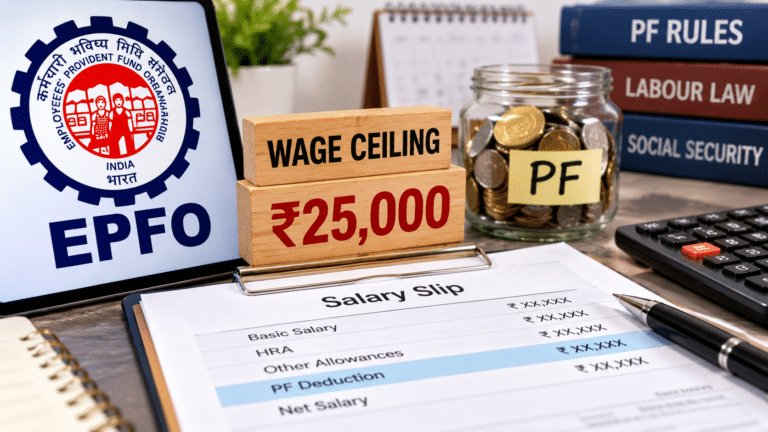
- The EPF and EPS wage ceiling rose from ₹15,000 to ₹25,000 a month on 17 September 2026.
- EPF-only members earning up to ₹25,000 must be enrolled in EPS from that date, with no separate application.
- The employer’s 12% splits into 8.33% for EPS, capped at ₹2,083, and the remainder to EPF.
- EPS pension is pensionable salary times pensionable service divided by 70, with two years’ weightage at 20 or more years of service.
- Existing EPS members do not lose membership when their pay later crosses ₹25,000.
What Is Still Unclear
- How service before 17 September 2026 at the old ₹15,000 ceiling will be weighted for existing members’ pensions.
- Whether any route exists to opt out; current reporting says enrolment is automatic.
- Whether the ceiling, and therefore the ₹2,083 cap, will be revised again before today’s young workers retire.
- Future EPF interest rates, which EPFO resets every year and which change the gap.
Where the ₹20 Lakh Actually Comes From
Start with someone on ₹25,000 basic pay who joined the workforce after September 2014. Under the old rules, anyone who joined after that date with pay above ₹15,000 was kept out of EPS. So their employer’s entire 12%, ₹3,000 a month, went into the PF account. Add the employee’s own ₹3,000, and ₹6,000 a month was compounding at EPF rates.
From 17 September 2026, their pay sits at or below the new ₹25,000 ceiling, so they must be in EPS. The employer still pays ₹3,000, but 8.33% of ₹25,000, which is ₹2,083, now goes to the pension fund. Only ₹917 reaches the PF account. Monthly PF inflow falls from ₹6,000 to ₹3,917.
Business Standard ran this through 25 years at 8.25% and arrived at ₹59.44 lakh of PF under the old split against ₹38.80 lakh under the new one, a difference of ₹20.63 lakh. That calculation compounds monthly. EPFO actually computes interest on the monthly running balance and credits it once a year, which compounds slightly more slowly. On that basis we get ₹57.04 lakh against ₹37.24 lakh, a gap of ₹19.80 lakh. Either way, the “₹20 lakh” headline is a fair rounding.
Why a higher salary does not widen the gap
Because the EPS share is capped at ₹2,083, the gap stays the same whether basic pay is ₹25,000 or ₹50,000, provided the employer contributes on full pay and the employee is already in EPS. We tested a basic of ₹25,000 rising 5% a year for 25 years: the PF corpus grows to about ₹89.6 lakh under the old split and ₹69.8 lakh under the new one. The difference is still ₹19.80 lakh, because the diverted amount never changes.
Are You in the ₹20 Lakh Group? Six Member Types Compared
Most of the confusion around this headline comes from treating every PF member as the same. They are not. The size of your shift depends on two things: whether you were already in EPS before 17 September, and how much your employer contributes on.
| Member type | EPS share before | EPS share now | Monthly shift out of PF | Lower PF after 25 years |
|---|---|---|---|---|
| Joined after Sep 2014, basic ₹15,001 to ₹25,000, was EPF-only | ₹0 | ₹2,083 at ₹25,000 basic | Up to ₹2,083 | Up to ₹19.80 lakh |
| Already in EPS, employer pays on full basic of ₹25,000 or more | ₹1,250 | ₹2,083 | ₹833 | ₹7.92 lakh |
| Already in EPS, basic ₹20,000 | ₹1,250 | ₹1,666 | ₹416 | ₹3.95 lakh |
| Already in EPS, basic ₹15,000 or less | 8.33% of basic | 8.33% of basic | ₹0 | No change |
| Joined after Sep 2014, basic above ₹25,000, EPF-only | ₹0 | ₹0, fresh EPS entry generally not allowed | ₹0 | No change |
| New joiner after 17 Sep 2026, basic up to ₹25,000 | Not applicable | Up to ₹2,083 from day one | Never had it | Starts under new split |
The full ₹20 lakh applies only to the first row: post-2014 joiners who were outside EPS and now earn between ₹15,001 and ₹25,000 of basic pay. Workers on lower pay who were already in EPS see no change, because 8.33% of their basic already went to pension. Existing EPS members earning more see a smaller shift of ₹833, because their share was already ₹1,250 under the old cap. Workers above ₹25,000 who were never in EPS stay out, as EPFO’s October clarification indicates that fresh membership above the ceiling is generally not available.
The take-home trap nobody mentions
If your employer previously calculated PF on the old ₹15,000 ceiling, your own deduction was ₹1,800. On a basic of ₹25,000 it now rises to ₹3,000, so take-home pay falls by ₹1,200 a month. For these members the change is not just a PF-to-pension switch. It is also more money leaving the salary each month.
How the Rule Arrived: Eight Dates That Matter
The change came in steps rather than one announcement, which is part of why members are only now noticing it in their passbooks.
Your Age Decides the Deal More Than Your Salary
The ₹20 lakh figure assumes 25 years of contributions. That only fits someone aged about 33 today. A newly enrolled member gets EPS service only from 17 September 2026, so a 45-year-old has 13 years until 58, not 25. The amount given up is smaller, but so is the pension.
Read the chart from the bottom up and the power of compounding is obvious. The last five years of a 35-year career alone add more than ₹16 lakh to the gap. That is why the trade looks harshest for the youngest workers, the people with the longest time for money to grow in PF.
| Age today | Years to 58 | PF given up at 58 | EPS pension a month | Pension years to recover rupees |
|---|---|---|---|---|
| 25 | 33 | ₹40.14 lakh | ₹12,500 | 26.8 |
| 33 | 25 | ₹19.80 lakh | ₹9,643 | 17.1 |
| 35 | 23 | ₹16.43 lakh | ₹8,929 | 15.3 |
| 40 | 18 | ₹10.02 lakh | ₹6,429 | 13.0 |
| 45 | 13 | ₹5.71 lakh | ₹4,643 | 10.2 |
| 50 | 8 | ₹2.80 lakh | No pension, under 10 years | Withdrawal benefit only |
Two patterns stand out. First, the younger you are, the longer you must draw the pension just to get your rupees back: almost 27 years for a 25-year-old, meaning past age 84. Second, members in their late 40s and 50s with no earlier EPS service face a different problem altogether. EPS requires at least 10 years of service for a monthly pension. Someone joining at 50 cannot reach that by 58 and would receive only a withdrawal benefit, a lump sum calculated under the scheme’s tables, not the full PF that the same money would have built.
Worked example: Priya, 33, basic ₹25,000
Priya joined her employer in 2017 on a basic above ₹15,000, so she was EPF-only. From 17 September 2026 she is auto-enrolled into EPS. If her employer keeps contributing on ₹25,000 and EPF pays 8.25%, her PF at 58 will be about ₹37.24 lakh instead of ₹57.04 lakh. Her 25 years of service plus two years’ weightage give 27 years: ₹25,000 × 27 ÷ 70 = ₹9,643 a month. To collect the missing ₹19.80 lakh in pension instalments, she must draw it for 205 months, which takes her to about 75.
What ₹9,643 a Month Will Really Be Worth
An EPS pension is fixed in rupees. It does not rise with inflation. So the ₹9,643 that Priya starts receiving in 2051 will buy far less than ₹9,643 buys today, and it keeps losing ground every year she draws it.
Fairness cuts both ways here. The ₹19.80 lakh gap is also future money. Converted into today’s rupees at the same 6% inflation, it is worth about ₹4.61 lakh. The headline compares a large future lump sum with a pension that sounds small, but both are shrunk by the same inflation. The meaningful comparison is the value of the pension stream at 58 against the lump sum at 58.
Putting a price on a lifelong pension
One way to compare the two is to ask how much a ₹9,643 monthly pension is worth on the day it starts, discounted at a rate the lump sum could reasonably earn. The answer depends heavily on how long you live and what return you assume.
| Assumed return | Paid 15 years | Paid 20 years | Paid 25 years | Paid 30 years |
|---|---|---|---|---|
| 5% | ₹12.19 lakh | ₹14.61 lakh | ₹16.50 lakh | ₹17.96 lakh |
| 6% | ₹11.43 lakh | ₹13.46 lakh | ₹14.97 lakh | ₹16.08 lakh |
| 7% | ₹10.73 lakh | ₹12.44 lakh | ₹13.64 lakh | ₹14.49 lakh |
| 7.5% | ₹10.40 lakh | ₹11.97 lakh | ₹13.05 lakh | ₹13.79 lakh |
| 8.25% | ₹9.94 lakh | ₹11.32 lakh | ₹12.23 lakh | ₹12.84 lakh |
Every cell is below ₹19.80 lakh. On pure numbers, for the member alone, the lump sum is worth more. Even a pension paid for 30 years and discounted at only 5% is worth about ₹18 lakh at 58. Put another way, ₹19.80 lakh earning 7% would pay about ₹11,551 a month in interest alone, while leaving the capital intact for heirs. This is the strongest version of the case against the change, and it deserves to be said plainly.
What the Lump Sum Cannot Do That the Pension Can
If the maths is that one-sided, why would the government design EPS this way? Because the table above values only the member’s own pension and assumes a disciplined saver who never touches the PF until 58. Real lives rarely look like that.
First, most PF never reaches retirement. People withdraw on job changes, for weddings, for homes and medical bills. The new EPF rules allow repeated partial withdrawals for education, marriage, housing and illness, subject to limits and a 25% minimum balance. The ₹19.80 lakh figure assumes not one rupee of the diverted money would ever have been taken out early. The pension share cannot be raided in the same way once 10 years of service are complete.
Second, EPS is family insurance. If a member dies in service, the family pension can begin immediately, even with short service, for the spouse and up to two children. A PF balance in the early years of a career is small and runs out quickly. That protection is worth something real, especially to single-earner families, and it does not appear in a corpus chart.
Third, a pension solves longevity risk. A ₹19.80 lakh lump sum managed by an 80-year-old, or by family members, can be lost to bad advice, fraud or simple overspending. A monthly credit that lasts as long as you do cannot be outlived. Kunal Kabra of Kustodian.Life told Business Standard that building such capital needs “humongous” discipline and called the change “a step in the right direction.”
Fact box: the tax angle
EPF withdrawals are tax-free after five years of continuous service. EPS pension, by contrast, is taxable as income in the year you receive it. At ₹9,643 a month, or ₹1.16 lakh a year, it is likely to fall within the basic exemption for many retirees, but it adds to other income such as interest and rent.
The Interest Rate Assumption Moves the Gap by ₹3 Lakh
Every figure above uses 8.25%, the EPF rate retained for 2025-26. EPFO’s board resets the rate every year, and nobody can promise it for 25 years. The gap rises or falls with that rate, while the pension formula ignores it entirely.
If EPF returns drift lower over the decades, as they have at times in the past, the cost of the switch shrinks. If they stay high, the cost grows. The pension stays ₹9,643 in both cases. That asymmetry is worth understanding before you take any headline figure as fixed.
Four Ways People Misread This Change
What to Check in Your PF Account This Month
You cannot undo the rule, but you can make sure it is applied correctly, because errors in the split are expensive to fix later. Business Standard quoted Ketan Das of FinRight Technologies warning that errors in PF records are already common, and that a wrong Form 11 entry can take months to correct.
- Download your passbook from the EPFO member portal and compare the employer EPF and EPS columns for August, September and October 2026.
- If you were EPF-only and earn up to ₹25,000, check that EPS contributions have started. If they have not, your employer may be non-compliant, which can lead to arrears later.
- Check that your date of joining and personal details match your Aadhaar, because pension claims depend on clean service records.
- Nominate your spouse and children for both EPF and EPS, since family pension is one of the scheme’s biggest benefits.
- If the lower PF growth worries you, consider topping up retirement savings yourself, for example through the Voluntary Provident Fund or other long-term options suited to your situation.
Frequently Asked Questions
Will my PF balance really be ₹20 lakh lower because of the new wage ceiling?
Only if you were an EPF-only member, earn about ₹25,000 in basic pay and have about 25 years left to 58. For that member, ₹2,083 a month moves to EPS, which adds up to about ₹19.80 lakh at 8.25%. Existing EPS members see a smaller shift of up to ₹833 a month, or about ₹7.92 lakh over 25 years.
Who is auto-enrolled into EPS from 17 September 2026?
EPF members who were outside the pension scheme and earn up to ₹25,000 a month. Employers must enrol them without any application. Members above ₹25,000 who were never in EPS generally cannot join fresh.
Can I opt out of EPS and keep the full employer share in PF?
Current reporting, including Business Standard’s analysis and EPFO’s FAQs summarised by KPMG, describes enrolment as mandatory for eligible members. No opt-out route has been announced.
How is the EPS pension of ₹9,643 calculated?
It uses the formula pensionable salary times pensionable service divided by 70. With pensionable salary at the ₹25,000 cap and 25 years of service, plus two years’ weightage for 20 or more years, the result is ₹25,000 × 27 ÷ 70, or ₹9,643 a month.
What happens if I have fewer than 10 years left before 58?
EPS needs at least 10 years of service for a monthly pension. With less, you receive a withdrawal benefit, a lump sum worked out from the scheme’s tables, rather than a lifelong pension. Earlier EPS service with any employer counts towards the 10 years.
Is the EPS pension better value than keeping the money in EPF?
For the member alone, on a disciplined-saver basis, the lump sum is usually worth more. Our calculations put the value at 58 of a ₹9,643 pension between about ₹10 lakh and ₹18 lakh, against ₹19.80 lakh of PF. The pension’s advantages are family pension, protection if you die in service, and money you cannot outlive or withdraw early.
Does my take-home salary fall after the wage ceiling change?
It does if your employer previously calculated PF on ₹15,000. Your deduction rises from ₹1,800 to up to ₹3,000, cutting take-home by up to ₹1,200 a month. If PF was already on your full basic, take-home does not change.
Is the EPS pension linked to inflation?
No. EPS pensions are fixed in rupees. At 6% inflation, ₹9,643 received 25 years from now is worth about ₹2,247 in today’s money, and it continues to lose purchasing power after it starts.
The Short Version
The “₹20 lakh less” headline is accurate arithmetic for one group: post-2014 EPF-only workers with basic of ₹15,001 to ₹25,000, now auto-enrolled into EPS. For them, ₹2,083 a month of the employer’s contribution now buys a pension instead of growing in PF. Over 25 years that is about ₹19.80 lakh less PF in exchange for roughly ₹9,643 a month for life. On pure numbers the lump sum usually wins. The pension wins on family protection, forced discipline and longevity. Check your passbook, confirm your membership and plan to top up savings yourself if the slower PF growth worries you.