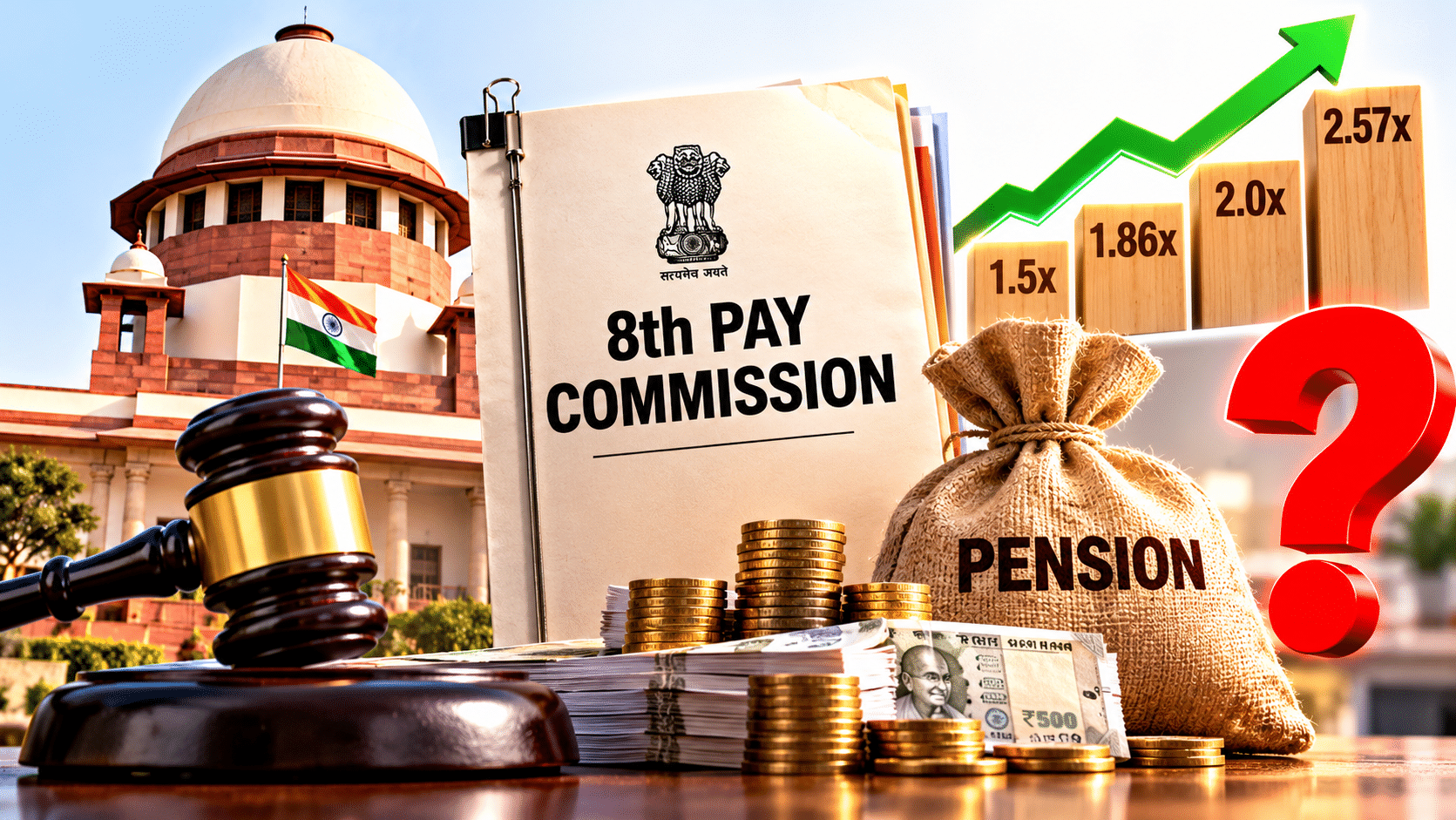
8th Pay Commission and Pensioners: Where the Supreme Court Challenge Stands and What Each Fitment Factor Means for Your Pension
8th Pay Commission and Pensioners: Where the Supreme Court Challenge Stands and What Each Fitment Factor Means for Your Pension
Petitions challenging the 2025 law that lets the Centre treat pensioners differently by retirement date are pending before the Supreme Court. Meanwhile, the 8th Pay Commission is touring the country, with staff unions seeking a fitment factor as high as 3.833.
If you retired from central government service before 1 January 2026, two questions have probably kept you checking the news all year. Will the 8th Pay Commission revise your pension at all? And if it does, by how much? Both questions now lead to the same place: a set of petitions in the Supreme Court and a single number, the fitment factor.
The anxiety has a real legal basis, and it also has a lot of noise around it. This article separates the two. It sets out what the 2025 validation law actually does, which cases are pending and what they ask for, what the government has said on record, and what your pension would look like at every fitment factor currently being discussed.
Quick Summary
No court has ruled, and no fitment factor has been decided. The Supreme Court has issued notice on petitions challenging the 2025 validation of the CCS (Pension) Rules, which restores the Centre’s power to distinguish pensioners by retirement date. The cases are tagged together and awaiting final hearing, with no verdict reported as of October 2026. Separately, the Finance Minister told Parliament on 27 March 2025 that the change does not affect existing pensioners. On the money, a minimum pension of ₹9,000 would become ₹19,350 at a 2.15 factor, ₹23,130 at 2.57 and ₹34,497 at the unions’ 3.833 demand, before dearness relief resets.
What We Know
- The Finance Act 2025 includes a part validating the CCS (Pension) Rules and the principles for pension expenditure, with retrospective effect.
- The Supreme Court issued notice in W.P.(C) 525/2025 on 23 May 2025 and in NCCPA’s petition on 17 November 2025.
- A retired IPS officers’ forum petition was tagged with the lead case on 24 November 2025.
- The 8th CPC was constituted on 3 November 2025 and must report within 18 months.
- The government said in Parliament that existing pensioners’ benefits are not affected.
What Is Still Unclear
- The date of final hearing in the tagged validation petitions.
- Whether the 8th CPC will explicitly recommend parity for pre-2026 pensioners, as the 7th CPC terms of reference required.
- The fitment factor; every figure in circulation is a demand or an estimate.
- Whether revised pensions will apply from 1 January 2026 with arrears.
The 2025 Clause That Turned a Pay Panel Into a Court Fight
In March 2025, Parliament passed the Finance Bill with an unusual addition: a part titled validation of the Central Civil Services (Pension) Rules and the principles governing pension expenditure from the Consolidated Fund of India. Pensioner groups say it was made effective retrospectively from 1 June 1972. In plain terms, it affirms that the government may classify pensioners, including by the date they retired, and treat those classes differently.
Why does that matter? For more than four decades, pensioners have relied on the Supreme Court’s 1982 Constitution Bench judgment in D.S. Nakara, which held that splitting pensioners by an arbitrary cut-off date violates the right to equality under Article 14. Later cases, including S.P.S. Vains in 2008, built on that principle. The validation clause, critics argue, was drafted to blunt exactly those rulings.
The case that triggered it
The immediate background, as reported by LiveLaw, is a long dispute by pre-2006 senior pensioners in the S-30 pay scale. They argued that a 2008 office memorandum implementing the 6th Pay Commission left them with lower pensions than some officers who retired later from junior grades. The Central Administrative Tribunal agreed in January 2015, the Delhi High Court ordered revised pensions on 20 March 2024, and the Supreme Court dismissed the Centre’s appeal on 4 October 2024. In later contempt proceedings, the Union argued it was no longer bound because of the new validation law.
Fact box: what the government said in Parliament
Finance Minister Nirmala Sitharaman told Parliament on 27 March 2025 that the rule changes were procedural and did not affect civil or defence pensioners’ benefits. She said pensioners who retired before 2016 received equal benefits under the 7th Pay Commission and that the same principle would apply under the 8th. That is a statement of intent, not a legal guarantee, which is why the court cases continue.
Inside the Supreme Court File: Three Petitions, One Question
Three petitions now sit together before the Supreme Court. All ask, in different words, whether Parliament can retrospectively validate a classification the courts had struck down. None has reached a verdict.
| Petition | Petitioner | Notice or tagging | Bench reported | Main relief sought |
|---|---|---|---|---|
| W.P.(C) 525/2025 | All India S-30 Pensioners Association | Notice, 23 May 2025 | Not reported in sources checked | Strike down validation; enforce 2024 Delhi HC order |
| W.P.(C) 1057/2025 | NCCPA, pensioners’ coordination body | Notice, 17 Nov 2025 | Justices P.S. Narasimha and A.S. Chandurkar | Declare validation unconstitutional for all pensioners |
| Diary No. 48588/2025 | Forum of Retired IPS Officers | Tagged, 24 Nov 2025 | Justices K.V. Viswanathan and P.B. Varale | Pension from 2006 with arrears and 12% interest |
| Contempt matter | S-30 pensioners | Delhi HC set aside reference, 13 May 2025 | Delhi High Court | Compliance with 20 March 2024 judgment |
| Next listing | All tagged matters | Not confirmed | To be heard together | Final hearing date awaited |
The NCCPA case record, as reported by a pensioners’ association website in January 2026, showed the matter at the motion stage after notice, listed with W.P.(C) 525/2025, with a computer-generated tentative date in January 2026. We could not find a report of a final hearing or judgment as of 23 October 2026. If you see a forward claiming the Supreme Court has “decided” the 8th CPC pension question, treat it with caution and check the court’s own case status page.
Why a constitutional bench could matter
Because Nakara was decided by a five-judge Constitution Bench, a smaller bench cannot overrule it. If the government argues the validation law is consistent with later judgments that distinguish between liberalising an existing scheme and creating a new benefit, the question could eventually require a larger bench. That would add time. Pensioners should plan on the court process and the pay commission running on separate tracks for now.
The Missing Line in the 8th CPC Terms of Reference
The Cabinet approved the 8th CPC’s terms of reference on 28 October 2025. They cover retirement benefits and ask the commission to consider, among other things, the unfunded cost of non-contributory pension schemes. What pensioners noticed was a missing phrase. The 7th CPC’s terms explicitly asked it to examine revision of pension for employees who retired before the date its recommendations took effect. The 8th CPC’s terms, as summarised by pensioner groups, do not repeat that wording.
A gap in wording is not an exclusion. Pay commissions have broad mandates on retirement benefits, and the 8th CPC has invited and received submissions from pensioner associations at hearings across the country. But put together with the validation clause, the omission explains why pensioners fear a cut-off date could be used to treat pre-2026 and post-2026 retirees differently.
What pensioners often get wrong
Two different things are being mixed up. Your monthly basic pension has been revised for existing pensioners after every recent pay commission, and the government says that principle continues. Your gratuity and commuted pension lump sum, by contrast, are calculated on your pay on the date you retired and are not increased by a later commission. Someone who retired in 2025 will likely see their monthly pension revised, but not their gratuity.
Fitment Factor: The Single Number That Multiplies Your Pension
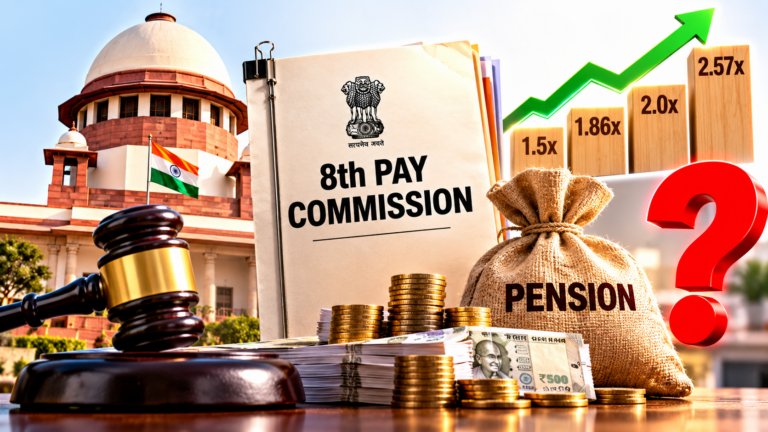
For existing pensioners, the fitment factor is the multiplier applied to basic pension to arrive at the revised figure. Under the 7th CPC it was 2.57, which took the minimum pension from ₹3,500 to ₹9,000 and the minimum pay from ₹7,000 to ₹18,000. For the 8th CPC, every number in circulation is a demand or an estimate.
The NC-JCM staff side, which represents central employees, submitted its memorandum on 14 April 2026 and presented it to the commission on 28 April. It seeks 3.833, a minimum pay of ₹69,000 based on a five-unit family, restoration of commuted pension after 11 years, and periodic pension increases. These are negotiating positions. The commission is not bound by them, and past commissions have landed well below union demands.
Why the headline factor overstates the real increase
When a new pay commission takes effect, dearness relief is usually reset to zero, because past inflation is folded into the new basic figure. So the real increase is the new basic pension compared with the old basic plus dearness relief, not the old basic alone. That is the number pensioners should watch.
At a 1.92 factor, a pensioner on ₹9,000 basic would move from about ₹14,220 total to ₹17,280, a real gain of about 21.5%, not 92%. At 2.57, the same pensioner would gain about 62.7%. The higher the dearness relief climbs before implementation, the smaller the real gain from any given factor.
Your Pension at Four Possible Factors
The table below applies four factors to five levels of current basic pension. It uses the simple multiplication method used for most pre-2016 pensioners under the 7th CPC. The actual 8th CPC method may differ, including notional pay fixation, which can give some pensioners a higher figure.
| Current basic pension | At 2.15 | At 2.57 | At 2.86 | At 3.833 |
|---|---|---|---|---|
| ₹9,000, minimum | ₹19,350 | ₹23,130 | ₹25,740 | ₹34,497 |
| ₹20,000 | ₹43,000 | ₹51,400 | ₹57,200 | ₹76,660 |
| ₹35,000 | ₹75,250 | ₹89,950 | ₹1,00,100 | ₹1,34,155 |
| ₹50,000 | ₹1,07,500 | ₹1,28,500 | ₹1,43,000 | ₹1,91,650 |
| ₹75,000 | ₹1,61,250 | ₹1,92,750 | ₹2,14,500 | ₹2,87,475 |
Figures are revised basic pension before dearness relief and before any additional pension for age. Under current rules, pensioners receive additional pension of 20% at 80, rising to 30% at 85, 40% at 90, 50% at 95 and 100% at 100. Those age-linked additions are applied on the revised basic pension, so they rise with the fitment factor too.
This is one of the reasons older pensioners’ associations push hard on the fitment factor. A pensioner in their 90s receives a percentage addition on top of the revised basic, so every step up in the multiplier is magnified. It also means the age slabs themselves, which the 8th CPC is free to review, matter almost as much to the oldest pensioners as the headline factor.
Worked example: a family pensioner on ₹20,000
Kamla receives a family pension with a basic of ₹20,000. With dearness relief at 58%, her monthly pension is ₹31,600. At a 2.15 factor, her revised basic would be ₹43,000, a real increase of ₹11,400 a month, or 36%. At 2.57 it would be ₹51,400, a rise of ₹19,800 a month. The gap between those two factors alone is ₹8,400 a month, or ₹1,00,800 a year. If she is 82, her 20% additional pension would be calculated on the new basic as well. These are illustrations, not entitlements.
From Nakara to the 8th CPC: The Dates Behind the Dispute
Three Ways This Could End for Pre-2026 Pensioners
Nobody can predict a court verdict or a commission’s recommendation. But the realistic outcomes fall into a few clear patterns, and each has a different effect on your monthly pension.
What Pensioners Can Do While the Case Waits
You cannot speed up the Supreme Court or the commission. You can make sure your own records are clean, so that any revision is paid correctly and quickly when it comes.
- Keep a copy of your pension payment order showing basic pension, date of retirement and pay level. Every revision is calculated from these figures.
- Check that your annual life certificate is up to date, so pension and any arrears are not held back.
- Note your date of birth on the pension records, since additional pension at 80 and above depends on it.
- Follow your pensioner association for representations to the 8th CPC; submissions are being heard state by state.
- Rely on the Supreme Court’s case status page or reputable legal reporting, not forwarded messages, for court updates.
Frequently Asked Questions
Will pensioners who retired before 2026 get the 8th Pay Commission benefit?
The Finance Minister told Parliament in March 2025 that existing pensioners would be treated as under the 7th CPC, when pre-2016 retirees received revisions. Pensioners remain worried because the 8th CPC terms of reference do not explicitly repeat the 7th CPC wording on revising pensions of earlier retirees. No final decision has been made.
What is the Supreme Court case about the pension validation law?
Pensioner bodies, including the All India S-30 Pensioners Association and NCCPA, have challenged the part of the Finance Act 2025 that validates the CCS (Pension) Rules and allows distinctions among pensioners. The Supreme Court has issued notice and tagged the petitions together. No verdict has been reported.
When is the next Supreme Court hearing on the pension validation case?
No confirmed final hearing date has been reported as of October 2026. Check the Supreme Court’s case status page using W.P.(C) 525/2025 or W.P.(C) 1057/2025.
What fitment factor will the 8th Pay Commission give?
It has not been decided. The NC-JCM staff side has demanded 3.833, AITUC and FNPO have sought at least 3.0, and one federation has suggested 2.86. Media estimates range lower. The 7th CPC used 2.57.
How much will the minimum pension be after the 8th Pay Commission?
At current demands and estimates, the ₹9,000 minimum pension would become about ₹19,350 at 2.15, ₹23,130 at 2.57, ₹27,000 at 3.0 and ₹34,497 at 3.833. These are calculations, not announcements.
Will dearness relief continue after the 8th CPC?
Typically, dearness relief is merged into the new basic pension and restarts from zero when a new pay commission takes effect, then rises again twice a year. That is why the real increase is smaller than the fitment factor suggests.
When will the 8th Pay Commission report?
It was constituted on 3 November 2025 with 18 months to report, which points to around May 2027. It may issue interim reports. The expected effective date is 1 January 2026, but this has not been formally notified.
Will my gratuity increase under the 8th Pay Commission?
Generally no. Gratuity and commuted pension are calculated on pay on the date of retirement and are not revised by a later commission. Only monthly pension is typically revised for existing pensioners.
The Short Version
Pensioners have two separate issues in play. In the Supreme Court, petitions led by W.P.(C) 525/2025 challenge the 2025 law that lets the Centre classify pensioners by retirement date; notice has been issued and the cases are tagged, but no hearing outcome or verdict has been reported as of October 2026. At the 8th Pay Commission, the fitment factor is undecided, with unions asking up to 3.833 and the 7th CPC benchmark at 2.57. The government says existing pensioners will not lose out. Keep your records ready, rely on official updates, and judge any factor by real gain after dearness relief resets.