Gujarat’s 5th Pay Commission Pensioners Get DA Raised to 443% — With Arrears Going Back to 2021
Pensions · Gujarat · 5th Pay Commission
Gujarat’s 5th Pay Commission Pensioners Get DA Raised to 443% — With Arrears Going Back to 2021
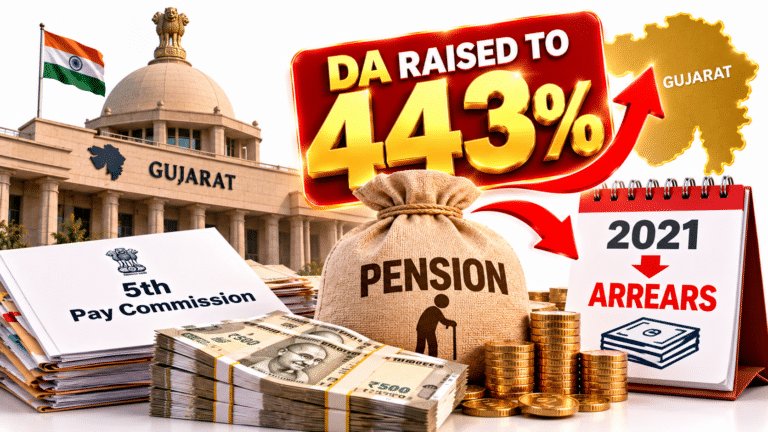
A Gujarat Finance Department resolution dated October 22, 2026 lifts the temporary increase for state pensioners on 5th Pay Commission scales to 443% from January 1, 2024, in stages, and orders arrears for July 2021 to June 2024. The Centre’s equivalent rate is already 483%.
vs Centre’s 483%
For a dwindling group of Gujarat’s oldest government pensioners, the dearness allowance on their pension has been stuck for years. These are retirees and family pensioners whose pensions are still calculated on 5th Pay Commission scales, and whose cost-of-living top-up had fallen well behind the rate the Centre pays its own equivalent pensioners.
On October 22, 2026, the state Finance Department issued a resolution that closes part of that gap. It raises the temporary increase, Gujarat’s term for dearness relief on pensions, to 443% of basic pension from January 1, 2024, in four stages, and orders arrears for three years. Here is what changes, how much it is worth, and why the number is still behind the Centre’s.
Who Is Still on 5th Pay Commission Scales?
The 5th Pay Commission set pay and pension scales from 1996, and Gujarat adopted them through its 1998 pay rules. Most later retirees moved to 6th and then 7th Pay Commission scales. But some pensions, particularly older ones and certain family pensions, are still calculated on the 5th Commission basis, either because of when the pensioner retired or how their pension was fixed.
Because 5th Commission basic pensions are small by today’s standards, the dearness element on them is very large in percentage terms. A 443% rate means the dearness relief is 4.43 times the basic pension. That is why the percentages look startling next to the 7th Pay Commission rate of 60% from January 2026: the basic amounts they multiply are very different.
Temporary Increase, Dearness Relief, DA: One Idea, Three Names
Gujarat’s resolutions use the term temporary increase, often shortened to T.I., for the cost-of-living addition paid on pensions. The central government calls the same idea dearness relief, or DR, for pensioners and dearness allowance, or DA, for serving employees. News reports, including those on this order, often use DA for all three.
The mechanics are the same whatever the label. The rate is a percentage of the basic pension, revised periodically to offset rising prices, and it is paid on top of the basic amount every month. When a new rate takes effect from a past date, the pensioner is owed the difference for each month since then. Those back payments are the arrears.
Why the rates move in half-years
Central rates are revised twice a year, from January 1 and July 1, based on movements in the consumer price index for industrial workers. Many states copy that rhythm. Gujarat’s schedule follows it exactly, which is why the resolution lists separate rates for each six-month period rather than one flat increase.
Four Steps Up to 443%
The resolution does not jump straight to 443%. It sets a rate for each half-year from July 2022, matching the pattern of the Centre’s twice-yearly revisions. The staircase below combines those rates with the earlier periods implied by the arrears schedule.
The 381% figure appears in both readings. Sandesh and Gujarat Samachar describe 381% as the previous rate, while the arrears differences in Gujarat Samachar’s English report are measured against 312%. Both can be true if pensioners had been paid 312% for those older periods and a later order lifted the current rate to 381%.
The Arrears Schedule, Period by Period
The resolution lists the difference payable for each period between July 2021 and June 2024. These percentages are of the basic pension, for each month in the period.
| Period | Months | Difference payable | Implied rate | Arrears on ₹5,000 basic |
|---|---|---|---|---|
| Jul 2021 to Dec 2021 | 6 | 56% | 368% | ₹16,800 |
| Jan 2022 to Jun 2022 | 6 | 69% | 381% | ₹20,700 |
| Jul 2022 to Dec 2022 | 6 | 84% | 396% | ₹25,200 |
| Jan 2023 to Jun 2023 | 6 | 100% | 412% | ₹30,000 |
| Jul 2023 to Oct 2023 | 4 | 115% | 427% | ₹23,000 |
| Nov 2023 to Dec 2023 | 2 | 115% | 427% | ₹11,500 |
| Jan 2024 to Jun 2024 | 6 | 131% | 443% | ₹39,300 |
| Total | 36 | ₹1,66,500 |
What 443% Means for a Monthly Pension
For pensioners, the bigger long-term effect is the higher rate itself. The table shows monthly dearness relief at different basic pensions under the old and new rates, and at the Centre’s current 483% for comparison.
| Basic pension | At 312% | At 381% | At 443% | At Centre’s 483% |
|---|---|---|---|---|
| ₹3,000 | ₹9,360 | ₹11,430 | ₹13,290 | ₹14,490 |
| ₹5,000 | ₹15,600 | ₹19,050 | ₹22,150 | ₹24,150 |
| ₹8,000 | ₹24,960 | ₹30,480 | ₹35,440 | ₹38,640 |
| ₹10,000 | ₹31,200 | ₹38,100 | ₹44,300 | ₹48,300 |
| Gain, 381% to 443%, on ₹5,000 | ₹3,100 a month more in dearness relief | |||
On a ₹5,000 basic pension, moving from 381% to 443% adds ₹3,100 a month, and total monthly pension rises from ₹24,050 to ₹27,150. The gap to the Centre’s 483% is still ₹2,000 a month on the same basic.
Gujarat Is Two Years Behind the Centre
Gujarat’s new rates mirror the Centre’s 5th CPC rates step for step, but with a long delay. The Centre raised its 5th CPC dearness allowance to 427% for July 2023, to 443% from January 2024 by a Finance Ministry order of June 3, 2024, to 455% from July 2024, to 466% from January 2025 and to 474% from July 2025. The Department of Pension’s order of May 22, 2026 sets dearness relief for 5th CPC CPF beneficiaries at 483% from January 2026.
States are not bound to follow the Centre’s dearness rates, but many track them with a lag. For older pensioners, the delay is not just about money arriving late: arrears are generally paid without interest, so years of waiting erode their real value.
Reading the Two Starting Figures Correctly
The single most confusing part of the coverage is the starting rate. Gujarati reports say the temporary increase rises from 381% to 443%. The English report describes payouts being raised from 312% to 443%, and its arrears differences only make sense if 312% was the rate paid in those past periods. A pensioner reading one report could expect a 62-point rise, while another expects 131 points.
The likely explanation is that both figures are right for different periods. An earlier order, reportedly from December 2024, appears to have moved the rate being paid to 381%, which matches the Centre’s January 2022 step. For months before that change, pensioners would still have been paid at 312%. The new resolution then fills the gap between what was paid and what the staged rates say should have been paid.
That has a practical consequence. For the 36 months up to June 2024, pensioners paid at 312% are owed the full differences in the schedule. For any months since December 2024 when they were already paid 381%, they are owed 62 points, the gap between 381% and 443%, not 131. What people often get wrong is applying the largest percentage to every month. Your pension office’s statement should show the rate used for each period; if it does not, ask for it.
How the Money Reaches Pensioners
The resolution places the work on pension disbursing authorities. They calculate each pensioner’s entitlement period by period and credit it. Pensioners living outside Gujarat are covered too: the resolution asks Accountants General of other states and central authorities to instruct disbursing agencies and public sector banks to pay them.
Local bodies, corporations and municipalities that pay their own retirees on similar terms may extend the increase, but the resolution says they must decide based on their own finances and will get no extra state grant for it.
Why Late Arrears Are Worth Less Than They Look
A pensioner who receives arrears in late 2026 for money owed since July 2021 gets the full rupee amount, but not the use of it. Prices have risen in the meantime. RBI’s October 2026 policy statement put CPI inflation at 4.8% in August 2026 and projected 5.2% for the year, according to SCC Online. Money that should have arrived in 2021 buys less in 2026.
The reported resolution does not mention interest on the arrears, and government dearness arrears are generally paid without it. For a retiree in their late seventies or eighties, a lag of more than two years also carries a harsher cost: some pensioners do not live to receive what they were owed, leaving family pensioners or heirs to follow up.
What family pensioners should know
The order covers family pensioners as well as retirees. If a pensioner has died since July 2021, the arrears for the period before death belong to the pensioner’s estate or nominee, while arrears for the period after death are paid on the family pension. Disbursing authorities usually need the death certificate and the family pension authority to split the two correctly.
A note on income tax
Arrears are taxable as pension income in the year they are received, even though they relate to earlier years. For most 5th Pay Commission pensioners, total income will stay low, but a large lump sum can push some into a higher tax bracket. Income tax law provides relief for arrears of salary or pension spread across past years; ask a tax adviser how it applies to your 2026-27 return.
If Your Arrears Look Wrong
- Get your pension payment order and confirm your basic pension and that it is on 5th Pay Commission scales.
- Check which rate you were paid for each period since July 2021: 312%, 381% or another figure.
- Recompute the difference for each period using the new rates, as in the worked example.
- Ask your treasury or bank for a statement showing how the arrears were worked out.
- Write to the Pension Disbursing Authority if the figures do not match, quoting the October 22, 2026 resolution.
A Quick Pensioner Checklist
Frequently Asked Questions
What is the new DA for Gujarat 5th Pay Commission pensioners?
Under the Gujarat Finance Department resolution dated October 22, 2026, the temporary increase for 5th Pay Commission pensioners and family pensioners is 443% of basic pension from January 1, 2024. It rises in stages: 396% from July 2022, 412% from January 2023 and 427% from July 2023.
Who gets the 443% DA in Gujarat?
State government pensioners and family pensioners whose pensions are calculated under the 5th Pay Commission, governed by the Gujarat Civil Services (Revision of Pay) Rules, 1998. It does not apply to pensioners on 6th or 7th Pay Commission scales.
How much arrears will Gujarat pensioners get?
Arrears cover July 2021 to June 2024, with differences of 56% to 131% of basic pension depending on the period. On a ₹5,000 basic pension, that works out to about ₹1,66,500 over 36 months if 312% was paid in those periods. Actual amounts depend on the rate already paid.
When will the arrears be paid?
Reports say the arrears will be paid in cash to pensioners’ accounts, calculated by each pension disbursing authority. A specific payment date has not been reported. Check with your treasury or bank.
What is the 5th Pay Commission DA rate for central pensioners?
The Centre’s 5th CPC dearness allowance reached 443% from January 2024, 455% from July 2024, 466% from January 2025 and 474% from July 2025. The Department of Pension’s order of May 22, 2026 sets dearness relief at 483% from January 2026 for 5th CPC CPF beneficiaries.
Why is the DA percentage so high for 5th Pay Commission pensioners?
Because the basic pension on 5th Pay Commission scales is small, and dearness relief has accumulated over decades to compensate for inflation. A 443% rate means dearness relief equals 4.43 times basic pension. The 7th Pay Commission rate is much lower, at 60% from January 2026, because its basic amounts are far higher.
Will Gujarat pensioners living in other states get the increase?
Yes. The resolution asks Accountants General of other states and central authorities to instruct disbursing agencies and public sector banks to pay Gujarat pensioners living outside the state.
Do retirees of Gujarat municipalities and boards get the 443% DA?
Not automatically. Local bodies, corporations and municipalities may extend the increase to their retirees, but must decide based on their own finances, and the state will not provide extra grants for it.
The Short Version
Gujarat’s Finance Department, in a resolution dated October 22, 2026, has raised the temporary increase for state pensioners on 5th Pay Commission scales to 443% of basic pension from January 1, 2024, through steps of 396%, 412% and 427%. Arrears are due for July 2021 to June 2024, with differences of 56% to 131%. On a ₹5,000 basic pension, that could mean about ₹1.67 lakh in arrears and ₹3,100 a month more. Gujarat still trails the Centre, which pays 483% from January 2026. Check your basic pension and the rate already paid.