India's Rupee Volatility and RBI's Next Move: What Global Investors Are Quietly Watching This May
The Indian rupee has crossed a threshold that few analysts saw coming at the start of 2026. On May 15, 2026, it crashed to a historic low of 96.07 against the U.S. dollar — a level that sent shockwaves through trading desks from Mumbai to Singapore, and put India’s macroeconomic stability under a microscope that global investors haven’t trained on it this intensely in over a decade. What began as a gradual slide from around ₹89.86 per dollar at the start of the year has turned into a near 7% depreciation in just four and a half months, making the rupee one of Asia’s weakest-performing currencies in 2026. Understanding why this is happening, what the Reserve Bank of India is doing about it, and where the currency heads next is no longer just a domestic concern — it has become an urgent conversation in boardrooms and portfolio management firms the world over.
The Anatomy of a Historic Slide
The rupee’s freefall in 2026 is not a single-factor story. It is the convergence of three powerful and simultaneous forces: a global energy shock, sustained foreign capital flight, and a structural widening of India’s current account deficit. Each factor alone would pressure any emerging market currency. Together, they have created conditions that stripped the rupee of every psychological support level from ₹90 to ₹96 within months.
The most immediate driver is the brutal surge in crude oil prices. Global crude has surged close to $110 per barrel following escalating tensions in the Middle East and disruptions around the Strait of Hormuz. For India, the world’s third-largest oil importer, this is a body blow. Every $10 per barrel increase in crude oil prices widens India’s current account deficit by approximately 36 basis points and raises domestic inflation by 35 to 40 basis points, according to research from the State Bank of India. When crude sustains itself above $100 per barrel, the impact on the current account deficit and inflation does not remain linear — it becomes exponential, as SBI’s group chief economic adviser Soumya Kanti Ghosh explicitly warned. India is now living that scenario in real time.
The current account deficit itself has been widening steadily. India’s CAD expanded to $13.2 billion in Q3 of FY26, up from $11.3 billion in the same quarter the previous year. CRISIL has projected that under elevated crude oil price scenarios — where oil averages between $82 and $87 per barrel — the CAD could widen to 2% of GDP in FY27. The government is now actively considering emergency measures to shore up foreign exchange reserves, including curbing non-essential imports such as gold and electronic goods, and potentially hiking fuel prices. These are not routine policy discussions; they signal the seriousness with which New Delhi views the situation.
The FII Exodus and Its Compounding Effect
Foreign institutional investor (FII) outflows have acted as the second engine of depreciation, and the scale of withdrawals in 2026 has been staggering. FIIs pulled out ₹60,847 crore from Indian equities in April alone. By early May 2026, total FPI outflows had crossed ₹2.6 lakh crore for the year — a figure that already exceeds the total FPI outflows for the entire calendar year 2025. Foreign investors have remained net sellers in every single month of 2026 except February.
The capital migration pattern tells its own story. Portfolio investors are shifting from Indian equities toward technology-heavy markets like South Korea and Taiwan, driven by AI-driven capital reallocation and more attractive valuations elsewhere. This is not simply risk-off behavior; it reflects a structural reassessment of India’s relative attractiveness amid geopolitical risk, energy shock, and policy uncertainty. The daily selling pressure has been considerable — FIIs sold ₹8,438 crore worth of equities on May 11 alone, the single largest single-day sell-off in that stretch. Domestic institutional investors (DIIs) have absorbed a significant portion of this pressure, infusing ₹35,323 crore into equities during the first seven sessions of May, but DII support can cushion equity markets only partially — it cannot substitute for the dollar inflows that forex markets require.
India’s foreign exchange reserves have been drawn down to defend the rupee. Reserves fell from $723.60 billion in February 2026 to $690.69 billion by May 1, 2026. While the reserves still cover approximately 10 to 11 months of imports, the directional trend is concerning. The RBI has already taken micro-interventions like limiting banks’ daily open positions in foreign exchange to $100 million and temporarily restricting non-deliverable forward offerings to non-residents.
Where the RBI Stands: A Calculated Restraint
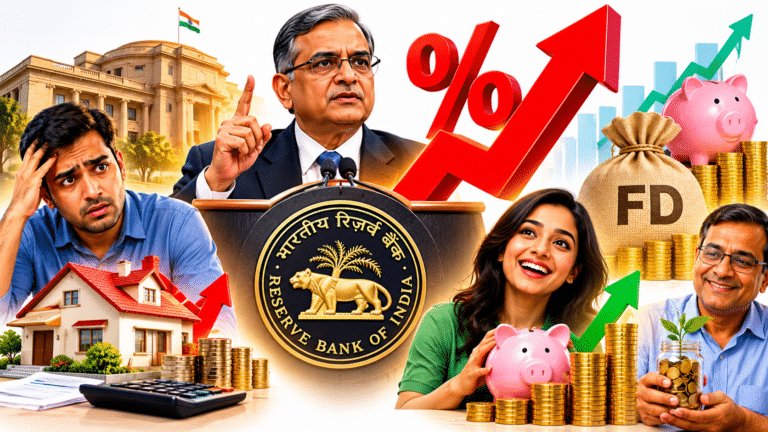
The Reserve Bank of India, under Governor Sanjay Malhotra, has maintained the repo rate at 5.25% with a neutral stance throughout 2026. The central bank’s monetary policy posture reflects a delicate balancing act between supporting growth, containing imported inflation from surging energy costs, and defending the rupee without burning through reserves. In February 2026, the MPC voted unanimously to retain the 5.25% rate, projecting FY26 GDP growth at 7.40% and keeping inflation expectations anchored.
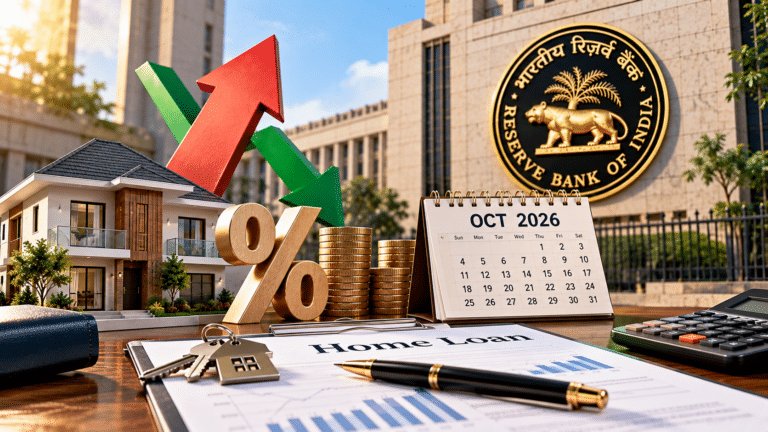
The question now consuming every macro analyst watching India is what the RBI will do in its next MPC meeting, scheduled for June 3-5, 2026, with the decision to be announced on June 5. The consensus from leading economists is clear: the RBI will hold rates steady. Pranjul Bhandari, Chief India and ASEAN Economist at HSBC, stated explicitly that the June policy meeting will likely see no change in the repo rate. Instead, the RBI is expected to focus on providing liquidity support to the banking sector, keeping liquidity conditions flush while avoiding rate action that could either further weaken the rupee or choke off growth at a vulnerable moment. Bhandari noted that any meaningful rate decision is unlikely before the end of calendar year 2026.
This “hold with support” posture is a calculated strategic choice. Raising rates to defend the rupee would risk slowing an economy that is navigating an external energy shock simultaneously — exactly the wrong medicine when the illness is supply-side in origin. Cutting rates to stimulate growth would accelerate capital outflows and further weaken the rupee. The RBI is therefore threading a needle: maintaining the existing rate architecture while using liquidity tools, forex market interventions, and import curbs as the primary instruments of stabilization.
What Global Investors Are Actually Watching
For foreign investors monitoring India from offshore — whether in hedge funds tracking Asian emerging markets, sovereign wealth funds evaluating long-term allocations, or multinational corporations managing currency exposure on Indian operations — May 2026 is a period of critical observation rather than decisive action. Several specific developments are on their radar.
The first is the trajectory of crude oil prices relative to $100 per barrel. Markets understand that sub-$100 crude is manageable for India, even uncomfortable. Crude above $100, sustained, changes the inflation calculus completely and could force the RBI into a reactive policy posture rather than a proactive one. At $110 per barrel, India’s import bill explodes, the fiscal deficit widens as fuel subsidies become politically necessary, and inflation targeting becomes near-impossible.
The second is the progress — or lack thereof — on the US-India trade deal. Currency markets priced in significant optimism earlier in 2026 that a favorable agreement reducing US tariffs to the 15-20% range would allow the rupee to recover toward ₹87.50-88.00. That optimism has not materialized into concrete policy, and the continued absence of a deal has been cited as a key structural uncertainty keeping institutional investors cautious on the rupee.
The third is whether the RBI will eventually move on overseas investment limits for mutual funds. Since February 2022, SEBI has halted fresh investments in overseas funds after mutual funds hit the $7 billion limit. The RBI has been reluctant to raise this limit precisely because of its concerns about rupee depreciation. For global fund managers, this structural constraint on Indian capital outflows is a double-edged observation — it limits arbitrage but also signals the central bank’s defensive posture.
The fourth and perhaps most sophisticated concern is the RBI’s forward book. The central bank reportedly holds a short dollar forward book position of approximately $80 billion. This is a significant hedging position that gives the RBI tools to intervene in the forward market, but it also creates obligations that constrain future flexibility. International currency analysts are watching the forward position carefully as an indicator of how much dry powder the RBI has left for sustained defense of the rupee.
The Inflation-Growth Tightrope
One of the more nuanced dimensions of India’s current predicament is how energy-driven inflation intersects with the monetary policy framework. India targets inflation in a 2-6% band. FY26 inflation was projected at 2.10% at the start of the year, providing considerable headroom. But imported inflation from a near-$110 crude price environment fundamentally disrupts that comfortable baseline.
Every pass-through of higher energy costs into domestic fuel prices, freight rates, and manufacturing inputs acts as a tax on the Indian consumer and a margin compressor for Indian industry. If the government defers fuel price hikes to limit political fallout, it widens the fiscal deficit. If it passes on the costs, it stokes inflation. Neither option is clean, and the RBI must calibrate its stance knowing that the root cause — geopolitical disruption in West Asia — is entirely outside its control. This is precisely why HSBC’s Bhandari described the current moment as a “double energy shock” scenario requiring liquidity support rather than rate action.
The Domestic Investor Response
Amid the volatility, domestic institutional investors have emerged as a critical buffer. DIIs infused approximately ₹35,323 crore into equities during the first seven sessions of May 2026, partially offsetting FII selling. This reflects the maturation of India’s domestic savings and investment ecosystem — the systematic investment plan (SIP) culture among retail investors, driven by mutual fund penetration, has created a structural source of demand that absorbs foreign selling pressure in ways that were not available during India’s currency crises of the 1990s or even 2013.
Yet domestic investors cannot stabilize the currency directly. Rupee defense ultimately requires dollar supply — either through export earnings, foreign investment inflows, or RBI intervention. The government’s consideration of emergency measures including curbing gold and electronics imports is aimed at precisely this arithmetic: reduce dollar outflows to protect the remaining reserve buffer. India’s gold imports are traditionally among the largest non-oil components of its import bill, and any administrative restriction there would reduce dollar demand meaningfully, even if it creates friction in consumer markets.
The Longer Outlook: Stabilization or Extended Weakness?
Before the energy shock of early 2026, currency analysts broadly expected the rupee to consolidate in a range of ₹88-91.50, with 2026 characterized as a year of stabilization rather than further sharp depreciation. That thesis has been overtaken by events. The rupee has breached ₹96, and the question now is whether it finds a floor near current levels or continues searching for support further down.
The base case among serious analysts still involves stabilization, conditioned on two things: crude oil prices retreating from their spike highs as geopolitical risk premiums ease, and some constructive movement on the US-India trade relationship. A services trade surplus, which India continues to run robustly through IT exports and business process outsourcing, provides a structural offset to the merchandise trade deficit. Remittances — India receives more inward remittances than any other country in the world — also buffer the current account in ways that raw trade data does not fully capture.
But global investors looking at India this May are not operating on optimistic base cases. They are stress-testing portfolios against a scenario where crude stays elevated, the rupee tests ₹98-100, and the RBI is forced to choose between growth support and currency defense more explicitly than it would prefer. That scenario assigns higher risk premia to Indian assets across the board — equities, bonds, and currency hedges alike. The decisions being made quietly in those risk assessments this month will shape the next leg of capital flows into or out of India for the remainder of 2026.
What India Has Working in Its Favor
It would be intellectually incomplete to frame this purely as a crisis narrative. India enters this volatile stretch with several structural advantages that matter. Forex reserves at $690.69 billion still cover 10-11 months of imports — a far more robust buffer than India had during the 2013 “taper tantrum” that triggered a far more damaging currency collapse. The banking system is better capitalized. The fiscal deficit, while under pressure, is not in freefall. GDP growth projections remain in the 7%+ range, making India one of the fastest-growing large economies globally even in a difficult external environment.
A decade ago, the Indian rupee was one of Asia’s most volatile currencies. The systematic effort to stabilize it through foreign exchange reserve accumulation, inflation targeting, and institutional reform created hard-won credibility. The RBI will not surrender that credibility lightly. Governor Malhotra’s team has demonstrated a willingness to tolerate gradual depreciation while intervening aggressively against speculative moves. That approach preserves competitiveness for India’s exporters while preventing disorderly market conditions that erode investor confidence.
The Signal Underneath the Noise
What sophisticated global investors are watching in May 2026 is less the rupee’s daily price and more the quality of India’s institutional response. A central bank that communicates clearly, intervenes decisively when needed, and avoids panic rate action demonstrates exactly the kind of credible policymaking that attracts long-term capital. The RBI’s expected decision to hold rates in June while maintaining liquidity support fits this template. The real test will come if crude oil sustains above $110 or if forex reserves fall below $650 billion — thresholds where the calculus shifts and harder choices become unavoidable.
For now, the rupee at ₹96 is an uncomfortable number for Indian importers, overseas students, and policymakers. But for global investors who have watched emerging market crises far more severe unfold in countries with far fewer buffers, India’s current situation — while genuinely stressed — remains one that competent, well-resourced central bank management can navigate. The June 5 MPC announcement will be watched very, very closely.