RBI's New Digital Lending Rules (2026): What Changed for Personal Loan Approvals?
The Reserve Bank of India’s digital lending rules that took effect on January 1, 2026, have fundamentally transformed how personal loans are approved, disbursed, and managed across India. If you have applied for a personal loan recently, you have likely noticed that the entire process feels different. The most critical changes include mandatory Key Fact Statements disclosing complete loan costs before approval, direct fund transfers from lender to borrower without intermediaries handling your money, zero prepayment penalties on floating-rate loans, legally protected cooling-off periods allowing loan cancellation within 24 hours to 3 days, and access only to RBI-verified digital lending apps listed on the regulator’s public directory operational since July 1, 2025. These rules apply to all regulated entities including banks, Non-Banking Financial Companies, and their Lending Service Provider partners, ensuring that every personal loan applicant in India now has legally protected rights to transparency, data privacy, and fair treatment throughout the borrowing journey.
The Regulatory Overhaul That Changed Personal Lending Forever
The RBI issued the Reserve Bank of India (Digital Lending) Directions on May 8, 2025, representing the most comprehensive regulatory overhaul of personal lending norms in over a decade. This framework became fully effective on January 1, 2026, with registration deadlines for digital lending apps set for June 15, 2025. Any app not listed on the RBI’s public directory of verified Digital Lending Apps is now considered unauthorized and operating illegally, protecting borrowers from fraudulent lending platforms that previously targeted millions of Indians.
The regulatory shift directly addresses three persistent problems that plagued personal loan borrowers before 2026: hidden costs appearing after loan approval, predatory digital lending practices from unauthorized apps, and lack of borrower awareness about total loan costs. Before these rules, stories of borrowers discovering unexpected processing fees, insurance premiums, and penalty clauses buried in fine print were commonplace across India’s personal loan market. The RBI recorded over 50,000 consumer grievances between 2020 and 2024, mostly pointing to unscrupulous lending practices, and these new rules directly attack those systemic problems.
The framework consolidates and streamlines the regulatory ecosystem for digital lending by Regulated Entities such as banks and NBFCs. It emphasizes transparency, borrower rights, data protection, and grievance systems to ensure ethical fintech practices across India. This is not merely an update but a complete restructuring of how digital credit operates, placing the borrower at the center of the lending relationship rather than the lender.
Key Fact Statement: The Transparency Tool That Changed Everything
The single most impactful change for personal loan applicants is the mandatory Key Fact Statement that lenders must provide before any loan agreement is signed or funds are disbursed. This standardized one-page document fundamentally changes how you compare loan offers and understand your complete financial commitment. Previously, lenders could present different fee structures to different borrowers without clear disclosure, making it nearly impossible to compare offers accurately.
What the KFS Must Include for Every Borrower
The KFS discloses the Annual Percentage Rate, which represents the total cost of credit including interest, processing fees, and all charges expressed as a single annual percentage. This is fundamentally different from the headline interest rate that lenders previously advertised prominently. For example, a personal loan might advertise 10.5% interest but the APR could be 12.8% when including all fees and charges. The APR disclosure ensures you understand the true cost before committing to the loan.
The document must clearly list the exact loan amount you will receive after all deductions, the complete tenure in months, and the full EMI schedule showing every payment date and amount. All applicable charges appear upfront including processing fees typically ranging from 1-3.5% of the loan amount, penal interest rates for late payments, and clear foreclosure terms explaining what happens if you repay early. The KFS also includes contact details of the grievance redressal nodal officer specific to your lender, giving you a direct channel for complaints.
Crucially, the KFS must be presented in the borrower’s preferred language before contract execution, ensuring that complex financial terms are understood in simple language rather than confusing legal jargon. This document enables apples-to-apples comparison across different lenders, which was practically impossible before the RBI’s intervention. You can now compare loan offers from HDFC Bank, ICICI Bank, Axis Bank, SBI, and various NBFCs using the same standardized metrics.
Why KFS Matters for Personal Loan Decisions
With personal loan interest rates in India ranging from as low as 9.50% per annum to as high as 24% per annum in 2026, the APR disclosure in the KFS helps borrowers identify the true cost of their financial commitment. A loan offering 10.99% interest with 2.5% processing fee might actually cost more than a 11.5% loan with zero processing fees when you calculate the APR. This transparency prevents borrowers from being misled by attractive headline rates that hide substantial fees.
The KFS requirement benefits all borrower categories equally, from salaried professionals working in IT companies and multinational corporations to self-employed business owners and small traders. Previously, lenders could present different fee structures based on borrower profile without transparent disclosure. Now, every borrower receives the same standardized cost breakdown, enabling fair comparison regardless of income level or employment type.
Digital Lending App Verification: Protecting Borrowers from Fraud
The explosion of digital lending apps in India brought both unprecedented convenience and significant risks. Before 2026, millions of Indians faced numerous unauthorized lending apps that misused personal data, charged hidden fees, and employed aggressive recovery tactics. The new rules establish a robust verification system that fundamentally changes app-based lending.
Mandatory App Registration on RBI’s CIMS Portal
All Digital Lending Applications must be registered on the RBI’s Centralised Information Management System portal. The RBI operationalized a public directory of verified DLAs on its website effective July 1, 2025, consisting of all DLAs deployed by regulated entities. Before applying for a personal loan through any app, you must verify it at rbi.org.in to confirm it is registered and authorized. This simple step protects you from fraudulent platforms.
This directory automatically updates as regulated entities add or remove their digital lending apps based on data submitted to the RBI. Any lending app not listed is unauthorized and operating illegally. This protects borrowers from the hundreds of fraudulent apps that previously targeted borrowers across India, particularly in tier-2 and tier-3 cities where awareness about regulatory compliance was lower. The RBI’s directory provides a single source of truth for verifying app legitimacy.
Direct Fund Transfers Only: Eliminating Intermediary Fraud Risk
Under the new rules, loan disbursals and repayments must flow directly between your bank account and the lender’s account. No intermediary, not even a Lending Service Provider, can handle your money. This eliminates a major source of fraud where unscrupulous intermediaries would deduct excessive fees before transferring remaining funds to borrowers. Previously, some platforms routed funds through third-party pool accounts, creating opacity and fraud opportunities.
For borrowers, this means when you receive a personal loan of ₹5 lakh, the full amount minus any disclosed processing fee that appears in your KFS transfers directly from the lending institution to your account. The direct transfer mandate ensures complete transparency in fund flow and eliminates the possibility of intermediaries siphoning off portions of your loan amount. This is particularly important for first-time borrowers who may not understand how lending platforms operate.
Data Privacy Protections That Protect Every Borrower
The new guidelines strictly regulate what personal data lenders can collect and how it can be used. Apps must obtain granular, opt-in consent before accessing your phone’s contacts, camera, or location data. Data must be stored within India and cannot be transferred to overseas third parties without explicit approval. This addresses a major concern for borrowers who previously had their personal data misused by lending apps.
Before 2026, aggressive recovery agents accessed borrowers’ contact lists to harass family members and friends when payments were delayed. The new rules explicitly ban apps from accessing your contact list, photo gallery, or call logs without specific, purpose-limited consent. Your data can only be used for credit underwriting, not for marketing other financial products without fresh consent. This protection applies to all borrowers regardless of their location or socio-economic status.
How Personal Loan Approval Criteria Changed in 2026
The RBI’s 2026 policy stance has influenced personal loan interest rates, lending conditions, and credit availability through banks and NBFCs across India. While the RBI does not set loan terms directly, its monetary and regulatory decisions determine how lenders price risk, assess eligibility, and apply consumer protection norms. The framework has introduced stricter rules for unsecured personal lending to manage financial risk.
Credit Score Requirements and Risk Assessment
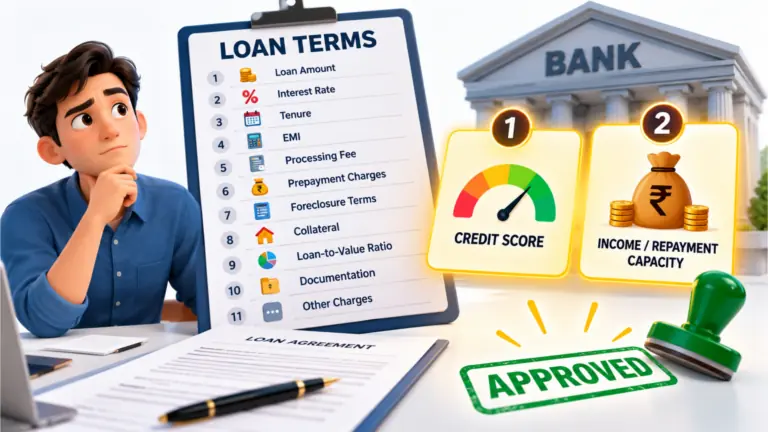
The new framework has led to greater emphasis on credit scores for personal loan approvals. A CIBIL score above 750 significantly improves your personal loan approval chances on favorable terms, while scores below 700 may still qualify but from NBFCs at higher rates. Previously, many borrowers with scores between 650-700 could secure personal loans from various NBFCs with relatively lenient criteria. Now, lenders prioritize borrowers with strong credit history as part of the risk tightening in unsecured lending.
A high credit score of 750+ signals lower default risk and qualifies you for better interest rates. For context, personal loan interest rates in India range from 9.50% to 24% per annum in 2026, with your rate depending on credit score, income, employer profile, and lender choice. The real-time credit bureau reporting mandate means all lending activity gets reported to Credit Information Companies like CIBIL immediately, preventing borrowers from taking multiple loans simultaneously from different lenders without detection.
Income Verification and Documentation Standards
The new framework requires more detailed income verification for all personal loan applicants. For salaried professionals, lenders now require salary slips for the last 6 months, Form 16, and bank statements showing regular salary credits. Self-employed borrowers need ITR returns for 2-3 years, GST returns if applicable, and business proof. This detailed verification ensures lenders accurately assess repayment capacity before approving loans.
The mandatory reporting to Credit Information Companies in real time rather than monthly or quarterly ensures accurate, up-to-date credit history for all borrowers. If you take a personal loan from any bank on January 15, 2026, that information appears in your CIBIL report within days, not weeks. This prevents the previously common problem of borrowers hiding existing debt obligations when applying for new loans.
Typical eligibility criteria include minimum age of 21 years, maximum age of 57-60 years, monthly income requirements varying by lender, and minimum CIBIL scores ranging from 650-725 depending on the lender. However, with the new risk tightening, most top-tier lenders now prefer 725+ for competitive rates. The stricter criteria ensure that borrowers only take loans they can genuinely afford, reducing default rates.
Your Rights as a Borrower Under New RBI Rules
The RBI guidelines introduce several borrower rights that fundamentally change your relationship with lenders. These protections apply equally to borrowers across India, from metropolitan cities to smaller towns, ensuring that every personal loan applicant receives fair treatment and transparent information.
Cooling-Off Period: Your Legal Safety Net
Borrowers now have a mandatory reflection window of at least 24 hours, extending up to 3 days for longer-tenure loans, after the KFS is shared. During this period, you can cancel the loan by repaying only the principal disbursed plus proportionate APR for the days you held the money, with no penalty charges. This protects borrowers from making hasty decisions based on confusing or misleading offers.
Previously, borrowers who realized they had taken a loan with unfavorable terms had no exit option without paying heavy foreclosure charges. The cooling-off period gives you time to compare offers, consult family members, or reconsider if the loan truly fits your financial needs. This is especially valuable for first-time borrowers who may not have extensive experience with personal loans and may feel pressured to accept offers quickly.
Zero Prepayment Penalty on Floating-Rate Loans
If your personal loan carries a floating interest rate, lenders cannot charge foreclosure or prepayment penalties. You can repay early and save on interest without financial punishment. This benefits borrowers who receive bonuses, salary increments, or business profits and want to close their loans early. For example, if you take a ₹5 lakh personal loan at 12% floating rate for 36 months and receive an inheritance or bonus after 12 months, you can repay the remaining balance without any penalty.
This contrasts with the previous practice where lenders charged 2-4% foreclosure fees for early repayment. The zero prepayment penalty rule on floating-rate loans gives borrowers flexibility to manage their debt according to their financial situation rather than being locked into long-term obligations.
No Automatic Credit Limit Increases Without Consent
Lenders cannot increase your credit limit without receiving an explicit, documented request from you. This protects borrowers from being pushed into higher indebtedness without their knowledge. Previously, some digital lending platforms would automatically increase limits, encouraging borrowers to take on more debt than they could handle. You maintain complete control over your borrowing capacity and must actively request any credit limit enhancement.
Regulated Recovery Practices Protecting Borrower Dignity
Recovery agents can only contact you between 7 AM and 7 PM. Intimidation, harassment, or contact with family members is strictly prohibited. Lenders must designate a nodal grievance officer whose details appear in your KFS. If not resolved within 30 days, you can complain through the RBI CMS portal at cms.rbi.org.in. This addresses a major problem that affected many borrowers previously, where aggressive recovery tactics included late-night calls, visiting homes repeatedly, and contacting relatives.
What Lenders Must Do Differently Now
Banks and NBFCs operating across India must comply with operational mandates that change how they serve borrowers. Major players including HDFC Bank, ICICI Bank, Axis Bank, SBI, and NBFCs like Hero FinCorp, Bajaj Finserv, and Tata Capital must all follow these new compliance requirements.
CIMS Registration and Public Directory Compliance
All regulated entities must register their Digital Lending Applications on the CIMS portal and ensure their apps appear in the RBI’s public directory. This means every legitimate lender has verified their app’s compliance status. Lenders must maintain transparent audit logs for all matching algorithm changes, ensuring no undisclosed favoritism toward high-commission lenders. The public directory provides borrowers with confidence that registered apps meet regulatory standards.
Real-Time Credit Bureau Reporting
Lenders must report all lending activity to Credit Information Companies in real time rather than monthly or quarterly. This ensures accurate, up-to-date credit history for all borrowers. The immediate reporting prevents the previously common practice of borrowers taking multiple loans from different lenders simultaneously without detection. This real-time transparency benefits both lenders and borrowers by creating accurate credit profiles.
Practical Steps for Personal Loan Applicants
Before You Apply
Check your credit score first. A CIBIL score of 725 or above qualifies you for competitive personal loan rates starting from 9.50% to 11.5% from top banks. Scores below 700 may still qualify but from NBFCs at higher rates. Verify the lender’s DLA listing on the RBI’s public directory before applying through any app. Search for the app name at rbi.org.in to confirm it is registered. This simple step protects you from fraudulent apps.
During Application Process
Always read the KFS in full before signing. Compare the APR, not just the headline interest rate. A loan advertising 10.5% with 2.5% processing fee might have an APR of 12.8%, while another offering 11% with zero fees might have an APR of 11.2%. The second option is cheaper despite the higher headline rate. Use the cooling-off period if you feel uncertain. You have at least 24 hours to reconsider after receiving the KFS.
After Loan Approval
Keep copies of your KFS and all loan documents. Note the grievance redressal officer’s contact details from your KFS. If you experience any violations, report them immediately to the lender’s nodal officer, and if unresolved within 30 days, escalate to RBI Ombudsman at cms.rbi.org.in. Maintain records of all communications with your lender for future reference.
Common Mistakes Personal Loan Applicants Should Avoid
Ignoring the KFS Details
Many borrowers focus only on the loan amount and EMI, skipping the APR and fee breakdown. Always calculate the total cost using the APR. A ₹5 lakh loan at 12% for 36 months with 2% processing costs significantly more than the same loan at 12.5% with zero fees. The KFS exists specifically to prevent this mistake by providing complete cost transparency.
Using Unverified Apps
Avoid apps not listed in the RBI’s DLA directory. Thousands of unauthorized apps still operate, targeting borrowers across India. These apps may offer quick approval but employ predatory practices. Verify every app before sharing personal data. The RBI directory is your first line of defense against fraudulent lending platforms.
Sharing Excessive Data
Do not grant unnecessary permissions. Legitimate lenders need only basic KYC, income proof, and bank statements. They do not need access to your contacts, photos, or location. Deny such permissions and consider switching lenders if they insist on accessing irrelevant data. Your data privacy is a legally protected right under the new framework.
The Future of Digital Lending in India
The RBI’s digital lending framework will continue evolving with stronger safeguards. Expected trends include increased transparency across all lending channels, more sophisticated AI for credit underwriting, and better borrower protection mechanisms. India’s lending ecosystem is becoming safer and more efficient, benefiting the growing middle class across the country. Financial inclusion will improve as trust in digital lending increases.
When borrowers see that apps are backed by regulated banks, provide clear KFS documents, and respect data privacy, their confidence grows. This trust is the foundation for financial inclusion, encouraging more people to step into the formal credit system. The guidelines are not a barrier to growth but a foundation for building a stable, globally respected digital lending market that balances rapid innovation with crucial consumer protection.
Frequently Asked Questions
What are the new RBI guidelines for personal loans in 2026?
The RBI issued the Digital Lending Directions on May 8, 2025, effective January 1, 2026. Key changes include mandatory Key Fact Statements, real-time credit bureau reporting, direct fund transfers, public DLA directory, and regulated cooling-off period for borrowers.
Which RBI guidelines apply specifically to personal loan apps?
All Digital Lending Applications must register on RBI’s CIMS portal. Apps must comply with data localization norms, ban dark UI patterns, and ensure only direct fund transfers. Unregistered apps are unauthorized under the new framework.
Can a lender increase my credit limit without asking me?
No. Under new RBI rules, credit limit increases require explicit request from the borrower. Automatic enhancements are prohibited.
Is there a penalty for prepaying a personal loan?
For floating-rate personal loans, RBI prohibits prepayment or foreclosure penalties. You can repay early without additional charges.
How do new RBI guidelines protect against digital loan fraud?
RBI maintains a live public directory of verified DLAs. Any lending app not registered is unauthorized. Direct fund transfer mandates prevent intermediaries from mishandling money.
What is the cooling-off period under new RBI personal loan rules?
After receiving KFS, borrowers have at least 24 hours up to 3 days for long-tenure loans to reconsider. If exiting within this window, pay only principal plus proportionate APR, no penalty.
Conclusion
The 2025 RBI guidelines for personal loans represent a fundamental shift in how credit is offered and experienced across India. From mandatory cost disclosure through the KFS to regulated recovery practices and banned dark patterns, every rule puts borrowers in control. For personal loan applicants seeking transparent, compliant financial support, these rules ensure you receive fair treatment, clear information, and legal protection throughout your borrowing journey.
The transformation extends beyond rules to cultural change in lending practices. Lenders now compete on transparency, customer experience, and fair pricing rather than hiding fees or using predatory tactics. This benefits all borrowers, from first-time borrowers to experienced loan seekers. The RBI’s framework ensures that India’s growth as an economic hub is matched by growth in responsible, transparent financial services accessible to all residents.
If you are considering a personal loan, verify your lender’s compliance, read your KFS carefully, use the cooling-off period if uncertain, and report any violations. Your rights are stronger than ever, and the digital lending ecosystem is safer for everyone. The RBI’s framework ensures a stable, transparent digital lending market that balances innovation with essential consumer protection.