Bank, NBFC, Government Scheme or Venture Debt — Which Startup Loan Actually Costs You Least
Business finance · Startup capital · India · 2026
Bank, NBFC, Government Scheme or Venture Debt — Which Startup Loan Actually Costs You Least
Four lenders quote you four numbers and none of them is the price. The bank says 11%, the NBFC says 18% but can fund on Thursday, the government scheme says 9% and wants a project report you have not written, and the venture debt fund says 14% and mentions warrants in the second-last slide. The cheapest headline rate is almost never the cheapest capital, and the gap between the two is where founders lose the most money.
Quick Summary
Four routes, four different prices for the same rupee. Government schemes are cheapest at roughly 8.6% to 12% but slowest and most paperwork-heavy. Bank finance runs about 9% to 16%, anchored to a repo rate of 5.25%. NBFC and fintech credit costs 14% to 30% and can fund in 48 to 72 hours. Venture debt sits at 13% to 15% plus warrants, but only if you already have institutional equity behind you. Pick on total cost and timing together, never on the headline rate alone.
Start with the anchor: what money costs in India right now
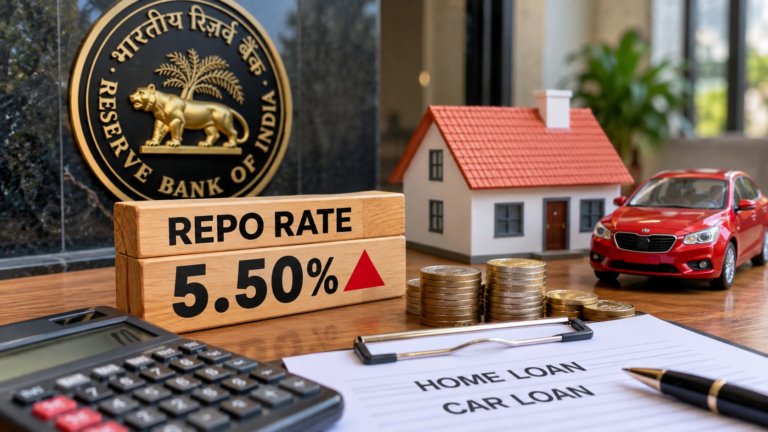
Every rupee of bank credit is priced off a benchmark, so knowing the benchmark tells you whether a quote is competitive or lazy. The Reserve Bank held the repo rate at 5.25% at its 5 August 2026 review, with the standing deposit facility at 5.00% and the marginal standing facility at 5.50%.
Since October 2019, new retail and MSME loans from banks must be linked to an external benchmark, and in practice almost every bank uses the repo rate. Your rate is therefore the repo rate plus the bank’s spread. One mid-sized bank publishes an external benchmark linked rate of 10.00%, being repo at 5.25% plus a spread of 4.75%. That arithmetic is public, and you can check whether a quoted rate is a fair spread or an opportunistic one.
Two things follow. Repo-linked loans reprice quarterly, so a cut reaches you within one to three months, while older loans still on the marginal cost of funds lending rate can take six to twelve. At end-June 2025, external benchmark linked loans were 62.9% of banks’ floating rate rupee book and MCLR-linked loans 33.8%, which means a third of borrowers are still on the slower regime, usually without knowing it.
The four routes, priced side by side
Headline rates across the four routes span more than a threefold range, which sounds decisive until you notice that the cheapest route is also the one you may wait ten weeks for. Both facts are true simultaneously, and the whole art of this decision is holding them together.
Indicative annual interest ranges by capital source, India, August 2026
Bar length reflects the upper bound of each range. Rates are indicative of market practice, not quoted terms, and your own rate depends on credit profile, vintage, turnover and security.
Now invert the question and ask how fast each route produces money. The ordering reverses almost perfectly, and that inversion is the actual trade-off you are being asked to make.
Typical time from application to funds in the account, by route
Bar length reflects the upper bound in days. In-principle approval can arrive far sooner than funds; the public sector portal issues one in under an hour.
Government schemes: cheapest money, highest friction
If you qualify, this is where you start, because nothing else competes on price. MUDRA loans are commonly quoted at 8.60% to 12% depending on the lending institution, and CGTMSE-backed bank credit carries an annual guarantee fee starting at about 0.37% on top of a normal bank rate rather than a penalty spread.
The costs are real but modest. Under CGSS, the annual guarantee fee is 1% for startups in the 27 Champion Sectors and 2% otherwise. PMEGP requires you to contribute 10% as margin money and pays a capital subsidy in return. None of this approaches the 6 to 14 percentage point premium an NBFC would charge for the same unsecured exposure.
What you pay instead is time and paperwork. Udyam registration is a prerequisite for effectively every central scheme, DPIIT recognition gates CGSS, and PMEGP is restricted to genuinely new units. Guarantee cover is also not applied automatically: the bank must choose to register the loan, and many will not unless you ask in writing.
Bank finance: the default, and usually the right default
Banks offer the lowest sustainable rate for a borrower with documentation, typically 9% to 16%, with tenures up to 60 or even 84 months and no prepayment penalty on floating rate loans to individual borrowers. For anything above ₹25 lakh that you can evidence properly, this is the benchmark every other quote should be measured against.
The constraint is evidential rather than commercial. Banks want twelve months of operation minimum, reconciled GST and ITR filings, and either collateral or a guarantee wrap. What has changed in your favour is the collateral threshold: from 1 April 2026 banks may not demand security on loans up to ₹20 lakh to micro and small enterprises, and may waive it up to ₹25 lakh where your record justifies it.
NBFC and fintech credit: you are buying speed, and it is priced accordingly
Unsecured business loans from regulated NBFCs and digital lenders run roughly 14% to 26%, and up to 30% at the fintech end. One RBI-registered NBFC publishes rates from 15.99% for businesses at least 24 months old, lending ₹30,000 to ₹25 lakh over 12 to 36 months. Another funds ₹50,000 to ₹50 lakh in about 48 to 72 hours.
That premium is not exploitation, it is the price of underwriting without collateral on alternative data in two days. The honest test is whether the money arriving this week is worth more than the eight percentage points. Financing a confirmed purchase order at 20% for four months is usually excellent business. Funding twelve months of general working capital at the same rate rarely is.
What the headline rate hides
Compare the total, not the coupon. A processing fee of 1% to 3% on a ₹25 lakh loan is ₹25,000 to ₹75,000 before you receive a rupee. Flat-rate quoting makes a loan look roughly half its true cost: 12% flat on a three-year loan is close to 21% on a reducing balance. And foreclosure charges of 4% within the first six months turn a cheap short-term facility into an expensive one the moment you try to exit early. Ask for the annualised reducing-balance rate and the full schedule of charges in writing, every time.
Venture debt: cheap dilution, expensive discipline
Venture debt is a term loan for companies that have already raised institutional equity. Indian terms cluster at 13% to 15% a year over 18 to 36 months, with tickets from ₹50 lakh to ₹10 crore, an arrangement fee, and warrant coverage of 0.1% to 2% which typically translates to about 0.3% to 0.5% of dilution on a fully diluted basis.
The standard Indian pattern is not debt instead of equity but debt alongside it: raise the round, then add venture debt equal to roughly 25% to 30% of the equity amount, which buys six to twelve additional months of runway without a second dilution event. The market grew 12% to $1.38 billion across 187 deals in 2025 while seed equity fell 30%, so this is now a mainstream option rather than a niche one.
The catch is structural. Venture debt is priced off the quality of your existing backers as much as your numbers, so it is unavailable precisely when you most want it, and repayment starts on a fixed schedule regardless of how the business performs. Where the lender is a foreign entity the facility is classified as External Commercial Borrowing under the FEMA amendment regulations that came into force on 16 February 2026, which brings its own filing obligations.
Worked example: ₹8 crore as equity or as debt
A founder needs ₹8 crore at a ₹120 crore pre-money valuation. As equity, that is 8 divided by 128, or 6.25% of the company, permanently. As venture debt at 14% over 30 months, interest works out to roughly ₹1.7 crore, plus about ₹8 lakh in arrangement fees, plus warrants at 1.5% coverage worth around ₹12 lakh, which is close to 0.1% dilution. If the company later exits at ₹500 crore, that 6.25% equity slice was worth ₹31 crore against a total debt cost near ₹1.9 crore. The debt is dramatically cheaper — provided the business survives the repayment schedule, which the equity would never have imposed.
The decision variable nobody puts on a comparison table
Rate and ticket size are the wrong first questions. The right one is how many months of runway you have left, because that determines which routes are even reachable. A route that funds in ten weeks is not an option for a founder with eight weeks of cash, however cheap it is.
Months of cash at current burn, mapped against realistically available capital sources
Negotiate
Bank route
Blend
Pay for speed
Cut burn
Bands are indicative and reflect common practice, not an official framework. Timelines assume a complete document set at the point of application.
The full comparison, route by route
The table below is the version worth screenshotting. Every figure carries the same caveat: your own terms depend on credit profile, vintage, turnover and the security you can offer.
| Route | Typical cost | Ticket range | Time to money | What it demands |
|---|---|---|---|---|
| Government scheme | 8.6% to 12%, plus 0.37% to 2% guarantee fee | ₹50,000 to ₹20 crore | 4 to 10 weeks | Udyam, and DPIIT for CGSS |
| Bank, secured | 9% to 16% reducing | ₹5 lakh to ₹10 crore | 4 to 8 weeks | 12 months vintage, full documentation |
| NBFC, unsecured | 14% to 26% plus 1% to 3% fee | ₹30,000 to ₹50 lakh | 3 to 7 days | 24 months vintage, bank and GST data |
| Fintech, digital | 14% to 30% plus fees | ₹50,000 to ₹50 lakh | 48 to 72 hours | Digital footprint, bank feed access |
| Revenue-based finance | Repay 1.05x to 1.2x of the amount | ₹10 lakh to ₹5 crore | 1 to 3 weeks | Recurring revenue, gateway data |
| Venture debt | 13% to 15% plus 0.1% to 2% warrants | ₹50 lakh to ₹10 crore | 4 to 8 weeks | Institutional equity already raised |
| Equity round | 15% to 25% ownership per round | ₹1 crore upwards | 3 to 6 months | Board seat, governance, permanent dilution |
How to run the comparison in four weeks
The capital stack, in the order it should be used
These tiers are cumulative rather than alternative. Exhausting the cheap layers before reaching for expensive ones is most of what good capital strategy amounts to.
Decoder: the terms that change the real price
Nine items decide what a loan actually costs, and only one of them is the interest rate. Ask about every one before you sign.
| Term | What it means | Typical range | What to ask |
|---|---|---|---|
| Processing fee | Deducted before disbursal | 1% to 3% | Is it on sanctioned or disbursed amount? |
| Flat versus reducing | Flat charges interest on the original principal | 12% flat is close to 21% reducing | Quote me the annualised reducing rate |
| Foreclosure charge | Penalty for repaying early | 2% to 4% of outstanding | Is it waived after 6 or 12 months? |
| Moratorium | Interest-only period before principal starts | 3 to 12 months | Does interest capitalise during it? |
| Guarantee fee | Annual cost of CGTMSE or CGSS cover | 0.37% to 2% a year | Is it passed through to me? |
| Warrant coverage | Lender’s right to buy equity later | 0.1% to 2% of the facility | What dilution does that imply? |
| Personal guarantee | Your personal assets stand behind the loan | Common on unsecured credit | Can it be capped or released later? |
| Financial covenants | Ratios you must maintain | Standard in venture debt | What happens on a breach? |
| Benchmark and reset | What your floating rate tracks | Repo-linked, quarterly reset | EBLR or MCLR, and what spread? |
What to do, in order
- Work out your runway in months before you look at a single rate. It eliminates two of the four routes immediately.
- Check scheme eligibility first. Udyam registration, and DPIIT recognition if you might qualify. This is the cheapest capital and gets skipped most often.
- Build one document pack covering all four routes: bank statements, ITRs, GST returns, entity proof, Udyam certificate, project report.
- Run soft eligibility checks only at first. They leave no mark on your personal report or the firm’s rank.
- Apply to your own bank and one alternative. Two hard enquiries, not six. A cluster reads as distress to every lender that follows.
- Ask explicitly for CGTMSE or CGSS cover in writing. Banks do not apply it by default because registration is extra work.
- Convert every offer to total rupees repaid over the full tenure, including fees, guarantee cost and any dilution. Compare only that number.
- Use the second offer to negotiate the first. Rate, processing fee and foreclosure terms all move; lenders expect the conversation.
Eight habits that lower your cost of capital
Frequently asked questions
Which startup loan is cheapest in India in 2026?
Government scheme credit, at roughly 8.6% to 12%, plus a guarantee fee starting around 0.37% a year. Bank finance follows at 9% to 16%, NBFC and fintech credit at 14% to 30%, and venture debt at 13% to 15% plus warrants. The cheapest route is also the slowest, so cost and timing have to be judged together.
Is an NBFC business loan worth the higher interest rate?
It depends entirely on what the money does. Funding a confirmed order at 20% for four months, repaid from the proceeds, is usually good business. Taking the same rate for twelve months of general working capital rarely is. You are buying 48 to 72 hour disbursal, so the premium only makes sense when speed itself has value.
What does venture debt actually cost a founder?
In India, typically 13% to 15% a year over 18 to 36 months, plus an arrangement fee and warrant coverage of 0.1% to 2% of the facility, which usually works out to about 0.3% to 0.5% dilution. The real cost is structural: repayment starts on a fixed schedule regardless of how the business performs.
Should I take venture debt instead of raising equity?
Usually alongside it, not instead. The standard Indian pattern is to raise the equity round and add venture debt equal to about 25% to 30% of it, which buys six to twelve months of extra runway without a second dilution event. Venture debt is also priced off the quality of your equity backers, so it is rarely available without a round first.
How is a bank business loan interest rate calculated?
New MSME and retail loans from banks must be linked to an external benchmark, and almost every bank uses the repo rate, currently 5.25%. Your rate is the repo rate plus the bank’s spread, so a published rate of 10.00% means a spread of 4.75%. Repo-linked loans reset quarterly, so cuts reach you within one to three months.
What is the difference between flat and reducing balance interest?
Flat rate charges interest on the original principal for the whole tenure, while reducing balance charges only on what you still owe. The difference is large: about 12% flat on a three-year loan is close to 21% on a reducing basis. Always ask for the annualised reducing-balance rate before comparing two offers.
Can a startup use more than one funding route at the same time?
Yes, and the better capital structures usually do. A common stack is scheme-backed bank credit for core working capital, receivables discounting for the cash conversion gap, and venture debt after an equity round to extend runway. What matters is exhausting the cheaper layers before reaching for the expensive ones.
Does applying to several lenders hurt my chances?
Yes, if they are formal applications. Each one is a hard enquiry recorded on your personal report and the firm’s rank, and six in a fortnight reads as distress to every subsequent lender. Marketplace eligibility checks are soft enquiries and leave no mark, so use those to shortlist and apply formally to two.
What is revenue-based financing and when does it beat a loan?
You receive capital and repay a fixed percentage of monthly revenue until a flat cap is met, typically 1.05 to 1.2 times the amount, with no equity dilution and usually no personal guarantee. It suits companies with predictable recurring revenue, and it beats a term loan when your cash flows are seasonal and a fixed EMI would strain a slow month.
The short version
Rank the routes by price, then eliminate the ones your runway cannot wait for. Government scheme credit at 8.6% to 12% is the cheapest capital in India and the most frequently skipped, largely because guarantee cover has to be requested rather than granted. Bank finance at 9% to 16% is the benchmark everything else should be measured against, and from 1 April 2026 nothing under ₹20 lakh needs collateral. NBFC and fintech money at 14% to 30% is worth its premium only when speed has a specific value. Venture debt is cheap dilution but unforgiving discipline. Convert every offer into total rupees repaid, then negotiate with the second-best in hand.