The Bank Approved ₹1 Crore — But Which Five Numbers Decide What You Should Actually Borrow?
Home Loans · Affordability · India · August 2026
The Bank Approved ₹1 Crore — But Which Five Numbers Decide What You Should Actually Borrow?
The sanction letter arrives and the number on it is larger than you expected. The relationship manager congratulates you. The builder’s sales team wants a booking amount by Friday. Somewhere in the middle of all that, a question gets skipped: the bank has told you what it is willing to lend, but nobody has told you what you can carry for the next 240 months without your financial life going quietly rigid.
Those are two different calculations, done by two different parties, with two different objectives. The lender is underwriting the risk of not getting its money back. You are underwriting the next two decades of your life. This piece sets out the five numbers that turn a sanction limit into a borrowing decision, with the arithmetic shown at every step.
Quick Summary
A sanction is a ceiling, not a recommendation. Lenders will typically approve an EMI up to 50% to 55% of net income, but a home loan EMI above 35% of take-home pay leaves very little room for existing loans, insurance, school fees and a bad year. On a ₹1 crore loan at 7.75% for 20 years, the EMI is ₹82,095 and the interest paid over the tenure is ₹97.03 lakh — almost the loan again. The comfortable answer is usually a smaller loan on a shorter tenure, not the maximum on the longest one.
What the lender is actually measuring when it says you are eligible
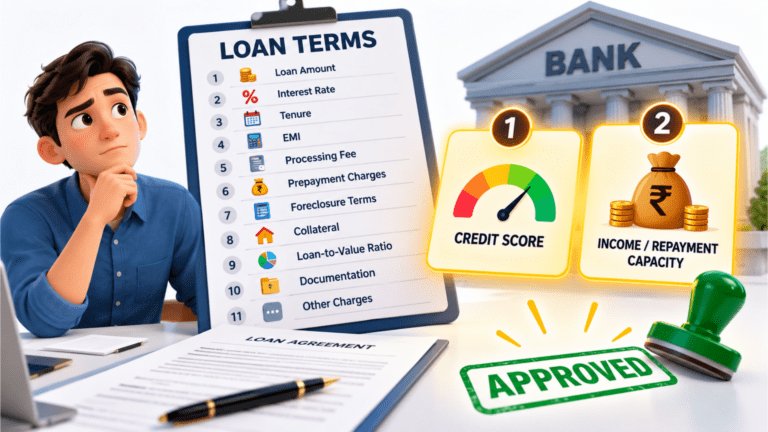
Eligibility is a risk test, not a comfort test. The lender runs two calculations and hands you the lower of the two. The first is income-based: it takes your net monthly income, subtracts your existing obligations, and applies a Fixed Obligation to Income Ratio — commonly 40% to 50% at lower incomes, 50% to 55% in the middle, and 55% to 65% for high earners. Whatever is left is deemed available for an EMI, and that EMI is converted back into a loan amount at the offered rate and tenure.
The second is collateral-based. The RBI caps loan-to-value at 90% for properties up to ₹30 lakh, 80% between ₹30 lakh and ₹75 lakh, and 75% above ₹75 lakh. Neither calculation asks whether you plan to have a second child, whether your industry is stable, or whether you would like to retire before 65. That is not the lender’s job. It is yours.
The context matters. Rates are low by the standards of the last decade: public sector lenders were advertising floating rates from about 7.00% per annum in late August 2026, with the range running past 10.5% at some NBFCs, according to Paisabazaar data reported by Business Standard on 27 August 2026. Cheap money makes big loans look reasonable. It is exactly the environment in which people overborrow.
The borrowing itself is also getting larger. CRIF High Mark’s How India Lends report put the average home loan ticket size at about ₹33 lakh in the December 2025 quarter, up 6.4% in three months, with loans above ₹75 lakh accounting for 40% of fresh originations against 35% a year earlier. The RBI’s June 2026 Financial Stability Report noted that housing loans of ₹50 lakh and above made up 44.7% of outstanding housing credit as of March 2026. The market has moved upmarket faster than incomes have.
Number one: what share of your take-home pay the EMI eats
This is the single number that decides whether the loan is comfortable, and it is the one most often outsourced to the lender. A lender will underwrite up to roughly half your income. Living on the other half, after tax, while also saving for retirement and a child’s education, is a different proposition entirely.
The zones below are conventions drawn from what lenders will approve and what financial planners generally treat as sustainable, not regulation. Use them as a first filter before you fall in love with a floor plan.
Comfortable
Workable
Stretched
Lender ceiling
Say no
Run it in reverse and the number gets concrete. To keep the ₹82,095 EMI on a ₹1 crore, 20-year loan at 7.75% inside the 35% band, a household needs about ₹2,34,557 of net monthly income. At 30% it needs ₹2,73,650. At the lender’s 50% ceiling it needs only ₹1,64,190 — which is precisely why sanctions come through for households that will struggle.
Number two: the EMIs you already have
Existing obligations do not reduce your eligibility gently. They come straight off the top of the FOIR headroom, and because the headroom is then converted into a loan amount at a long tenure, every rupee of existing EMI destroys roughly ₹122 of borrowing capacity at current rates over 20 years.
Credit cards deserve a separate warning. Many lenders treat a revolving card balance as an obligation at the minimum-payment level, and utilisation above roughly 30% of the limit also depresses the credit score that determines your spread. Clearing card balances six months before you apply improves both the eligibility number and the rate at which it is offered. Doing it the week before the application does neither, because bureau data lags.
The mistake that costs the most
Borrowers routinely take a car loan or a large personal loan in the twelve months before a home purchase, on the reasoning that they will clear it later. The RBI’s June 2026 Financial Stability Report found that non-housing retail loans now make up 58.4% of total household borrowing, a share that has been rising steadily. A ₹35,000 monthly obligation removes roughly ₹42.6 lakh from what a ₹2 lakh-income household can borrow. Nothing else on this list moves the number that hard.
Number three: the cash you need before you own anything
The down payment is the visible part of the upfront requirement, and it is not the largest surprise. Stamp duty, registration and documentation charges sit outside the property value used for the LTV calculation, which means they cannot be funded by the loan. They come entirely out of your own pocket, on top of the down payment, on the day of registration.
Take a ₹1.35 crore property, which is roughly what a ₹1 crore sanction at the 75% LTV cap implies. The stack looks like this, assuming a 6% stamp duty state and a lender charging 0.5% processing fee.
The first five items total ₹44,37,100. A household that has saved ₹45 lakh and hands over all of it has bought the property and eliminated its buffer in the same transaction. That is the failure mode the second panel of the illustration at the top of this article is pointing at: the difference between the two couples is not the size of the house, it is whether the savings and the emergency fund survived the purchase.
The cheapest thing you can do before applying
Ask each lender for the Key Facts Statement before sanction. It is mandatory, it states the all-in APR including fees rather than the headline rate, and it is the only document that makes two offers genuinely comparable. A 0.1 percentage point rate difference is usually worth less than a ₹25,000 fee gap or a rigid part-payment policy.
Number four: the interest, which is the actual price of the loan
An EMI is a monthly number and the brain treats it as the price. It is not. The price is the total interest, and on long tenures it approaches or exceeds the amount borrowed. Extending a ₹1 crore loan from 20 years to 30 reduces the EMI by ₹10,454 a month and increases the interest paid by ₹60.88 lakh.
₹1,20,011
₹94,128
₹82,095
₹75,533
₹71,641
The reason long tenures are so expensive is front-loading. In year one of that 20-year loan you pay ₹9,85,140 in EMIs, of which ₹7,67,373 is interest and only ₹2,17,766 reduces the principal. After five full years and ₹49.26 lakh paid, the outstanding balance is still ₹87.21 lakh. Borrowers who assume they will simply refinance or sell in year five often discover they have built almost no equity.
| Loan amount | EMI, 15 yrs | EMI, 20 yrs | EMI, 30 yrs | Interest, 20 yrs | Income needed at 35% |
|---|---|---|---|---|---|
| ₹25 lakh | ₹23,532 | ₹20,524 | ₹17,910 | ₹24.26 lakh | ₹58,640 |
| ₹50 lakh | ₹47,064 | ₹41,047 | ₹35,821 | ₹48.51 lakh | ₹1,17,277 |
| ₹75 lakh | ₹70,596 | ₹61,571 | ₹53,731 | ₹72.77 lakh | ₹1,75,917 |
| ₹1 crore | ₹94,128 | ₹82,095 | ₹71,641 | ₹97.03 lakh | ₹2,34,557 |
| ₹1.25 crore | ₹1,17,659 | ₹1,02,619 | ₹89,552 | ₹1.21 crore | ₹2,93,197 |
Worked example: the ₹10,000 that changes the loan
Priya takes ₹1 crore for 20 years at 7.75%. Her EMI is ₹82,095 and her scheduled interest is ₹97,02,766. She adds ₹10,000 a month from the first EMI and keeps the EMI itself unchanged. Over the life of the loan she deploys ₹18,80,000 of extra cash and avoids ₹24,18,175 of interest, closing the loan in 15 years 8 months instead of 20. The lever is not a bigger sanction. It is a modest, early, repeated prepayment on a smaller one.
Number five: whether the rest of your financial life still functions
This is the number with no formula, and it is the one the sanction letter is structurally incapable of assessing. A loan is affordable if, while servicing it, you can still fund the things that would otherwise become emergencies.
Where affordability actually breaks: the city you are buying in
Knight Frank India’s Affordability Index measures the share of average household income needed to service the EMI on a typical home in each city, and treats 50% as the line beyond which lenders rarely underwrite. For the first half of 2026, six of the eight largest markets sat inside that threshold; two did not.
Two readings are worth taking from this. First, affordability held broadly steady through the first half of 2026 because the RBI’s cumulative 125 basis points of easing offset rising prices, not because prices fell. Second, a buyer in Mumbai or Delhi-NCR is starting from a position where the average purchase already exceeds the underwriting threshold, which means the burden of running the five numbers falls on them hardest.
The five numbers, in the order you should run them
What the sanction letter is really telling you
Most of the terms that determine the true cost of the loan appear once, in small type, and are never explained. This is what they mean and what to do about each.
| Term | What it actually means | What to do |
|---|---|---|
| Sanctioned amount | The maximum the lender will release, based on its risk model | Treat it as a ceiling. Draw only what your own five numbers support. |
| EBLR or RLLR | The external benchmark, usually the repo rate, that your floating rate tracks | Confirm the reset frequency. Banks must reset at least quarterly. |
| Spread | The margin added to the benchmark, set from your credit profile at sanction | Negotiate before signing. It is sticky for the life of the loan. |
| FOIR applied | The share of your income the lender allowed for total EMIs | Ask what percentage was used. If it is above 50%, the sanction is stretched. |
| LTV ratio | Share of property value funded, capped at 75% above ₹75 lakh | Remember it excludes stamp duty and registration entirely. |
| APR in the KFS | The all-in annual cost including fees, in a standard format | Compare lenders on this and nothing else. |
| Pre-EMI | Interest-only payments during construction, with no principal repaid | Ask for full EMI instead if cash flow allows. |
| Reset date | When the rate re-prices against the benchmark | Check your statement after every policy move for silent tenure elongation. |
| Foreclosure charges | Barred on floating-rate individual loans sanctioned or renewed from 1 January 2026 | Confirm in writing. Fixed-rate loans may still carry them. |
The tax benefit most 2026 borrowers will not get
The new tax regime is the default, and under it a borrower with a self-occupied property gets no deduction for either interest or principal. The ₹2 lakh interest deduction and the ₹1.5 lakh principal deduction exist only under the old regime, which must be actively chosen. The Income-tax Act, 2025 took effect on 1 April 2026 and renumbers these provisions, with interest reportedly moving to Section 22(2) and principal repayment to Section 123. Sections 80EE and 80EEA are closed to fresh loans. Do not budget an EMI on the assumption of a tax saving you may not be eligible to claim.
How to run the test yourself, in an evening
- Write down your actual net monthly income — the credited figure, after tax, EPF and every deduction. Do not use CTC.
- List every existing EMI and credit card minimum. Add them up. Subtract that total from 45% of your net income. What remains is your realistic home loan EMI.
- Convert that EMI into a loan amount at a rate you have actually been quoted, over 20 years. That is your working budget, not the sanction figure.
- Add the down payment at the applicable LTV cap and the full cost stack — stamp duty, registration, processing fee, MODT and valuation — and check it against your savings, excluding the emergency fund.
- Compare total interest at 15, 20 and 30 years for that loan amount. Choose the shortest tenure whose EMI still passes step two.
- Stress test it: re-run step two with one income removed for six months, and with the EMI 10% higher to allow for a rate reset.
- Only then look at properties, and only in the price band the arithmetic produced.
Frequently asked questions
My bank approved ₹1 crore. Should I borrow the full amount?
Only if the EMI clears your own test. At 7.75% over 20 years, ₹1 crore means ₹82,095 a month, which needs roughly ₹2.35 lakh of net household income to stay under 35%. The sanction reflects the lender’s risk appetite and the collateral, not your other commitments. Borrow the amount your cash flow supports and let the sanction go unused.
What percentage of my salary should a home loan EMI be in India?
Lenders will typically approve total EMIs up to 50% to 55% of net income, and sometimes higher for large incomes. As a planning rule, keeping the housing EMI under 35% of take-home pay and all EMIs combined under 45% leaves room for insurance, investments and an income interruption. Above 50%, the loan is approvable but fragile.
Do my car loan and credit card dues reduce my home loan eligibility?
Directly and heavily. Existing obligations are subtracted from your FOIR headroom before the loan amount is calculated. On a ₹2 lakh monthly income at 7.75% over 20 years, a ₹35,000 obligation cuts indicative eligibility from about ₹1.22 crore to ₹79.18 lakh. Clearing card balances at least six months before applying also helps your credit score, since bureau data lags.
How much cash do I need beyond the down payment on a home loan?
Budget roughly 6% to 9% of the property value on top. Stamp duty runs about 4% to 8% depending on the state, registration is commonly around 1% and often capped, and processing fee, MODT, legal and technical valuation and CERSAI add more. None of it can be funded by the loan, because these charges sit outside the value used for the LTV calculation.
Is a 30-year home loan a bad idea if it lowers my EMI?
It is a trade, not a mistake. On ₹1 crore at 7.75%, thirty years cuts the EMI to ₹71,641 from ₹82,095 but raises total interest to ₹1.58 crore from ₹97.03 lakh. If the longer tenure is the only way to clear the affordability test, the property is probably too expensive. If you take it deliberately for cash-flow flexibility and prepay steadily, it can work.
Can I still claim the ₹2 lakh home loan interest deduction in FY 2026-27?
Only under the old tax regime, which is no longer the default and must be actively opted into. Under the new regime a self-occupied property attracts no interest or principal deduction at all. Run both regimes before choosing, and consult a qualified tax adviser for joint ownership, let-out property or pre-construction interest, where the treatment is genuinely case-specific.
Will a larger down payment get me a lower interest rate?
Often yes, indirectly. A lower loan-to-value ratio reduces the lender’s risk and many lenders price a tighter spread for it, alongside a credit score above 750. The spread is set at sanction and is generally fixed for the life of the loan, so negotiating it before signing is worth more than any request made afterwards.
Can I prepay or foreclose my home loan without penalty in 2026?
For floating-rate loans to individuals for non-business purposes, prepayment and foreclosure charges are barred under the RBI’s Pre-payment Charges on Loans Directions, 2025, for loans sanctioned or renewed on or after 1 January 2026. Fixed-rate loans may still attract charges. Check the minimum part-payment size and whether your lender reduces the tenure or the EMI by default.
Should I add my spouse as a co-applicant to increase eligibility?
Pooling income is the most effective way to raise eligibility, and several lenders offer a small rate concession for women applicants. For tax purposes each claimant must be both an owner and a borrower, and must actually contribute to repayment from their own income. Adding a non-earning spouse raises nothing and claims nothing, so document the ownership share in the sale deed.
The short version
A sanction letter answers the lender’s question, not yours. Before signing, run five numbers: the EMI as a share of take-home pay, aiming under 35%; all obligations combined, under 45%; the full upfront cash requirement including stamp duty and registration, which the loan cannot fund; the total interest across 15, 20 and 30-year tenures, which on ₹1 crore ranges from ₹69.43 lakh to ₹1.58 crore; and whether your emergency fund, insurance, retirement contributions and education savings all survive the purchase. The smartest borrower is not the one with the largest approval. It is the one whose financial life still works in year seven.