Banks Open on Sunday, 27 September 2026 Before UFBU Strike — So Why Won't Your Cheque Clear?
Bank Strike September 28–30: Why Unions Are Fighting Over Saturdays, and How to Bank Around It
The United Forum of Bank Unions has called a three-day nationwide strike at public sector banks. The five-day banking week is the unresolved demand, and PSBs and RRBs will open on Sunday, September 27 to soften the blow.
If you bank with SBI, Punjab National Bank, Bank of Baroda, Canara Bank or any other public sector lender, next week will look unusual. Branches are open on a Sunday, then face three days of possible closure, and the last of those days is the half-yearly closing date for the entire banking system.
The trigger is a demand that sounds small but has been unresolved for more than two years: making every Saturday a bank holiday. Here is what is driving the strike, what the government has already conceded, and a practical plan for getting your banking done.
The whole fight comes down to 40 minutes a day
Under the current rules, which date back to 2015, public sector banks close on the second and fourth Saturdays of every month and stay open on the first, third and, where there is one, the fifth. Unions want all Saturdays off.
According to the UFBU’s strike notice, the Indian Banks’ Association (IBA) agreed in the 12th Bipartite Settlement and 9th Joint Note, signed on March 8, 2024, to introduce five-day banking by adding 40 minutes to working hours from Monday to Friday. The IBA recommended it to the government. The unions say it has been pending there ever since.
That is the heart of the unions’ case: they are not asking for fewer hours, they argue, only for the same work spread across five days, on a deal the employer side has already signed.
One demand settled, one still standing
The unions went into this dispute with two headline demands. The first was the five-day week. The second was the withdrawal of a Performance Linked Incentive (PLI) scheme for bank officers, which unions described as unilateral and divisive.
On the second point, the Centre has moved. The Finance Ministry says it has already kept the PLI scheme in abeyance following talks with the unions. That removes one grievance but leaves the one that matters most to employees, which is why the strike call has not been withdrawn.
The longer list behind the headline demands
Some reports and union statements also point to older employee and retiree issues that have run alongside this agitation. These are background demands rather than the stated trigger for this particular strike:
- Restoration of the Old Pension Scheme, or an option for staff to move from NPS to OPS.
- Updated and improved pension benefits for retired bank staff.
- A uniform dearness allowance formula for pensioners.
- Broader improvements in retirement benefits.
The calendar that nearly shut branches for five days straight
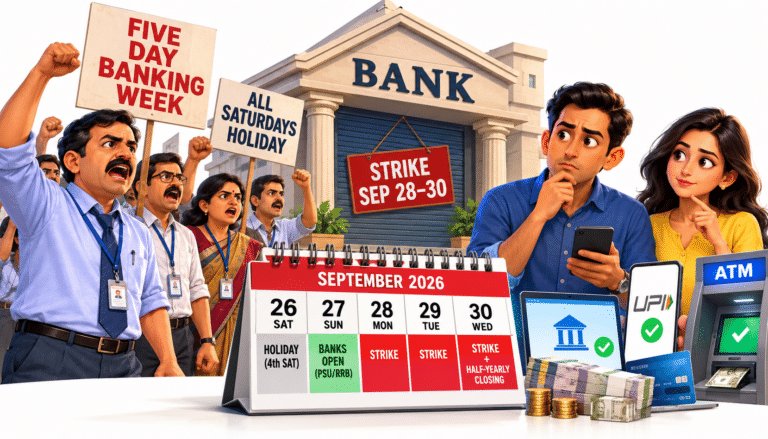
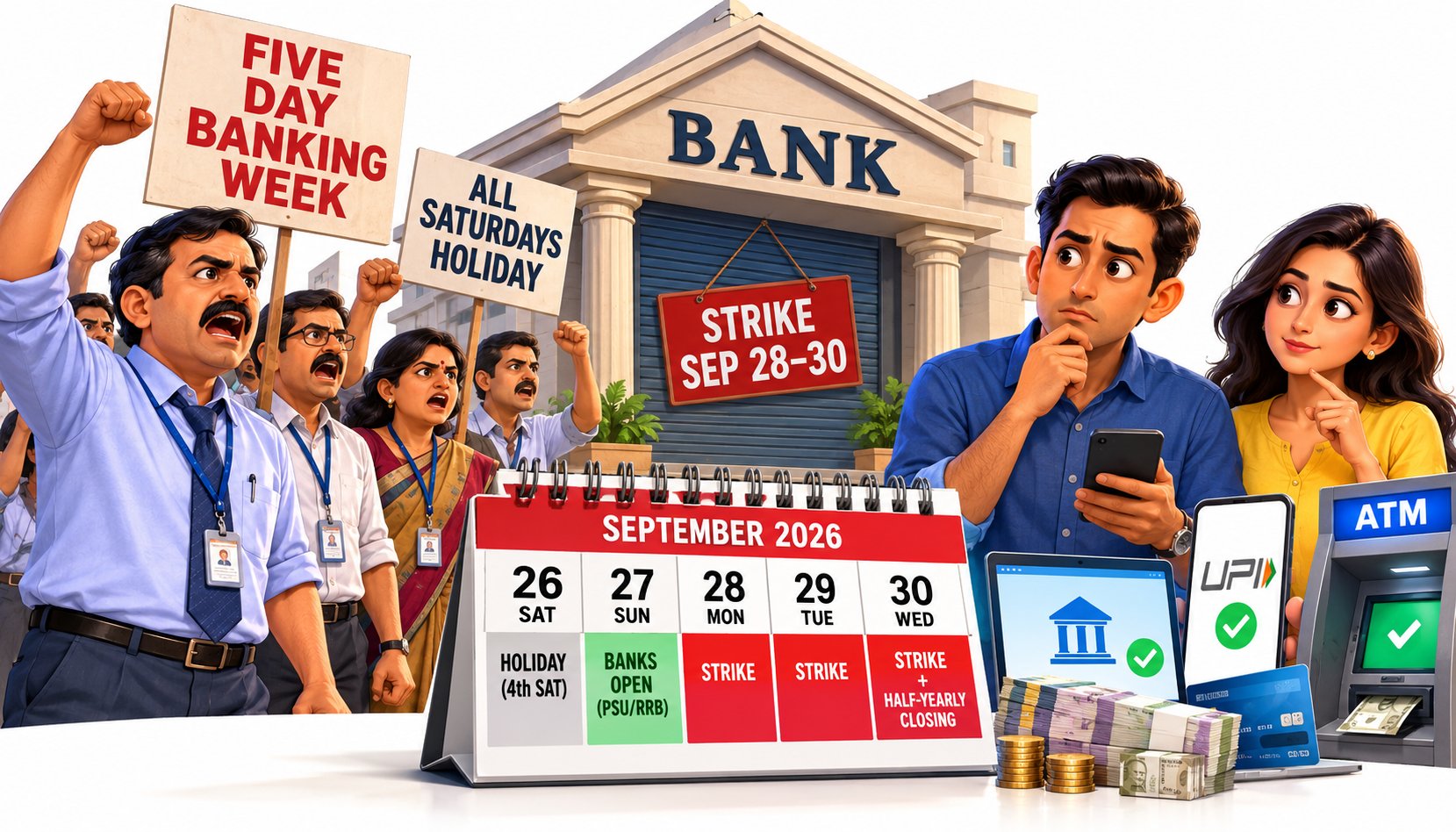
The dates are what turned a routine labour dispute into a customer problem. September 26 is the fourth Saturday of the month, a scheduled holiday. September 27 is a Sunday. Put those in front of a Monday-to-Wednesday strike and you get five consecutive days with no branch service.
The Finance Ministry described that scenario as an effective five-day closure at a particularly sensitive point in the financial calendar. On September 23 it announced that all public sector banks and regional rural banks will function normally on Sunday, September 27, with RBI approval for branches, offices, ATM-linked branches and currency chests to operate.
That last detail is worth noticing. Even after the strike ends, the week that follows has one working day before another holiday, so any backlog from September 28 to 30 may take longer to clear than the three strike days alone suggest.
Your money will still move. Your paperwork may not.
A bank strike is not a banking-system shutdown. The people who staff counters and process documents may be absent, but the payment rails run on technology. SBI, Canara Bank, Bank of Baroda and Indian Bank have all issued advisories steering customers to digital and self-service channels. Canara Bank specifically asked customers to complete branch work by September 25.
| Service | Expected status | What to do |
|---|---|---|
| UPI payments | Available | Use any UPI app linked to your account |
| Mobile and internet banking | Available | YONO, bob World and other bank apps work as usual |
| IMPS, NEFT, RTGS transfers | Available | Initiate online instead of at a branch |
| ATM cash withdrawal | Available | Withdraw early; heavy demand can drain machines |
| Cash deposit machines and ADWMs | Where installed | Check limits and locations in advance |
| Customer Service Points and BCs | Where operating | Useful for basic cash and balance services |
| Cheque deposit and clearing | Possible delays | Deposit before Sept 26 or expect slower credit |
| Cash counter transactions | Likely disrupted | Use Sunday, Sept 27, or ATMs |
| KYC, account opening, drafts, loan papers | Likely disrupted | Finish by Sept 25 or on Sept 27 |
| Locker access | Likely disrupted | Visit before the strike begins |
Which banks feel it, and which mostly do not
The strike call and the Finance Ministry’s Sunday order both concern public sector banks and regional rural banks. That covers SBI, PNB, Bank of Baroda, Canara Bank, Union Bank of India, Indian Bank, Bank of India, Central Bank of India, Indian Overseas Bank, UCO Bank, Bank of Maharashtra and Punjab & Sind Bank, along with RRBs.
New-generation private banks such as HDFC Bank, ICICI Bank, Axis Bank and Kotak Mahindra Bank are not the target of this call and are generally expected to keep branches running. There are two caveats. Cheques drawn on a PSB account may clear more slowly even if your own bank is open. And in past UFBU strikes, some older private banks with unionised staff, such as CSB Bank in 2022, warned that a limited part of their workforce might participate.
Where each side stands, in plain terms
The unions’ argument
The five-day week was agreed with the IBA in the March 2024 settlement, in exchange for longer weekday hours. It has waited more than two years for a government decision. RBI and many government departments already follow a five-day week.
The government’s argument
The PLI grievance has been addressed. Working Saturdays give customers access to branches. The five-day week should be settled through dialogue, and strikes around a sensitive closing date hurt the public.
Both positions contain something the other side does not dispute. The government has not denied that the IBA recommended five-day banking; the unions have acknowledged that PLI is in abeyance. The gap is about timing and a formal notification, which is why a settlement before Monday cannot be ruled out, but also cannot be assumed.
How the dispute reached this point
Second and fourth Saturdays declared holidays for public sector banks.
12th Bipartite Settlement and 9th Joint Note: IBA agrees to five-day banking with 40 extra minutes on weekdays, and recommends it to the government.
One-day nationwide bank strike; several PSB branches closed or partly affected.
Centre urges employees to call off the September 28 to 30 strike and confirms PLI is in abeyance.
Finance Ministry announces PSBs and RRBs will function on Sunday, September 27.
Three-day strike scheduled, ending on the half-yearly closing date.
Proposed indefinite strike if the five-day week remains unresolved.
Deadline for the next Bipartite Settlement, for which talks have begun.
A four-step plan for your banking this week
- By Friday, September 25: finish anything that needs a person, including KYC, drafts, loan documents, locker visits and large cash deposits.
- Sunday, September 27: treat it as a normal working day at your PSB or RRB branch if you missed Friday. Expect queues.
- September 28 to 30: move routine payments to UPI, IMPS, NEFT or your bank app, and draw cash from ATMs early in the day.
- From October 1: follow up on any cheques deposited around the strike, remembering October 2 is a holiday.
What We Know
- The UFBU has called a nationwide strike at PSBs and RRBs from September 28 to 30, 2026.
- The five-day banking week is the main unresolved demand; the PLI scheme is in abeyance.
- PSBs and RRBs will function on Sunday, September 27, with RBI approval.
- Banks including SBI, Canara Bank, Bank of Baroda and Indian Bank have urged customers to use digital channels.
- An indefinite strike has been proposed from October 26.
What Is Still Unclear
- Whether last-minute talks will lead unions to defer or call off the strike.
- How many branches will actually close; participation can vary by bank and region.
- Whether, and when, the government will notify five-day banking.
- How quickly cheque and back-office backlogs will clear after September 30.
Questions readers are asking
Are banks closed on September 28, 29 and 30, 2026?
Public sector bank and RRB branches may be closed or partly functional because of the UFBU strike. Banks are not formally closed, but branch services depend on how many employees participate. Digital channels are expected to keep working.
Will banks be open on Sunday, September 27?
Yes. The Finance Ministry has said all public sector banks and regional rural banks will function normally on Sunday, September 27, with RBI approval for branches, offices, ATM-linked branches and currency chests.
Will UPI and ATMs work during the bank strike?
UPI, mobile banking, internet banking and ATMs are expected to remain available. ATMs can run short of cash during heavy demand, so it is sensible to withdraw early.
Are private banks like HDFC and ICICI affected by the strike?
The strike is directed at public sector banks and RRBs, so major private banks are generally expected to operate normally. Cheques involving PSB accounts may still clear more slowly.
Why are bank employees on strike?
The main demand is a five-day banking week with all Saturdays off. Unions say the IBA agreed to it in the March 2024 settlement, with 40 extra minutes on weekdays, but the government has not yet approved it.
What is the PLI issue in the bank strike?
Unions opposed a Performance Linked Incentive scheme for bank officers that they called unilateral. The government has kept the scheme in abeyance, so the five-day week is now the central issue.
Will cheques clear during the bank strike?
Cheque clearing depends on branch and back-office staff, so delays are possible, especially for cheques involving public sector banks. Depositing before the strike reduces the risk.
Is there another bank strike after September 30?
Unions have proposed an indefinite strike from October 26, 2026, if the five-day banking demand is not resolved. That date could change depending on talks.