How Much Can You Borrow Without Collateral in India Now — and What Documents Prove You Qualify
Business finance · Startup loans · India · 2026
How Much Can You Borrow Without Collateral in India Now — and What Documents Prove You Qualify
The branch manager was encouraging on the phone and unrecognisable across the desk. Somewhere between those two conversations, someone opened your file and found that your GST turnover, your income tax return and your bank credits describe three different companies. That is what a rejection usually is in India. Not a verdict on your business, but a failure of evidence, and almost all of it is fixable in the fortnight before you apply.
Quick Summary
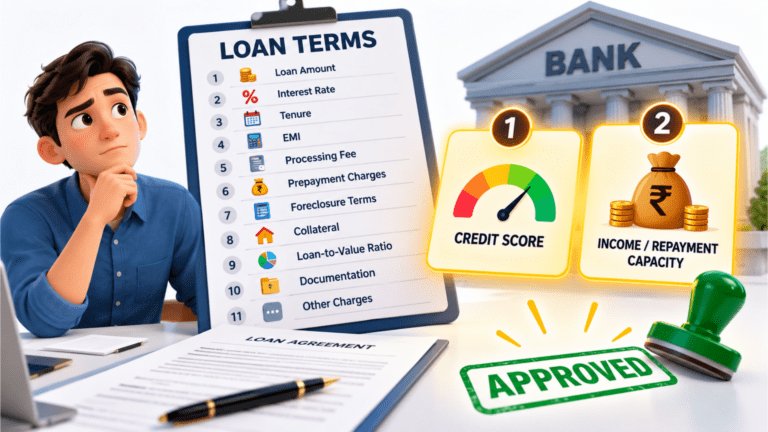
From 1 April 2026 banks cannot demand collateral on loans up to ₹20 lakh to micro and small enterprises, doubled from ₹10 lakh, and may waive it up to ₹25 lakh where your record justifies it. Above that, guarantee schemes replace security: CGTMSE covers up to ₹10 crore and CGSS up to ₹20 crore for DPIIT-recognised startups. What you actually need is documentary: 6 to 12 months of bank statements, 2 to 3 years of ITRs, GST returns that reconcile with both, and a personal credit score above the 650 to 700 band most lenders screen on.
What eligible actually means, in numbers
Eligibility in India is not one test. It is four, applied in sequence, and a file can clear three and still fail. Lenders check the entity, the vintage, the credit record and the cash flow, and the thresholds are more consistent across lenders than the marketing suggests.
On entity, almost every registered form qualifies: sole proprietorships, partnership firms, LLPs, private and public limited companies, HUFs, trusts, co-operative societies and self-employed professionals. Charitable organisations, NGOs and trusts operating non-commercially are generally excluded from standard business loan products.
On vintage, the honest range is wide. Government schemes like MUDRA Shishu impose no turnover minimum and welcome first-year businesses. Mainstream bank products typically want at least one year of operation. Several NBFCs require three. That spread of one to thirty-six months is the single biggest reason two founders with identical numbers get opposite answers.
The collateral rule changed this April, and most founders have not caught up
This is the most consequential change of the year for small borrowers. Under the Lending to Micro, Small and Medium Enterprises Sector (Amendment) Directions, 2026, notified on 9 February 2026 and effective for all loans sanctioned or renewed on or after 1 April 2026, banks are mandated not to accept collateral security for loans up to ₹20 lakh to units in the MSE sector. The previous ceiling, in place for years, was ₹10 lakh.
Two extensions matter. Banks may, on the basis of a good track record and sound financial position, dispense with collateral for loans up to ₹25 lakh under their own internal policy. And the ₹20 lakh collateral-free treatment extends to all units financed under the Prime Minister Employment Generation Programme administered by KVIC. RBI Governor Sanjay Malhotra framed the intent as strengthening last-mile credit delivery for enterprises with limited collateral.
One clarification in the amendment is quietly useful. Gold or silver pledged voluntarily by a borrower for a loan within the collateral-free limit is not treated as a violation of the mandate. If a branch tells you that offering household gold disqualifies you from the collateral-free bracket, that is now expressly wrong.
None, mandated
Bank discretion
CGTMSE cover
CGSS, startups
Security expected
Your size category decides which schemes you can even apply to
Since 1 April 2025 the MSME thresholds have been substantially higher, notified through S.O. 1364(E) dated 21 March 2025. Investment ceilings rose 2.5 times and turnover ceilings roughly doubled. A micro enterprise now means investment up to ₹2.5 crore and turnover up to ₹10 crore. Small means ₹25 crore and ₹100 crore. Medium means ₹125 crore and ₹500 crore.
The criterion is composite, so you must satisfy both limits. Cross either one and you move up a category, which can quietly cost you access to schemes reserved for micro and small units. Existing Udyam certificates stayed valid through the change and no re-registration was needed, though the self-declared figures on your profile should reflect the current brackets.
There is a useful provision for genuinely new businesses. Where a firm has no turnover yet, classification falls back on investment alone. A first-year startup with ₹80 lakh of equipment and nothing on the top line is still a micro enterprise, and still qualifies for MUDRA Tarun and full CGTMSE treatment.
The document set, by entity type
The list below is the complete standard file. Not every lender asks for all of it, but every lender asks for a subset of it, and assembling the whole set once means never scrambling again.
| Document | Proprietorship | Partnership or LLP | Private limited | What it proves |
|---|---|---|---|---|
| PAN and Aadhaar | Individual plus firm | Firm plus all partners | Company plus directors | Identity and tax linkage |
| Entity proof | Shop and Establishment or GST certificate | Partnership deed or LLP agreement | MOA, AOA and incorporation certificate | Legal existence |
| Udyam certificate | Required for schemes | Required for schemes | Required for schemes | MSME category and scheme eligibility |
| Bank statements | 6 to 12 months | 6 to 12 months | 6 to 12 months | Cash actually received |
| Income tax returns | Last 2 to 3 years | Firm and partners | Company returns | Declared income |
| Audited financials | Often waived | Last 2 to 3 years | Last 2 to 3 years, mandatory | Profitability and leverage |
| GST returns | GSTR-3B, 6 to 12 months | GSTR-3B, 6 to 12 months | GSTR-3B, 6 to 12 months | Declared turnover consistency |
| Board resolution | Not applicable | Partners’ authority letter | Mandatory | Authority to borrow |
| Project report or DPR | For new or expansion | For new or expansion | For new or expansion | Use of funds and repayment plan |
| DPIIT recognition | For CGSS only | For CGSS only | For CGSS only | Startup status for CGSS and 80-IAC |
The three documents that fail verification most often
A Shop and Establishment certificate that lapsed two renewals ago. Bank statements downloaded as screenshots rather than bank-generated PDFs, which underwriting systems reject outright. And an Udyam certificate showing the old category because the profile was never updated after the April 2025 threshold revision. None of these is a credit problem. All three send the file back to you and cost between one and three weeks.
What the credit check actually looks at
Two reports get pulled, and they run on opposite scales. Your personal CIBIL score runs 300 to 900 with higher better, and most lenders screen at 650 to 700, though several NBFCs set 750. The firm carries a separate CIBIL MSME Rank running CMR-1 to CMR-10, where lower is better and CMR-1 to CMR-3 gets faster approvals with reduced documentation.
Where the personal score is strong and the file still fails, the business rank is usually the reason. It is worth pulling both before you apply, because disputes are free and errors are more common than founders expect. A newer firm may have no CMR at all, which lenders read as unproven rather than bad.
One tactical point that costs people money. A marketplace eligibility check is a soft enquiry and does not mark either report. A formal application is a hard enquiry. Six hard enquiries in a fortnight reads as distress and will depress your score at exactly the moment you need it.
Revenue proof: the three numbers that must agree
This is where most applications are actually decided. Lenders reconstruct your turnover from three independent sources and compare them: GST returns, credits into your business bank account, and the turnover declared in your ITR. They are looking less at the level than at the agreement between them.
The arithmetic is unforgiving. A trader reporting ₹80 lakh turnover whose current account shows ₹22 lakh of credits will be underwritten at ₹22 lakh, because the lender cannot see cash and will not assume it. Splitting receipts across three accounts and disclosing one produces the same outcome for a different reason, and an undisclosed account found during verification is treated far more harshly than a modest balance declared upfront.
Worked example: what Priya’s file supports
Priya’s design studio shows ₹64 lakh GST turnover, but her main current account carries only ₹41 lakh of credits because a second account takes retainer payments. Her ITR declares ₹58 lakh. The lender underwrites on the lowest defensible figure it can verify. Disclosing both accounts lifts verified credits to ₹63 lakh, which reconciles with GST inside 2%, and moves her from a rejected ₹25 lakh request to a sanctioned one. The disclosure was worth ₹25 lakh; the second account was never the problem.
How long a record you actually need
Every route has a documentary vintage requirement, and knowing yours prevents applying six months too early. The thresholds below are the ones written into scheme rules or standard lender policy, not aspirations.
The collateral-free routes, ranked by ceiling
These are not alternatives to each other. They stack by size, and applying to the wrong tier wastes the weeks you can least afford.
Guarantee cover is not free, but it is cheap relative to what it replaces. The CGTMSE annual guarantee fee starts at about 0.37% a year following the revision effective 1 April 2025, charged on the guaranteed amount and usually passed through to you. Under CGSS the fee is 1% for startups in the 27 Champion Sectors and 2% otherwise. Weigh that against the cost of pledging property: valuation fees, stamp duty on the charge, and an asset locked up for the life of the loan.
The sentence that changes the conversation
Guarantee cover is not applied automatically. A bank can sanction your loan without it and ask for security you do not have, and many do, because registering the guarantee is extra work. Say this in the meeting: “Please process this under CGTMSE cover” — or CGSS if you hold DPIIT recognition. The bank registers the loan on the CGTMSE portal itself and you take no further action. Once cover is agreed, collateral cannot be the reason for declining you.
The application timeline, stage by stage
Four to six weeks is realistic for a guarantee-backed bank loan, and the stages are unevenly weighted. Approval is fast; verification is not. Knowing where the time actually goes tells you which delays are normal and which mean something has gone wrong with your file.
What to do, in order
The first four steps cost nothing and prevent most rejections. Do them before you speak to a lender, not after.
- Pull both credit reports. Personal CIBIL and the firm’s CIBIL MSME Rank. Dispute errors immediately; corrections take two to four weeks.
- Reconcile GST, ITR and bank credits across twelve months. Where they differ, write the reason down. Having the answer ready turns a rejection into a query.
- Update your Udyam profile to reflect the April 2025 thresholds, and download the certificate from DigiLocker so you always have a valid copy.
- List every business bank account and disclose all of them. Verified credits determine your limit, and concealment is punished harder than a weak balance.
- Download bank-generated statement PDFs for six to twelve months, ending within the last few days. Not screenshots, not net banking exports.
- Check your loan size against the collateral bands. Under ₹20 lakh, no bank may ask for security from 1 April 2026. Say so if asked.
- Ask explicitly for CGTMSE or CGSS cover in writing, and ask which Member Lending Institution code the branch uses.
- Apply to your own bank first, then one NBFC. Space applications four weeks apart. A cluster of hard enquiries reads as distress.
Decoder: what each document actually proves
Every item in the file answers a specific underwriting question. Knowing which one tells you what a gap will cost you.
| Document | Question it answers | The red flag | Fix before applying |
|---|---|---|---|
| Bank statements | How much cash can we verify? | Credits well below claimed turnover | Disclose every account |
| GST returns | Is turnover declared consistently? | Missed or late filing months | File all pending returns |
| Income tax returns | Does declared income match banking? | Turnover understated against GST | Reconcile and document why |
| Audited financials | Is the business profitable and how leveraged? | Negative net worth or rising debt | Clear one small obligation |
| Udyam certificate | Which schemes can we apply? | Lapsed or showing the old category | Update the profile, redownload |
| Entity proof | Does this business legally exist? | Expired Shop and Establishment licence | Renew before applying |
| Board resolution | Who is authorised to borrow? | Missing or unsigned by all directors | Pass and certify a fresh one |
| Project report | What will the money do and how is it repaid? | Absent, or projections with no basis | Tie projections to signed orders |
| DPIIT recognition | Does CGSS apply to this borrower? | Lapsed recognition | Renew before, never during |
Eight habits that make the next application easier
Frequently asked questions
How much can a startup borrow in India without collateral in 2026?
Banks cannot demand collateral on loans up to ₹20 lakh to micro and small enterprises from 1 April 2026, and may waive it up to ₹25 lakh on a good track record. Above that, guarantee schemes substitute for security: CGTMSE covers up to ₹10 crore and CGSS up to ₹20 crore for DPIIT-recognised startups.
What documents are required for a startup business loan in India?
PAN and Aadhaar for the applicant and the firm, entity proof appropriate to your structure, the Udyam certificate, six to twelve months of bank-generated statements, two to three years of ITRs, GST returns for six to twelve months, and a project report where funds are for a new venture or expansion. Companies also need a board resolution.
What CIBIL score do I need for a business loan?
Most lenders screen at 650 to 700 on the personal score, and several NBFCs set 750. But the firm’s CIBIL MSME Rank matters as much: it runs CMR-1 to CMR-10 where lower is better, and CMR-1 to CMR-3 gets faster approval with lighter documentation. Pull both before applying, because a strong personal score cannot rescue a poor CMR.
Can I get a business loan without ITR or with a new business?
Yes, through specific routes. MUDRA Shishu imposes no turnover minimum and welcomes first-year businesses, and PMEGP is designed exclusively for new units. Where a firm has no turnover yet, MSME classification falls back on investment alone, so a first-year startup with equipment but no revenue is still a micro enterprise for scheme purposes.
How much revenue proof do lenders need?
Typically six to twelve months of bank statements and GST returns, plus two to three years of ITRs. What matters more than the volume is agreement between the three. Lenders underwrite on the lowest figure they can independently verify, so unreconciled sources cost you limit rather than triggering questions.
What are the current MSME classification limits?
Effective 1 April 2025, micro means investment up to ₹2.5 crore and turnover up to ₹10 crore, small means ₹25 crore and ₹100 crore, and medium means ₹125 crore and ₹500 crore. Both criteria must be satisfied; exceeding either moves you to the next category. Existing Udyam certificates stayed valid without re-registration.
Does CGTMSE cover apply automatically to my loan?
No. The bank must choose to register the loan under the scheme, and many do not unless asked, because it is additional work. Request it explicitly and in writing. Once the lender agrees to cover, collateral cannot be the ground for declining you, and the bank handles the portal registration itself.
How long does a business loan take from application to disbursal?
Realistically four to six weeks end to end for a guarantee-backed bank loan. In-principle approval can come within days, or within 59 minutes on the public sector portal, but verification runs one to two weeks and guarantee registration adds several more days. Document gaps are what turn six weeks into ten.
Will checking my eligibility hurt my credit score?
A marketplace or lender eligibility check is a soft enquiry and leaves no mark on either your personal report or the firm’s. Submitting a formal application is a hard enquiry and does. Six hard enquiries in a fortnight reads as distress to every subsequent lender, so space applications about four weeks apart.
The short version
Under ₹20 lakh, no bank may ask you for collateral from 1 April 2026, and the waiver stretches to ₹25 lakh on a good record. Above that, ask explicitly for CGTMSE cover up to ₹10 crore, or CGSS up to ₹20 crore if you hold DPIIT recognition, because neither is applied automatically. Assemble the file once: bank-generated statements for six to twelve months, two to three years of ITRs, GST returns, current Udyam certificate and entity proof. Then spend a fortnight making your GST, ITR and bank credits tell the same story, because that reconciliation decides your limit more than anything you say in the meeting.