Banks Open on Sunday, 27 September 2026 Before UFBU Strike — So Why Won't Your Cheque Clear?
Banking · Strike Update · India
Banks Open on Sunday, 27 September 2026 Before UFBU Strike — So Why Won’t Your Cheque Clear?
Public sector and regional rural banks will run counter services on Sunday ahead of the 28 to 30 September strike, but clearing, bill retirement and Negotiable Instruments Act work are excluded. Here is what that covers.
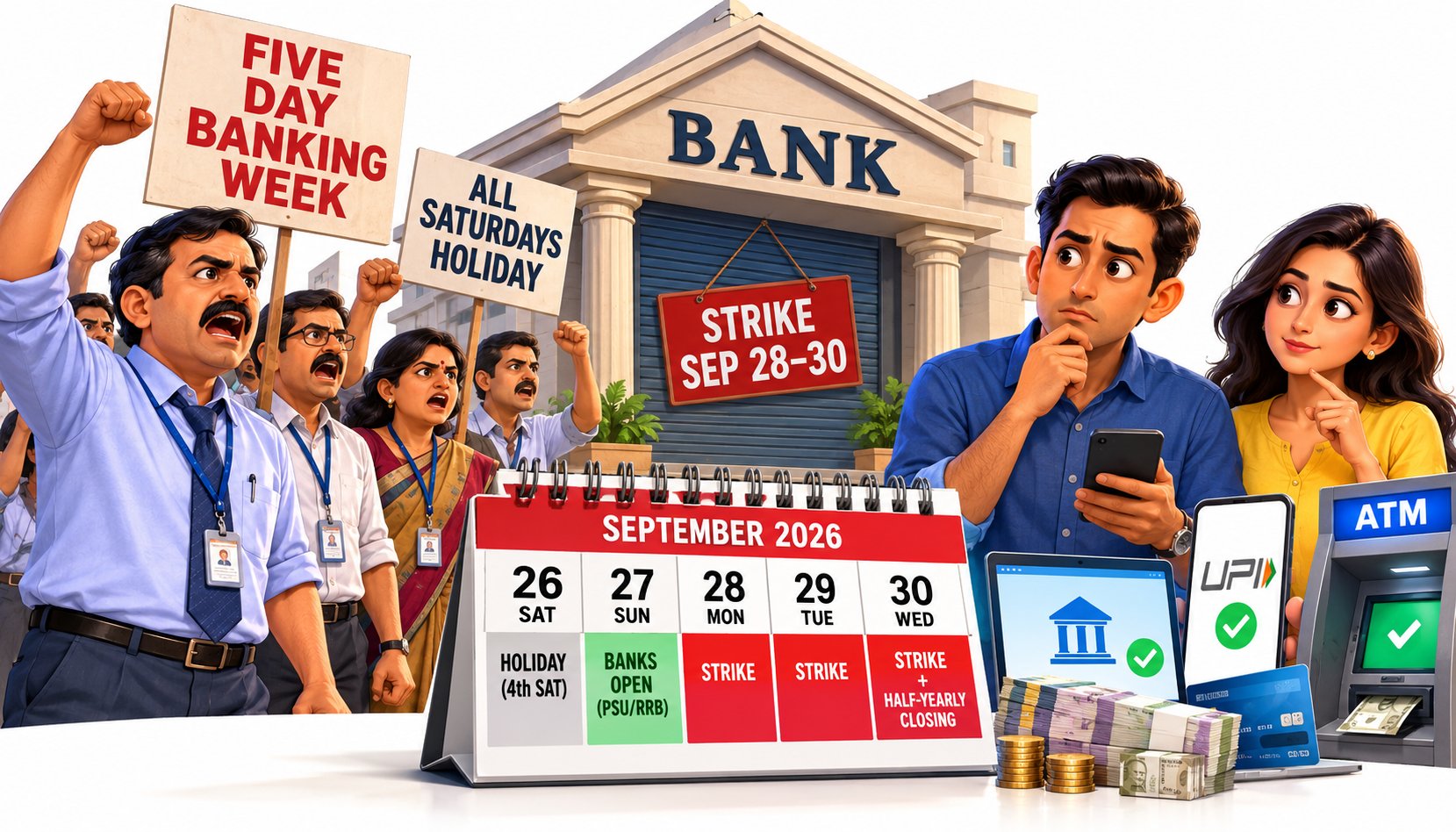
A bank branch opening on a Sunday is rare enough to make people look twice. This weekend it is happening across the country, and for a clear reason: a three-day nationwide strike called by the United Forum of Bank Unions is due to begin on Monday, 28 September. Saturday, 26 September is already the fourth-Saturday holiday. Without the Sunday opening, many customers would have faced a five-day gap in branch banking.
But there is a twist most customers will not notice until they reach the counter. Banks have said that on Sunday, clearing transactions, retirement of bills and negotiations under the Negotiable Instruments Act, 1881 will not be undertaken. You can deposit cash and handle routine work, but a cheque you hand in will not move through clearing that day. Understanding why tells you exactly which of your transactions can be finished on Sunday and which cannot.
A Sunday Opening Built Around a Five-Day Gap
The Ministry of Finance announced on 23 September that all public sector banks and regional rural banks will function normally on Sunday, 27 September, so that the genuine banking needs of the public are not held up for an extended period. The Reserve Bank of India approved all bank branches, offices, ATM-link branches and currency chests to remain operational that day.
The strike itself follows failed conciliation. At a meeting before the Deputy Chief Labour Commissioner on 22 September, the Department of Financial Services and the Indian Banks’ Association appealed to the unions to defer the action. The UFBU responded that it would consider deferral only if there was concrete progress on its main demand, a five-day banking week, and asked members to go ahead.
The UFBU is the umbrella body for the major employee and officer unions in public sector banks, including AIBEA, AIBOC, NCBE, AIBOA and BEFI. When it calls a strike, branch operations at state-run banks are usually hit hardest, while private banks with fewer union members often keep working.
The timing is awkward for banks. The strike overlaps with the half-yearly closing on 30 September, a date that matters for reconciliation, provisioning and treasury operations. Unions had already struck for one day on 11 September. The government has kept the performance-linked incentive scheme, another union grievance, in abeyance, but the five-day week remains unresolved.
What You Can and Cannot Get Done on Sunday
The customer notices issued by banks draw a precise line. Over-the-counter services will be provided to the extent operationally feasible, which means staffing and systems will decide what each branch can offer. Three categories are ruled out entirely. The table below maps common tasks across the Sunday opening and the strike days.
| Transaction | Sun 27 Sep | Strike, 28–30 Sep | Governing framework |
|---|---|---|---|
| Cash deposit or withdrawal at counter | Yes | Likely hit | Banking Regulation Act, bank rules |
| Depositing a cheque | Accepted, not cleared | Likely hit | NI Act, 1881 |
| Cheque clearing through CTS | No | Likely hit | NI Act and RBI clearing rules |
| Retirement of import or trade bills | No | Likely hit | NI Act, 1881 |
| Negotiation or discounting of bills | No | Likely hit | NI Act, 1881 |
| Demand draft or pay order issue | Branch discretion | Likely hit | NI Act, 1881 |
| UPI, IMPS, NEFT, RTGS | Yes, 24×7 | Expected to work | Payment and Settlement Systems Act, 2007 |
| ATM withdrawals | Yes | Cash may run low | RBI ATM rules |
| Passbook, KYC, FD opening | If feasible | Likely hit | Bank rules, RBI directions |
Deposited a cheque on Sunday? Read this
Handing a cheque in on 27 September does not start clearing. If the strike goes ahead, the next regular day for clearing at affected branches may be Thursday, 1 October. If your cheque’s three-month validity ends in this window, or a payment you owe depends on it, move the funds by UPI, NEFT or RTGS instead.
The 1881 Law Behind the Sunday Exception
The Negotiable Instruments Act, 1881 is one of India’s oldest commercial laws still in daily use. Section 13 defines a negotiable instrument as a promissory note, bill of exchange or cheque payable either to order or to bearer. The defining feature is transferability: ownership passes by delivery or endorsement, and a holder in due course can claim payment even if an earlier holder’s title was flawed.
The Sunday exclusion comes from Section 25. It says that when a note or bill falls due on a public holiday, it is treated as due on the preceding business day. The explanation to that section defines a public holiday to include Sundays and any other day the Central Government notifies. A bank choosing to open its doors does not change that legal status. Sunday, 27 September is still an NI Act holiday.
That is why banks are steering clear. Presenting, clearing, negotiating or retiring an instrument on a legal holiday creates doubt about maturity dates, days of grace and presentment deadlines. Those dates decide who is liable if something goes wrong. Excluding the work entirely is simpler and safer than arguing about it later.
Three terms from the bank notices, decoded
Clearing is the exchange of cheques between banks through the Cheque Truncation System, which settles funds only on working days. Retirement of bills means a buyer, often an importer, paying a bill drawn under a letter of credit or collection to receive the shipping documents. Negotiation means a bank buying or discounting an exporter’s bill and paying out before the importer pays.
Inside the NI Act: Which Transactions Qualify, Which Do Not
The quickest test is simple. If the transaction depends on a paper or electronic instrument that orders or promises payment and can be transferred, it is NI Act territory. If it is a direct credit, a debit or a service, it is governed elsewhere.
Covered by the NI Act, 1881
- Cheques, including electronic and truncated cheques (Section 6)
- Bills of exchange, such as trade and export bills (Section 5)
- Promissory notes made by individuals or firms (Section 4)
- Demand drafts between branches (Section 85A)
- Banker’s cheques and pay orders, treated like cheques
- Collection and clearing of cheques and bills
- Discounting and negotiation of bills
- Retirement of bills under LC or collection
- Cheque dishonour and its penalties (Section 138)
Outside the NI Act
- Cash deposits and withdrawals
- UPI, IMPS, NEFT and RTGS transfers
- NACH and e-mandates for EMIs and SIPs
- Debit and credit card payments
- Fixed deposit receipts, which are not transferable
- Passbook updates, KYC, nominations
- Locker access and safe custody
- Loan sanction and documentation
- Currency notes, governed by the RBI Act, 1934
Why electronic transfers escape the Sunday rule
Digital payments are governed by the Payment and Settlement Systems Act, 2007, not the NI Act. UPI and IMPS run around the clock, and the RBI made NEFT and RTGS available 24×7 in December 2019 and December 2020. That is why they are the practical workaround for anything urgent this week. Even a bounced e-mandate has its own penalty under Section 25 of the 2007 Act, separate from the cheque-bounce provision.
Where it gets tricky: demand drafts
A demand draft is legally a bill of exchange drawn by one branch on another, so it is an NI Act instrument. Issuing one is not the same as negotiating or clearing it, and some branches may still issue drafts on Sunday. Presenting a draft for payment through clearing, however, will have to wait for a working day.
A promissory note is not a fixed deposit
People often assume any bank document with a rupee amount on it is a negotiable instrument. It is not. A fixed deposit receipt records a deposit but cannot be transferred by endorsement, so opening or renewing an FD on Sunday is ordinary counter work. A loan agreement is a contract, not an instrument, even when a demand promissory note is signed alongside it.
Which Payment Route Still Moves Money This Sunday?
The difference between an NI Act transaction and an electronic one is easiest to see by asking how many hours each route is actually open on 27 September. Cheque clearing is the outlier. The electronic rails that most households now use every day were built to run without a branch.
This is also why the Sunday opening matters most for a narrow set of people. Salaried households who pay by UPI and receive salary by NEFT will barely notice the strike, apart from branch-only tasks. The people most exposed are those who still depend on paper: small traders collecting cheques from customers, landlords receiving rent by cheque, senior citizens who prefer the counter, and businesses that import or export under letters of credit.
Why exporters and importers should call their bank today
Trade bills run on fixed dates. An importer whose bill falls due during the strike, or an exporter hoping to have documents negotiated before the half-year closing, cannot use the Sunday opening for that work. Section 25 already moves a bill due on a holiday to the preceding business day, which for a bill due on Sunday, 27 September means Friday, 25 September. For bills due on the strike days themselves, the treatment depends on whether a holiday is formally declared. Speak to your trade finance desk about the exact date your bank will apply.
The Cheque-Bounce Clock That Keeps Running
For anyone expecting or issuing cheques this week, the stakes are not just inconvenience. The NI Act sets fixed time limits for cheque dishonour, and some are counted in calendar days that do not pause for strikes.
The three-month validity comes from RBI instructions. Section 138 itself requires presentment within six months or the instrument’s validity period, whichever is earlier. The 30-day notice window starts when the payee learns of the dishonour, so a delayed return memo during a strike does not by itself shorten your time. Legal advice is worth taking if a large cheque is involved.
How the Standoff Unfolded
What We Know
- PSBs and RRBs will function on Sunday, 27 September 2026, with RBI approval.
- UFBU has called a strike from 28 to 30 September, mainly over five-day banking.
- Banks have excluded clearing, bill retirement and NI Act negotiations on Sunday.
- Sunday is a public holiday under Section 25 of the NI Act.
- 2 October is Gandhi Jayanti, a national holiday.
What Is Still Unclear
- Whether the strike will be called off at the last minute after fresh talks.
- How many private bank branches will be affected or open on Sunday.
- Whether any special clearing arrangements will follow on 1 October.
- Whether the threatened indefinite strike from 26 October will go ahead.
Your Sunday Checklist Before the Strike Begins
If you are planning a branch visit on 27 September, a few minutes of preparation can save a wasted trip.
For businesses paying salaries or vendors
Cheque-based payroll or vendor runs due on 30 September should shift to NEFT or RTGS, which settle regardless of branch staffing. Reports indicate central government salaries and pensions were released early, on 25 September, to avoid disruption.
Frequently Asked Questions
Are banks open on Sunday, 27 September 2026?
Yes. The Ministry of Finance said all public sector banks and regional rural banks will function on Sunday, 27 September 2026, and the RBI approved branches, offices, ATM-link branches and currency chests to operate that day. Over-the-counter services will be offered to the extent operationally feasible.
When is the bank strike in September 2026?
The United Forum of Bank Unions has called a nationwide strike from Monday 28 September to Wednesday 30 September 2026. Its main demand is a five-day banking week. Branch services at banks whose staff join the strike may be disrupted on those days.
Will cheques be cleared on Sunday, 27 September 2026?
No. Banks have said clearing transactions will not be undertaken on the special Sunday. You can usually deposit a cheque, but it will be sent for clearing only on the next day the clearing system and the branch are working.
What transactions come under the Negotiable Instruments Act, 1881?
The Act covers promissory notes, bills of exchange and cheques, including electronic and truncated cheques, and banking work built on them such as cheque presentment and clearing, collection, discounting or negotiation of bills, retirement of bills, demand drafts and cheque dishonour under Section 138.
Which banking transactions do not fall under the NI Act?
Cash deposits and withdrawals, UPI, IMPS, NEFT and RTGS transfers, card payments, NACH mandates, fixed deposit receipts, passbook updates, KYC, lockers and loan documentation are not governed by the NI Act. Electronic payments fall under the Payment and Settlement Systems Act, 2007.
Why can’t bills be negotiated or retired on Sunday?
Under Section 25 of the NI Act, Sunday is a public holiday for negotiable instruments, and an instrument due on a holiday is payable on the preceding business day. Handling negotiation, retirement or clearing on a legal holiday could create disputes over dates, so banks have excluded this work.
Will UPI, ATMs and net banking work during the bank strike?
Digital channels such as UPI, net banking, mobile banking and ATMs are expected to keep running, as they do not depend on branch staff. ATM cash can run short in some areas if the disruption is prolonged, so withdraw what you need in advance.
Is 2 October 2026 a bank holiday?
Yes. Gandhi Jayanti on Friday, 2 October 2026 is a national holiday. That makes Thursday, 1 October the only regular branch working day between the strike and Saturday, 3 October, so plan cheque and bill deadlines around it.
The Short Version
Public sector and regional rural banks are opening on Sunday, 27 September so customers can finish essential work before the UFBU strike from 28 to 30 September. Cash and routine counter services will be available where feasible. Anything tied to a negotiable instrument, meaning cheque clearing, bill negotiation and bill retirement, will wait, because Sunday remains a legal holiday under the NI Act, 1881. Use UPI, NEFT or RTGS for urgent payments, withdraw cash in advance, and plan around 1 October as the next regular working day.