How Much Money Should You Keep in Your Bank Account in 2026 — and When Does Safe Cash Start Losing Value?
Personal Finance · Banking · India 2026
How Much Money Should You Keep in Your Bank Account in 2026 — and When Does Safe Cash Start Losing Value?
A layer-by-layer answer for Indian households, built on August 2026 inflation data, current savings account rates and the ₹5 lakh deposit insurance limit.
Open your banking app and look at the balance. Is that number a safety net, a spending pot, or money that quietly forgot it was supposed to grow? Most people cannot say, because a single savings account ends up holding rent, groceries, a hospital fund, a holiday plan and a bonus nobody decided what to do with.
The honest answer to “how much should I keep in the bank” has two parts. The first is a small, deliberate amount in the savings account itself, sized to your monthly spending. The second is a larger reserve that should be close to hand but not necessarily in the same account. Mix the two, and you either run short in a crisis or lose money to inflation every single month.
The Number Everyone Wants Is Actually a Range
There is no single rupee figure that fits a family in Pune spending ₹50,000 a month and a freelancer in Kochi whose income swings between zero and ₹3 lakh. What does translate across households is a ratio: months of your own expenses. That is why this guide measures every balance in months rather than rupees.
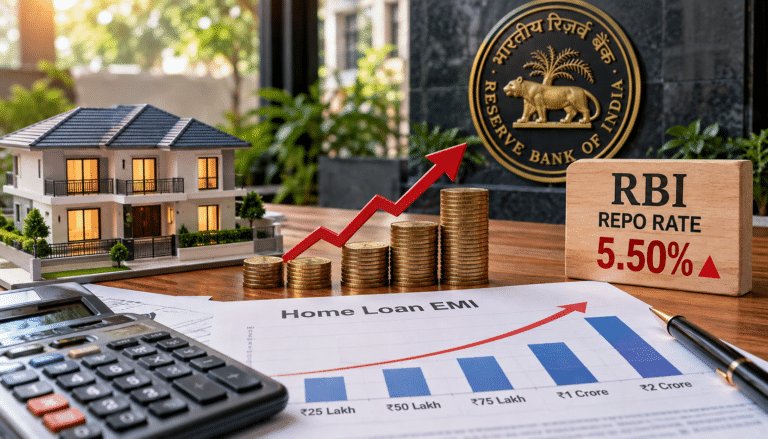
The backdrop for that ratio changed in 2026. The Reserve Bank of India has kept the repo rate at 5.25% through its 2026 policy reviews, with its latest projection putting average inflation for the year at about 5.1%. Meanwhile, the National Statistics Office reported on 14 September that retail inflation rose to 4.82% in August, the highest reading since late 2024, driven by food and an energy-price shock linked to conflict in the Middle East.
Put those numbers side by side and the problem is obvious. SBI, ICICI, Axis, Kotak and most public sector banks have converged on a flat savings rate of about 2.50%, according to 2026 rate comparisons. When prices rise faster than that, a large, untouched savings balance is not standing still. It is shrinking in what it can buy.
Your Balance Is Secretly Doing Four Different Jobs
The single biggest mistake is treating “money in the bank” as one pile. Financial planners split it into layers because each layer has a different deadline, and money should be parked according to when it will be needed, not according to where the salary happens to land.
Why the operating float is smaller than people expect
Salary arrives every month, so the savings account only has to bridge one cycle plus a small cushion. The extra half month exists because EMI and SIP dates rarely line up neatly with payday, and because annual items such as insurance premiums or school fees tend to cluster. If your known big debits in the next 30 days exceed a normal month, add them on top. Anything above that is no longer operating money.
Why the emergency reserve should not sit in the same account
Money that is visible in the spending account gets spent. It is not a character flaw; it is how people read a balance. Keeping the reserve one tap away, in a sweep-in deposit or a separate account, removes the temptation while keeping it available the same day.
The Savings-Account Thermometer: When Does Safe Become Wasteful?
A quick way to judge your own situation is to divide your current savings balance by your monthly expenses. The result tells you which zone you are in and what to do next.
Too thin
Right-sized
Drifting
Leaking value
Idle wealth
Being in the “too thin” zone is not a moral failing, but it is expensive. The fallback for a short balance is usually a credit card or an instant loan, and revolving card debt in India typically costs 3% to 3.75% a month, roughly 36% to 45% a year. No savings product comes close to earning that back.
How Big Should the Emergency Reserve Really Be?
The widely used rule is 6 to 12 months of expenses. Where you land in that range depends less on income and more on how fragile that income is, and on how many people rely on it.
Here is how those multiples translate into rupees. Find the row closest to your monthly spending, then read across. Monthly spending should include rent or EMIs, school fees averaged per month, insurance premiums divided by twelve and any regular support you send to family.
| Monthly expenses | Savings float (1.5 mo) | Reserve: 6 mo | Reserve: 9 mo | Reserve: 12 mo |
|---|---|---|---|---|
| ₹30,000 | ₹45,000 | ₹1.8 lakh | ₹2.7 lakh | ₹3.6 lakh |
| ₹50,000 | ₹75,000 | ₹3 lakh | ₹4.5 lakh | ₹6 lakh |
| ₹75,000 | ₹1.13 lakh | ₹4.5 lakh | ₹6.75 lakh | ₹9 lakh |
| ₹1,00,000 | ₹1.5 lakh | ₹6 lakh | ₹9 lakh | ₹12 lakh |
| ₹1,50,000 | ₹2.25 lakh | ₹9 lakh | ₹13.5 lakh | ₹18 lakh |
Worked example: a family spending ₹60,000 a month
Ananya and Rohit, a hypothetical couple in Bengaluru, spend ₹60,000 a month including a ₹15,000 car EMI. Only Rohit earns. Their savings float should be 1.5 × ₹60,000 = ₹90,000. With one income and an EMI, a 9-month reserve fits: 9 × ₹60,000 = ₹5.4 lakh. They keep ₹60,000 of that reserve in a linked sweep-in deposit for instant use and the remaining ₹4.8 lakh in short FDs and a liquid fund split across two institutions. Everything beyond ₹6.3 lakh in total goes to their goal and SIP layers.
When the standard rule should bend
Retirees living off pension or deposit interest often need a larger operating float, closer to 2 or 3 months, because income can arrive quarterly and medical costs are less predictable. Their reserve also benefits from the extra senior citizen rate most banks offer on deposits. Freelancers face the opposite problem: income is lumpy, so the float should be measured against a lean month, not an average one, and tax set aside for advance tax instalments should be kept apart from spending money entirely.
Young earners without dependents can start smaller. Three months of reserve, built within the first year of work, is a reasonable first milestone before stretching to six. The point is to have something real in place early, rather than waiting for a perfect number.
The Quiet Leak: What Idle Cash Loses Every Year
This is where curiosity should turn into action. A savings account feels risk-free because the number never falls. But the number is only half the story. What matters is what that number buys, and that depends on inflation.
Take ₹5 lakh left untouched at 2.50%. It earns ₹12,500 in a year. If prices rise 4.82% over the same year, the balance buys about ₹11,000 less than it did twelve months earlier, even after interest. Stretch that over five years at the same rates and the real value slips to roughly ₹4.47 lakh in today’s money.
The interest you see is not the interest you keep
Savings account interest is taxed at your slab rate as income from other sources. Under the old tax regime, individuals below 60 can deduct up to ₹10,000 a year of savings interest, and senior citizens can deduct up to ₹50,000 of bank interest, including FD interest. Under the new regime, which most salaried taxpayers now use, this deduction is not available. The Income-tax Act, 2025, which took effect on 1 April 2026, renumbered these provisions, but reporting guides indicate the limits themselves are unchanged.
For a saver in the 30% bracket on the new regime, 2.50% becomes roughly 1.75% after tax. Against inflation near 5%, that is a real loss of more than 3% a year on every rupee that sits there without a job.
Where Each Rupee Should Live, Ranked by How Fast You Can Reach It
Liquidity and return pull in opposite directions. The trick is to use the fastest, lowest-yielding home only for money that genuinely needs to move today.
| Where | Access speed | Indicative return | Main risk | Best used for |
|---|---|---|---|---|
| Savings account | Instant, 24×7 | About 2.50% at large banks | Inflation erosion | Layer 1 float |
| Sweep-in or flexi FD | Instant, breaks in units | Short-term FD rates | Lower rate on broken units | First slice of the reserve |
| Liquid fund | ₹50,000 instant, rest next business day | Market-linked, low volatility | Small credit and rate risk | Bulk of the reserve |
| Short FD ladder | Same day, with penalty | About 5.9% to 6.4% at SBI | Premature-exit penalty | Reserve and Layer 3 goals |
| Recurring deposit | On maturity | Similar to FD rates | Missed-instalment charges | Saving toward a dated goal |
| Equity SIP | Usually 2 to 3 working days | Market-linked, volatile | Short-term losses | Layer 4, 5+ years |
The ₹50,000 surprise hiding in liquid funds
Many savers assume a liquid fund works exactly like a savings account. It does not. Under SEBI’s Instant Access Facility, you can withdraw instantly only ₹50,000 or 90% of your holding per day per scheme, whichever is lower, and only in schemes that offer the feature. The rest follows through normal redemption, usually the next business day. That is fine for most emergencies, but it is exactly why the first month of your reserve should sit somewhere truly instant.
The ₹5 lakh insurance line
DICGC insures deposits up to ₹5 lakh per depositor per bank, covering principal and interest together across savings, current, fixed and recurring deposits held in the same capacity. Splitting across branches of one bank does not add cover; different banks do. Small finance banks are covered too, but a higher advertised rate does not extend protection beyond ₹5 lakh.
The Order of Operations That Protects Your Balance
Sizing the bank balance is only useful if it fits into a sequence. Getting the order wrong, such as investing aggressively while carrying card debt, can undo years of discipline.
Five Balance Mistakes That Look Sensible but Are Not
These patterns show up again and again, often among careful savers who simply never revisited an old habit.
- Letting bonuses pile up in savings. A windfall that sits for a year at 2.50% loses real value; give it a layer within 30 days of arrival.
- Counting the emergency fund as investable. Reserve money that chases returns in equity can be down 20% on the exact day you need it.
- Ignoring lifestyle inflation. A raise that lifts spending also lifts the required float and reserve, yet most people never recalculate.
- Keeping everything in one bank. A single-bank reserve above ₹5 lakh sits partly outside deposit insurance.
- Breaking long FDs for small shocks. Premature withdrawal usually reprices the whole deposit at a lower rate, which is why a layered structure beats one large FD.
Timeline: The 2026 Numbers Shaping Your Balance
Each of these dates moved at least one figure that feeds into how much you should hold, and where.
What We Know
- Retail inflation was 4.82% in August 2026, per the NSO release of 14 September.
- The RBI repo rate stands at 5.25%, unchanged through 2026.
- Most large banks pay about 2.50% on savings balances.
- DICGC cover is ₹5 lakh per depositor per bank, including interest.
- Liquid fund instant withdrawals are capped at ₹50,000 or 90% per day per scheme.
What Is Still Unclear
- Whether the RBI will change rates at its next review, which would move FD returns.
- How long the energy-driven rise in food and fuel prices will last.
- Whether more banks will cut savings or short-term FD rates in the coming months.
- How the renumbered savings-interest deduction will appear in returns filed in 2027.
Monthly Habits That Keep the Balance Honest
None of this works as a one-time exercise. These eight habits, most taking under ten minutes, keep each layer the right size.
Frequently Asked Questions
How much money should I keep in my savings account in India?
For day-to-day use, keep about 1 to 1.5 months of your total expenses, including EMIs, rent and insurance premiums due in the next 30 days. Your emergency reserve of 6 to 12 months of expenses can sit in a sweep-in FD, short FDs or a liquid fund rather than the plain savings balance.
Is it bad to keep too much money in a savings account?
It is safe but costly. Large banks pay about 2.50% on savings balances while retail inflation was 4.82% in August 2026, so idle money loses about 2.2% of its purchasing power a year. Move anything beyond your operating float and emergency needs into instruments matched to when you need the money.
How many months of expenses should an emergency fund cover?
The common guideline is 6 to 12 months. Dual-income salaried households with stable jobs can aim for about 6 months, single-income families with EMIs for 9, and self-employed or commission-based earners for 12. Build it gradually and keep part of it instantly accessible.
How much money in a bank account is insured in India?
DICGC insures up to ₹5 lakh per depositor per bank, covering principal and interest together across savings, current, fixed and recurring deposits held in the same capacity. Balances above that in a single bank are not insured, so large sums are often spread across banks.
Is savings account interest taxable in India?
Yes, it is taxed at your slab rate as income from other sources. Under the old regime, individuals below 60 can deduct up to ₹10,000 of savings interest a year, and senior citizens up to ₹50,000 of bank interest. The new regime does not offer this deduction.
Where should I keep my emergency fund for quick access?
Keep one month of expenses in the savings account and the rest in a sweep-in FD, short FDs or a liquid fund. Liquid funds allow instant withdrawal of only ₹50,000 or 90% of the holding per day per scheme, whichever is lower, with the rest usually arriving the next business day.
Should I use my savings to pay off credit card debt?
Usually yes, for any amount above your core emergency buffer. Revolving card balances typically cost about 36% to 45% a year, far above anything savings can earn. Clear the card first, then rebuild the reserve with a fixed monthly transfer.
How often should I review my bank balance and emergency fund?
Check the savings balance monthly against your 1 to 1.5 month target and sweep out any excess. Recalculate the emergency fund every 6 to 12 months or after a salary change, a new EMI, a new dependent or a job switch.
The Short Version
Keep 1 to 1.5 months of expenses in your savings account so bills and EMIs never bounce. Build a separate emergency reserve of 6 to 12 months, with the first month instantly available and the rest in sweep-in deposits, short FDs or a liquid fund spread across banks to stay within the ₹5 lakh insurance line. Clear expensive card debt before investing, insure your family, park dated goals in deposits that mature on time, and send everything else to long-term SIPs. With inflation at 4.82% and savings rates near 2.50%, every rupee without a job is losing ground.