Has India's ₹1 Lakh Crore Deep-Tech Fund Stalled? Where the RDI Scheme Stands After 11 Months
Science and Tech PolicyRDI FundIndia, October 2026
Has India’s ₹1 Lakh Crore Deep-Tech Fund Stalled? Where the RDI Scheme Stands After 11 Months
Launched in November 2025 to fund private research at low interest, the RDI Fund has committed about 2.2% of its corpus, paused fresh applications and is facing conflict-of-interest questions. It has slowed sharply, but it has not been shut down.
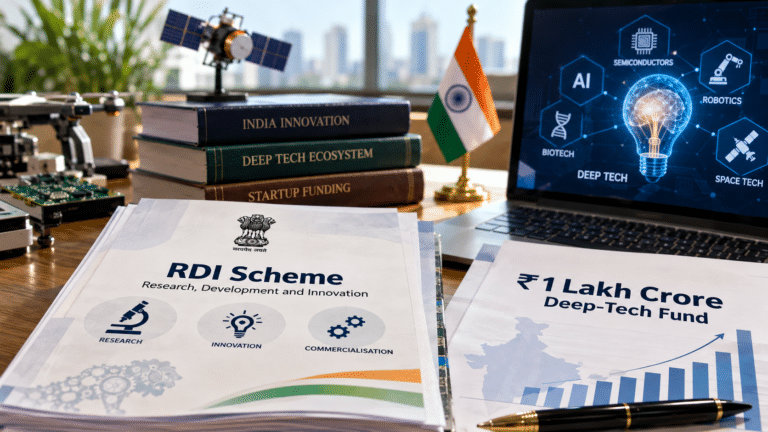
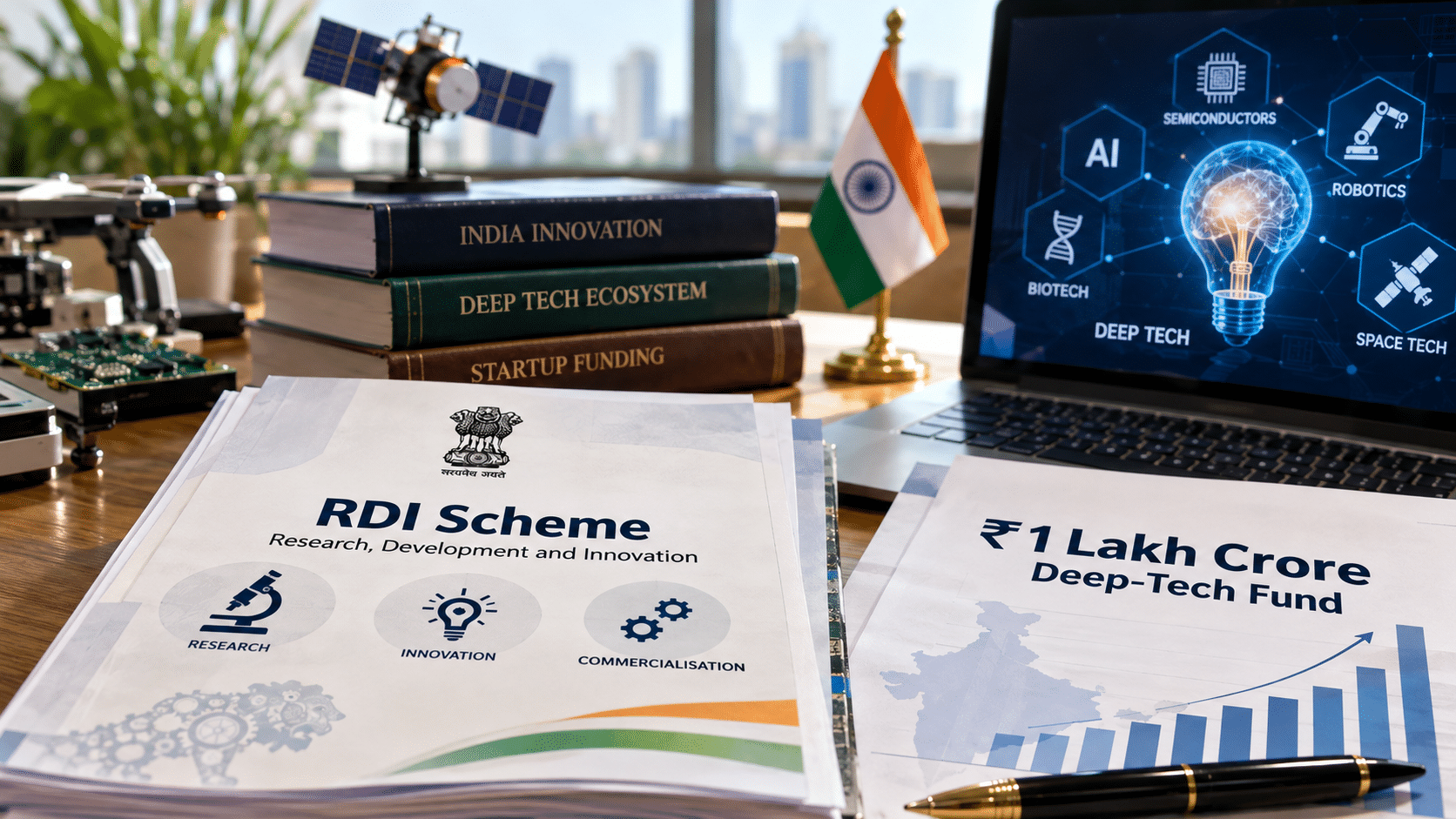
In November 2025, India announced one of the largest pools of public money ever set aside for private research: ₹1 lakh crore, lent at low interest for up to 15 years, to companies building rockets, quantum hardware, chips, batteries and drugs. Founders who had spent years hearing that Indian capital was too impatient for deep tech were told that problem had been solved.
Eleven months later, the first lender under the scheme has said it will stop taking fresh applications after October. Its first round was larger than the money it had received. Dozens of venture funds that applied to manage the money have not been approved. And 15 of the first 22 companies funded turn out to have links to members of the committee that chose them. So is India’s flagship deep-tech initiative stalled, or just slow?
What We Know
- The Cabinet approved the ₹1 lakh crore RDI Fund on 1 July 2025, and the Prime Minister launched it on 3 November 2025.
- The Technology Development Board approved 22 projects worth ₹4,744 crore, with ₹2,192 crore of RDI Fund support.
- BIRAC shortlisted 8 projects for about ₹390 crore, according to a July 2026 Parliament reply.
- TDB will stop accepting new applications after October 2026, citing administrative reasons, Outlook Business reported on 1 October.
What Is Still Unclear
- When fresh money will reach TDB and BIRAC, and how much the 2026-27 budget actually provides.
- When the 13 second-round companies will receive letters of intent.
- Whether, and when, any of the 162 venture funds that applied will be appointed as fund managers.
- Whether the conflict-of-interest questions will change how committees are formed.
A Fund Built to Fix India’s Patient-Capital Gap
The logic of the RDI Fund is simple. India spends little on research for an economy of its size, and private companies spend a smaller share of that than in most leading economies. A Parliament reply in July 2026 put India’s gross expenditure on research at ₹2.44 lakh crore in 2023-24, or 0.84% of GDP, up from 0.66% in 2019-20. Other commonly cited estimates are lower; Business Today’s report used 0.64%. Either way, the country sits far below the 2% to 5% range of the world’s most research-intensive economies.
Deep-tech companies face a specific version of this problem. A rocket, a quantum key distribution system or a new battery chemistry can take a decade to reach revenue. Venture funds with seven to ten year lives are wary, and banks want collateral that early-stage hardware firms do not have. The RDI Fund was designed to fill that gap: loans at about 2% to 4% interest, for up to 15 years, without collateral or personal guarantees, covering up to half of a project’s cost.
How the Money Is Supposed to Move
The government does not lend to companies directly. The corpus sits in a Special Purpose Fund under the Anusandhan National Research Foundation, or ANRF. From there it is meant to flow to second-level fund managers, who choose and finance projects. That two-tier design is central to understanding the slowdown, because each tier has its own approvals.
The intended evaluation and disbursal targets, about eight and twelve weeks, were described by Business Today. The design also allows alternative investment funds, development finance institutions, NBFCs and focused research organisations to become fund managers. In practice, by October 2026 only the two government bodies, the Technology Development Board and the Biotechnology Industry Research Assistance Council, are operating.
Five Signs the Engine Has Sputtered
1. The first round outran the money
TDB’s first cohort of 22 companies was offered loans totalling ₹2,192 crore. Outlook Business reported that TDB had received ₹2,000 crore, which ran out after that round. A July 2026 Parliament reply, summarised by several outlets, said ₹1,000 crore each had been sanctioned to TDB and BIRAC, and that ₹500 crore had been released to TDB by March 2026. The figures differ by source and date, but they agree on one point: approvals have run ahead of cash.
2. Intake is pausing
TDB told applicants it will stop accepting fresh applications after October 2026, citing “administrative reasons”, according to Outlook Business. It has also not issued letters of intent to the 13 companies chosen in its second round. BIRAC, the other fund manager, had not begun final selection of companies at the time of that report.
3. The private fund managers are still waiting
The scheme’s reach depended on dozens of private fund managers. Raksha Anirveda reported that 162 alternative investment funds and 38 focused research organisations applied, proposing about ₹8,000 crore of commitments, and that none had received an approval letter. Applications closed in January and a committee finalised recommendations in May, Outlook Business said. Without those approvals, fund managers cannot close their own fundraising, which ties up private capital that was meant to sit alongside public money.
4. A tax question nobody has answered
Some RDI support can convert from loan to equity. BIRAC has sought clarity from the Finance Ministry on how such conversions are taxed, Outlook Business reported. Until that is settled, neither the fund manager nor the company can be sure what a conversion would cost.
5. A governance controversy
An Indian Express report in August, followed by other outlets, found that 15 of the 22 first-round companies had investment, equity or leadership links to 7 of the 12 members of TDB’s investment committee. Those 15 firms received ₹1,377 crore, about 62% of the round, according to The420.in. The committee members said they disclosed their interests and recused themselves from related discussions, and TDB Secretary Rajesh Kumar Pathak, quoted by PTI, said the guidelines require disclosure and recusal. The matter has been raised in a Rajya Sabha question.
What Has Actually Been Funded
For all the delays, the first cohort is substantial, and it is the strongest evidence that the scheme can work. Business Today reported that the 22 TDB projects add up to ₹4,744 crore of research spending, of which companies are putting in more than half. Fourteen are startups and 13 are in deep-tech areas such as reusable launch vehicles, earth observation satellites, quantum-secure communication, chip design, drones, robotics and next-generation batteries.
Named recipients reported by Outlook Business include Agnikul Cosmos, GalaxEye, QuNu Labs, ideaForge and EndureAir. Sudhir Mehta, a member of TDB’s investment committee, told Business Today that “India’s problem was never ideas. It was patient capital.” That is the case for the scheme in one line. The question is whether the patient capital is moving at a pace companies can plan around.
Stalled, Slowed or Simply Early? A Way to Judge
“Stalled” means different things to different people. The rail below sets out four states the scheme could be in, with the evidence that would place it in each. On current reporting, it sits in the second zone.
The signals to watch over the next six months are concrete. Has TDB received fresh money? Have the 13 second-round companies got letters of intent? Has any private fund manager been appointed? Has the 2026-27 budget money been released to ANRF’s fund? If two or more of those happen by March 2027, the scheme is recovering. If none do, “stalled” becomes the fair word.
Timeline: From Budget Promise to Paused Intake
- 1 Feb 2025Union Budget announces ₹20,000 crore to start a private-sector research and innovation initiative.
- 1 Jul 2025Cabinet approves the ₹1 lakh crore RDI scheme for six years.
- 3 Nov 2025Prime Minister launches the RDI Fund.
- Jan 2026Applications from prospective fund managers close.
- Mar 2026₹500 crore released to TDB.
- May 2026Committee finalises fund manager recommendations; no appointments follow.
- Jul 2026Parliament reply confirms 22 TDB approvals and 8 BIRAC shortlisted projects.
- Aug 2026Report links 15 of 22 recipients to 7 investment committee members.
- 29 Sep 2026First cohort details made public: ₹4,744 crore of projects.
- 1 Oct 2026TDB to stop new applications after October, citing administrative reasons.
The Wider Deep-Tech Toolkit
The RDI Fund is not India’s only deep-tech programme, and a slowdown in one does not mean all are stuck. The table lists the main central schemes, with the outlays announced when they were approved.
| Programme | Approved | Announced outlay | What it funds | Status signal |
|---|---|---|---|---|
| RDI Fund | July 2025 | ₹1,00,000 crore | Low-interest loans for private R&D | Slowed |
| Startup India Fund of Funds 2.0 | Notified April 2026 | ₹10,000 crore | Venture funds backing startups, including deep tech | Early stage |
| ANRF core budget | 2023 Act | ₹14,000 crore provision | Grants for academic and public research | Operating |
| National Quantum Mission | April 2023 | ₹6,003 crore | Quantum computing, communication, sensing | Operating |
| IndiaAI Mission | March 2024 | ₹10,372 crore | Compute, datasets, foundation models | Operating |
| India Semiconductor Mission | December 2021 | ₹76,000 crore | Fabs, packaging, chip design incentives | Operating |
Status signals are this desk’s summary of public reporting, not official ratings. The notable difference is that the RDI Fund lends to companies on commercial-style terms through a new two-tier structure, whereas most of the others make grants or incentive payments through established departments. New structures tend to stumble first on exactly the problems the RDI Fund now faces: appointments, tax treatment and governance rules.
What Founders and Investors Can Do Now
For a deep-tech company planning around RDI money, the practical response is to keep the option open without depending on it.
- Apply before the October cut-off if ready. TDB is reported to be pausing intake after October 2026; a complete application now keeps a place in the queue.
- Plan for 6 to 12 months, not 12 weeks. Build runway assuming the published targets will not be met in the current phase.
- Line up the matching 50%. The scheme funds at most half of a project; investors who commit the other half early make an application stronger.
- Document the technology readiness level. Projects must be at TRL 4 or above; independent test reports shorten evaluation.
- Disclose every link to committee members. After the August controversy, transparent disclosure protects both the company and the process.
- Project at technology readiness level 4 or higher
- Matching funding for at least 50% of cost identified
- Intellectual property to remain in India
- Control to stay with Indian citizens
- Repayment plan modelled over up to 15 years
- Interest of 2% to 4% built into the financial model
- Runway of at least 12 months without RDI money
- Alternative routes checked: FoF 2.0 funds, mission grants
Frequently Asked Questions
What is India’s RDI Fund?
The Research, Development and Innovation Fund is a ₹1 lakh crore scheme approved on 1 July 2025 and launched on 3 November 2025. It offers private companies long-term, low-interest loans for research projects at technology readiness level 4 or above, covering up to 50% of project cost.
Has the RDI scheme been stopped?
No. The scheme has not been cancelled. The Technology Development Board has said it will stop accepting fresh applications after October 2026, citing administrative reasons, and funding has been slow, but the scheme remains in place.
How much money has the RDI Fund given so far?
TDB approved 22 projects with ₹2,192 crore of support, and BIRAC shortlisted 8 projects for about ₹390 crore. A July 2026 Parliament reply said ₹500 crore had been released to TDB by March 2026.
What interest rate do RDI Fund loans carry?
Reports put the interest rate at about 2% to 4%, with tenure of up to 15 years and no collateral or personal guarantees. Exact terms depend on the fund manager and the project.
Which companies got RDI Fund loans?
Named recipients in the first TDB cohort include Agnikul Cosmos, GalaxEye, QuNu Labs, ideaForge and EndureAir. The 22 projects span space, quantum communication, chip design, drones, robotics and batteries.
What is the conflict-of-interest controversy about the RDI Fund?
Reports found that 15 of the 22 first-round companies had links to 7 of the 12 members of TDB’s investment committee, and that these firms received about ₹1,377 crore. Members said they disclosed their interests and recused themselves; the matter has been raised in Parliament.
Who manages the RDI Fund?
The corpus sits in a Special Purpose Fund under the Anusandhan National Research Foundation. Money reaches companies through second-level fund managers; so far these are the Technology Development Board and BIRAC.
How much does India spend on research and development?
A July 2026 Parliament reply put gross R&D spending at ₹2.44 lakh crore in 2023-24, or 0.84% of GDP. Other widely cited estimates are lower, at about 0.64% to 0.7%, depending on the year and method.
The Short Version
India’s ₹1 lakh crore RDI Fund has not been cancelled, but it has slowed badly at the point where money should reach companies. Eleven months after launch, 22 projects have ₹2,192 crore approved and 13 more are waiting, yet only ₹500 crore had been released by March. TDB is pausing new applications, no private fund manager has been appointed, and a conflict-of-interest controversy is unresolved. The first cohort shows the idea works. Whether it recovers depends on fresh releases, fund manager appointments and clear governance rules in the next six months.