OPPO Find X10 Pro Max: What’s in the Box, the Triple 200MP Camera Explained and Is ₹1,99,999 Worth It?
OPPO Find X10 Pro Max Unboxed: What’s in the Box, the Triple 200MP Camera Explained and Is ₹1,99,999 Worth It?
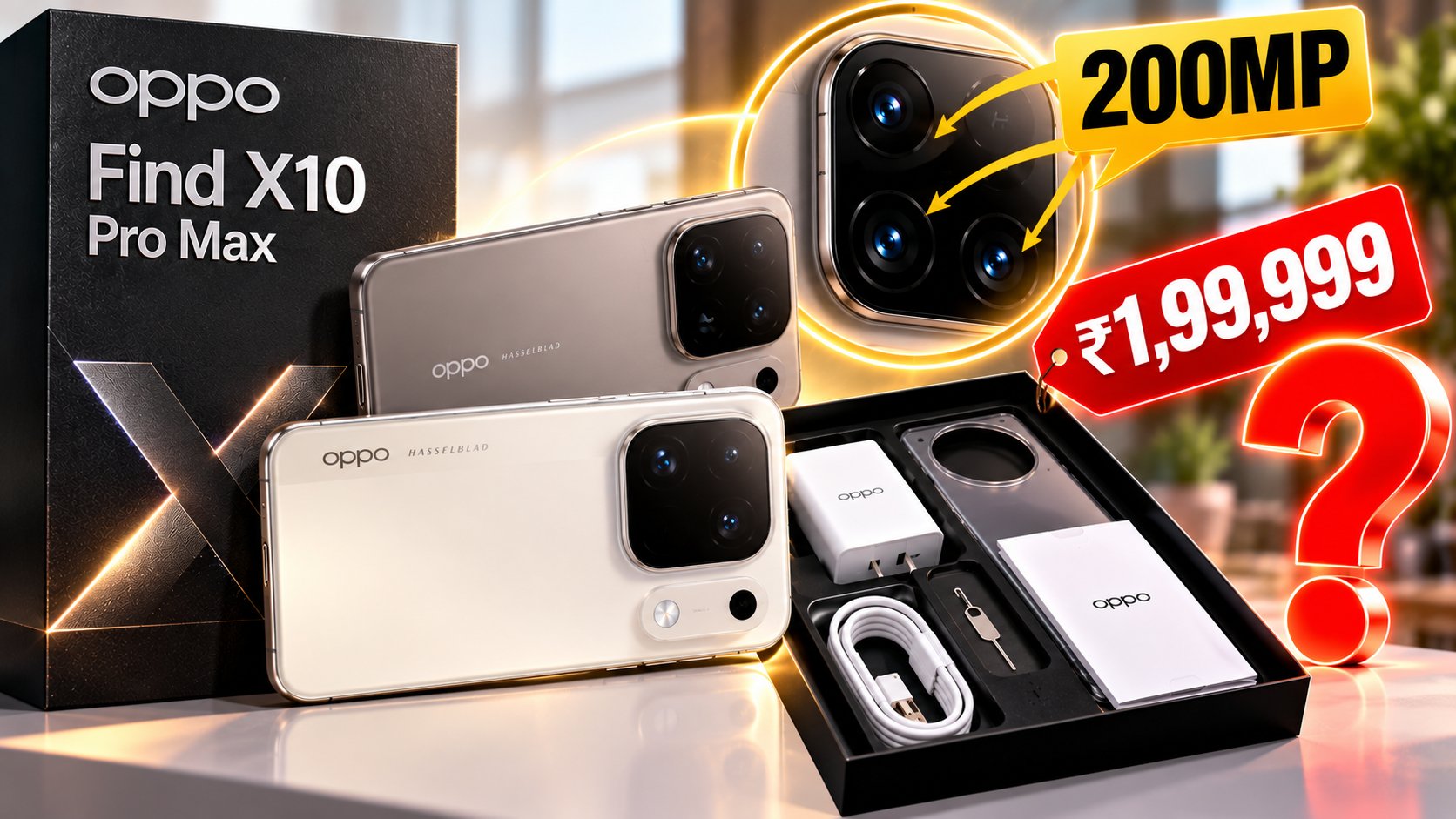
OPPO launched the Find X10 Pro Max in India on 22 October 2026 at ₹1,99,999 for 12GB RAM and 512GB storage. It is the first phone with three 200MP rear cameras, and it goes on sale on 29 October.
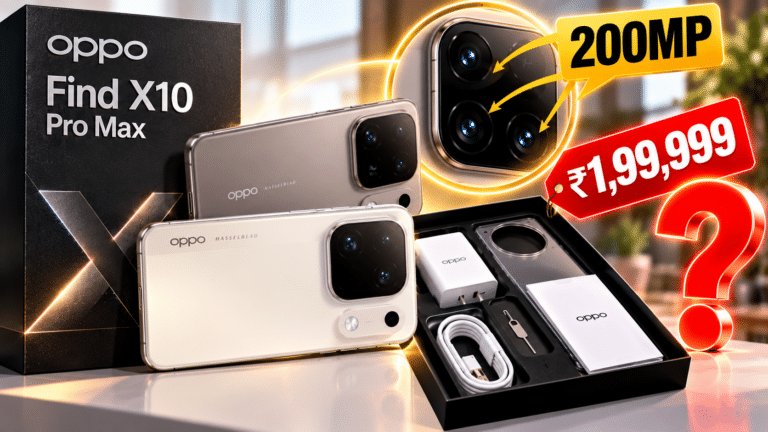
Lift the lid on most flagship phones in 2026 and you find a phone, a cable and a pin. The Find X10 Pro Max’s Indian retail box, going by the labels 91mobiles reported before launch, lists a charger, a USB cable, a SIM ejector tool and a protective case. That is already more generous than some rivals. But the reason anyone is curious about this box sits on the back of the phone: a circular module holding three 200-megapixel cameras.
No phone has done that before. The question worth asking is not whether 600 megapixels sounds impressive. It is what three 200MP sensors actually change in the photos you take, why the phone saves 26MP files by default, and whether it justifies a price that is ₹60,000 above the cheaper Find X10. This guide walks through the box, the cameras, the numbers and what the first reviews found.
Quick Summary
The Find X10 Pro Max puts three 200MP sensors behind 13mm, 24mm and 70mm lenses, giving equally high-resolution capture across ultrawide, main and 3x zoom. In practice the phone saves 26MP images by default and merges pixels to gather more light, so the benefit is consistency and zoom detail rather than giant files. India pricing is ₹1,99,999 for 12GB and 512GB, against a printed MRP of ₹2,39,999; the optional Hasselblad Teleconverter Kit costs ₹24,999. GSMArena found stills from all three cameras very good and low light top-class, but default 26MP daylight shots and video sharpness weaker than expected.
What We Know
- The phone launched in China on 22 September and in India and globally on 22 October 2026.
- India price is ₹1,99,999 for 12GB and 512GB; sales begin on 29 October.
- All three rear cameras use 200MP Samsung ISOCELL sensors: HPC for the main, HP5 for ultrawide and telephoto.
- It runs MediaTek’s Dimensity 9600 Pro on a 2nm process, with ColorOS 17 on Android 17.
- The Hasselblad Teleconverter Kit is sold separately in India at ₹24,999.
What Is Still Unclear
- Whether every Indian retail box includes the 80W charger and case listed on the leaked labels.
- India-specific bank offers and whether a 16GB variant will arrive; some listings mention it.
- How many years of Android version and security updates OPPO commits to in India.
- Independent battery and charging-time tests on the Indian 8,000mAh unit.
Inside the Box: Four Accessories and Two Details on the Label
Retail box labels for the Indian model, reported by 91mobiles from a tipster’s images before launch, carry more than a price. They list the accessories, the model number CPH2913, the weight and the dimensions, and they state that the phone is made in India, with an October 2026 manufacture date for the Pro Max.
One caution matters for buyers outside India. T3’s UK review notes that you need a suitable plug to get 80W charging, and lists the magnetic case, magnetic power bank and Hasselblad teleconverter as separate purchases. Box contents often vary by country, so check the listing for your market rather than assuming the Indian label applies.
Why the MRP and the price differ by ₹40,000
Indian packaging must print a maximum retail price, and brands often set it well above the launch price to leave room for later pricing. The ₹2,39,999 on the box is that ceiling. The ₹1,99,999 announced on 22 October is the price that actually matters, before bank offers or exchange deals.
Three 200MP Cameras, Not Three Identical Ones
The headline number hides an important detail. The three rear cameras share a resolution but not a sensor size. GSMArena’s review lists the main camera as a 1/1.3-inch Samsung ISOCELL HPC, while the ultrawide and periscope telephoto both use the smaller 1/1.56-inch ISOCELL HP5. A larger sensor gathers more light, which matters far more for image quality than the megapixel count.
| Camera | Sensor | Size | Lens | Pixel size | Default output |
|---|---|---|---|---|---|
| Main | 200MP ISOCELL HPC | 1/1.3-inch | 24mm, f/1.5, OIS | 0.6 to 2.4µm | 26MP |
| Ultrawide | 200MP ISOCELL HP5 | 1/1.56-inch | 13mm, f/2.2 | 0.5 to 2.0µm | 26MP |
| Periscope telephoto | 200MP ISOCELL HP5 | 1/1.56-inch | 70mm, 3x, f/2.1, OIS | 0.5 to 2.0µm | 26MP |
| Selfie | 50MP ISOCELL JN5 | 1/2.76-inch | 18mm, f/2.0 | 0.64 to 1.28µm | Not stated |
| True Color camera | 3.2MP multispectral | Not stated | 24 channels | Not stated | Colour data only |
The pixel-size ranges explain how a 200MP sensor works in a phone. Each individual pixel is tiny, 0.6 micrometres on the main sensor. In low light, the phone merges groups of 16 neighbouring pixels into one larger effective pixel of 2.4 micrometres. That is called pixel binning, and it is why a 200MP camera usually saves a much smaller image.
So the main camera has roughly 44% more sensor area than the other two rear cameras. That is still large for ultrawide and telephoto modules, which on many phones use much smaller sensors. The practical promise of the triple 200MP layout is that switching from wide to ultrawide to zoom does not produce the sudden drop in detail and colour consistency that many phones show.
Why Your “200MP Phone” Saves 26MP Photos
This is the part most buyers misunderstand. According to GSMArena, the main camera shoots in a 26MP “High resolution” mode by default, with 12.6MP Standard, 50MP and full 200MP options in the menu. In low light it drops to 12.6MP automatically. The ultrawide and telephoto also default to 26MP.
Why not save 200MP every time? Files would be enormous, processing slower, and in most light the extra pixels add noise rather than detail. GSMArena’s reviewer found the 200MP mode “didn’t add much useful detail.” More surprisingly, the reviewer felt the default 26MP output rendered grass, leaves and small text softly, and preferred 50MP files downscaled to 26MP. If you buy this phone, try the 50MP mode for daylight landscapes.
Fact box: the binning arithmetic
200 million pixels grouped 4 to 1 gives 50MP; grouped 16 to 1 gives 12.5MP, which OPPO labels 12.6MP. The 26MP default is an in-between processing mode rather than a simple binning ratio. Pixel size doubles at each step: 0.6µm native, 1.2µm when binned 4 to 1, and 2.4µm when binned 16 to 1.
From 13mm to 230mm: Where the Extra Megapixels Actually Pay Off
The real benefit of a 200MP telephoto is cropping. A 70mm lens with 200 million pixels can be cropped in software to 140mm, the 6x setting T3 mentions in the camera app, while still keeping more pixels than most phones’ native zoom images. GSMArena found 3x results “excellent” and close to pin-sharp in daylight, with detail holding up well at 6x.
The Teleconverter clips over the periscope and multiplies its reach by 3.28 times, to about 230mm, which Android Authority describes as 10x optical, 20x lossless and up to 200x digital. In India it costs ₹24,999. The kit includes the lens attachment, protective case, adapter ring, grip bracket, shoulder strap and storage pouch. It is aimed at concerts, wildlife and sport, not everyday use.
One overlooked strength: the telephoto focuses as close as about 9cm, according to GSMArena. That turns the 3x camera into a capable close-up lens, giving flatter, more flattering perspective on food, flowers and products than moving the main camera close to a subject.
What people get wrong about 200MP zoom
A higher megapixel count does not mean optical zoom beyond 3x. The 6x setting is a crop, and its quality depends on light. In dim indoor scenes GSMArena found telephoto shots softer, because the small pixels collect less light and the phone bins them. Expect your best zoom shots in daylight.
Video: 8K on Every Rear Camera, With a Catch
All three rear cameras record up to 8K at 30fps and 4K at 120fps in normal mode, per GSMArena; the ultrawide on the older Find X9 Ultra was capped at 4K60. Dolby Vision is on by default except in 8K. Pro mode adds 24fps recording, O-Log2 with LUTs and open-gate capture at up to 60fps. The 50MP selfie camera records 4K at 60fps.
The catch is detail. GSMArena described daytime video as vibrant with good dynamic range but only middling sharpness, and called 2x video “pretty meh,” softer than the X9 Ultra. For creators, the professional formats are excellent, but the phone is not a clear video leader on resolution alone.
Night Shots, Selfies and the Small Colour Sensor Most Buyers Will Ignore
Low light is where big sensors and pixel binning earn their keep, and it is the area where the two main reviews disagree most. GSMArena called low-light performance from all three rear cameras top-class, crediting the automatic switch to 12.6MP output, which merges 16 pixels into one. T3, testing the UK model, listed low-light photography as an area that could still improve. Both can be true: results depend heavily on the scene, how much movement there is, and which camera you use.
The selfie camera deserves more attention than it usually gets. It uses a 50MP Samsung ISOCELL JN5 sensor behind an 18mm lens, wider than many front cameras, which makes group selfies easier without stretching your arm. GSMArena found selfies excellent and said the wider lens carried no quality penalty, although the 2x selfie zoom was not pin-sharp.
What the True Color camera actually does
Next to the three big lenses sits a small 3.2MP sensor that OPPO calls a True Color camera. It does not take photos you will ever see. GSMArena describes it as a 24-channel multispectral sensor that measures the colour temperature of the light around you. The phone uses that reading to set white balance, which is why indoor shots under warm bulbs or mixed lighting should look closer to what your eyes saw. It is a quiet feature, but colour accuracy is one of the things reviewers consistently praised.
One practical point for the first hour with the phone: GSMArena noted that OPPO removed the dedicated hardware Quick Button from earlier models, leaving the Snap Key as a general-purpose button. If you were used to a physical shutter key on an older Find model, you will need to assign the Snap Key to the camera yourself in settings.
The Hardware Around the Cameras
Underneath, the Pro Max is a fully loaded 2026 flagship. The 6.78-inch LTPO OLED display runs at 1.5K resolution with up to 3,600 nits peak brightness and 3,840Hz PWM dimming. The chip is MediaTek’s Dimensity 9600 Pro on a 2nm process, paired with LPDDR5X memory and UFS 4.1 storage. It carries IP66, IP68 and IP69 ratings, a 3D ultrasonic fingerprint sensor, Wi-Fi 7, Bluetooth 6.2 and an infrared blaster.
| Feature | Find X10 | Find X10 Pro Max | Difference |
|---|---|---|---|
| India price | ₹1,39,999 or ₹1,69,999 | ₹1,99,999 | ₹30,000 to ₹60,000 more |
| Display | 6.59-inch flat LTPO | 6.78-inch LTPO OLED | 0.19 inch larger |
| Chipset | Dimensity 9600M | Dimensity 9600 Pro | Higher-tier chip |
| Rear cameras | 200MP + 200MP + 50MP | 200MP + 200MP + 200MP | 200MP ultrawide |
| Telephoto | 2.8x, f/2.6 | 3x, f/2.1 | Brighter lens |
| Weight | 216g | 233g to 235g | 17g to 19g heavier |
| Battery, India | 8,000mAh | 8,000mAh | Same |
| Charging | 80W wired, 50W wireless | 80W wired, 50W wireless | Same |
Battery is where regional versions differ. India and China get 8,000mAh silicon-carbon cells, while European and UK units carry 7,150mAh, a difference of 850mAh. T3’s reviewer, using the 8,000mAh model, still had about 45% left after 24 hours without overnight charging and estimated two working days with careful use.
What the Same Phone Costs Around the World
Pricing varies sharply by market, partly because of taxes and partly because of what is bundled. Converted to rupees, the Indian price is the highest of the four, slightly above Europe’s.
Conversions are approximate and exclude local taxes and bundles, so they show scale rather than a like-for-like deal. The UK launch includes a £100 discount until 28 October and a choice of free gift, which can include the Hasselblad Teleconverter, according to T3. In China, the range starts at CNY 6,799 for 12GB and 256GB and tops out at CNY 8,999 for 16GB and 1TB.
Worked example: the full kit in India
A buyer who wants the complete camera setup pays ₹1,99,999 for the phone and ₹24,999 for the Teleconverter Kit, a total of ₹2,24,998 before offers. That is still ₹15,001 below the box MRP of ₹2,39,999 for the phone alone. Compared with the 12GB and 512GB Find X10 at ₹1,69,999, the Pro Max costs ₹30,000 more, which buys the 200MP ultrawide, the brighter 3x telephoto, the larger screen and the higher-tier chip.
Who Should Buy It, and Who Should Wait
The Pro Max makes most sense for one kind of buyer: someone who shoots across focal lengths and wants consistent quality whether they use the ultrawide, the main camera or the zoom. If most of your photos come from the main camera, the Find X10 gets you a 200MP main sensor and a 200MP telephoto for ₹30,000 to ₹60,000 less.
- Check the box contents in the listing before buying, especially the charger, if you are outside India.
- Switch the main camera to 50MP for daylight landscapes, as GSMArena’s results suggest finer detail.
- Try the 3x camera for close-ups at about 9cm before reaching for macro modes.
- Budget for storage: 200MP photos and 8K video fill 512GB faster than typical use.
Frequently Asked Questions
What is the OPPO Find X10 Pro Max price in India?
₹1,99,999 for the 12GB RAM and 512GB storage model, announced on 22 October 2026. The retail box carries a higher printed MRP of ₹2,39,999. Sales start on 29 October.
Does the OPPO Find X10 Pro Max really have three 200MP cameras?
Yes. The main, ultrawide and 3x periscope telephoto all use 200MP Samsung ISOCELL sensors. The main camera’s sensor is larger, at 1/1.3-inch, than the 1/1.56-inch sensors used for ultrawide and telephoto.
What comes in the Find X10 Pro Max box?
Leaked Indian retail labels reported by 91mobiles list a charger, USB cable, SIM ejector tool and protective case. Contents can differ by country, so check your local listing.
Why are my Find X10 Pro Max photos only 26MP?
The phone saves 26MP by default and switches to 12.6MP in low light, combining pixels to capture more light. You can choose 50MP or full 200MP in the camera settings.
How much zoom does the Find X10 Pro Max have?
Optical zoom is 3x at 70mm. The camera app offers a 6x setting at 140mm by cropping the 200MP sensor. With the optional Hasselblad Teleconverter, reach extends to about 230mm, described as 10x optical.
Is the Hasselblad Teleconverter included?
No, it is sold separately, priced at ₹24,999 in India. In the UK it was offered as one free gift option during the launch promotion.
What is the battery capacity of the Find X10 Pro Max?
8,000mAh in India and China, and 7,150mAh in Europe and the UK. It supports 80W wired and 50W wireless charging.
What is the difference between the Find X10 and Find X10 Pro Max?
The Pro Max adds a 200MP ultrawide instead of 50MP, a brighter 3x telephoto, a larger 6.78-inch screen and the Dimensity 9600 Pro chip. It costs ₹30,000 to ₹60,000 more in India.
The Short Version
The OPPO Find X10 Pro Max is the first phone with three 200MP rear cameras, covering 13mm, 24mm and 70mm. It costs ₹1,99,999 in India for 12GB and 512GB, with sales from 29 October, and the Indian box is labelled to include a charger and case. The cameras save 26MP by default, so the benefit is consistent quality and strong zoom rather than huge files. Reviews praise the stills and low light, while flagging soft default daylight detail and middling video sharpness. Buy it for zoom and battery; consider the Find X10 if you mostly use the main camera.