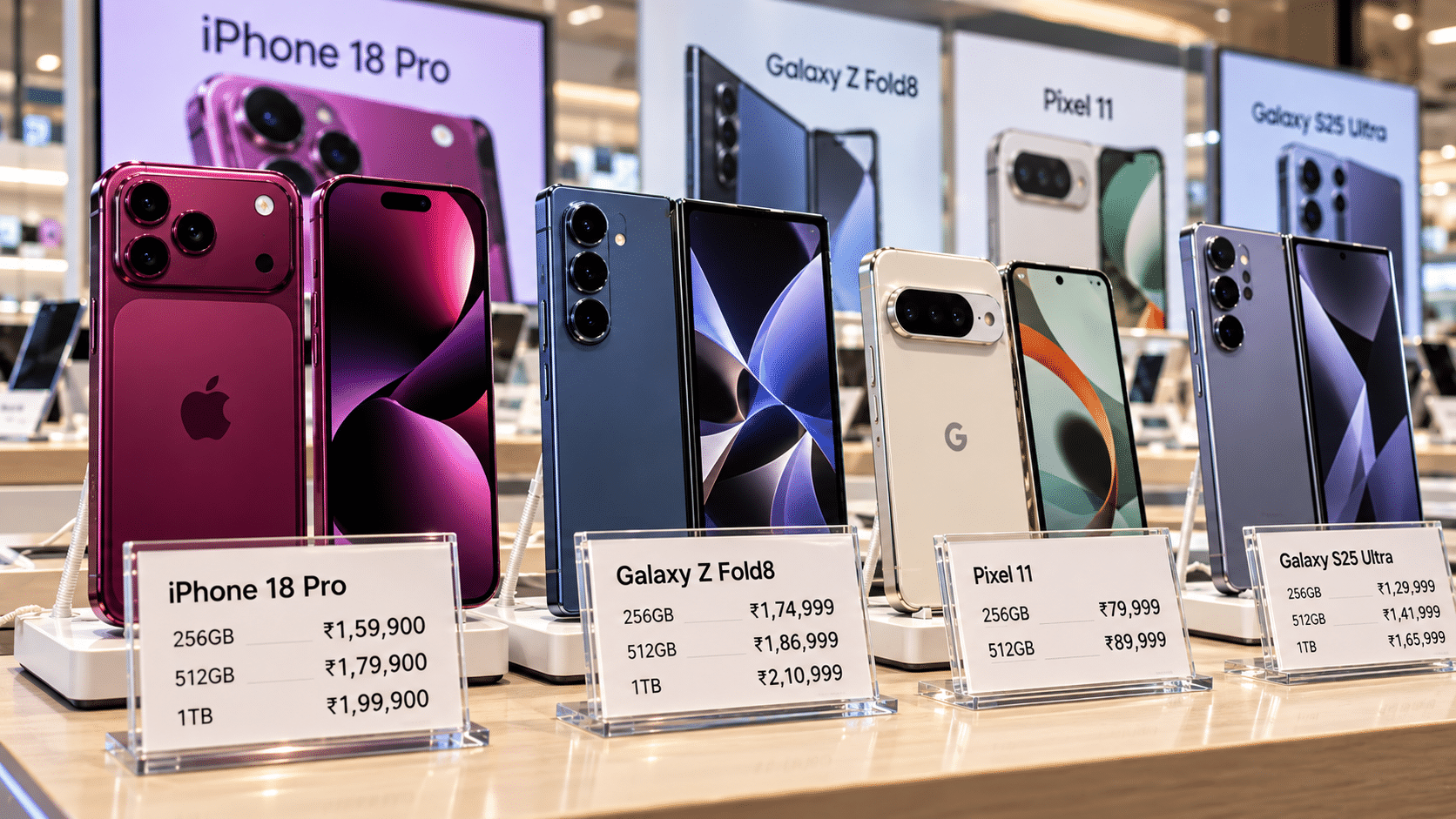
No GST Cut on Mobiles, Flagship Prices Up to 47% Higher: What a 5% Rate Would Have Saved on the iPhone 18 Pro, Fold 8 and Pixel 11
Smartphones · GST · India, October 2026
No GST Cut on Mobiles, Flagship Prices Up to 47% Higher: What a 5% Rate Would Have Saved on the iPhone 18 Pro, Fold 8 and Pixel 11
The GST Council left phones at 18% on 8 October 2026, just as new flagships launched at record prices. Here is the rupee maths of the cut that did not happen, and how to buy well anyway.
For weeks the rumour ran through social media and tech videos: the GST Council would cut the tax on smartphones, and phones would get cheaper in time for Diwali. Industry had asked for exactly that. Then the Council met on 8 October and the 18% rate did not move. In the same fortnight, vivo launched its new foldable in India at ₹70,000 more than last year’s model.
So buyers are facing two pieces of news at once: no tax relief, and flagship prices climbing faster than at any point in recent memory. This article separates the two, shows what a GST cut would actually have been worth on the phones people are considering, and explains why the bigger force on your phone’s price this year is not tax at all.
What We Know
- The 57th GST Council meeting on 8 October 2026 made no change to the 18% GST on mobile phones.
- The India Cellular and Electronics Association wrote to the finance minister on 2 September seeking a cut to 5%.
- IDC says India’s smartphone shipments fell 11.1% in April to June 2026 to 33.2 million units.
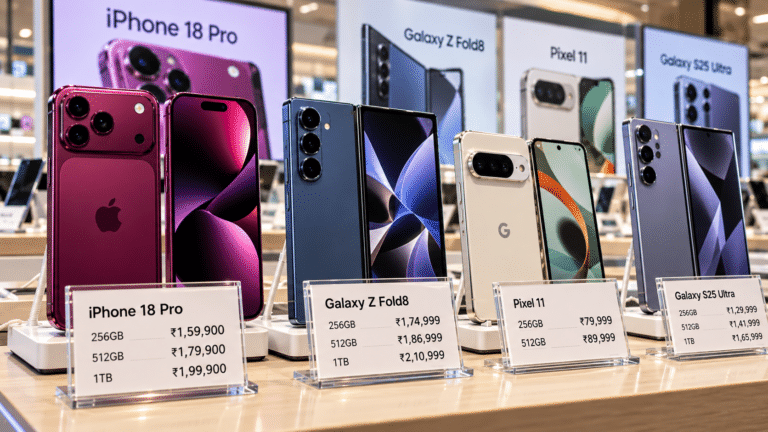
- Brand-announced India prices: iPhone 18 Pro from ₹1,64,900, Galaxy Z Fold 8 from ₹1,79,999, vivo X Fold 6 at ₹2,19,999.
What Is Still Unclear
- Whether the Council will revisit phone GST at a later meeting; no date or proposal has been announced.
- Whether brands would pass on a cut in full, since memory costs are still rising.
- Final India prices for the OPPO Find X10, iQOO 16 and vivo X500 series, which are not yet confirmed.
- How long the memory chip price spike lasts.
The Cut That Was Asked For, and the Answer
The request was specific. In a letter dated 2 September, the India Cellular and Electronics Association, led by chairman Pankaj Mohindroo, asked the finance minister to cut GST on mobile phones from 18% to 5%, with matching changes for components. The association’s case rested on demand: handset consumption had declined, people were keeping phones longer, and the cheapest phones were vanishing from shelves.
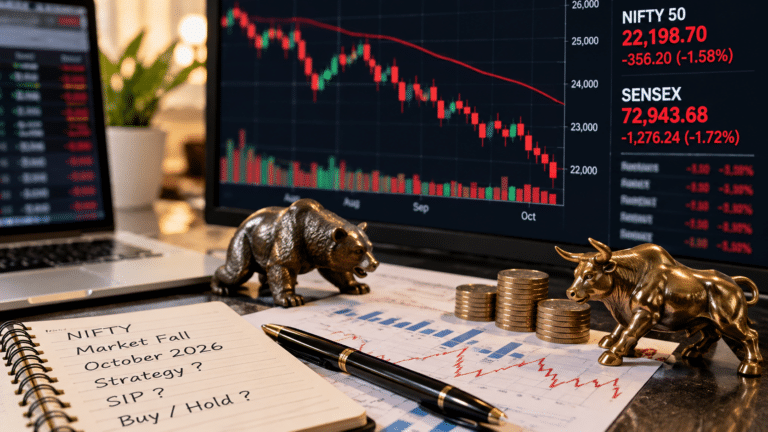
The Council’s 57th meeting was originally planned for 12 September and was moved because of the BRICS summit in New Delhi. When it met on 8 October, its agenda centred on registration, refunds, input tax credit and compliance. Reporting by Digit after the meeting confirmed that the Council did not recommend any change to the 18% rate on phones. A Business Today report in September had already signalled that broad rate cuts were unlikely at this meeting.
Why the Council may have held back
The Council has not published reasons for leaving phones alone, so any explanation is an inference. Two points are worth weighing. First, phones are a large, high-value category, and a cut from 18% to 5% would remove most of the tax collected on them. Second, the September 2025 rate reset, which moved most goods into 5% and 18% slabs, had just completed its first year; the Council was reported to be taking stock of that change rather than opening new cuts. Neither point rules out a later decision.
The 2020 lesson: why the rate went up in the first place
Phones were taxed at 12% when GST began in July 2017. The Council raised the rate to 18% from 1 April 2020 to fix an inverted duty structure: many components, such as displays, chips and batteries, were taxed at 18%, while the finished phone was taxed at 12%. Manufacturers paid more GST on inputs than they collected on sales and built up credits they struggled to use. Raising the phone rate to match the components removed that imbalance.
That history explains the shape of the industry’s request. A cut on phones alone, to 5%, would recreate the same problem at a much larger scale, because components would still carry 18%. ICEA therefore asked for “corresponding rate rationalisation” on components too. That makes the request more expensive for the exchequer, and harder for the Council to agree to quickly.
What 18% Actually Adds to a Flagship Price
The most common misunderstanding about phone GST is the arithmetic. Because the printed price already includes the tax, the GST portion is not 18% of the sticker price. It is 18% of the pre-tax price, which works out to 15.25% of the final price. On a ₹1,00,000 phone, the tax is ₹15,254, not ₹18,000.
The table below applies that to the flagships launched in India since July, and shows what each would cost at 12% or 5% GST, assuming the brand passed the full cut on. That assumption is generous. In practice, with memory prices still rising, some of any cut would probably be absorbed into margins.
| Phone, base variant | India price at 18% | GST inside price | Price at 12% | Price at 5% | Saving at 5% |
|---|---|---|---|---|---|
| vivo X Fold 6, 12GB/512GB | ₹2,19,999 | ₹33,559 | ₹2,08,813 | ₹1,95,762 | ₹24,237 |
| Pixel 11 Pro Fold, 512GB | ₹1,86,999 | ₹28,525 | ₹1,77,491 | ₹1,66,397 | ₹20,602 |
| Galaxy Z Fold 8, 256GB | ₹1,79,999 | ₹27,457 | ₹1,70,847 | ₹1,60,169 | ₹19,830 |
| iPhone 18 Pro Max, 256GB | ₹1,79,900 | ₹27,442 | ₹1,70,753 | ₹1,60,081 | ₹19,819 |
| iPhone 18 Pro, 256GB | ₹1,64,900 | ₹25,154 | ₹1,56,515 | ₹1,46,733 | ₹18,167 |
| Galaxy Z Flip 8, 256GB | ₹1,24,999 | ₹19,068 | ₹1,18,643 | ₹1,11,228 | ₹13,771 |
| Pixel 11 Pro, 256GB | ₹1,19,999 | ₹18,305 | ₹1,13,897 | ₹1,06,779 | ₹13,220 |
| Pixel 11, 256GB | ₹89,999 | ₹13,729 | ₹85,423 | ₹80,084 | ₹9,915 |
| Redmi 17C 5G, 4GB/128GB | ₹20,999 | ₹3,203 | ₹19,931 | ₹18,686 | ₹2,313 |
The Bigger Force on Prices: Memory, Not Tax
Compare the possible saving from a GST cut with how much flagship prices have actually risen this year. On many models, the year-on-year jump is larger than the whole GST saving would have been. vivo’s X Fold 6 launched at ₹2,19,999 against ₹1,49,999 for the X Fold 5, a rise of ₹70,000 or about 47%. The iPhone 18 Pro starts at ₹1,64,900, ₹30,000 above the iPhone 17 Pro’s ₹1,34,900 launch price for the same 256GB base storage.
The reason, according to industry bodies and market trackers, is memory. ICEA’s September letter said DRAM and NAND flash prices had risen roughly four-fold since September 2025, driven by demand from artificial intelligence data centres. IDC’s Aditya Rampal described “memory driven cost pressure showing up across the product lineup”. Every phone needs RAM and storage, so the effect reaches budget phones as well as flagships.
Why foldables jumped the most
The steepest increases are concentrated in foldables and the highest storage tiers. A foldable carries two displays, a complex hinge and, increasingly, 12GB or 16GB of RAM with 512GB of storage as standard. vivo now sells the X Fold 6 in a single 12GB and 512GB version, so there is no cheaper entry point. The same pattern shows in Apple’s range: the iPhone 18 Pro’s 2TB version costs ₹3,14,900, ₹1,50,000 more than the 256GB model for the same phone with more memory chips inside.
A Market Shrinking at the Bottom and Growing at the Top
IDC’s figures for April to June 2026 show a market splitting in two. Total shipments fell 11.1% year on year, and the first half of 2026, at 64.2 million units, was the weakest first half in five years. Yet the market’s value rose, because buyers who did purchase spent more. The average selling price reached a record $315.
The under-$100 band’s share fell from 15.6% to 4.5% in a year. ICEA says the supply of phones under ₹10,000 has contracted to less than 5% of the market, and that entry-level prices have risen 35% to 45%. This is the strongest argument for a GST cut: the buyers being priced out are those for whom a few thousand rupees decides whether they buy at all. It is also why a flagship buyer gains less, proportionally, from the debate than a first-time smartphone buyer would.
Discounts arrived late, and smaller
IDC noted that brands and retailers “leaned away” from the usual early festive discounting this year, because rising component costs left little room to cut prices. Shipments through online channels fell 19.8%, against 3.6% offline. Rampal said financing would be key to keeping phones affordable through the festive season, which matches what buyers see: more no-cost EMI and bank cashback, and fewer outright price cuts.
The Flagship Calendar From July to October
- 22 JulySamsung launches Galaxy Z Fold 8 from ₹1,79,999, Fold 8 Ultra from ₹1,99,999 and Flip 8 from ₹1,24,999.
- 13 AugustGoogle’s Pixel 11 series reaches India, from ₹89,999 to ₹1,86,999 for the Pro Fold.
- 2 SeptemberICEA asks the finance minister to cut phone GST from 18% to 5%.
- 18 SeptemberiPhone 18 Pro and Pro Max go on sale in India from ₹1,64,900 and ₹1,79,900.
- 6 Octobervivo launches the X Fold 6 at ₹2,19,999, a single 12GB and 512GB version.
- 8 October57th GST Council meeting keeps phones at 18%.
What is still coming this season
Several more flagships are expected in India before the end of the year. Their dates and prices are not yet confirmed, and the figures below are estimates drawn from Smartprix’s launch tracker, updated on 1 October. Treat them as a guide to the price bracket rather than a quote.
Should You Buy Now or Wait?
Waiting for a GST cut is not a plan. There is no proposal on the table, no meeting scheduled to consider one, and even a cut might not be passed on in full while memory costs are rising. A more useful question is whether this particular phone, at this particular price, is worth it to you now.
| Your situation | Budget | Best move | Why |
|---|---|---|---|
| Current phone is broken or failing | Any | Buy now, consider last year’s model | Older flagships often see the deepest festive cuts |
| Want the newest flagship | ₹1.2 lakh and above | Buy during a bank offer window | Bank cashback runs into thousands of rupees; no GST relief is coming soon |
| Comparing foldables | ₹1.8 lakh to ₹2.2 lakh | Compare effective price after offers | Launch prices vary by up to ₹40,000 for similar specs |
| Mid-range buyer | ₹30,000 to ₹60,000 | Buy if the phone fits; check memory variant | The $400 to $600 band is where brands are competing hardest |
| Budget buyer | Under ₹15,000 | Consider a certified refurbished phone | New phones under ₹10,000 are now under 5% of supply |
| Business buyer with GST registration | Any | Buy on a GST invoice | Input tax credit recovers the 18% on business use |
- Price the phone you actually want. Note the launch price, the base storage and whether the base variant has enough storage for you.
- Work out the effective price. Subtract bank cashback and exchange value, and add any extended warranty you will buy.
- Read the EMI terms. A no-cost EMI usually means the interest is given back as a discount; check for a processing fee of ₹99 to ₹299.
- Compare the predecessor. A 2025 flagship at a festive price may offer 90% of the experience for 60% to 70% of the cost.
- Keep the GST invoice. It is needed for warranty claims and, for registered businesses, input tax credit.
Price Terms Decoded
| Term on the listing | What it means | Typical effect | Watch for |
|---|---|---|---|
| MRP or launch price | Brand’s announced price, GST included | Highest figure you will see | Base storage, now 256GB on many flagships |
| Inclusive of all taxes | 18% GST already inside the price | 15.25% of the price is tax | Not 18% of the sticker price |
| Bank offer | Instant discount on specified cards | Commonly a few thousand rupees, indicative | Minimum spend and card exclusions |
| No-cost EMI | Interest offset by an equal discount | Spreads cost over 3 to 24 months | Processing fee and GST on that fee |
| Exchange value | Credit for your old phone | Varies widely by condition | Final value set at pickup inspection |
| Effective price | Price after all offers | Often 5% to 15% below MRP | Offers that cannot be combined |
| Input tax credit | GST recovered by a registered business | Recovers up to the full 18% | Business-use condition and a GST invoice |
Before You Pay: A Quick Checklist
- Base storage is at least 256GB if you keep phones 3 years or more
- Bank offer applied; compare at least 2 retailers’ card offers
- No-cost EMI processing fee checked, usually ₹99 to ₹299
- Last year’s model priced against the new one at festive offer prices
- Software update period noted; 7 years on several 2026 flagships
- Exchange quote compared with a resale price for your old phone
- GST invoice saved for the 1-year warranty and any business claim
- Return window of 7 to 10 days confirmed with the seller
Frequently Asked Questions
Has GST on mobile phones been reduced in 2026?
No. The 57th GST Council meeting on 8 October 2026 made no change, and mobile phones remain at 18% GST. The industry had asked for a cut to 5%, but no proposal was approved and no later date has been set.
What is the current GST rate on smartphones in India?
18%, the rate that has applied since 1 April 2020, when it was raised from 12%. It applies to all mobile phones regardless of price, and the printed price already includes it.
How much GST do I pay on a ₹1 lakh phone?
About ₹15,254. Because the price includes GST, the tax is 18% of the pre-tax value, which equals 15.25% of the final price, not 18% of it.
How much cheaper would phones be if GST were cut to 5%?
If a brand passed the full cut on, the price would fall by about 11%. A ₹1,64,900 iPhone 18 Pro would cost about ₹1,46,733. A cut to 12% would lower prices by about 5.1%.
Why are smartphone prices rising in 2026?
Mainly memory. ICEA says DRAM and NAND flash prices have risen about four-fold since September 2025 because of demand from AI data centres. IDC reports a record average selling price of $315 in April to June 2026, up 14.4% in a year.
What is the price of the iPhone 18 Pro in India?
The iPhone 18 Pro starts at ₹1,64,900 for 256GB, and the iPhone 18 Pro Max at ₹1,79,900. Both went on sale in India on 18 September 2026. The iPhone 17 Pro launched at ₹1,34,900.
Should I wait for a GST cut before buying a phone?
There is little reason to. No cut is proposed, and with memory costs rising, any future cut might not be passed on in full. Festive bank offers available now can save a similar amount to a partial GST cut.
Can a business claim GST back on a mobile phone?
A GST-registered business can generally claim input tax credit on a phone bought for business use, recovering the 18% paid, provided it holds a valid GST invoice. Personal purchases are not eligible.
The Short Version
There is no GST cut on mobile phones; the rate stays at 18% after the Council met on 8 October. Even a full cut to the 5% the industry wanted would have lowered prices by about 11%, which is ₹18,167 on an iPhone 18 Pro. Prices are rising faster than that for a different reason: memory chips that cost about four times what they did a year ago. That has pushed out budget phones and lifted flagships, with vivo’s new foldable up 47%. If you need a phone now, buy on bank offers and compare last year’s models. Waiting for a tax cut is a gamble with no date attached.