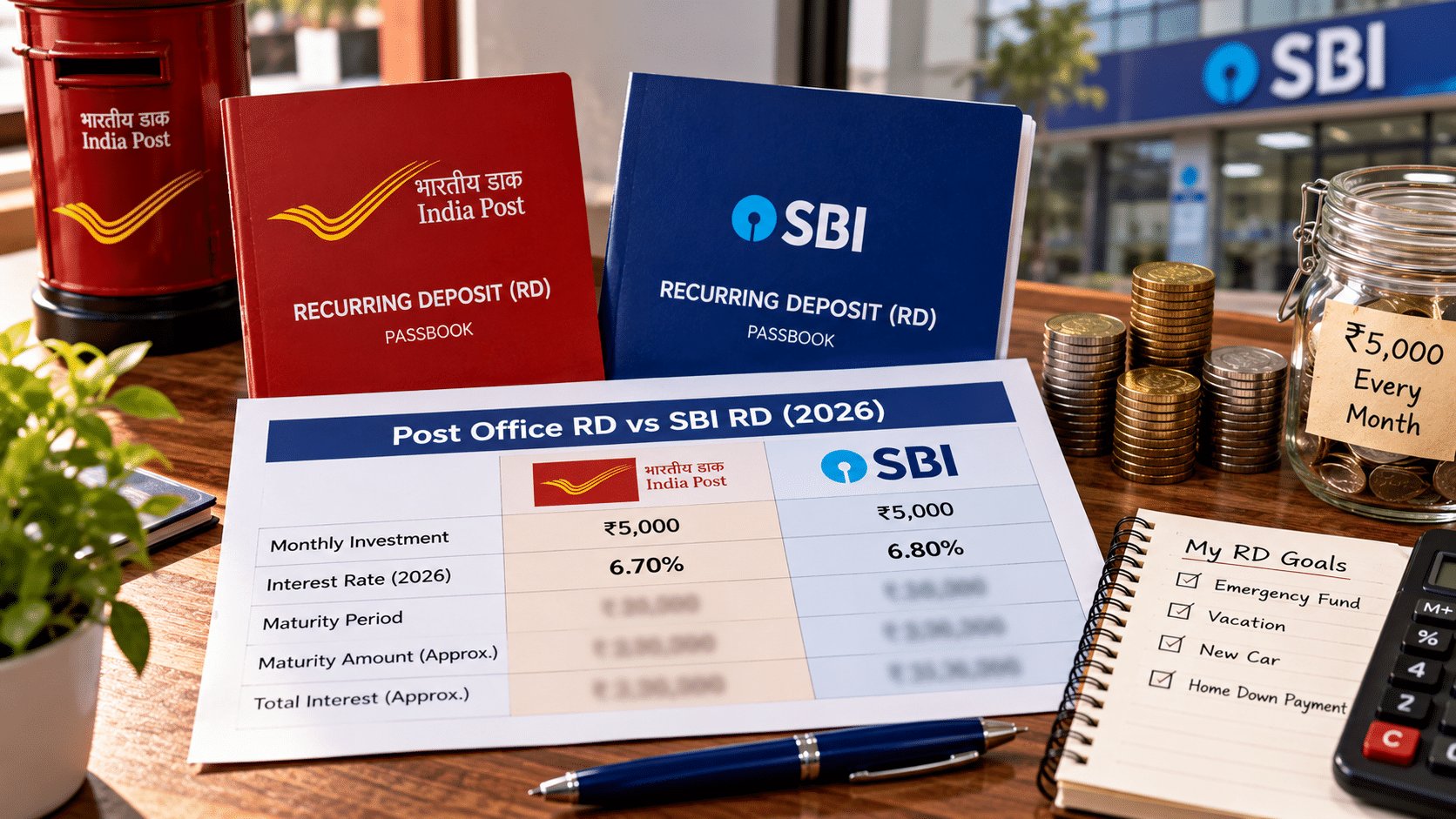
Post Office RD vs SBI RD 2026: Which Pays More on ₹5,000 a Month — and When Does SBI Win?
Post Office RD vs SBI RD 2026: Which Pays More on ₹5,000 a Month — and When Does SBI Win?
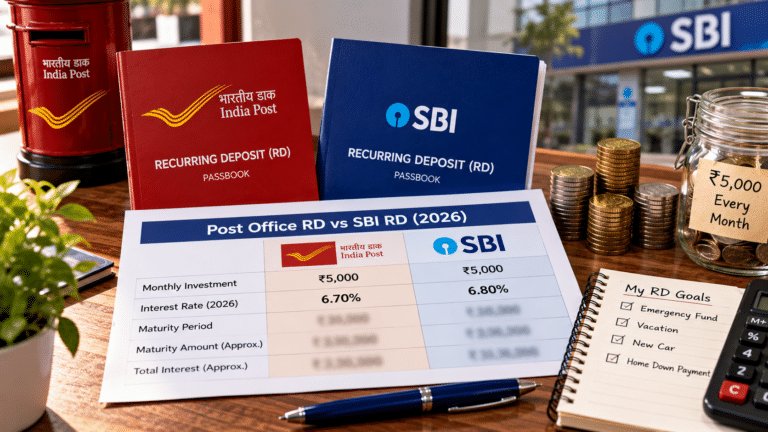
The Post Office 5-year recurring deposit pays 6.7% for October to December 2026, ahead of SBI’s regular RD rates of 6.05% to 6.45%. On ₹5,000 a month, that gap is worth about ₹6,051 over five years. But senior citizens, shorter goals and anyone who might stop early can do better at SBI.
You have decided to save a fixed amount every month. Maybe ₹2,000 for a child’s school fees in three years, maybe ₹5,000 towards a car down payment, maybe ₹10,000 as a forced savings habit. The recurring deposit is the obvious tool: simple, guaranteed, no market risk. The only question left is where to open it, the post office down the road or the SBI branch across the street.
Most comparisons stop at the headline rate, and on that measure the Post Office wins. But the right answer depends on how long you are saving for, your age, and how likely you are to need the money before maturity. On each of those, the picture shifts. We ran the numbers on both, using rates current in October 2026, so you can see exactly where the difference lies.
Quick Summary
For a regular saver holding for the full 5 years, the Post Office RD pays more. At 6.7%, ₹5,000 a month grows to about ₹3,56,829, against ₹3,50,778 in an SBI RD at 6.05% for 5 years. SBI wins in three cases: for senior citizens choosing its Har Ghar Lakhpati RD at 6.80%, for goals shorter than 5 years, which the Post Office RD does not offer, and for savers who may need to close early.
What We Know
- The Post Office 5-year RD pays 6.7%, compounded quarterly, for October to December 2026, after rates were kept unchanged on 30 September.
- SBI RD rates follow its term deposit card: 6.25% for 1 to 2 years, 6.45% for 2 to 3 years, 6.30% for 3 to 5 years and 6.05% for 5 to 10 years.
- SBI’s Har Ghar Lakhpati RD pays 6.55% for 3 to 4 years and 6.30% for 5 to 10 years, with seniors getting 0.50 points more.
- Both accept deposits from ₹100 a month, and RD interest is taxable at slab rates in both.
What Is Still Unclear
- Whether SBI will raise deposit rates after the RBI’s 7 October hike; its chairman said no move is likely for two to three months.
- The Post Office RD rate from January 2027, due by the end of December 2026.
- Exact SBI senior RD rates for each band, as aggregator listings conflict and some show older cards.
The Head-to-Head Number: ₹5,000 a Month for Five Years
Recurring deposits compound interest on each instalment from the month it is paid, so the first deposit earns for 60 months and the last for just one. That is why a 6.7% RD does not double your money’s growth compared with a lump sum; the average rupee is invested for only about half the term. India Post’s own example shows ₹5,000 a month at 6.7% for 60 months maturing at ₹3,56,830, and our calculation matches.
For a regular saver, the Post Office pays ₹6,051 more than SBI’s standard RD and ₹3,738 more than its Har Ghar Lakhpati variant. For a senior citizen, the order flips at the top: the Har Ghar Lakhpati senior rate of 6.80% beats the Post Office’s flat 6.7% by about ₹942 over five years. The Post Office RD has no senior premium at all.
- ₹3,56,829Post Office maturity on ₹5,000 a month
- ₹3,50,778SBI regular RD maturity, 6.05%
- 6.87%Post Office effective annual yield
- 0.65 ptsRate gap at 5 years, regular savers
ScaleHow the gap grows with your instalment
The difference is proportional. At ₹1,000 a month it is about ₹1,210 over five years, roughly ₹20 a month. At ₹10,000 a month it reaches about ₹12,102. For small savers, convenience may matter more than the rate; for larger monthly amounts, the Post Office’s advantage becomes real money.
SBI’s Hidden Strength: Tenure Choice
The Post Office RD comes in one size: 60 months. It can be extended for another five years at maturity, but you cannot open a 1, 2 or 3 year account. SBI lets you choose anything from 12 months to 10 years, and its rates vary by tenure. Its best regular rate, 6.45%, sits in the 2 to 3 year band. For a goal that is three years away, the Post Office simply is not an option, unless you are prepared to close early at a much lower rate.
TargetWhat Har Ghar Lakhpati actually is
SBI’s Har Ghar Lakhpati is a recurring deposit designed around a target maturity of ₹1 lakh or multiples of it. You pick the target and tenure, and SBI sets the instalment. According to SBI’s published terms as reported in August 2026, a general depositor needs about ₹2,510 a month for 3 years or ₹1,420 a month for 5 years to reach ₹1 lakh; seniors need ₹2,500 and ₹1,410. It suits savers who think in goals rather than instalments, and its 3 to 4 year rate of 6.55% is SBI’s best RD rate for regular depositors.
Feature by Feature: Where Each One Wins
Interest is only part of the decision. Penalties, flexibility, loans and safety all differ, and some of these differences matter more than a few hundred rupees of interest.
| Feature | Post Office RD | SBI regular RD | SBI Har Ghar Lakhpati |
|---|---|---|---|
| Rate, regular saver | 6.7% for 5 years | 6.05% to 6.45% by tenure | 6.30% to 6.55% |
| Senior citizen premium | None | 0.50 points | 0.50 points, up to 7.05% |
| Tenure | 60 months, extendable by 5 years | 12 months to 10 years | 3 to 10 years |
| Minimum instalment | ₹100 | ₹100 | Set by ₹1 lakh target |
| Missed instalment charge | ₹1 per ₹100 a month | Penalty as per bank rules | ₹1.50 per ₹100 a month, up to 5 years |
| Missed instalments before closure | 4 consecutive; revival within 2 months | 6 consecutive | 6 consecutive |
| Early closure | After 3 years, at savings rate of 4% | Allowed, with penalty on rate | Allowed; 0.50% penalty up to ₹5 lakh |
| Loan | Up to 50% after 12 months, at RD rate plus 2% | Loan or overdraft against deposit | As per bank rules |
| Safety | Government of India, no cap | DICGC cover up to ₹5 lakh per bank | DICGC cover up to ₹5 lakh per bank |
SafetyIs SBI less safe than the post office?
Technically, the guarantees differ. Post Office deposits are a direct obligation of the Government of India, with no upper limit. SBI deposits are insured by DICGC up to ₹5 lakh per depositor per bank, including interest. In practice, SBI is India’s largest bank and majority government-owned, and an RD of ₹5,000 a month for five years, maturing at about ₹3.57 lakh, sits comfortably within the insurance limit. For most RD savers, safety is not the deciding factor.
The Early-Exit Trap That Flips the Winner
This is the point most comparisons miss. The Post Office RD cannot be closed before three years, and if you close it after three years but before five, interest is paid at the post office savings account rate of 4%, not at 6.7%. SBI’s Har Ghar Lakhpati, by contrast, allows early closure with a modest rate penalty of 0.50% for principal up to ₹5 lakh.
- ₹1Per ₹100 latePost Office charge for each missed monthly instalment
- 4Missed in a rowPost Office RD is discontinued
- 2 monthsRevival windowPay arrears and charges to restart
- 6Missed in a rowSBI closes the RD and pays the balance
Missed payments follow a similar logic. The Post Office charges ₹1 for every ₹100 of a missed instalment and discontinues the account after four consecutive defaults, though it can be revived within two months. SBI allows up to six consecutive misses before closing the account. Setting up an auto-debit, available in both, removes most of this risk.
After Tax, the Gap Narrows Further
RD interest is taxable at your slab rate in both cases, and there is no Section 80C benefit on either. For a saver in the 30% slab, including cess, the Post Office’s ₹56,829 of interest on ₹5,000 a month leaves about ₹39,098 after tax, against about ₹34,935 for SBI’s regular RD. In the 5% slab, the figures are about ₹53,874 and ₹48,138. Under the new tax regime, income up to ₹12 lakh is effectively tax-free because of the rebate, so many RD savers will owe nothing at all.
TDS is handled differently. SBI deducts TDS on RD interest once your total deposit interest at the bank crosses the annual threshold, unless you submit Form 121, which replaced Forms 15G and 15H from 1 April 2026. Either way, report RD interest in your return each year.
How We Got Here: The Post Office RD Rate
The Post Office RD rate has risen more than a percentage point since the low of 2020 and has been unchanged for three years. The bars show its path, alongside the RBI’s recent moves that could shape what comes next.
- Apr 20205.8%Post-pandemic low
- Apr 20236.2%First increase
- Jul 20236.5%Second step up
- Oct 20236.7%Unchanged since
- 30 Sep 20266.7%Kept for Oct to Dec
- 7 Oct 20265.50%RBI repo hike
- End Dec 2026NextRate review for Jan to Mar
With the RBI having raised the repo rate by 25 basis points on 7 October, some savers expect higher deposit rates. SBI’s chairman said deposit rates may not change for two to three months, and small savings rates follow the government’s own formula and timing. An RD’s rate is locked when you open it, so waiting only makes sense if you expect a meaningful rise soon.
Which One Should You Open?
The answer depends on three questions: how long you are saving for, your age, and how certain you are about the timeline.
- Pick Post Office5-year goal, under 60, certain timeline6.7%Highest rate for regular savers, and full government backing. Best if you will not need the money early.
- Pick SBI Har Ghar LakhpatiSenior citizen, or a 3 to 4 year goal6.80% to 7.05%Seniors earn more than the Post Office; 3 to 4 years at 6.55% fills the gap the Post Office leaves.
- Pick SBI regular RDGoal of 1 to 3 years, or uncertain timing6.25% to 6.45%Short tenures and easier early closure. Best for school fees, travel or a near-term purchase.
StepsOpening either account
A Post Office RD can be opened at any post office with Aadhaar, PAN and photographs, and existing India Post Payments Bank customers can open and fund some accounts online. An SBI RD can be opened in minutes through YONO or internet banking if you already have an SBI savings account, with instalments auto-debited. Both allow nomination, which you should add at the start.
- Match the RD tenure to your goal date before comparing rates
- Under 60 and saving for 5 years: Post Office at 6.7%
- Aged 60 or above: compare SBI senior rates up to 7.05%
- For 3 to 4 years: SBI Har Ghar Lakhpati at 6.55%
- Set up auto-debit to avoid ₹1 to ₹1.50 per ₹100 penalties
- Do not plan to close a Post Office RD before 5 years
- Add a nominee and keep the passbook or e-receipt safe
- Report RD interest in your tax return every year
Frequently Asked Questions
Which is better, Post Office RD or SBI RD, in 2026?
For a regular saver holding for 5 years, the Post Office RD at 6.7% pays more than SBI’s 6.05% for 5 years. SBI is better for senior citizens through Har Ghar Lakhpati at up to 7.05%, for goals shorter than 5 years, and if you may need to close early.
What is the Post Office RD interest rate for October to December 2026?
6.7% a year, compounded quarterly, for the 5-year RD. The government kept it unchanged on 30 September 2026.
What is the SBI RD interest rate now?
SBI’s RD rates follow its term deposit card: 6.25% for 1 to 2 years, 6.45% for 2 to 3 years, 6.30% for 3 to 5 years and 6.05% for 5 to 10 years, with seniors getting 0.50 points more.
How much will ₹5,000 a month in Post Office RD give after 5 years?
About ₹3,56,829 at 6.7%, on total deposits of ₹3 lakh, giving about ₹56,829 in interest before tax.
Do senior citizens get a higher rate in Post Office RD?
No. The Post Office RD pays the same 6.7% to everyone. SBI pays seniors 0.50 points more, and its Har Ghar Lakhpati senior rate of 6.80% for 5 years is higher than the Post Office.
Can I close a Post Office RD before 5 years?
Only after 3 years, and interest is then paid at the post office savings rate of 4%, not the RD rate. You can also take a loan of up to 50% of the balance after 12 months.
Is RD interest taxable?
Yes. RD interest from both the Post Office and SBI is taxed at your slab rate, with no Section 80C benefit. SBI deducts TDS above the threshold unless you submit Form 121.
What is SBI Har Ghar Lakhpati RD?
A recurring deposit built around a target of ₹1 lakh or multiples. For example, about ₹1,420 a month for 5 years or ₹2,510 a month for 3 years reaches ₹1 lakh for a general depositor.
The Short Version
For a regular saver putting money away for exactly five years, the Post Office RD at 6.7% pays more than SBI: about ₹3,56,829 on ₹5,000 a month against ₹3,50,778. SBI wins elsewhere. Seniors earn up to 6.80% for 5 years in its Har Ghar Lakhpati RD, more than the Post Office. Goals of 1 to 4 years can only be met at SBI, where 2 to 3 years pays 6.45% and 3 to 4 years pays 6.55%. And if you might stop early, SBI’s smaller penalty beats the Post Office’s drop to 4%. Choose the tenure first, then the institution.