LIC, SBI Life, HDFC Life or ICICI Prudential — Which Child Insurance Plan Actually Fits Your Education Goal in 2026?
Insurance · Child Education Plans · India 2026
LIC, SBI Life, HDFC Life or ICICI Prudential — Which Child Insurance Plan Actually Fits Your Education Goal in 2026?
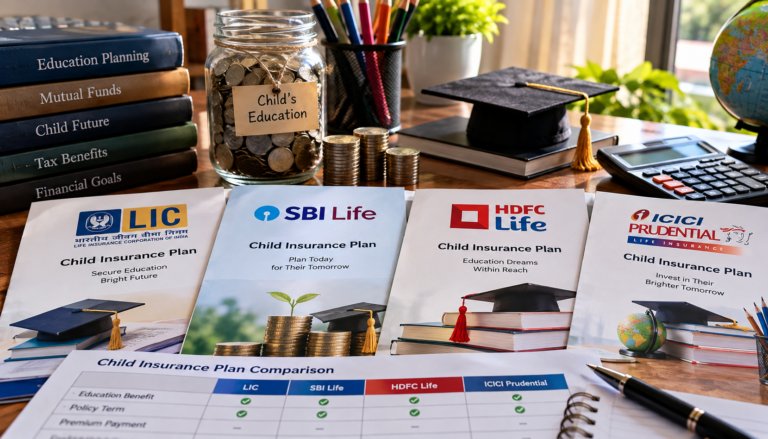
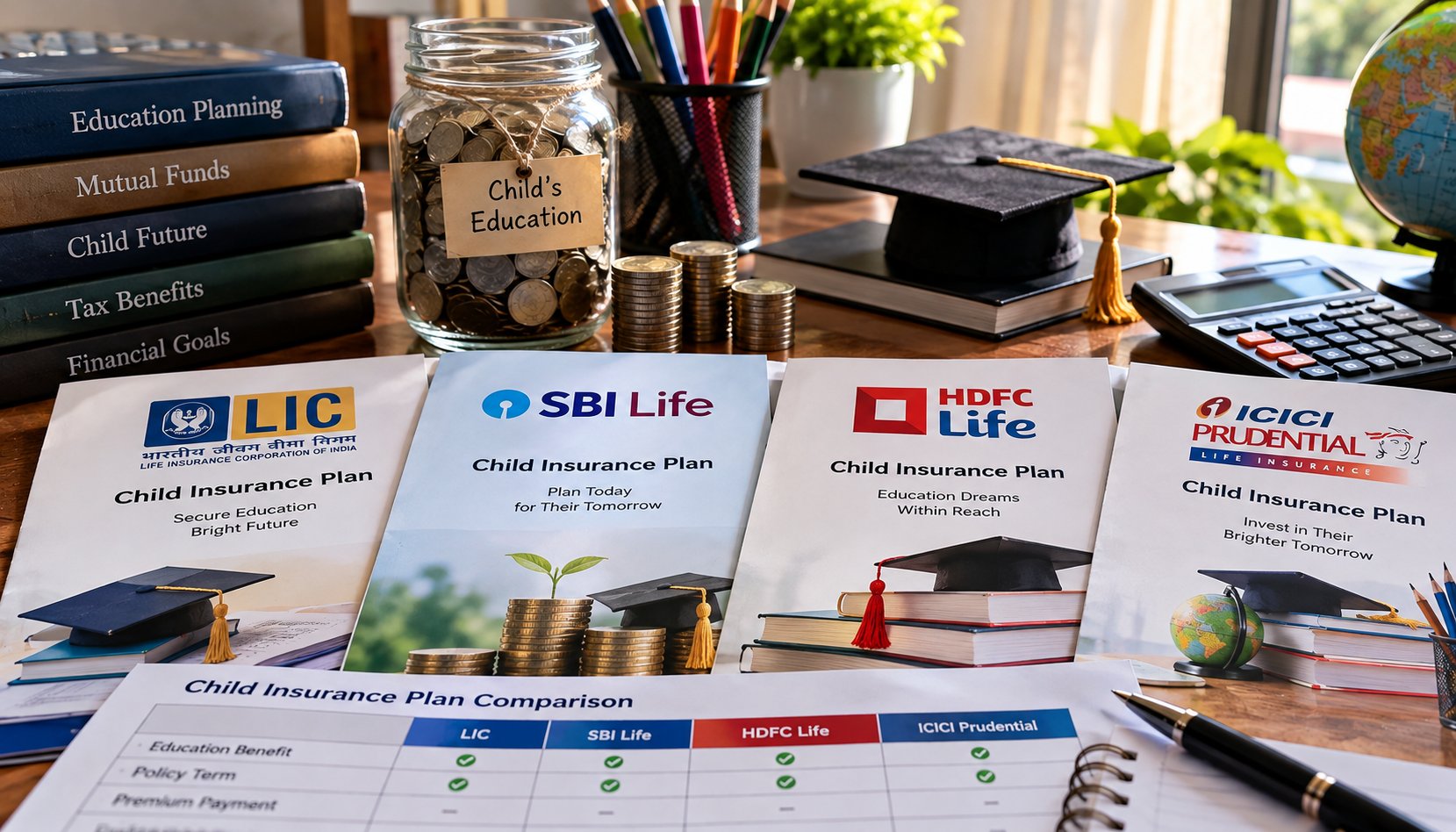
The four insurers’ flagship child plans differ less on brand than on three things: when they pay, how much they guarantee, and what happens if a parent dies. This comparison lines them up on all three.
A relationship manager at your bank suggests one child plan. An LIC agent in the family suggests another. A comparison site ranks a third at the top. All of them promise to secure your child’s education, and none of them leads with the number that matters most: what the plan actually returns, and when the money reaches your child.
This guide compares the main child education plans from LIC, SBI Life, HDFC Life and ICICI Prudential on the details buried in their brochures. The goal is not to crown a single winner. It is to show which plan fits which kind of parent, and when none of them is the right tool.
Why Child Plans Are Being Sold Harder Than Ever
Child plans exist because of one fear: what happens to the education fund if the parent dies. Every plan in this comparison answers that with a premium waiver, under which the insurer pays the remaining premiums and the policy keeps running for the child. That feature is genuine and valuable.
The trade-off is return. Writing in Business Standard in January 2026, SEBI-registered investment adviser Abhishek Kumar put traditional child plan returns at roughly 4% to 6% a year, against education inflation commonly estimated at 10% to 12%. That gap is the central tension in every child plan decision.
Four Plans, Four Very Different Designs
Each insurer sells several child products. The four below are their most widely marketed education-focused options in 2026, and they cover the full range from fully guaranteed to fully market-linked.
- Child age
- 30 days to 13 years
- Matures
- Between ages 18 and 25
- Premiums
- 5, 6 or 7 years, or single pay
- Minimum cover
- ₹2 lakh sum assured
- Waiver
- Optional rider, limited pay only
- Child age
- 0 to 17 years
- Parent age
- 18 to 50 years
- Term
- 8 to 25 years, child at least 18 at maturity
- Minimum premium
- ₹50,000 a year or ₹5,500 a month
- Waiver
- Built in, except single premium
- Term
- 15 to 25 years
- Premiums
- 7 years, 10 years or term minus 5
- Payouts
- Lump sum, or money back in the last 5 years
- Bonuses
- Reversionary and terminal, not guaranteed
- Waiver
- Classic Waiver death benefit option
- Premiums
- 5 to 12 years
- Minimum premium
- ₹1.5 lakh (5–6 yr), ₹50,000 (7–9 yr), ₹30,000 (10–12 yr)
- Payouts
- 3 or 4 milestone payouts, equal or increasing
- Waiver
- Built in
- Extra
- 10% a year income option if parent dies
Details from each insurer’s product page or brochure, and from published product reviews where the insurer page was incomplete. Check the current brochure before buying.
What We Know
Confirmed facts behind this comparison
- LIC’s Amritbaal adds a guaranteed ₹80 for every ₹1,000 of basic sum assured each year. In LIC’s illustration, a single premium of ₹3,89,225 for a five-year-old becomes ₹13 lakh in 20 years, an implied return of about 6.2% a year.
- LIC’s New Children’s Money Back Plan pays 20% of the sum assured at ages 18, 20 and 22, and 40% plus bonuses at 25, according to published plan summaries.
- SBI Life Smart Scholar Plus does not allow surrender or withdrawal in the first five years; partial withdrawals are permitted from the sixth policy year.
- Sukanya Samriddhi pays 8.2% and PPF 7.1% for October to December 2026, unchanged after the 30 September 2026 review.
When Does the Money Actually Reach Your Child?
This is the comparison almost nobody draws, and it matters more than the brand. A fee falls due in a specific year. A plan that pays its entire benefit at 25 is of limited use for a B.Tech that starts at 18. The table maps each plan’s payout pattern onto the college years.
| Plan | Age 18 | Age 20 | Age 22 | Age 25 | Pattern |
|---|---|---|---|---|---|
| LIC Children’s Money Back | 20% | 20% | 20% | 40% + bonus | Fixed, college-timed |
| LIC Amritbaal | Lump sum if chosen | – | – | Latest maturity | One payout, age 18 to 25 |
| ICICI SmartKid 360 (4 equal) | 25% | 25% | 25% | 25% | Milestones chosen at start |
| ICICI SmartKid 360 (increasing) | 15% | 20% | 30% | 35% | Back-loaded for PG study |
| HDFC YoungStar Udaan | Money back spread over final 5 policy years, or lump sum at maturity | Timed to policy end | |||
| SBI Smart Scholar Plus | Fund value at maturity; partial withdrawals allowed from year 6 | Market-linked | |||
The Return Gap Nobody Mentions at the Sales Meeting
Return is where child plans struggle. The chart below shows what ₹1 lakh a year for 10 years, a total of ₹10 lakh, becomes after 15 years at different annual returns. The lower rows reflect the range for traditional child plans. The middle rows are today’s government scheme rates. The top rows are assumed equity returns, which carry no guarantee.
The difference between ₹18.7 lakh and ₹28.2 lakh is the price of the guarantee and the bundled life cover. For some families, that price is worth paying. For many, the same protection costs far less through a separate term policy.
Worked example: Rohan’s two choices
Rohan, 32, can set aside ₹1 lakh a year for his son’s education. Option A: a traditional child plan returning about 6%, which grows to roughly ₹18.7 lakh after 15 years. Option B: a term policy for ₹1 crore, which typically costs well under ₹20,000 a year for a healthy non-smoker of his age, with the remaining ₹80,000 or more going into a SIP. At an assumed 10%, ₹80,000 a year for 10 years becomes about ₹22.6 lakh after 15 years, and his family is covered for ₹1 crore, not just the plan’s sum assured. Option B wins on numbers but needs discipline, because nothing stops Rohan from pausing the SIP.
Who Should Pick Which Plan
Use the rail below as a starting point. It sorts parents by what they value most, from certainty to growth, and points to the plan design that matches.
LIC: the certainty choice
LIC’s strength is predictability and a claims record of 99.6% of individual death claims settled in FY 2024-25, according to IRDAI annual report data compiled by Oquilia. Amritbaal’s guaranteed additions make the maturity value knowable from day one. The Money Back plan’s 18-20-22-25 schedule fits an undergraduate course neatly. Neither will beat education inflation.
SBI Life: the growth choice with a lock
Smart Scholar Plus is a ULIP, so its value depends on the funds you pick. It suits parents comfortable with market swings who want a built-in premium waiver. The five-year lock-in and ULIP charges mean it rewards those who stay invested for the full term.
HDFC Life and ICICI Prudential: the payout designers
Both have built their child plans around payout flexibility. HDFC’s Udaan lets you choose a lump sum or money-back payouts in the final five years. ICICI’s SmartKid 360 offers the widest menu, from equal splits to increasing payouts weighted towards postgraduate study, plus a 10% yearly income option if the parent dies.
How Reliably Do These Insurers Pay?
A child plan is only as good as the claim it pays when the worst happens. All four insurers settle the vast majority of death claims, though the published figures come from different periods and bases.
A gap of one or two percentage points between large insurers should not decide your purchase. What decides most rejected claims is non-disclosure at the time of buying, especially of health conditions, smoking or existing policies. Fill the proposal form yourself and read it before signing.
Buying a Child Plan the Right Way, Step by Step
If you decide a child plan belongs in your family’s finances, the order in which you do things matters. Most regret comes from buying first and reading later. The steps below reverse that, and each one takes less than an hour.
- Cost the goal first. Estimate the course fee in today’s money, then inflate it at 10% a year to the year your child will need it. This tells you how much of the target the plan can realistically cover.
- Decide the plan’s job. Choose whether it is your guaranteed floor, your protection layer or your growth engine. A traditional plan can be the first two, but rarely the third.
- Ask for the benefit illustration. Every insurer must show projected benefits. Work out the yearly return from the premiums and the maturity value, as this article did for Amritbaal.
- Map payouts to fee years. Write down your child’s age at each payout and compare it with when the college fees fall due.
- Check the waiver wording. Confirm whether the premium waiver is built in or a paid rider, whose life it covers, and whether it applies to disability as well as death.
- Use the free-look period. Read the policy document when it arrives. If anything differs from what you were told, you can return the policy within the free-look window for a refund, subject to deductions set by the insurer.
What tax changes in FY 2026-27
The Income-tax Act, 2025 applies from FY 2026-27. The old Section 80C deduction of up to ₹1.5 lakh for life insurance premiums now sits in Section 123, and it is available only to taxpayers who opt out of the new regime, which is now the default. For premiums to qualify, the yearly premium generally must not exceed 10% of the sum assured for policies issued after April 2012.
Maturity proceeds are a separate question. Under the rules that applied until FY 2025-26, maturity amounts were tax-free only if total yearly premiums stayed within ₹5 lakh for traditional policies issued from April 2023, or ₹2.5 lakh for ULIPs issued from February 2021. Most child plan buyers fall well within these limits, but confirm how the new Act treats your policy before relying on a tax-free payout.
What Is Still Unclear
Details we could not confirm
- HDFC Life has not published the exact money-back percentages, minimum premium or entry ages for YoungStar Udaan on the pages reviewed; these sit in the policy brochure.
- ICICI Prudential describes SmartKid 360’s returns as guaranteed but does not state a rate on its product page, so its implied yield could not be calculated.
- Claim settlement ratios for SBI Life, HDFC Life and ICICI Prudential for the full FY 2024-25 were not available from a primary IRDAI source in our review.
- Bonus rates on participating plans such as LIC Money Back and HDFC Udaan are declared yearly and are not guaranteed.
The Costly Mistakes Parents Make With Child Plans
The most common error is treating the sum assured as the education fund. A plan with ₹5 lakh of cover sounds substantial until you remember that a course costing ₹10 lakh today could cost ₹40 lakh or more by the time your child is 18.
The second is buying the plan on the child’s life rather than the parent’s. The risk you are insuring is the earning parent’s death, not the child’s. Check whose life the waiver covers.
Early exit is expensive
Traditional child plans usually return well below premiums paid if surrendered in the first few years, and SBI Life’s ULIP blocks withdrawals entirely for five years. Choose a premium you can sustain for the full payment term, whether that is 5, 7, 10 or 12 years.
Six questions to ask before you sign
- What is the yearly return? Ask for the benefit illustration; below 7.1% trails PPF.
- Whose life triggers the waiver? It should be the earning parent’s.
- When are payouts due? Match them to ages 17 to 22 for an undergraduate course.
- Which parts are guaranteed? Bonuses and fund values are not.
- What are the charges? For ULIPs, total them over the first 5 years.
- Is the cover enough? Separate term cover of 10 to 15 times income may still be needed.
Frequently Asked Questions
Which is the best child insurance plan for education in India in 2026?
It depends on your priority. LIC Amritbaal suits parents who want a guaranteed lump sum, ICICI Pru SmartKid 360 offers flexible guaranteed payouts, HDFC Life YoungStar Udaan times payouts to the final five years, and SBI Life Smart Scholar Plus is market-linked. Compare the payout ages with your child’s expected college years.
Is LIC better than private insurers for a child plan?
LIC settled 99.6% of individual death claims in FY 2024-25 and offers fully guaranteed designs such as Amritbaal. Private insurers settle around 98% to 99% and often offer more payout flexibility or market-linked options. For most buyers, plan design matters more than the insurer’s name.
What return does LIC Amritbaal give?
LIC’s own illustration shows a single premium of ₹3,89,225 growing to ₹13 lakh in 20 years, an implied return of about 6.2% a year. The return is guaranteed but lower than the current 7.1% PPF rate.
What is the minimum premium for SBI Life Smart Scholar Plus?
According to SBI Life, the minimum is ₹50,000 a year, ₹25,000 half-yearly, ₹15,000 quarterly, ₹5,500 monthly, or ₹75,000 as a single premium. Surrenders and withdrawals are not allowed in the first five years.
Do child insurance plans give good returns?
Traditional child plans typically return about 4% to 6% a year, according to a SEBI-registered adviser quoted by Business Standard. That is below education inflation of 10% to 12%. They are best seen as protection with modest savings, not as a growth investment.
Is term insurance plus SIP better than a child plan?
Often, on numbers. Term cover is cheap and large, and a SIP can earn more over 10 to 15 years, though without guarantees. A child plan suits parents who value forced discipline and an automatic premium waiver over higher potential returns.
What happens to a child plan if the parent dies?
In plans with a premium waiver, the insurer pays the remaining premiums and the policy continues to maturity, so the child still receives the scheduled payouts. Some plans, such as ICICI SmartKid 360, also offer a regular income option. Check whether the waiver is built in or an optional rider.
At what age should I buy a child education plan?
As early as possible. LIC Amritbaal accepts children from 30 days old, and premiums are lower when the policy term is longer. LIC’s Money Back plan closes at age 12 and Amritbaal at 13, so late starters have fewer options.
The Short Version
LIC, SBI Life, HDFC Life and ICICI Prudential all sell credible child plans with premium waivers and strong claim records of roughly 98% to 99.6%. Choose by design, not brand: LIC Amritbaal for a guaranteed lump sum at about 6.2%, ICICI SmartKid 360 for flexible guaranteed milestones, HDFC YoungStar Udaan for payouts in the final five years, and SBI Smart Scholar Plus for market-linked growth with a five-year lock-in. Because traditional child plans return about 4% to 6%, pair any of them with PPF, Sukanya Samriddhi or an equity SIP to keep pace with education costs.